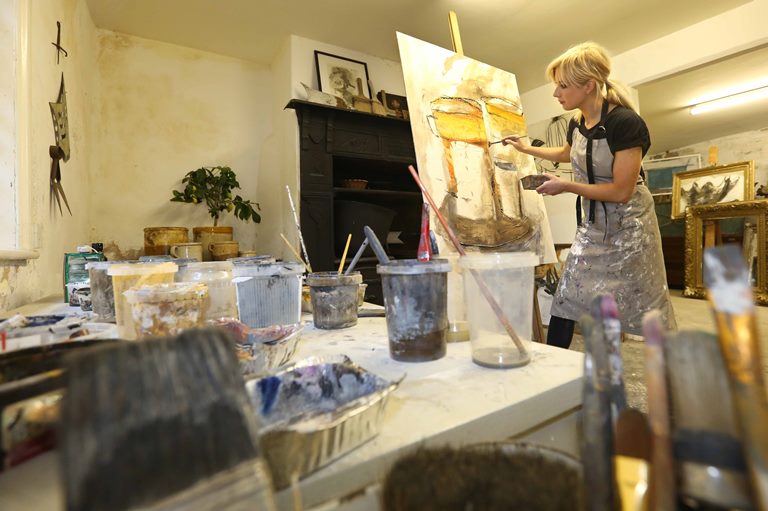
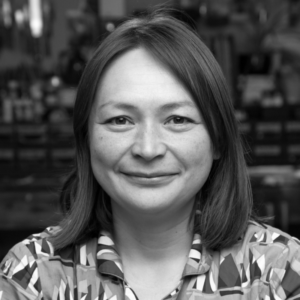
When you look at a still life by Chloe Holt you are faced with a painting that has a sense of timelessness, executed with a confidence that finds comfort in the shape of a strong design. There is something about the work that brings to mind a certain quality found in a lot of French Post Impressionism; a celebration and sympathy found with the objects she is painting. Holt’s work makes use of a sensitive and earthy palette applied in gestural powerful marks, made in graphite, oil bars and pastels, and dilute oil colour. Chloe gives us a sneak preview of what she will be showing at the Panter & Hall stand at the Battersea Affordable Art Fair which opens today and goes on until Sunday the 15th March.

Lisa: When did you first discover that you wanted to be a painter?
Chloe: Painting has always been part of my life. I have a very vivid memory of painting my entire face like an abstract canvas with poster paints at the age of three rather than playing with my Mum’s make up bag! I remember being entranced by the colours and how the water on my brush brought them to life and mixed them together like marbling.
Later around the age of six I recall being introduced to the artist Cesar Manrique, who was the Island of Lanzarote’s resident artist – an artist, painter, sculptor, architect and politician. Through his art he observed nature, responded to it sensitively and used it to enhance life. From his bold abstract textural surfaced paintings mimicking the lava flows and rocks pouring into the oceans, to his home and gallery built on a volcanic lava field – all big sheets of glass with unlimited vistas and soft organic white walls making a small presence on the surface of the earth – down to the subterranean labyrinth of natural lava bubbles below. Rooms connected by tunnels filled with contemporary furniture alongside those with a break on their surface bubble letting the light in, housing gardens and swimming pools enveloped with sunlight. Everything this artist produced had a synergy with the place and land. As a politician he campaigned to keep the island as a UNESCO biosphere reserve.
I remember the feeling of wanting to be part of this, having the ability to be able to observe the beauty in life and capture all of the wonders I was seeing.

Lisa: Does your educational background in textile design play a strong role in how to make your paintings?
Chloe: My textile design course at Manchester Metropolitan had a huge focus on painting and drawing. Their main ethos was to portray the personality of whatever it was you were observing, and by doing so allowing so many tangents and angles of exploration from a very solid base, with the importance of being able to draw and paint always coming first. I chose the course because I loved the idea that there were so many more ways I could represent what I could do in paint. I had already finished a Fine Art Foundation course and felt that experimenting with as many media as possible would open up more exciting possibilities. So I went on experimenting with everything from embroidery, felt making, knitting, weaving, dying to traditional screen printing and digital designing. At the end of the three years the most joy I had was the joy of making mistakes in the print room, experimenting with dye stuffs was almost like an alchemy. Techniques and media became paramount and have since influenced everything I do.
Lisa: How do you go about developing an idea for a painting?
Chloe: I can’t solidly describe how an idea comes for a painting. It’s always a natural progression, a feeling or a need to paint a certain subject. Some days my mind is filled with memories of a landscape I visited or I’m falling in love with the mystery and history behind an object and that is feeding the direction I’m taking. Often I work in ‘collections’ or ‘series’ where I explore a notion from a single spark. The latest works came from being given the gift of a lemon from Sorrento by my Italian friends who are antique dealers. They also brought back collections of Puglian conserve pots from Matera. The lemon and this feeling of sunshine and warmer climes reignites my own memories of places and the works grow and develop from a combination of this memory and of actual observation of objects.

Lisa: How do you select your palette for a painting?
Chloe: My palette is always from nature. I tend to be drawn towards natural pigments. I limit my palette to a handful of these colours: Burnt umber. burnt siena; yellow ochre; red earth; cadmium yellow; ultramarine; mars black….all of my colours are mixed from these. I feel grounded when I paint with them, if I come across a man-made pigment I never feel it looks completely right, almost alien when my work is about history and sensitive observation.

Lisa: What makes a good subject?
Chloe: Anything can make a good subject! I’m looking at my desk now, the light on the pots of paint. We can make a painting that is about something as simple as light! I’m happy with a painting when its about something I’ve observed and am true to…something that has made me notice it and feel something.
Lisa: How important are the antique frames that you use to frame your work?
Chloe: Antique frames fit perfectly with the work I’m currently producing. I use them for their connection to history, the sense of time and time passing in their surfaces. I like the frames for different reasons. With my Waterlily series many of the frames were from Paris – they reminded me of the colour of the stone in Paris’ buildings, particularly the walls by the water. Others I’ve used for landscape paintings have previously had landscapes or seascapes in them which have long gone, but they often have their names on the backs. I like the idea of putting back the painting to reconnect the frame.

Lisa: What do you do if you feel a painting has ‘gone wrong’?
Chloe: I say don’t be afraid to take it off and start again! I often take off an entire surface with white spirit and work with the ‘ghost’ of the painting I produced…this shadow of the last works often work as very happy mistakes and lead to something much more interesting – it can be a stressful feeling to go through but I can hand on heart say if you don’t like what you are producing don’t be afraid to start again!
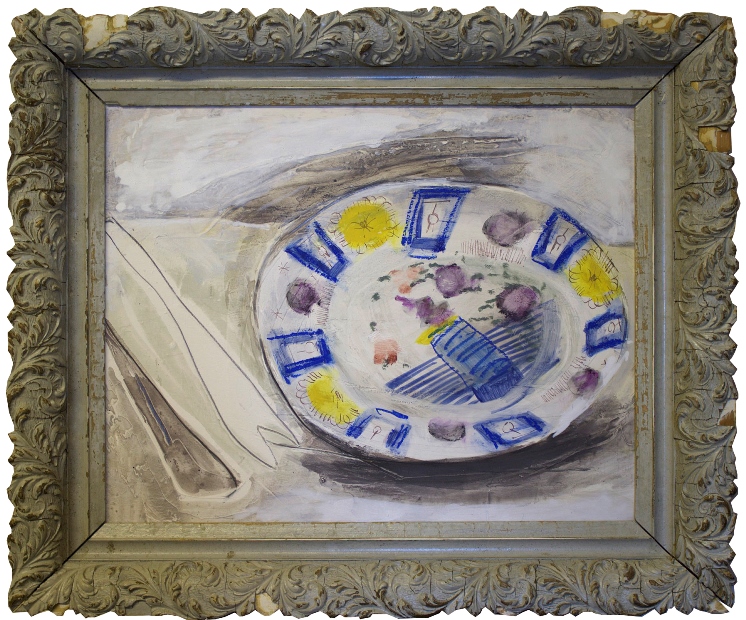
Lisa: Can you describe the works you are showing at the Battersea Affordable Art Fair?
Chloe: The new works at the AAF are a combination of still lifes and waterscapes. The still lifes run from the Sorrento lemon series then into my latest obsession with collecting early rare English Delftware plates. I love the mark making by the artists who decorated the ceramics in contrast to the very basic simple practical shapes of the tin-glazed chargers. The overriding mood is provincial and naive rather than urban and sophisticated, much like the shapes of the Puglian pots from Matera you see in my work “Famiglia”.
The waterscapes of Waterlilies at Plumpton Rocks, Yorkshire, are in contrast to the controlled still lifes – sometimes I like to lose myself in mark making and expression and also find something new which has inspired me. Yet you could say that the marks in these paintings are like the marks on the Delft plates with the same ceramic value to the surface.
I always ask myself “How could this be painted?” I like to keep my work fresh, a delight for me to paint and the knock on effect being new and surprising to the viewer. I tend to become obsessed with a subject and let it run its natural course until I’ve “painted it out”, but often need to return to the subject months later when I feel there is more I can say.
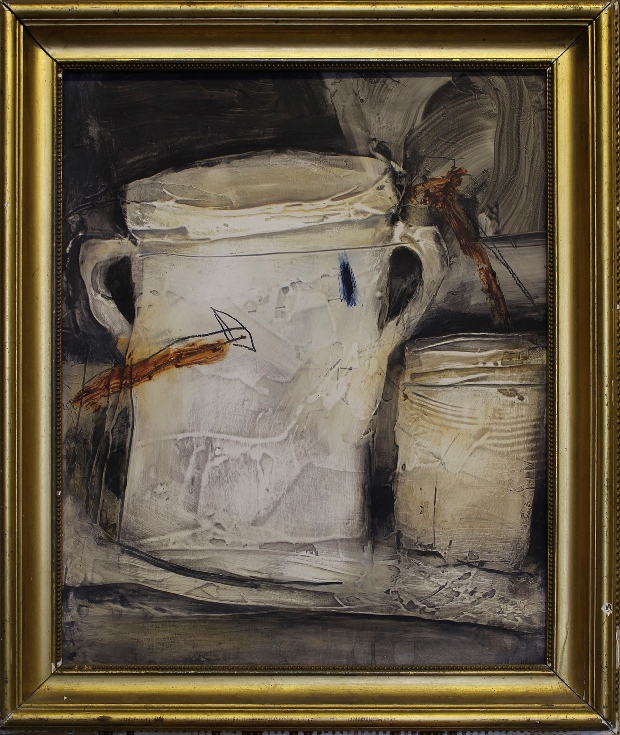
Lisa: Where else can we see more of your work?
Chloe: You can see my work in a number of galleries across the country. They are:
Panter & Hall, Pall Mall, London.
Denise Yapp Contemporary Art, Monmouth.
Ffin y Parc, Llanrwst, North Wales.
Gallerina, Darlington, County Durham.
Fountain Fine Art, Cardiff.
Cricket Fine Art, Park Walk, London.
108 Fine Art, Harrogate.
Chris Holmes Decorative Interiors, Harrogate.
RCA (Royal Cambrian Academy, Conwy, North Wales)