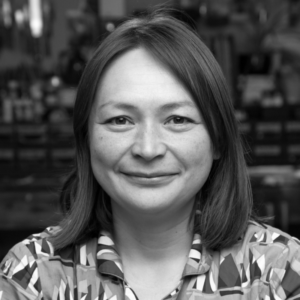
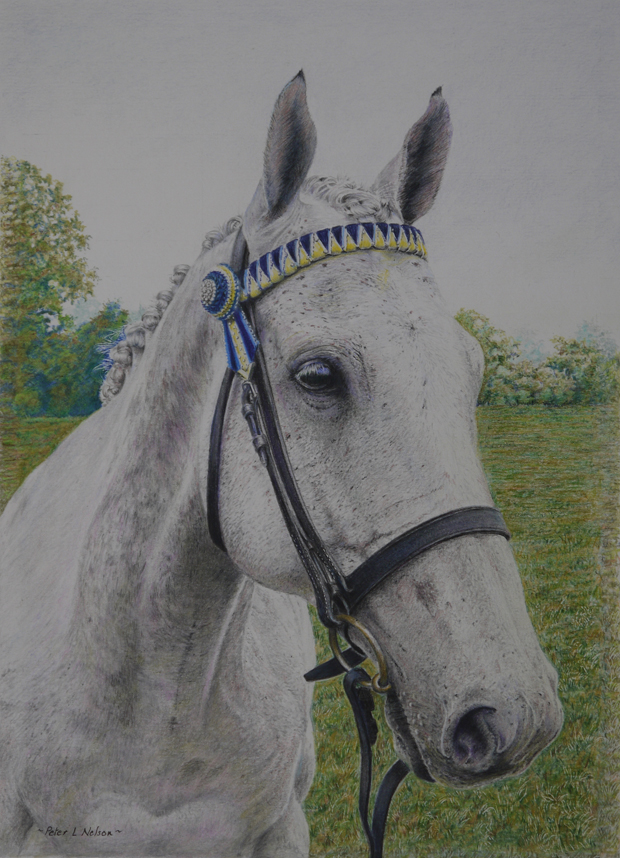
Peter Nelson’s impressive art works get the very best qualities from coloured pencil. Nelson is a master of fine detail, depicting the fur of a dog, lush mosses or the textures of the seaside with such care that you cannot help but be awed by the results. There is a real sensitivity and empathy with the subjects that he studies. The beauty of the work is a product of his skill, dedication and patience with his craft.
Lisa: What aspects of working with coloured pencil do you enjoy the most?
Peter: It’s the precise control and details that can be achieved and how you can build up the depth of colour with layers. There are an enormous variation of techniques required to reach a realistic end result that I try to achieve. This then depends on the pencil brands and type of support you use and finally the subject composition worked on. All these points make coloured pencils a fabulous medium to work with.
Lisa: How large are your drawings and what surface do you prefer to work on?
Peter: I started with A4 and A3 but prefer to work with larger pieces. Some I have produced to 40cm Square, 58 x 22 cm and 20 x 64 cm, but would really love to try larger works of 1 to 2 meters in length. I have found that the hot pressed 300gsm (140lb) is starting to become my favourite, working with Fabriano 5, Fabriano Artistico and Daler Rowney. But I have seen some beautiful work created on many other surfaces and realise that I still have a lot of experimentation still to do.
Lisa: Do you have a favourite brand of coloured pencil?
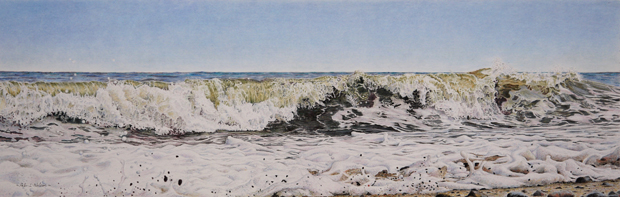
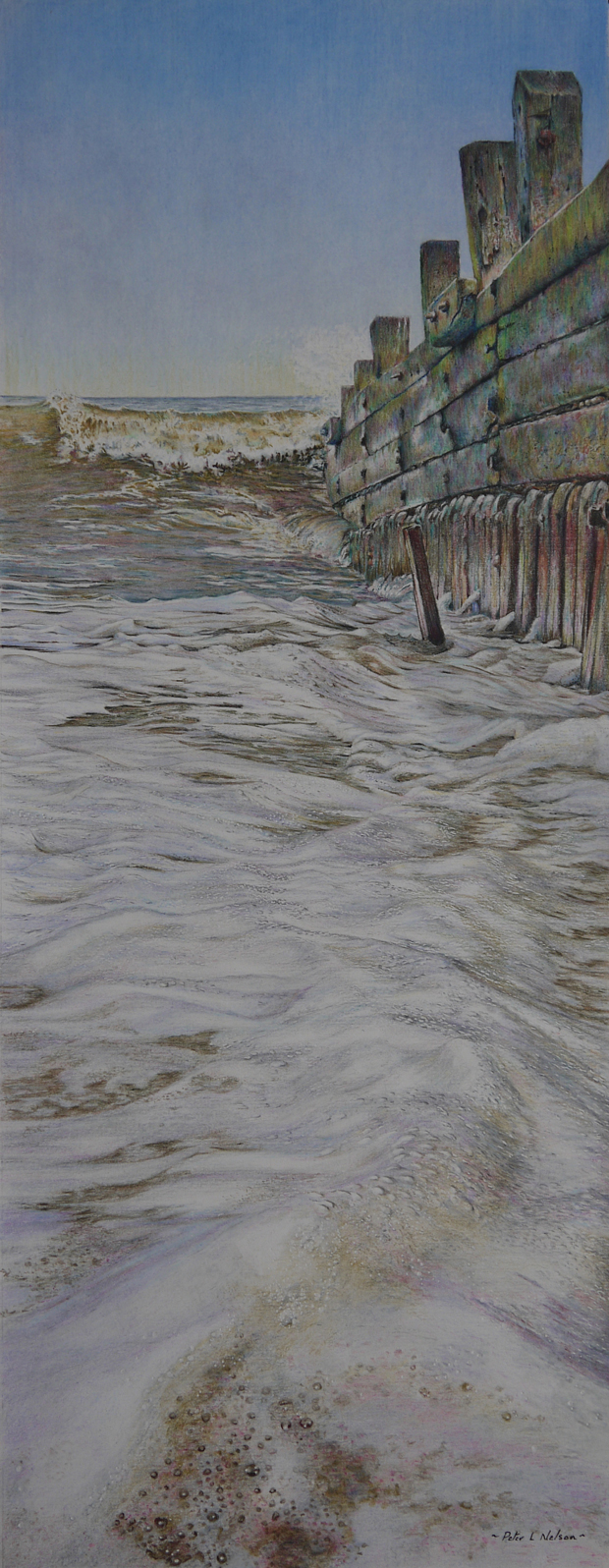
Peter: I suppose I don’t have a favourite brand. I initially started with the Derwent range of Coloursoft, only because I’d seen it used in an article in the Artist magazine, but I soon realised the limitations when used on their own. I stayed with the Derwent range and acquired their Artist and Studio sets. This is when I really found the excitement of coloured pencils. My work “Rolling Breaker” (below) was the climax of their use.
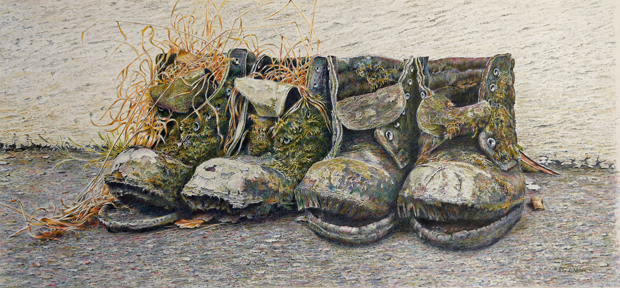
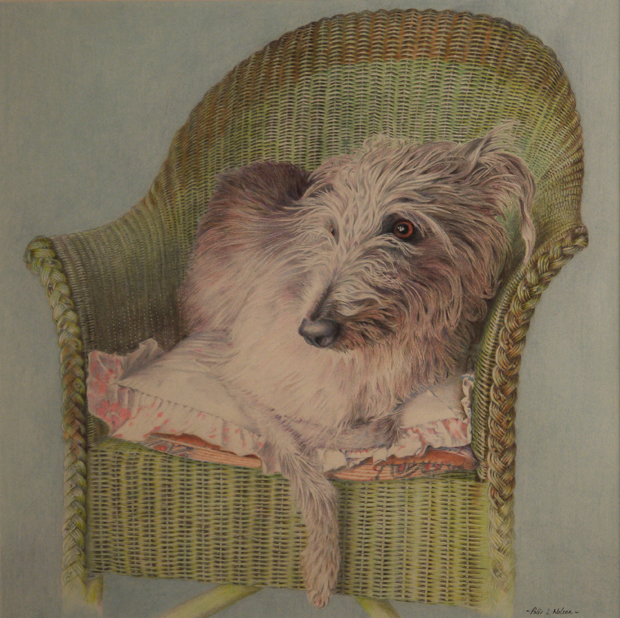
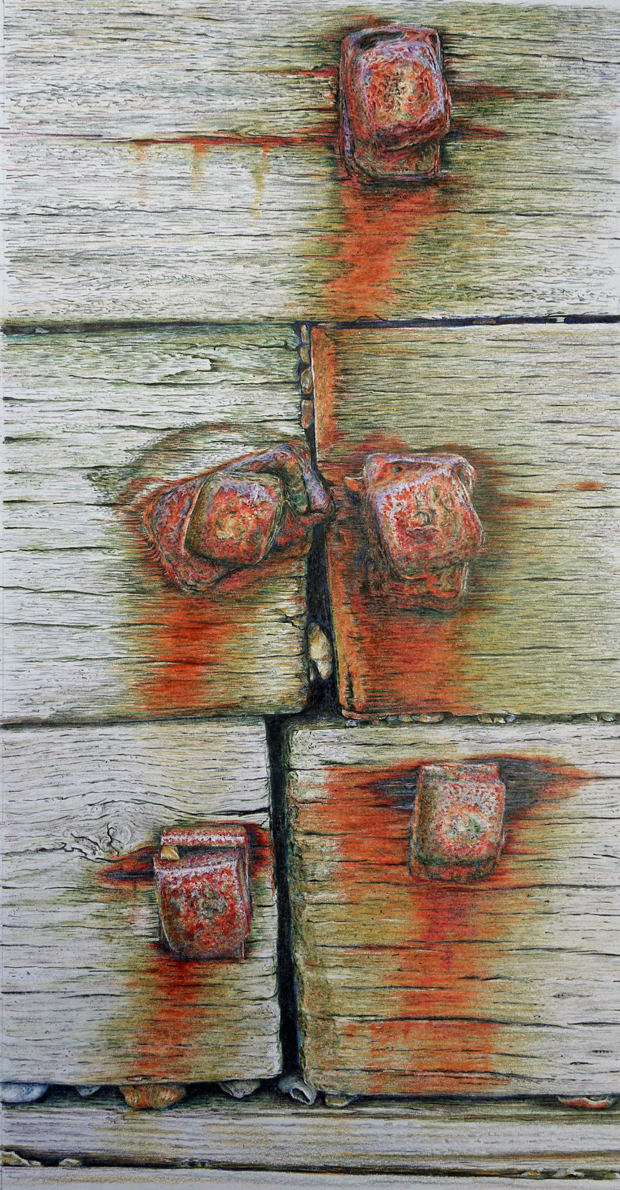
My wife used Faber Castell Polychromos for her parchment craft and hearing how good they were on many of the different Internet sites, gave them a try. I love their feel, they have a different consistency to the Derwent range, being oil based instead of wax and have allowed me to achieve deeper depths of colour. My work “The Four Jolly Old Men of Lydford” (pictured above) is a example of this.
I have since started to include a few pencils from other brands, such as Prismacolour and Caran D’ache Pablo ranges, I suppose you never stop experimenting and I’m finding individual favourite pencils from each brand and again this enormously depends on the subject and support.
Lisa: Can you describe where you do the majority of your drawing?
Peter: All my work is carried out in a converted bedroom, which I have turned into a small studio for my wife and I. We work together a lot and I find her critique helpful, especially when the work is not flowing well, but I suppose I would like more space and my eventual aim (come dream) would be to have our own purpose made studio and even start to teach.
Lisa: What are the greatest difficulties you face with working in coloured pencil and how would you overcome them?
Peter: This would be composition, creation, effect and impact, especially when it’s something for my own creation. Commissions are relatively simple as you are given the subject and applying the various rules overcomes that problem. When working with coloured pencils, it is always the colour combinations and mixes, what pencils to choose to give the desired hues and tones. I find that sometimes producing small sections of the intended subject, using the same support, allows me to get close to what I’m trying to achieve before committing myself.
Lisa: Are there any tools/gadgets or hints/tips you use when working with coloured pencil that make life a little easier?
Peter: The main three tools used are Blu-Tack, embossing/indent tools and my electric eraser, but I am just starting to look into solvents.
Lisa: Which artists do you most admire?
Peter: This is a hard one, there are so many fantastic coloured pencil artist that I admire. The list is as long as my arm. But I always come back to the watercolour artist Richard Bolton, who first inspired me back in 1986, with his weathered textures and deep rich colours. Even though I use coloured pencil now, those first impressions will never be forgotten.
Lisa: Do you have any preferences for how you like to frame/present your work?
Peter: Its always under glass and double mounted, the actual frame depends on the subject, but for my rustic work I tend to use natural wood, such as light oak. The mounts are always chosen to match the composition colours used.
Lisa: Will you be showing work at the forthcoming UK Coloured Pencil Society exhibition? If so what will you be showing?
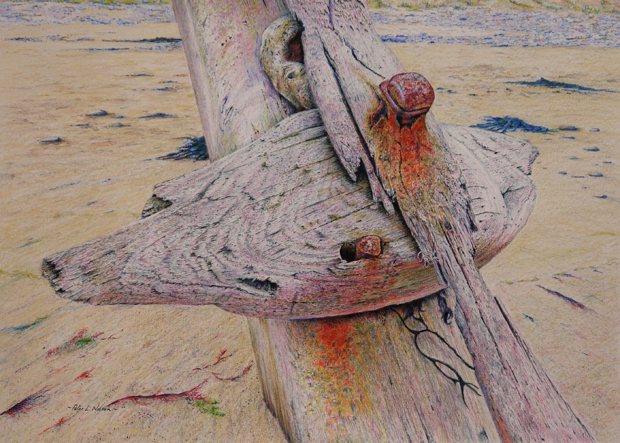
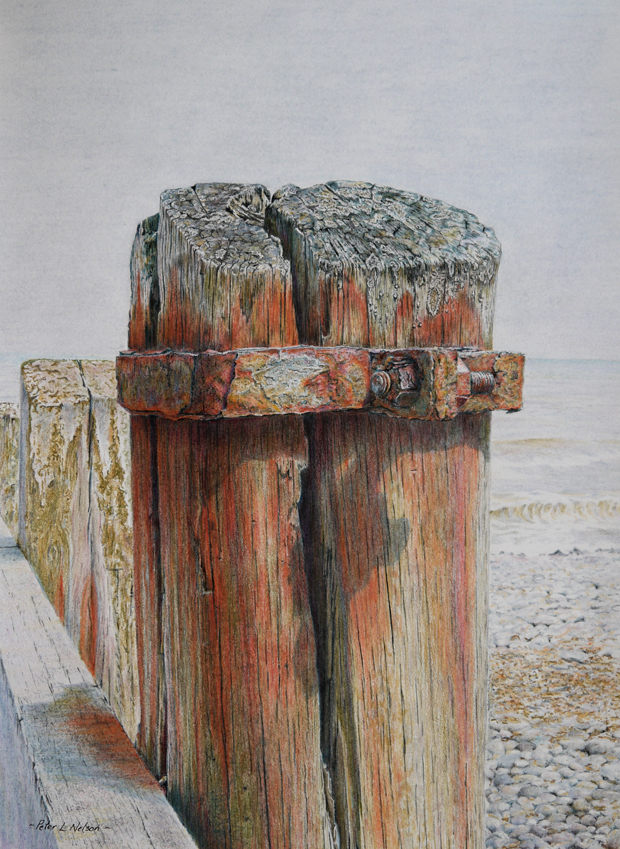
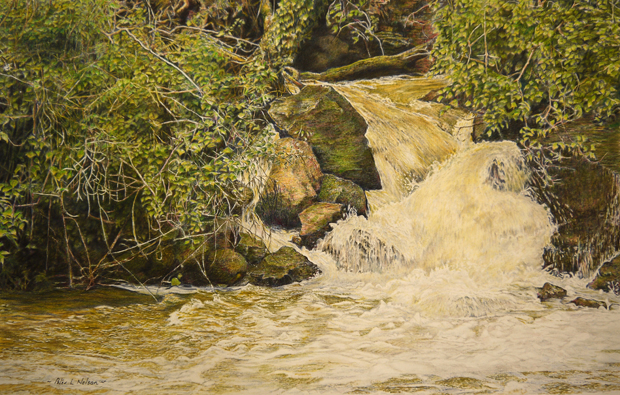
Peter: Yes, I have four pieces, “Wave Foam” “Foix Falls” “Salt Water Decay” and “The Four Jolly Old Men of Lydford” (Fred, Harry, George and Henry).
Lisa: Where online or in the flesh can we view more of your work?
Peter: All my work is shown on my Facebook art page https://www.facebook.com/petenelsonsart and profile page Peter L Nelson. As yet I don’t have a Web site, and am not exhibiting in any other galleries other than the forthcoming event in London. I can’t wait for the UK Coloured Pencil Society exhibition, as I know the standard of all the other selected pictures will be extremely high and I’m looking forward to seeing such a wide diversity of work in real life, together with meeting all the other artists, it promises to be a great day.
The annual UK Coloured Pencil Society Open International Exhibition is sponsored by Caran d’Ache and is on at the Menier Gallery, London, from 6th -16th May. More information on the exhibition can be found by clicking here.