You can find all of our recommended art exhibitions in one place. Below is a list of our 7 must-see art shows for the month, along with a navigation that can take you to smaller weekly listings that are worthy of note, this section is updated with new shows every week. If you want to see exhibitions in London or in your area simply go to our Artist Calendar – let us know about an exhibition using the form at the bottom of that page for the chance to be included in one of our Art Exhibitions on Now posts!
7 Unmissable Art Exhibitions on in January
Interesting Exhibitions upcoming in January:
*Exhibitions on in the beginning of January
*Exhibitions on in the middle of January
*Exhibitions on at the end of January
Find out about further art gallery and exhibition listings.
Tell us about an exhibition, art class or opportunity.
7 Unmissable Art Exhibitions on in January
This month’s art exhibitions not to miss choices includes 7 exhibitions that all focus on pivotal things that inspire individual artists, whether it be their relationships, a particular exhibition, a social cause, an economic state, recent history or a particular medium.
1. Modern Couples: Art, Intimacy and the Avant-garde

This major exhibition explores modern art and modern love. It shows how many artists relationships with one another reinforced and inspired their own creativity. Modern Couples looks at the creative relationships that were present in the disciplines of painting, photography, design and literature. These couples found new ways to make art and new ways to live and love. Presenting the individuals work, letters and other material this exhibition reflects on how relationships, whether lifelong, fleeting or obsessional, change and affect creative paths.
Aino and Alvar Aalto / Vanessa Bell and Roger Fry / Vanessa Bell and Duncan Grant / Benedetta and Filippo Tommaso Marinetti / Lilya Brik, Osip Brik and Vladimir Mayakovsky / Claude Cahun and Marcel Moore / Leonora Carrington and Max Ernst / Camille Claudel and Auguste Rodin / Natalie Clifford Barney and Romaine Brooks / Nancy Cunard and Henry Crowder / Sonia Delaunay and Robert Delaunay / Lili Elbe and Gerda Wegener / Emilie Flöge and Gustav Klimt / Federico García Lorca and Salvador Dalí / Natalia Goncharova and Mikhail Larionov / Eileen Gray and Jean Badovici / Barbara Hepworth and Ben Nicholson / Winifred Roberts and Ben Nicholson / Hannah Höch and Til Brugman / Hannah Höch and Raoul Hausmann / Frida Kahlo and Diego Rivera / Dora Maar and Pablo Picasso / Alma Mahler and Gustav Mahler / Alma Mahler and Oskar Kokoschka / Maria Martins and Marcel Duchamp / Margrethe Mather and Edward Weston / Lee Miller and Man Ray / Lee Miller and Roland Penrose / Tina Modotti and Edward Weston / Lucia Moholy and László Moholy-Nagy / Gabriele Münter and Wassily Kandinsky / Georgia O’Keeffe and Alfred Stieglitz / PaJaMa: Paul Cadmus, Jared French, and Margaret French / George Platt Lynes, Monroe Wheeler and Glenway Wescott / Lilly Reich and Mies van der Rohe / Lavinia Schulz & Walter Holdt / Varvara Stepanova and Alexander Rodchenko / Toyen and Jindrich Styrsky / Sophie Taeuber-Arp and Jean Arp / Dorothea Tanning and Max Ernst / Marianne von Werefkin and Alexej von Jawlensky / Virginia Woolf and Vita Sackville-West / Virginia Woolf and Leonard Woolf / Unica Zürn and Hans Bellmer
Showing at the Barbican, London until 27th January 2019.
2. Albert Irvin and Abstract Expressionism

This major retrospective of Albert Irvin, who is known mainly for his large abstract colourist work, demonstrates his move from a post-WWII kitchen sink painter to the seminal moment when he saw ‘The New American Painting’ exhibition 1959. This show redefined for Irvin what was possible and lead him to abandon still life and instead pursue colour, emotion and abstract marks. Albert Irvin is seen as one of Britain’s most important post-war painters and printmakers partly because of this radical change and his vibrant yet nuanced use of colour and form.
Marking the 60th anniversary of ‘The New American Painting’, this retrospective includes works by abstract expressionists who inspired Irvin including Jackson Pollock, Willem de Kooning, Robert Motherwell, Barnett Newman, Sam Francis, Adolph Gottlieb, Grace Hartigan and Jack Tworkov, as well as, other leading British abstract painters: Peter Lanyon, Basil Beattie, Gillian Ayres, John Hoyland and Sandra Blow. The inclusion of these artists in the show gives Irvin’s work a context, which is emphasised by the inclusion of other Kitchen Sink painters, Edward Middleditch, John Bratby and Peter Coker, who provide a comparison for his earlier work and help demonstrate the extent seeing work from New York Abstract Expressionism scene had on his practice.
Showing at The Royal West of England Academy, Bristol, until 3rd March 2019.
3. Edward Burne-Jones

This is the first solo show of Edward Burne-Jones’ work since 1933. Born in 1833 Burne-Jones was one of the last Pre-Raphaelites and while he lacked much formal training he remains one of the most influential artists of the 19th century. Rejecting any focus on industrialism, he was fascinated by Medieval traditions and religion as well as story telling, myths and legends. This comes across clearly in his work across different disciplines, including stained glass, embroidery, jewellery and of course painting. Working across these mediums was part of him pioneering with William Morris the arts and crafts movement which attempted to make art accessible to the everyday world, through design and reform.
This exhibition holds over 150 pieces by Burne-Jones and collects together major works of his spanning his career, including his large paintings telling the narrative of Sleeping Beauty and stunning tapestries that cover whole walls.
Showing at Tate Britain, London, until 24th February 2019.
4. Andy Warhol and Eduardo Paolozzi : I want to be a machine

‘I want to be a machine’ was Andy Warhol’s response to an interviewer about why he painted how he did, it is also the theme around the curation of this exhibition which ties Scottish artist Edurado Paolozzi and Andy Warhol together through shared themes, mediums and interests, and places them rightly as the fathers of Pop Art.
While everyone knows what to expect from Warhol with his self portraits and his glorification of technology and consumerism as well as radical eye both in commercial and fine art, this exhibition both demonstrates Paolozzi’s key fascination with America, technology and the future but also his stark traditionalism. His work was clearly operating within the boundaries of traditional work and was directed towards institutions rather than towards the masses.
The exhibition has parallel parts which trace chronologically the development of both arts allowing one to see similarities in key influences as well as their joint interest in screen printing and capturing images and ideas from photography and advertisements.
Showing at Scottish National Gallery of Modern Art (Modern Two), Edinburgh, until 2nd June 2019.
5. Norman Ackroyd: The Furthest Lands

‘My style is continuously evolving in a way that is continuous and limitless.’
Norman Ackroyd
Norman Ackroyd made his first etching over 60 years ago from then on he started creating etchings of the British landscape initially of Yorkshire and then further afield.
As one of the foremost British landscape artists and contemporary printmakers, his latest solo exhibition ‘The Furthest Lands’ showcases a collection of work that looks at and captures the western edges of the British isles. From the northern point on the Shetland Islands the collection of aquatint etchings and watercolours traces the coastline down to the far south-west point of Ireland. His work uses muted tones to demonstrate the vitality of the landscape and to give the viewer an immense sense of depth, awe and recognition.
There are a series of events to complement the show including an etching demonstration where Ackroyd will show the process behind aquatint etching using sugar lift or soft ground etching to show how he creates a piece from plein air watercolour sketches through to a final print. This will take place on 16 February 2019.
Showing at Yorkshire Sculpture Park, Yorkshire until 24th February 2019.
6. Everybody Razzle Dazzle

Everbody Razzle Dazzle is a commissioned work by Pop Artist Sir Peter Blake, where he has transformed Snow drop, a working Mersey Ferry, into a moving art piece which you can ride — all by using his iconic, bright and mesmerising designs. While you’re aboard you can discover more about the painting technique dazzle which was used to camouflage British ships and the role Mersey Ferries played in the First World War. This dazzle was designed not to hide ships but to optically distort them so that submarines couldn’t work out their course and thus where to attack them. The designs themselves owe a lot of their design to Cubism and are spectacular in their own right.
The Dazzle Ferry was commissioned by 14-18 NOW WWII Centenary Art Commissions and Tate Liverpool and is the third of a series of Dazzle Ship commissions that also include Induction Chromatique à Double Fréquence pour l’Edmund Gardner Ship / Liverpool. Paris 2014 by Carlos Cruz-Diez on the Liverpool Waterfront and Tobias Rehberger’s Dazzle Ship on the River Thames in London.
Showing at Tate Liverpool, Liverpool until 6th April 2019.
7. Anni Albers

Anni Albers combined groundbreaking modern art techniques with the traditions and knowledge of hand weaving. Her pieces grapple and play not only with colour theory, the mechanisms of weaving and the quality of threads but also with the philosophical implications of writing, symbols and the architecture of society.
Albers when she was at the radical Bauhaus art school was discouraged as a woman from joining certain classes, this lead her to take up weaving and use textiles as a key form of expression. To see her designs, plans, working notes, swatches and finished pieces in one place is to begin to grasp the complexity of her work both practically and visually.
By working with her teacher Paul Klee and her husband Josef Albers she both was inspired and inspired them along with artists around the world. This exhibition showcases more than 350 objects that range dramatically in use and scale from large wall hangings, pictorial weavings, fine art commissions to mass produced fabrics, designs for student dormitories through to swatches, prints and drawings.
A particular flourish is a section that looks at her text On Weaving 1965 where source material and relevant textile pieces are displayed next to extracts of her writing in order to illuminate both the text and her work itself.
Her re-imagining of what textiles can be along with her use of colour and her subtle, concise designs are a joy to see together and reinforce the recognition Anni Albers should receive.
Showing at Tate Modern, London until 27th January 2019.
Interesting Upcoming Artist Shows on this Month:
This is a selection of UK art exhibitions, including group, solo, artist-led and gallery curated shows, that we think are interesting or unusual in some way. We update this section every week so you know the exhibitions to see now. Formally, we presented this information as our Current Events weekly blog posts. If you want to submit your own, follow the link at the bottom of this section.
Exhibitions on in the Beginning of January
You Can’t Beat a Woman
8 January – 19 January 2019
Private View: Monday 7 January 5-7pm

You Can’t Beat a Woman is a Heritage Lottery Fund project directed by June Freeman and Ravi Thiara.
For centuries domestic violence was both wide-spread and widely tolerated in the UK. With the resurgence of feminism in the late 1960s and the birth of anti-racism in the 1970s, however, a new awareness of domestic violence spread among young White British and British Asian and other ethnic minority women. Anger mounted over the misery and damage it caused to many women and a determination that something should be done about this grew.
The exhibition tells the story of how groups of White and Asian women began to campaign for houses to set up as refuges for women desperate to escape from violent husbands and partners. Securing a house was not enough, however. Women also had to learn how to set up viable businesses offering the services abused women needed. The exhibition outlines the way refuges developed as organisations run by women for women.
Directed and curated by June Freeman and Ravi Thiara
Espacio Gallery
159 Bethnal Green Road,
London,
E2 7DG
Bone Memory
30 November – 4 January 2019

An exhibition with work from Bea Bonafini, Freya Douglas-Morris, Marlene Steyn, Aishan Yu, Lian Zhang and Vivien Zhang.
Lychee One, Unit 1, The Gransden,
39-45 Gransden Avenue
London,
E8 3QA
Exposed: The Naked Portrait
On until 3 March 2019

‘This exhibition of unclothed portraits from the National Portrait Gallery Collection invites questions about identity and gender, the real and ideal. It includes portraits of exposed sitters from Nell Gwyn to Naomi Campbell, Gilbert & George to John Lennon and Yoko Ono. Featured artists include Duncan Grant, Vanessa Bell, Sam Taylor-Johnson, David Hockney, Annie Leibovitz, Linda McCartney, Tracy Emin, David Bailey, Mario Testino and Dorothy Wilding. This exhibition is a partnership jointly curated between the National Portrait Gallery and the Laing Art Gallery.
Exposure has more than one meaning. It can describe harmful or welcome experiences: the revelation of a shameful secret or the achievement of longed-for publicity for a person or cause. It can refer to acute vulnerability or complete self-assurance. The various meanings of ‘exposed’ can be found in the portraits in this exhibition.’
Laing Art Gallery
New Bridge Street
Newcastle upon Tyne
NE1 8AG
Close: Drawn Portraits
Until 3 February 2019

‘Bringing together historic figures such as Ingres, Picasso and Hepworth, and recent and contemporary artists including Lassnig, Hockney and Landy, this exhibition reveals close encounters between artists and their subjects over the past 200 years. Remarkable drawn portraits, rarely seen, sit beside those made today, and demonstrate drawing’s enduring ability to bring characters to life.’
Drawing Room
1-27 Rodney Place,
London
SE17 1PP
Anima Mundi Mixed Winter Exhibition
20 December 2018 – 8 February 2019

oil and acrylic on panel . 90 x 90 cm
‘Anima Mundi are delighted to close another exciting and eventful year with our annual Mixed Winter Exhibition.
The Anima Mundi Mixed Winter Exhibition offers visitors an elaborate overview of the idiosyncratic artists who we have the privilege of working alongside, emphasising the kaleidoscope of themes and issues represented within our programme.
The display will feature a curated selection of works from gallery artists, shown across all three floors of the gallery and includes works from William Arnold, Simon Averill, Sarah Ball, Samuel Bassett, Harriet Bell, Trevor Bell, Paul Benney, Jim Carter, Mat Chivers, Phoebe Cummings, Andrew Hardwick, Rebecca Harper, Youki Hirakawa, Joy Wolfenden Brown, Henry Hussey, Sax Impey, Arthur Lanyon, Andrew Litten, Jamie Mills, Richard Nott, Dr Martin Shaw, Tim Shaw, Roger Thorp, Abbie Trayler-Smith, David Kim Whittaker and Carlos Zapata.’
Joseph Clarke . Gallery Director
Anima Mundi
Street-an-Pol
St. Ives
Cornwall
TR26 2DS
Lucy Orta: Procession Banners
Until 20th January

‘Early last year artist Lucy Orta collaborated with female residents of HMP Downview to design 30 banners to mark 100 years since British women won the vote. In 2016, many residents were transferred to HMP Downview after the closure of HMP Holloway, then the largest all women prison in Europe, and the notorious site where over 1,000 suffragettes were imprisoned. Seven banners were carried by London College of Fashion students as part of the centenary Processions march, produced by Artichoke, in London, Cardiff, Edinburgh and Belfast on 10 June 2018.
Ikon exhibits a selection of banners for the first time at Medicine, the former gallery of the Royal Birmingham Society of Artists.’
[Ikon Gallery]
Medicine Bakery and Gallery,
69 New Street,
Birmingham B2 4DU
Exhibitions on in the middle of January
Sara Dare : An exhibition of new works
10 January – 30 January 2019

‘Sid Motion Gallery is delighted to present a solo show by Sara Dare, an abstract painter and installation artist. Primarily working on a large scale, she explores the limits of surface using paper, linen and canvas, combined with ink, oil, emulsion, acrylic or varnish.
Through the use of organic bold shapes and complex, experimental colour combinations, Dare seeks to convey an initial playful light-heartedness followed by a sense of unease and tension.
For this exhibition of new work, Sid Motion Gallery is delighted to present framed works on paper, which is a new strand to the artist’s practice. Striking a balance with the works on canvas, the works on paper reveal a different materiality and gestural mark making. The selected large colour work on canvas ‘Peach’ stays true to the bold use of acrylic, emulsion and varnish that draws on a loaded visual language for Dare. Influenced by derelict architecture and grey or bleak industrial locations, these contemporary works refer to those urban landscapes yet are conceptually open to interpretation through their scale and abstract composition.’
Sid Motion Gallery
142 York Way,
Kings Cross,
London N1 0AX
This Year’s Model 2019 (part I) ‘Repurpose/Reverse’
11 January – 3 February 2019

Annual members’ show: Jillian Knipe, Rupert Hartley, Caroline Thomson, David Edmond, Olivia Irvine, Wayne Clough, Julie Caves, Amanda Benson, Miranda Boulton, Trevor Simmons, Rosie West, Russell Herron, Pauline Hall, Kelly Sweeney, Euan Stewart, Bol Marjoram, Gavin Maughfling, Stephen Buckeridge
studio 1.1, London
57a Redchurch Street
Shoreditich
London E2 7DJ
Cornelia Parker: One Day This Glass Will Break
12 January – 16 February 2019

Courtesy and © the artist and Alan Cristea Gallery
‘The exhibition includes twenty large-scale photogravures by Cornelia Parker from three experimental series: Fox Talbot’s Articles of Glass (2017); One Day This Glass Will Break(2015) and Thirty Pieces of Silver (exposed) (2015). These three series, which are brought together for the first time in this exhibition, explore the artist’s fascination with the physical properties of objects, materials and their histories.
The exhibition includes eight works from the series One Day This Glass Will Break (2015) which arose from Parker’s investigations into thephotogravure,a photomechanical process which produces an image through the exposure of a photographic positive onto a copper printing plate. Inspired by the 19th century photographic pioneer William Henry Fox Talbot, Parker combined two of his early techniques,solar prints and the photogravure,creating a new hybrid form of print by exposing three-dimensional objects to ultraviolet light. In these works, she uses found objects such as a tower of crystal glasses, a shattered light bulb and melting ice cubes, with the resulting prints capturing their shadows in a spectral still life.
In Fox Talbot’s Articles of Glass (2017) series of nine prints, Cornelia Parker explores thistechnique further using the last remaining items of glassware belonging to Fox Talbot, which he famously used in his early photograph, Articles of Glass (c. 1844), and are now housed in Oxford’s Bodleian Library. The artist arranged these historical objects in various informal compositions on the printing plate, with some with their museum labels still attached. The lead content of this early glassware produces darker shadows, resulting in prints that are richer and deeper in tone.
Two prints from another series, Thirty Pieces of Silver (exposed) (2015), are also included. Here, the artist uses found glass photographic negatives of antique silverware, originally produced for a 1960s Spink auction catalogue. Exposed to the photogravure plate in their original glassine bags, the negatives appear as physical, dimensional objects themselves. This series evokes a major early work by Cornelia Parker, Thirty Pieces of Silver, (1988-89), which consisted of over a thousand pieces of silver flattened by a steamroller and suspended on wires hovering above the gallery floor. ’
Gerald Moore Gallery
Mottingham Lane
London
SE9 4RW
Roots & Rifts
22 January – 3 February 2019

‘People grow in different ways, sometimes take directions that they never expected and experience new forms of living. Taking another path will bring new memories and could reinforce our roots, but can also produce rifts with the past. But rifts can also bring awareness and, upon reflection, enhance our original roots and make possible the understanding and acceptance of changes. Perhaps one should never get so attached to their own roots. After all, a tree must one day reach beyond its roots as we must leave our baby shoes behind. It was this thought that gave rise to Roots and Rifts.
Bringing together a group of national and international artists, the exhibition showcases works exploring a wide range of observations and experiences. These may include issues related to living abroad and identity, as well as memories and other impressions that each artist has absorbed on their journey through life.
Anyi Ren, Art Hop Life, Ben Mellor, Carla Fleck, Constantin Botezat,
Consuelo Radclyffe, Cristina Cantilena, Daniela White, Denise Wyllie,
Diogo Lando, E Sap, Elena Rizzardi, Frank Balbi Hansen,
Helena Maxwell-Jackson, Huw Briggs, Ida Ndoni, Inha Bastos, JC Trouboul,
Justyna Koziczak, Kofi Boamah, Lawrence Mathias, Le Guerrier Project,
Lella Castello-Branco, Les Lismore, Lizy Bending, Marcos Buarque de Holanda,
Maria Di Gaetano, Marta Boros, Martyn Royce, Munisha Gupta,
Naked Nature Project, Natan Heber, Rafael R., Shabs Beigh,
Thomas Young, Viola Rühse, Yuki Otake’
Espacio Gallery
159 Bethnal Green Road
London, E2 7DG
Pulling Teeth
10 January – 18 January 2019

‘Pulling Teeth is an exhibition of new work from first year graduate painting students of the Slade School of Fine Art, UCL. This show brings together seventeen artists who are involved in the exploration of process and the materiality of paint’
ASC Gallery
The Chaplin Centre,
Taplow House,
Thurlow Street
London, SE17 2DG
Uncertainty + Diversity = Painting Today
19 January – 3 February 2019

First exhibition of paintings by Redbrick Artists a group who work at Redbrick Mill Batley under the guidance of Tom Wood.
Dean Clough Art Gallery,
Crossley Gallery Dean
Clough Halifax,
Yorkshire, HX3 5AX
Painter’s Beach Club: Telescope
19 January – 24 March 2019

‘As part of his main exhibition Painter’s Beach Club Nigel Cooke has curated a two room show of artists that he has discovered, or reconnected with via Instagram. Below, read how this plays an import part in the way that Nigel Cooke works, in his own words:
“I was interested in how we use social media to stay in touch. One thing I hear a lot from other artists when I teach, or other artists in different stages of their career is how hard it is to get their work seen and I liked the idea of a sharing platform, sharing an opportunity.
I also thought about the parallel lives that go alongside your working life, like the other painters you you know and have made contact with are there alongside you as you go. And I wanted to represent that in some way.
The title of the exhibition Painter’s Beach Club started the thought process – historically, there’s been places for painters to gather together – the Colony Room in London where Francis Bacon and Freud used to go, the Cedar Tavern in New York where the Abstract Expressionists used to hang out. So sort of mythically there’s always been these places for painters and I thought that maybe social media was like a new version of that. A bit like a club of the mind if you like, where you can offer informal feedback and support to each other and get into dialogues and conversations about what you’re doing. And I found it really fruitful. I found it really rewarding to do that and discover loads of things I would never have known about.
I wanted there to be a representation of this alongside the main exhibition. Telescope includes artists who I’ve taught as a tutor in the past who have gone on to have careers. There’s people I was at college with, people I’ve lost touch with, or people I’ve discovered who are new. It’s a cross section of the contact I’ve made with other artists who I find interesting at different stages in their career and a bit like a mix tape would be I suppose from a musician.
The title Telescope is a metaphor of the ocean voyage which is always present for me in terms of how painting can be difficult. So it made me think of the phone as being like a telescope, sitting on your desk or pallet alongside you as you work and when you’re up against it you might flick through Instagram and look up what your friends are doing and you may see they’ve got a show, they’ve got a book, they’ve got a new work out or something’s happening with someone’s visited someone else and it just it just feels nice. It feels good, like a community again and I wanted to celebrate that. I wanted to have a sort of a snapshot of that visible alongside my work to maybe suggest how the support network is something we should really cherish” – Nigel Cooke’
Jerwood Gallery,
Rock-a-Nore Road,
Hastings Old Town,
TN34 3DW
Andrew Bick: Concrete-Disco-Systems
18 January – 2 March 2019
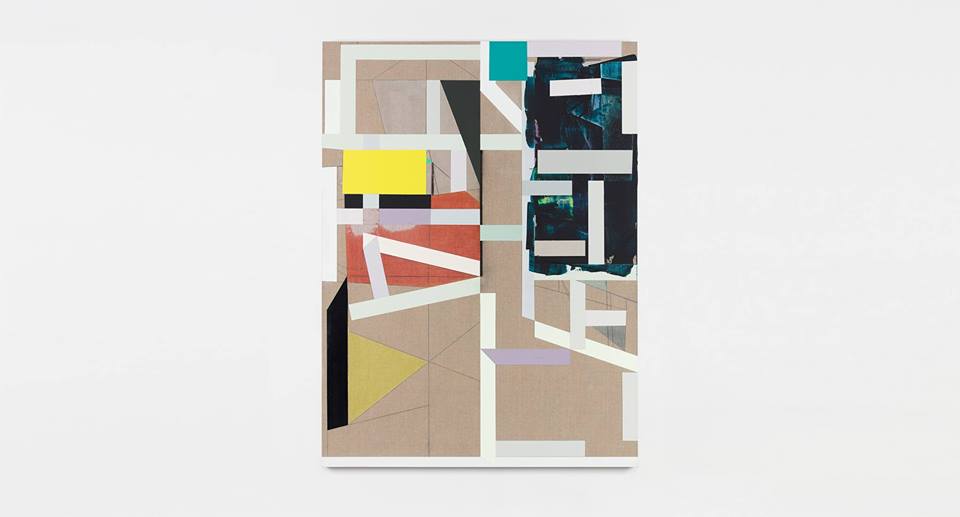
In Bick’s work, mediated layering of geometry and gesture act as an antidote to a world of instantaneous information. It is evident that the paintings are made laboriously, testing how far he can take the medium. An amalgamation of watercolour, oil paint, marker pen and encaustic are used to carefully block off areas, building the surface and composition, contrasting with casual-seeming brushstrokes and open areas of untouched support.
The paintings featured in Concrete-Disco-Systems are spatially complex, drawing the viewer closer to the work to explore what is illusory depth and what has been physically layered in three-dimensional relief. The relationship between each element of the work is restless; these are paintings full of internal argument, revelling in the idea of the grid as a contradictory format. They are simultaneously precise yet unresolved, playful and serious, transparent and opaque. Each work further extends the possible intersections and overlaps, revealing the process of painting by suspending sections in layers of wax encaustic.’
Hales London,
7 Bethnal Green Road,
London, E1 6LA
Exhibitions on at the end of January
Portraits from Medieval India: Minerva Huerta
12 January – 10 February 2019

An exhibition of work by Minerva Huerta.
Hanbury Hall,
Spitalfields,
22 Hanbury St,
London E1 6QR
Elephant x Anna Liber Lewis x Four Tet Exhibition: Muscle Memory
18 January – 3 March 2019

‘About Anna Liber Lewis
Anna was born and grew up in London.
She attended Wimbledon School of Art for her Foundation course and went on to do a BA (Hons) in Fine Art at Central St Martins followed by an MA in Fine Art Painting at the Royal College of Art in 2015.
Anna has been the recipient of a number of awards and residencies and has exhibited in numerous group shows across the UK.
She was the winner of the Griffin Art Prize in 2017.
annaliberlewis.com
About Kieran Hebden
Kieran was born and grew up in London. He is best known for his stage name Four Tet.
Hebden is a musician and solo artist and first came to prominence as a member of the band, Fridge before establishing himself as a solo artist.
He now travels the world with his music.
www.fourtet.net
About Elephant West
Elephant West is a pioneering new creative space in West London that was launched in the autumn of last year.
Designed by the award-winning architecture studio, Liddicoat & Goldhill, the space serves as a platform for emerging talent through an ambitious programme of immersive cultural experiences.
Elephant West is the physical manifestation of the print and online visual-culture magazine, Elephant. ‘
Elephant West,
62 Wood Lane,
Shepherd’s Bush,
London
W12 7RH
Imbalance
19 January – 30 March 2019

With the political world leaving us all feeling a little off kilter we’re embracing tension and asymmetry with a mixed exhibition of painting, sculpture, ceramics and jewellery.
Artichoke Gallery,
Church Street,
Ticehurst,
TN5 7AE
Jörg Immendorff: Questions from a Painter Who Reads
16 November – 25 January 2019

This exhibition of paintings is a visual history of one of the most important artists to emerge from post-war Germany and spans four decades of the artist’s career from 1974 to 2007.
Michael Werner Gallery,
Mayfair,
London
Irving Penn: Paintings
28 November – 26 January 2019

‘Hamiltons presents the first-ever UK exhibition of paintings by Irving Penn. Although Penn is internationally renowned for his work as a photographer, he initially set out to be a painter and worked in the medium at the beginning and end of his career. Focused on Penn’s paintings from the artist’s final two decades, Hamiltons’ exhibition will be on view until 25thJanuary 2019.
Encompassing multiple works drawn from the collection of The Irving Penn Foundation, the exhibition will showcase Penn’s mixed-media paintings from the late 1980s through the early 2000s, highlighting the artist’s experimentation with materials, form, and colour. Drawing inspiration from leading 20th century figures such as Henri Matisse, Giorgio Morandi, and Fernand Léger, Penn’s textured, primarily abstract, paintings deviate from the striking style of his photographs yet share in similar techniques and bold character. Penn’s paintings comprise successive layers, resembling collages. In an evolution of his platinum-palladium printing technique for photography, many of Penn’s paintings commenced with the artist creating a drawing in graphite or ink of subjects ranging from mushrooms to mythical creatures, which he would then photograph, enlarge, and print to emphasize his lines’ graphic style. The printed form served as the painting’s design, over which Penn would apply combinations of watercolour, ink, dry colour pigments and gum arabic, sometimes adding sand to achieve greater texture. As this practice evolved in the early 2000s, Penn began to forego the printing step, painting more directly and freely. By surveying the full range of Penn’s painting, the exhibition reveals how his style grew increasingly gestural and fluid over time, embracing all that the medium offers.’
Hamiltons Gallery
13 Carlos Place
London
W1K 2EU
Stephen Buckley: Close Cousins
10 January – 8 February 2019

‘For more than forty years Stephen Buckley, (b. 1944 Leicester, England) has concerned himself with addressing the major themes of the twentieth century through a personal style oscillating between the matière of Kurt Schwitters, the dandyism of Francis Picabia and the intellectual rigour of Marcel Duchamp.
He takes the two most basic components of a conventional painting (canvas and stretcher), and makes multi-dimensional constructions, joins groups of single canvases together in overlapping structures, makes shaped canvases, cuts a stretcher with a variegated edge, stitches and weaves together strips of canvas, patches pieces of canvas onto another support, and adds cardboard tubing, rope, found objects and cut out shapes. In the 1970’s and 1980’s, Buckley saw extended prominence in the art press, starting with the artist being described as ‘the Punk Rock of contemporary painting’ and ending with him gaining the title of ‘the ubiquitous Stephen Buckley’. There is now a large portfolio of themes, references, motifs and symbols which are continually reworked and reinvented. Since then, he has made some of his most compelling paintings, lush pop canvases full of symbols and colour, a far cry from the pared-down, industrial feel of some of his early works.’
The Mayor Gallery,
21 Cork Street
First Floor
London
W1S 3LZ
If you want to find out about more exhibitions that are on near you, or if you are feeling inspired to try something new, search our Exhibition and Artist Opportunity Calendar by region to find an event for you.
Let us know about your exhibition by filling out the form at the bottom of the page and we may include it in one of our Art Exhibitions on Now posts.
all images are copyright of the artist