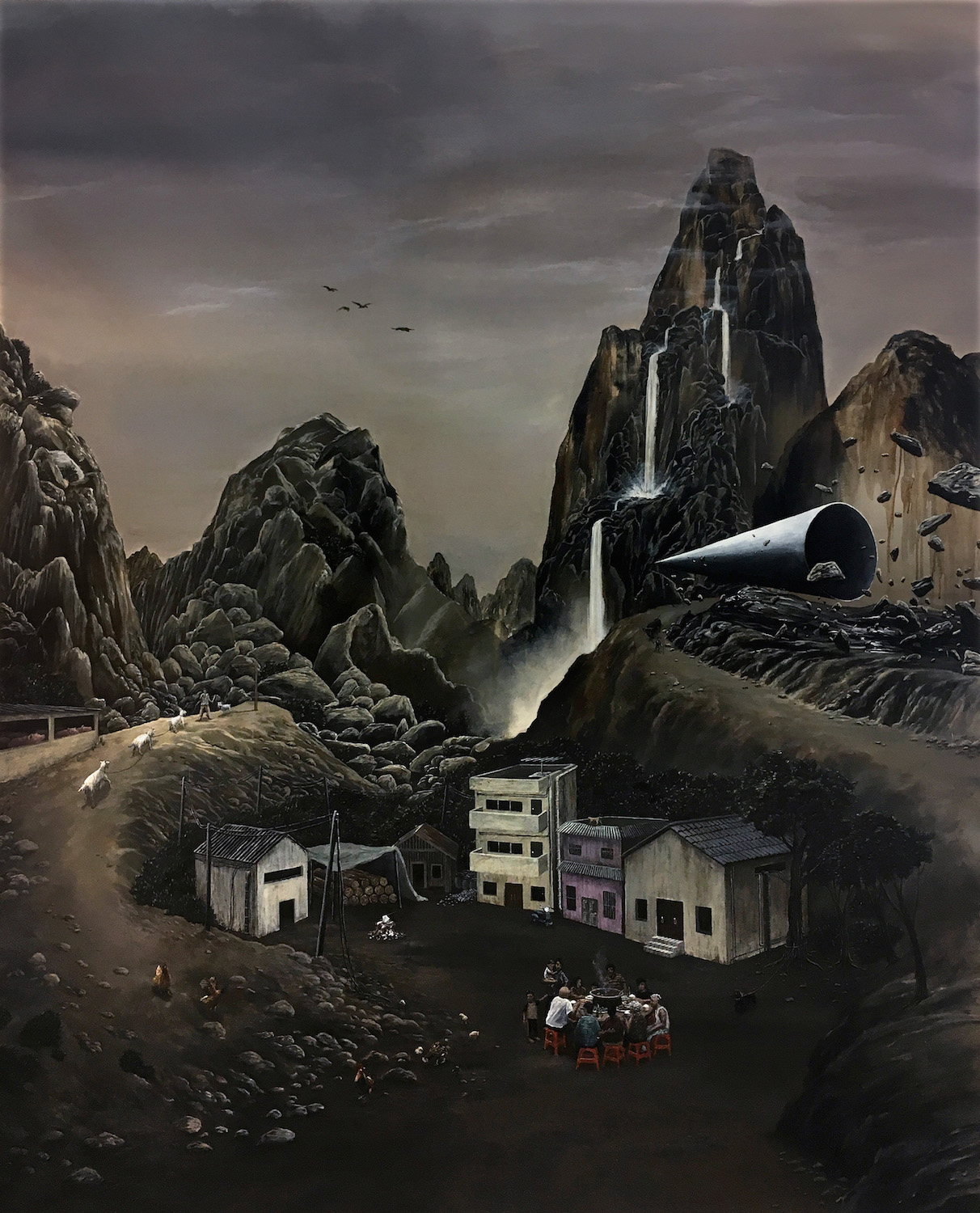
Esmond Loh’s mysterious work, Village, was shortlisted in the Jackson’s Open Painting Prize 2019. The painting depicts an imaginary village scene, where rural reality and surrealism meet, in a valley, at the bottom of a jagged rocky mountain landscape. Both literary and cinematic in its themes, it is at once rich in narrative clues but entirely open to the viewer’s interpretation. We caught up with Esmond to ask about his directorial painting approach, intuition and lightning bolts.
Esmond Loh
Acrylic on canvas, 220 x 180 cm
Clare: Tell us a little bit about your artistic background/education.
Esmond: I started drawing a lot from a very young age. However, I did not have much guidance and exposure in art as nobody in my immediate family were artists or even interested in art. Drawing was simply a way for me to express myself and have fun. It was only when I was recruited into the talent art programme in my secondary school that I started to become serious about art and learnt about various artistic media, materials, processes and techniques. Thereafter, I did art at the A levels and did two years of mandatory military service in Singapore. I then went on to pursue a Bachelor’s in Fine Art at the Slade School of Fine Art and graduated in June this year.
Esmond Loh
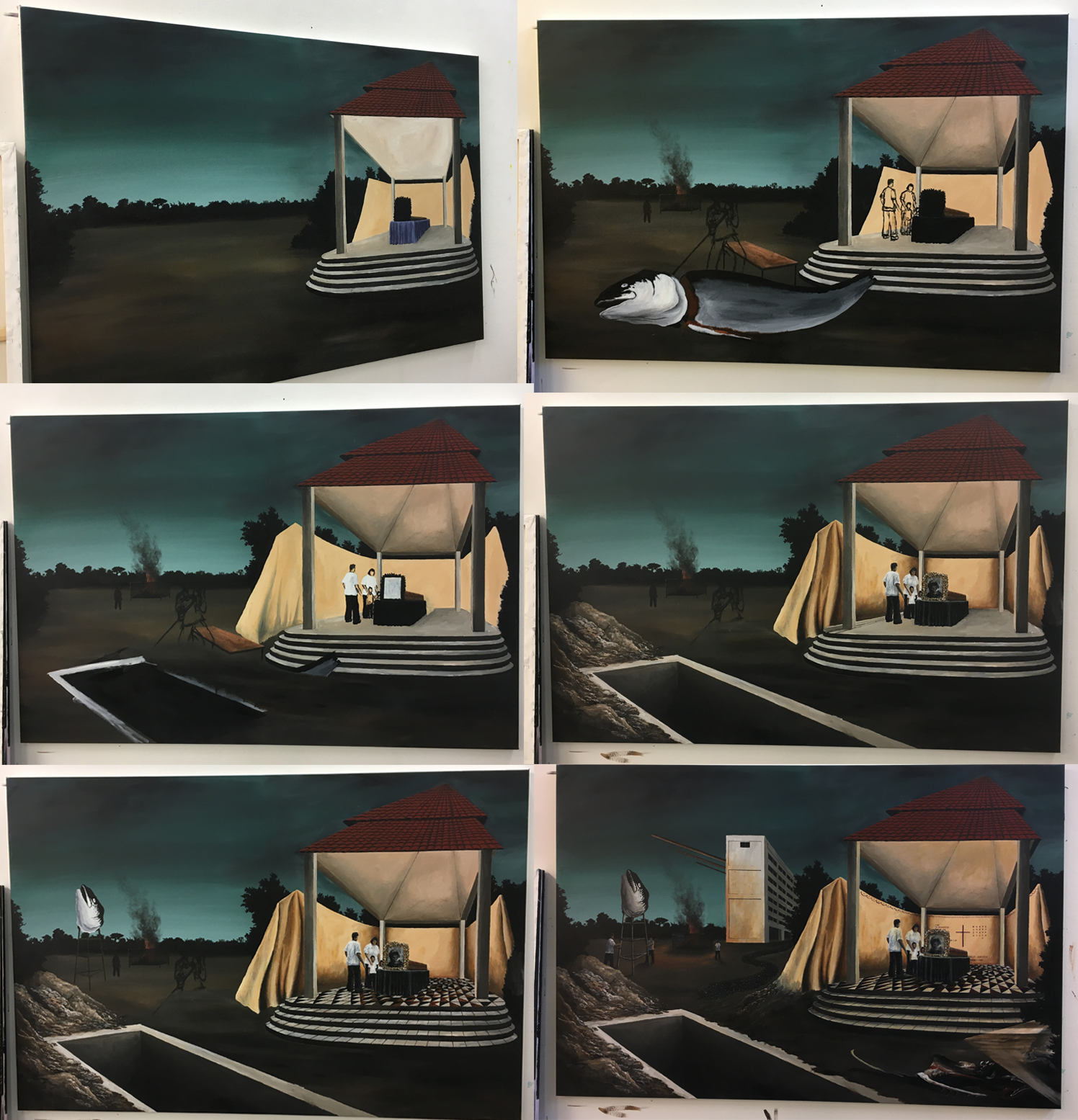
Different stages of work in progress.
Esmond Loh
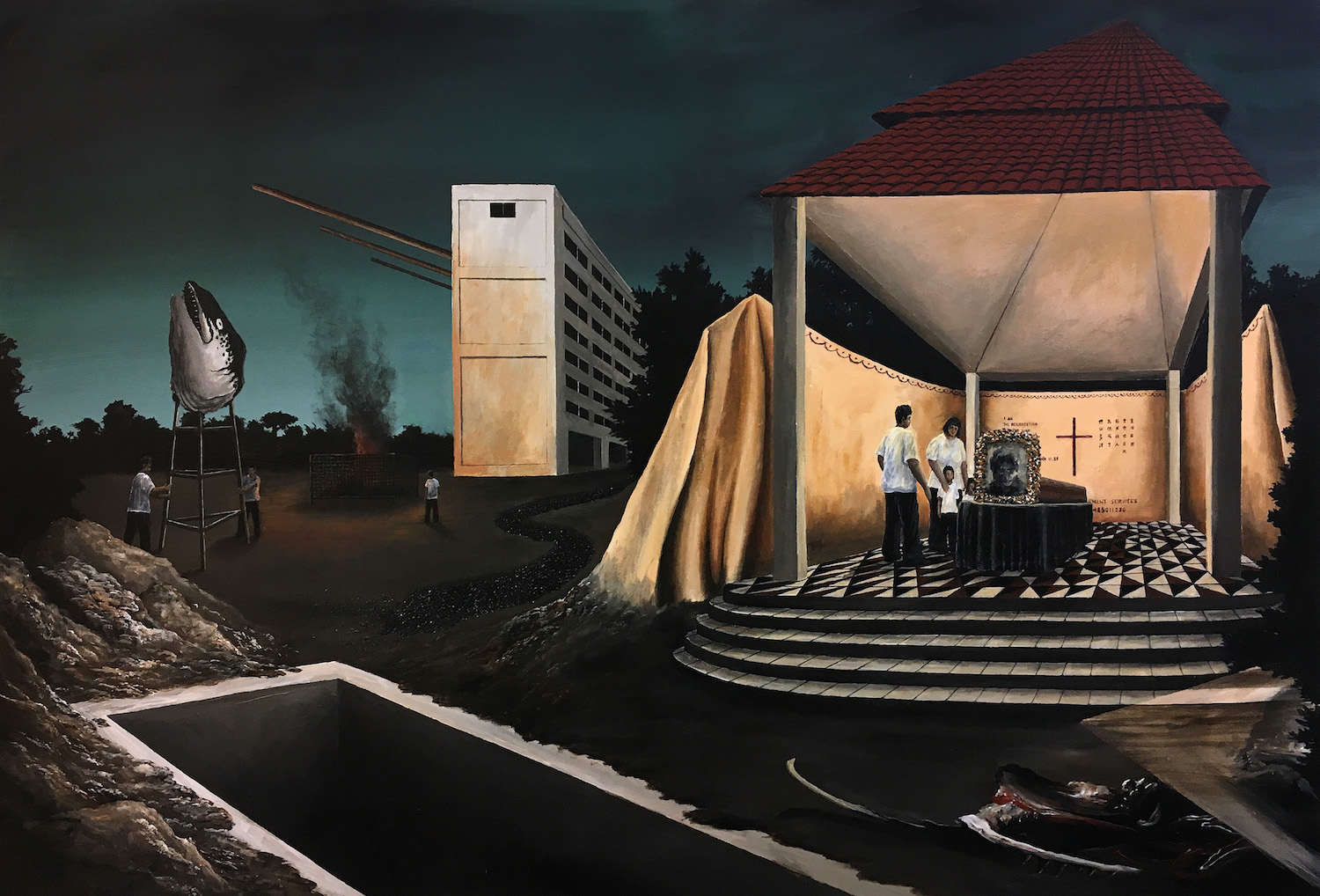
Acrylic on canvas, 120 x 180 cm
Clare: How would you describe your practice?
Esmond: My practice has always revolved around painting. As an introvert, I generally see my practice as a way of talking to myself rather than to convey certain messages and ideas to people. I believe painting (and to a lesser extent, drawing) is the most simple, direct way of expressing my vision and imagination, offering myriad possibilities and endless excitement, but at the same time not being too ostentatious. Currently, I am interested in constructing dramatic scenes charged with tension and ambiguity. My paintings appear to depict absurd realities that meld figuration with abstraction.
Esmond Loh
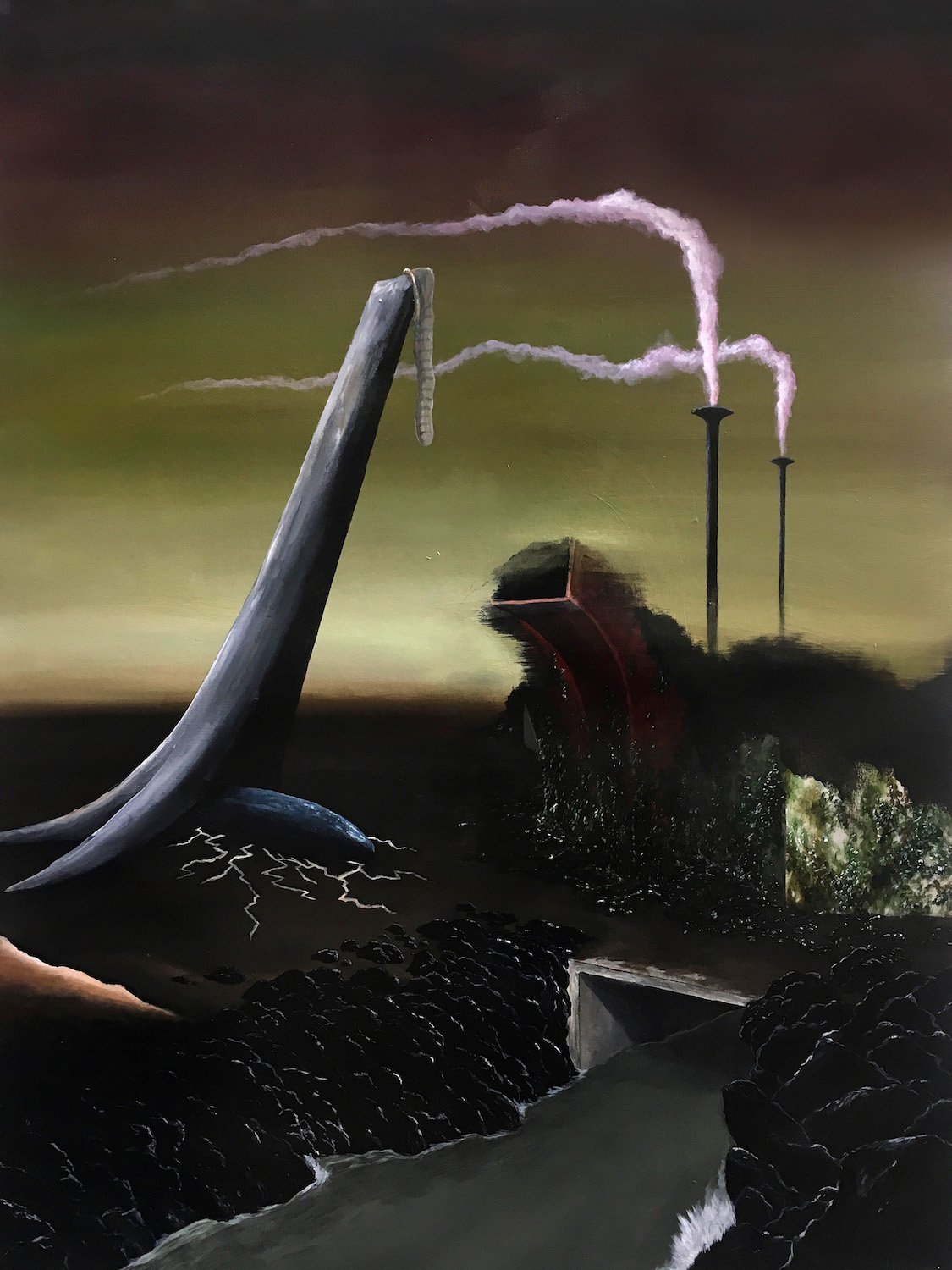
Acrylic on canvas, 122 x 91.5 cm
Clare: Your artist bio states that you take inspiration from the Surrealists and the Formalists, building up your compositions freely and spontaneously, paying close attention to how various forms, colours and textures work with one another. So, while your work is largely figurative, you have this spontaneous approach and I wonder, where does a painting start? What do you bring to the studio, canvas or palette first?
Esmond: Just like my process, the starting points of my paintings can also be very unpredictable. For some paintings, I begin with an idea in mind. This idea in my head is usually not a full picture but a part of it – either a narrative, subject matter or composition. I sometimes, very crudely, do a drawing of it on paper to gain better clarity. For other paintings, I begin without any idea, taking to the studio only the will to make a painting. I then paint whatever comes to mind. If nothing comes to mind, I apply paint onto the canvas until something appears and gives me an idea.
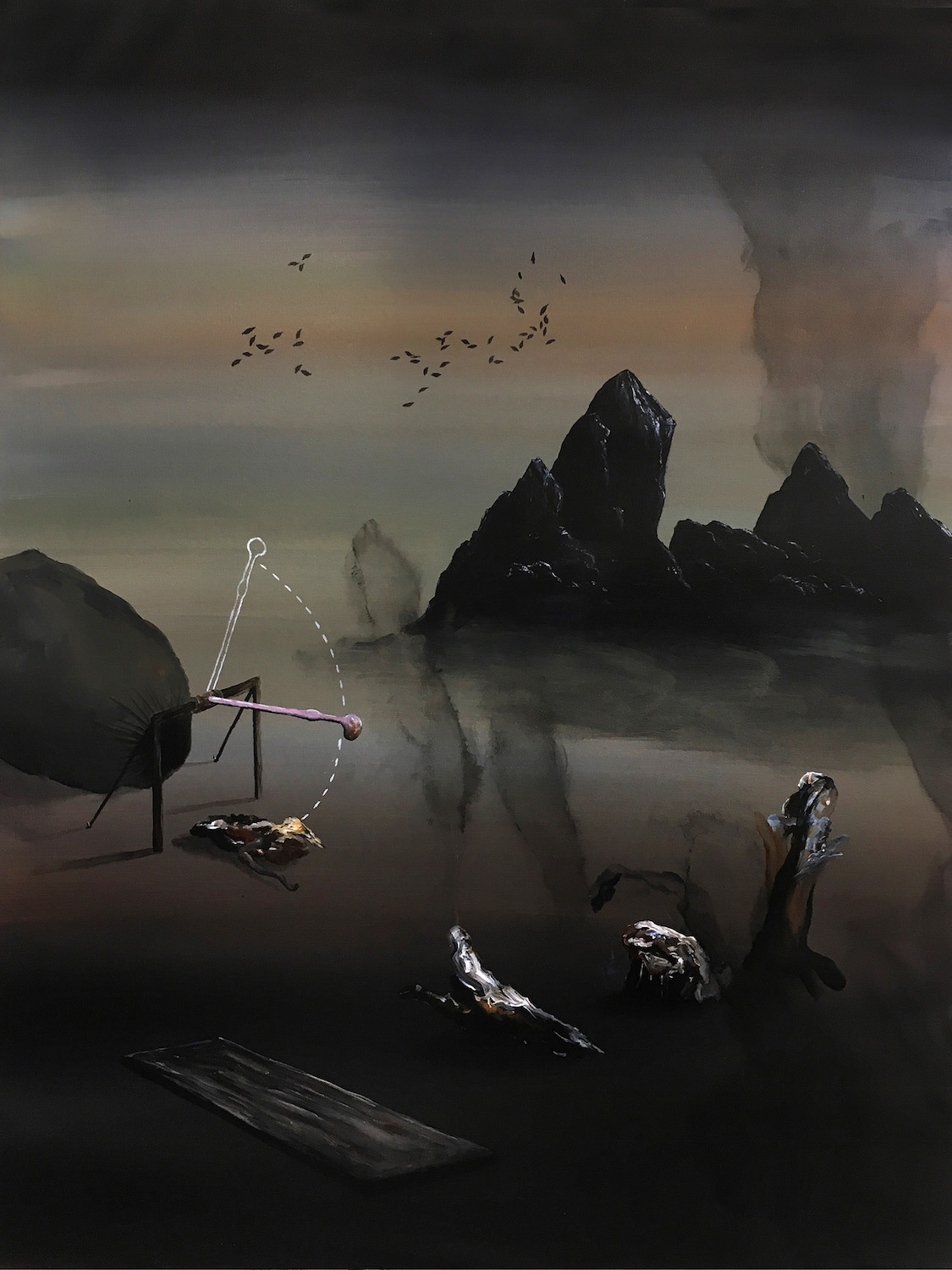
Esmond Loh
Acrylic on canvas, 122 x 91.5 cm
Clare: Because you work so intuitively and make quite major alterations on the canvas, do you intend for there to be traces of past “scenes” coming through? What are the benefits, in terms of your style and process, of working with acrylic?
Esmond: I do not intentionally leave traces of what came before, but I do feel there is beauty in these traces. A painting is ultimately a culmination of a series of decisions. Traces of past decisions convey the history behind every painting as well as the adventure that the artist has gone on in creating the painting. Unless a trace seriously affects the quality of the end product, I usually leave it.
My first exposure to painting was with acrylic. I then switched to oils as their longer drying time allow for greater flexibility and easier blending of colours. After working with oils for a number of years, I switched back to acrylic. My paintings were becoming more and more uncertain and spontaneous, and oil paint simply did not allow me to cover up mistakes and change direction swiftly enough. Furthermore, acrylic is a simpler and cleaner medium; not only are paint stains are easier to remove, but the only solvent I really need is water, which means I no longer need to put up with toxic and pungent turpentine fumes.
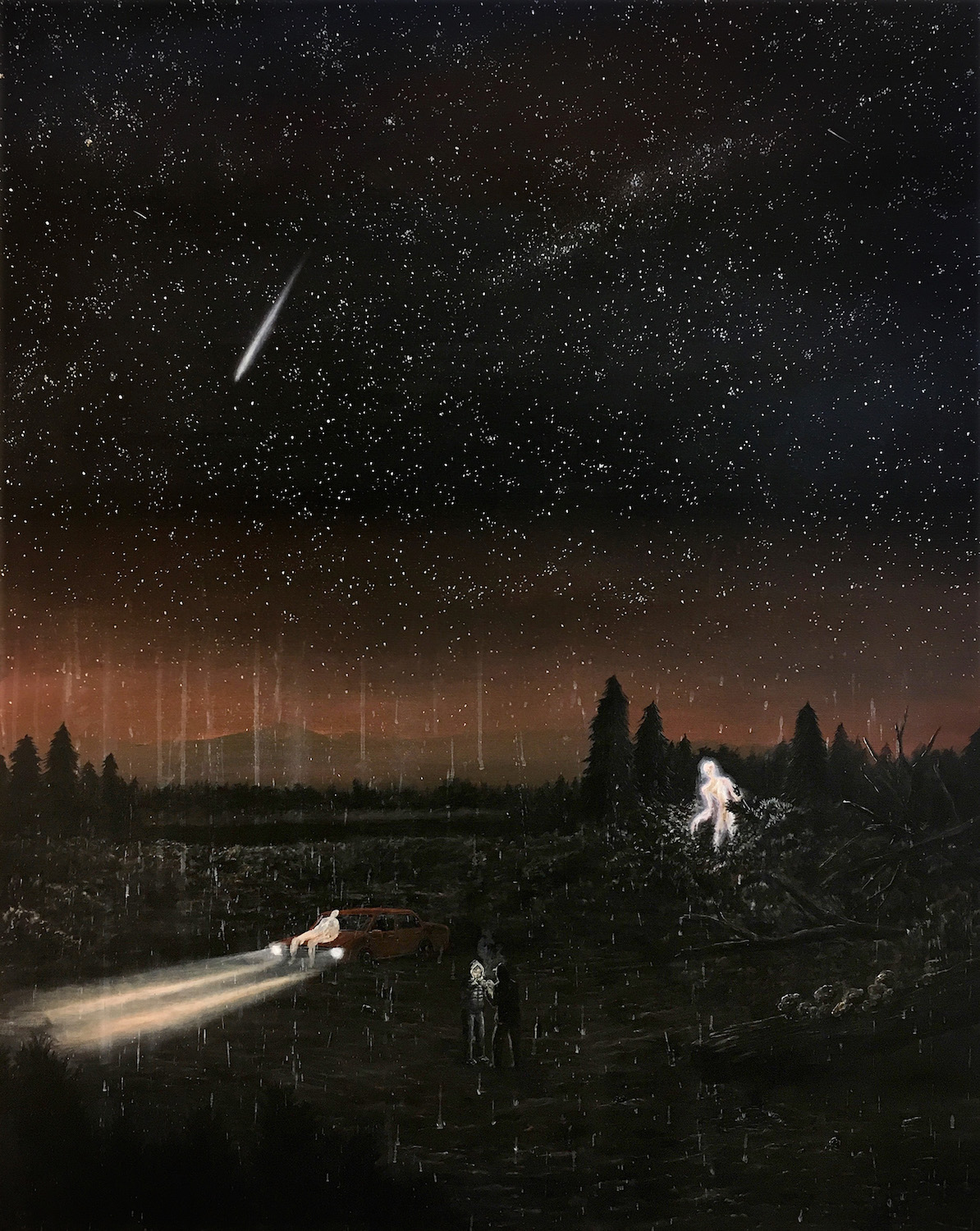
Esmond Loh
Acrylic on Canvas, 152 x 122 cm
Clare: Can you talk about your interest in drama as something you strive for in your work? Is there a dramatic element to the way you paint?
Esmond: I did not quite realise this before, but drama has always been something I am interested in. I constantly seek parallels between our real world and the fictional worlds portrayed in television, film and video games. As a result, the scenes in my paintings often appear “staged”, similar to the set of a movie or a play. However, I don’t think there is anything dramatic about my painting process!
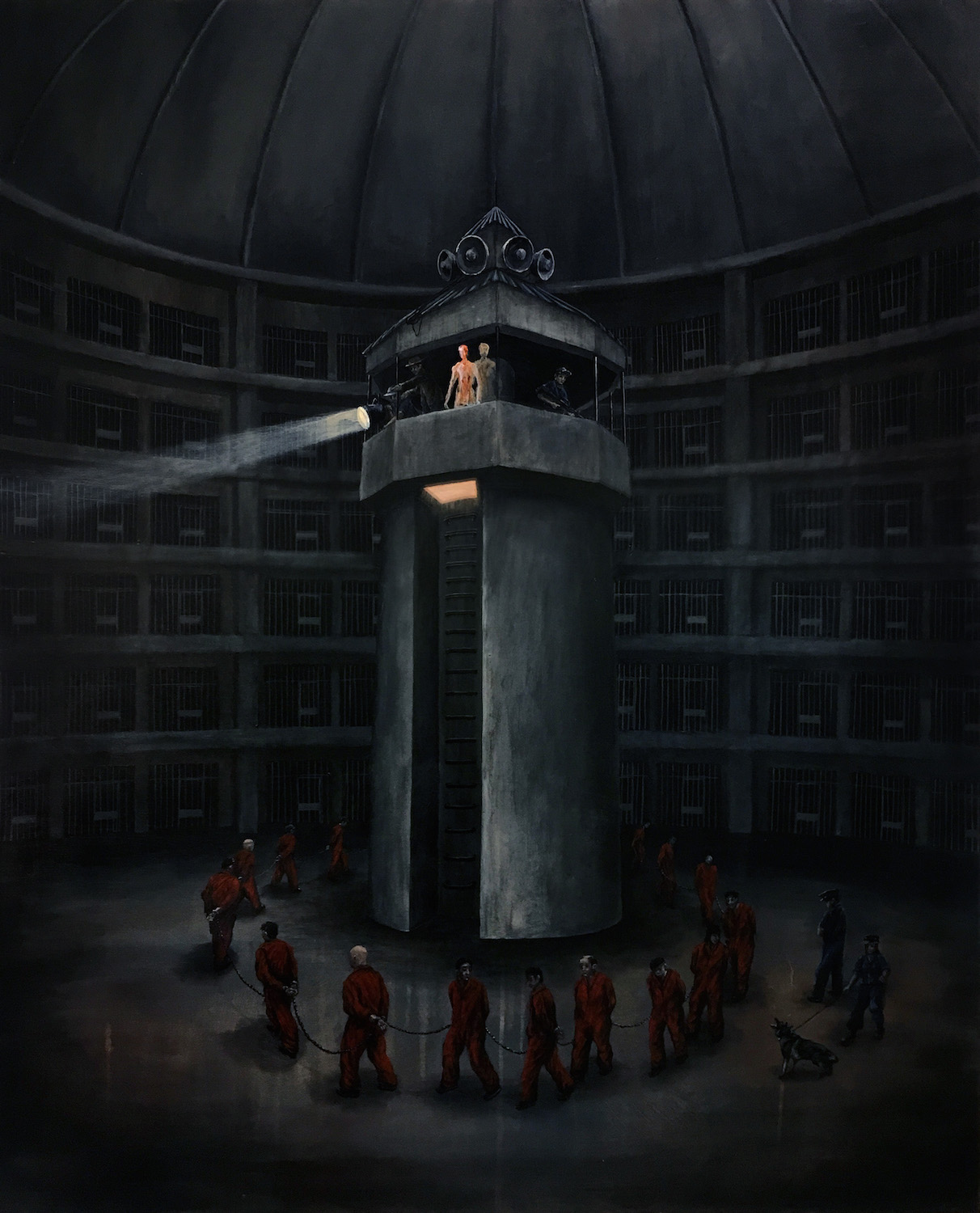
Esmond Loh
Acrylic on canvas, 152 x 122 cm
Clare: I really enjoy the lightning bolt motif that re-occurs in your work in various forms–whether it appears as a jagged bolt of light, or a more illustrative lightning bolt shape, or even as the basis for the overall composition–can you talk about why you use this and what it means to you?
Esmond: Like all my other motifs, the lightning bolt is primarily used as a formal strategy – to balance and complement other forms in the painting. For instance, I feel that its jaggedness and hard-edge juxtaposes well against more organic-looking, amorphous forms. I also believe there is something very dramatic, powerful and destructive about the lightning bolt as a form, and those are the feelings that it may evoke. It does not have any personal meaning or symbolism.
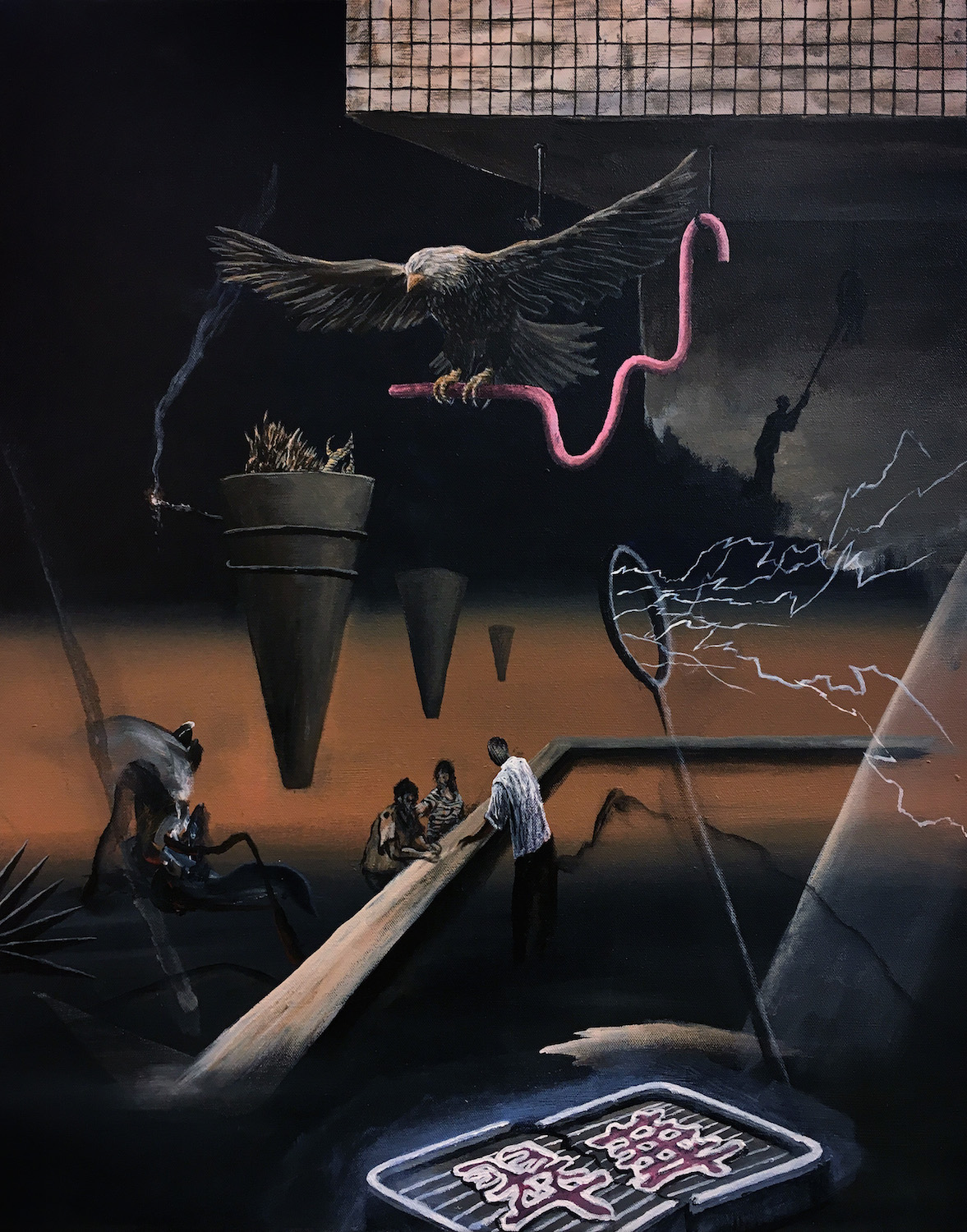
Esmond Loh
Acrylic on canvas, 75 x 60 cm
Clare: Do you collect reference images from the various inspiration sources you mention or do paint from memory?
Esmond: I do save the pictures that I like on Instagram and I take photos of artworks and things that inspire me. However, they are not necessarily “reference” images, in the sense that I very seldom refer to them when I paint. Referring to an image can stifle my imagination and my willingness to accept mistakes. Therefore, I prefer to work directly from my head. When I am not painting, I study my images to get inspiration and build my visual vocabulary.
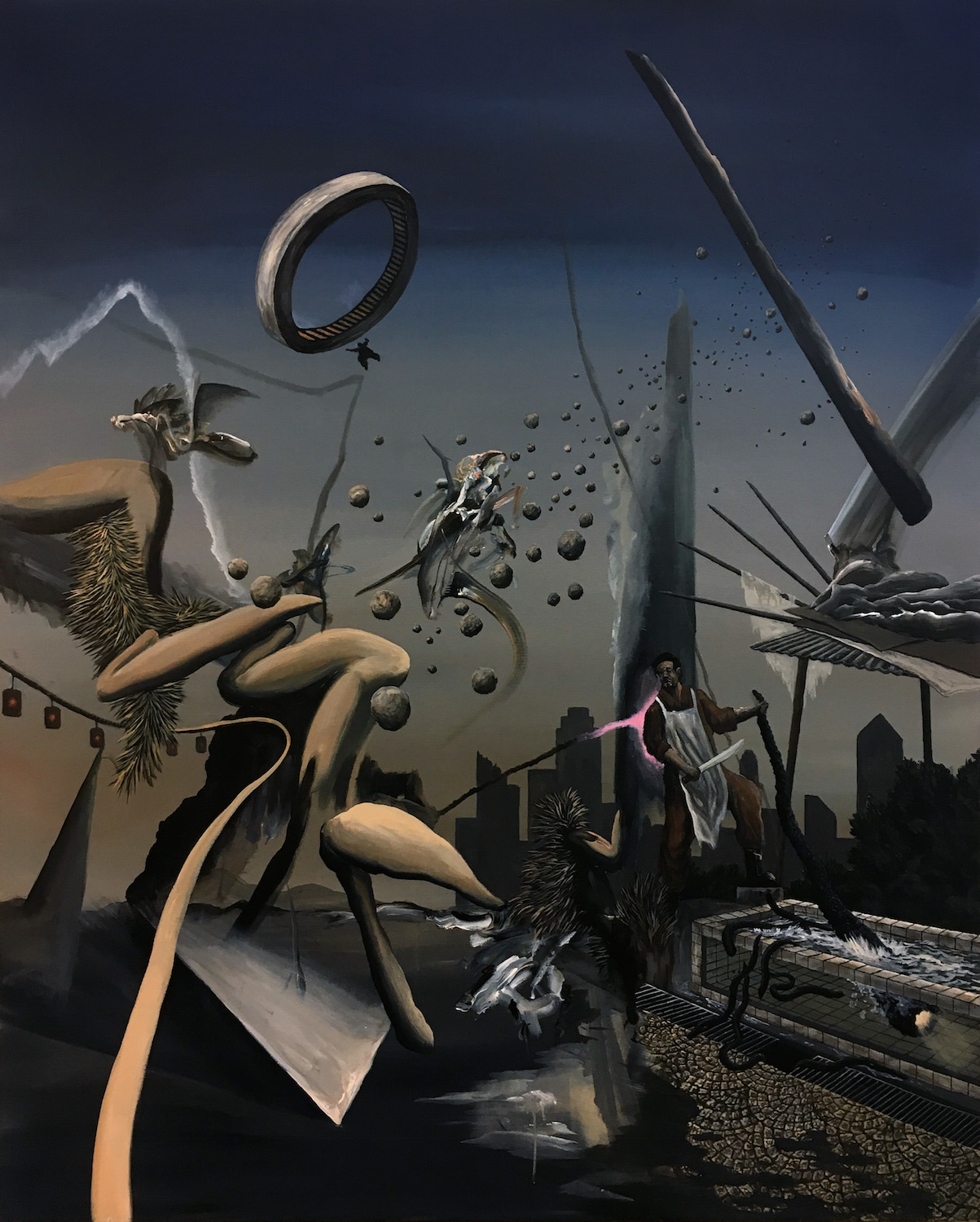
Esmond Loh
Acrylic on canvas, 152 x 122 cm
Clare: Do you maintain a practice of sketching? If so, what materials do you use?
Esmond: Esmond: I sketch only once in a while. I sometimes use graphite pencils, but I enjoy using black marker pens the most. With ink, I know I have very little room for error. This forces me to pay closer attention to my subject. The pens I currently use are the Copic Multiliner and the Staedtler Pigment Liner
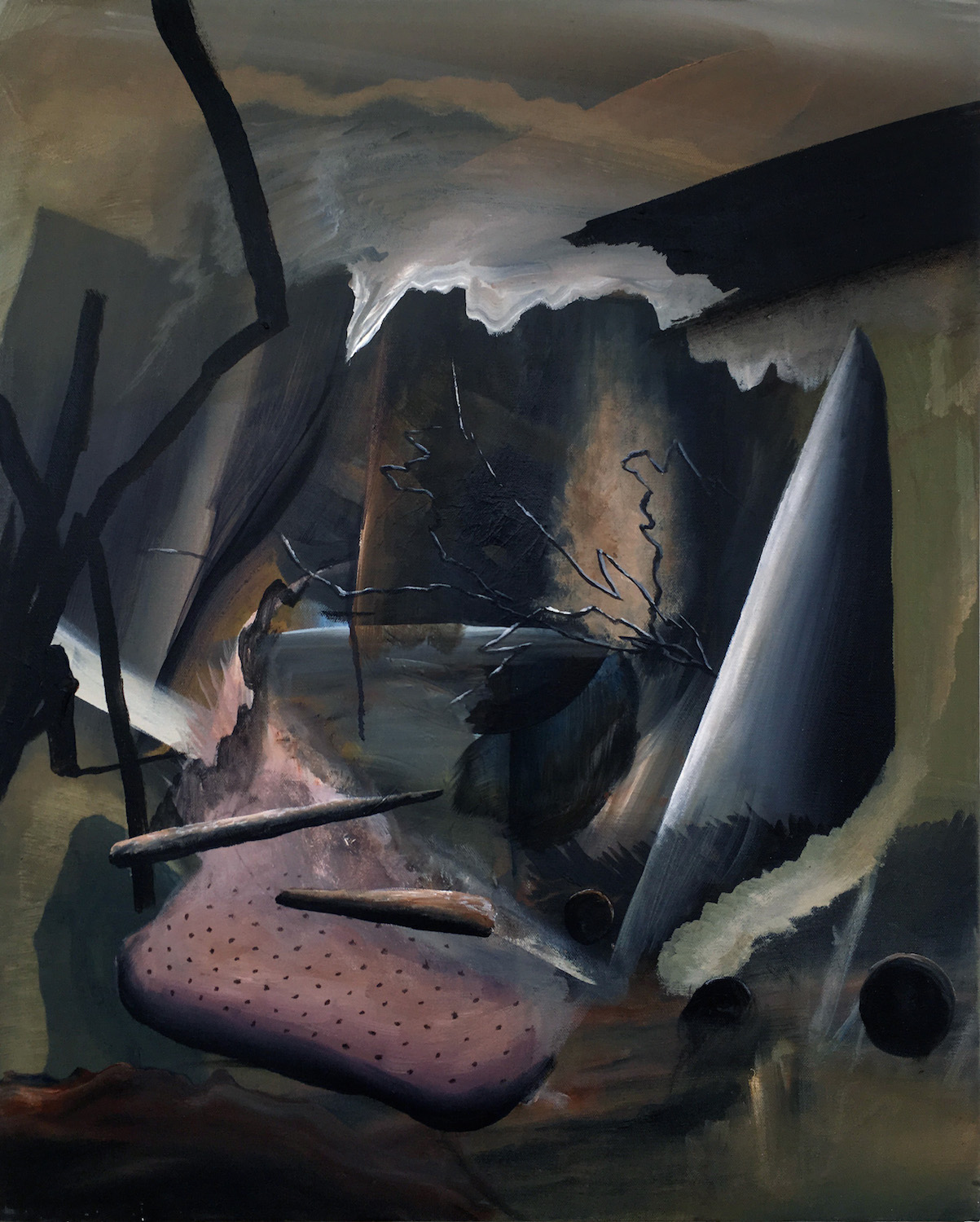
Esmond Loh
Acrylic on canvas, 75 x 60 cm
Clare: What are your most important artist’s tools? Do you have any favourites?
Esmond: A good stretched canvas, good synthetic paintbrushes, decent paint, and a small bucket of water are the essentials. If my canvas is not stretched, then a hammer, a pair of canvas pliers, and a staple gun are also crucial.
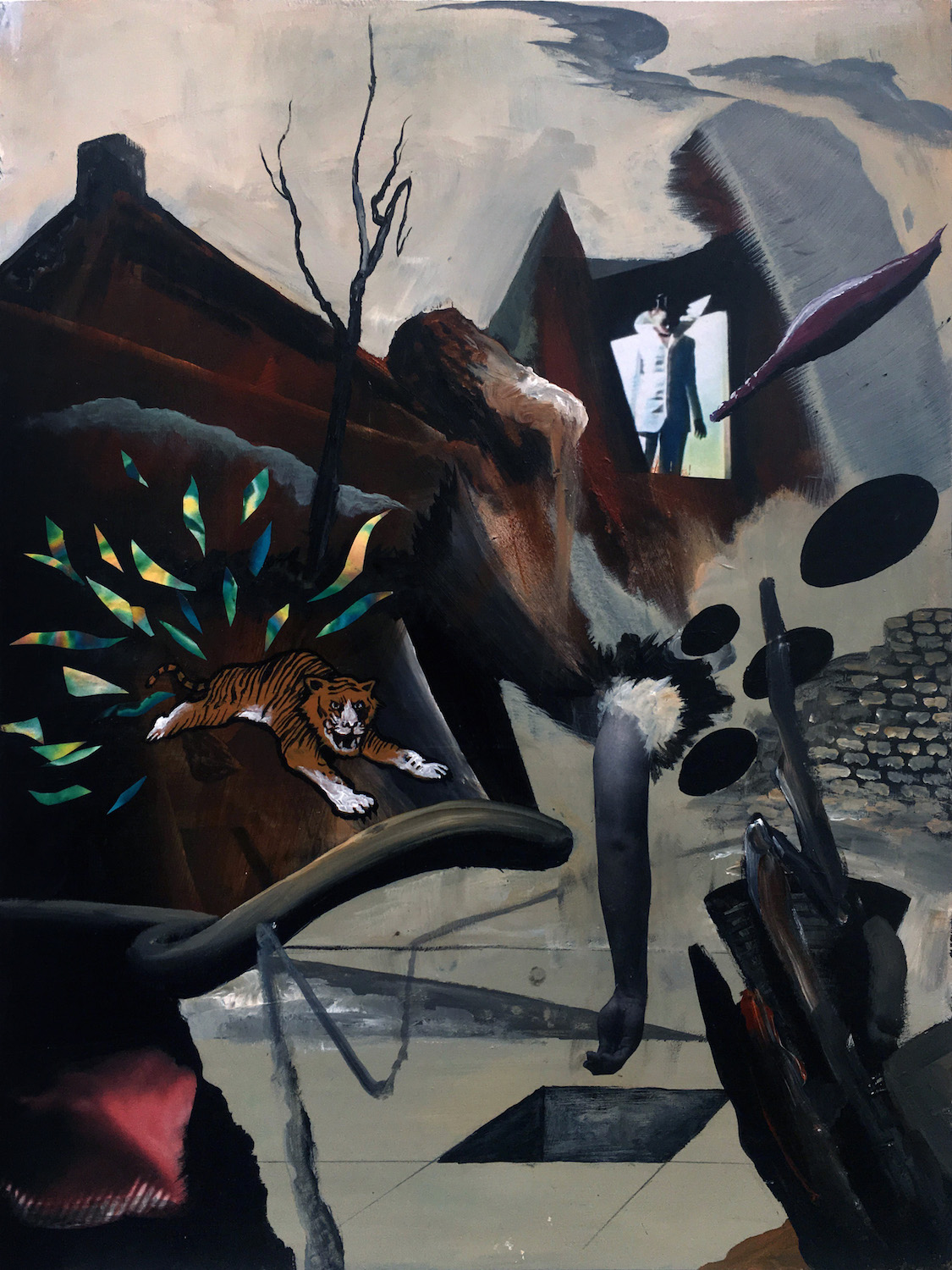
Esmond Loh
Acrylic, graphite and collage on wood, 70 x 50 cm
Clare: What makes a good day in the studio for you?
Esmond: When I manage to stay focused and be productive. That is a good day in the studio.

Clare: What are your art influences? Who are your favourite contemporary artists (or filmmakers)?
Esmond: My influences are always changing. In terms of movements and styles – Surrealism, Formalism, and Brutalism. For artists, Edward Hopper has always been a favourite. More recently, I started studying the works of German painter Neo Rauch, Chinese painters Zhong Biao and Zhang Yingnan, and the Chinese photography duo Li Yu and Liu Bo.
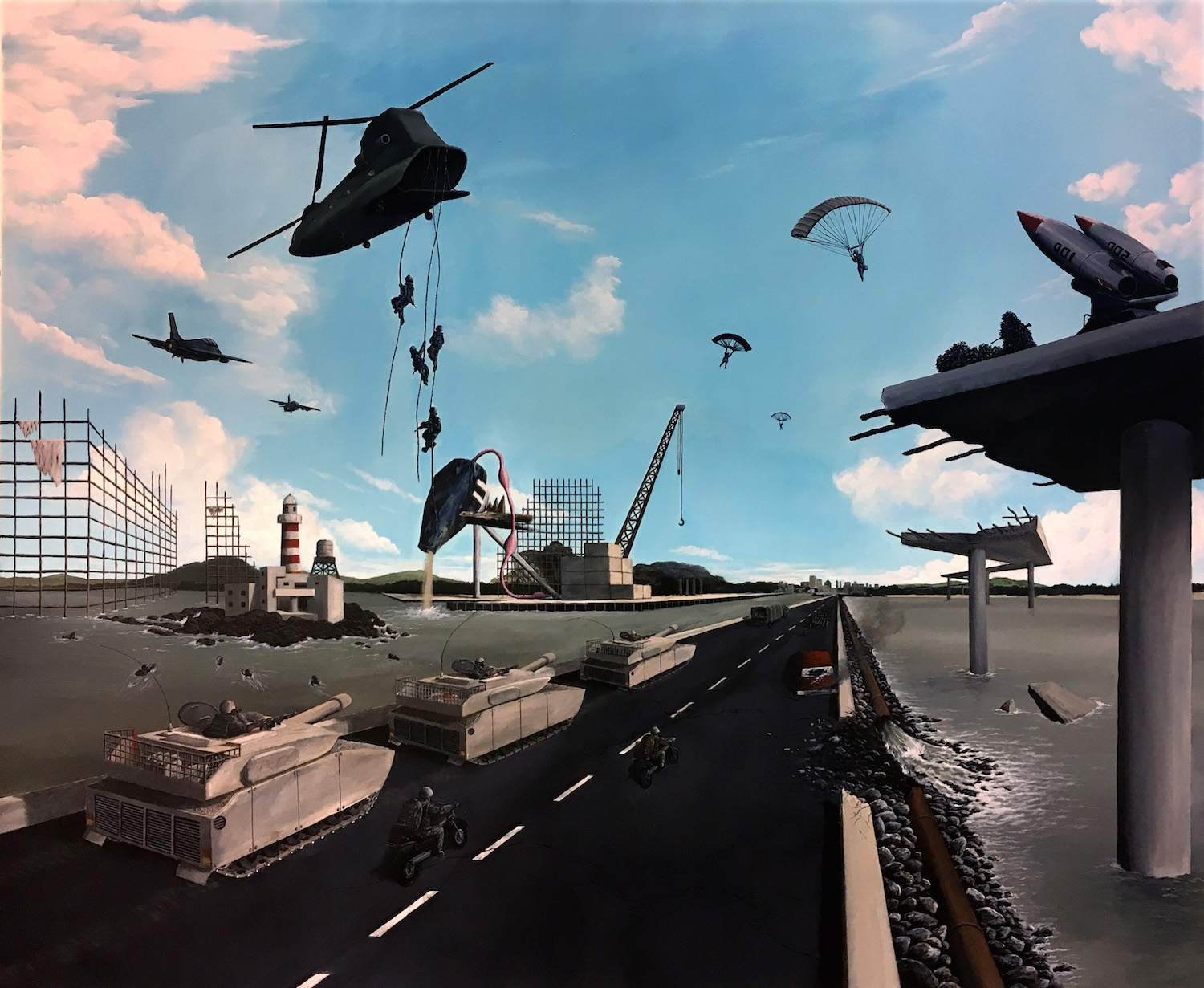
Esmond Loh
Acrylic on canvas, 160 x 190 cm
Clare: In the studio – music, audiobook, podcast, Radio 4 or silence?
Esmond: It used to just be silence. Now it’s either music or audios of debates, speeches, and documentaries.
Clare: What is coming up next for you and where can we see more of your art in the flesh or online?
Esmond: Recently, I have taken a break from my painting practice to focus on a side project that I have been working on. More than a hundred black and white ink drawings about my experience in the military, done over the last six years, were put together into a book titled ‘Serve And F_______’. The book was published in Singapore just a month ago.
As for my paintings, I have no big plans except to continue working in my home studio. I have no upcoming exhibitions but I do have some paintings that are available for viewing at my gallery, Chan + Hori Contemporary, in Singapore. Online, you can see them at my website www.esmondloh.wixsite.com/fineart or on my Instagram account @esmondloh.