



Gouache is a versatile, quick drying, water-medium paint, originally created to dry to an opaque finish and provide matte, flat, highly pigmented colour straight out the tube. It can be easily diluted to function like a watercolour paint but gouache has its own specific advantages: the ratio of pigment to binder is usually much higher than it is in watercolour, providing much stronger colour pay off for relatively little product used, and usually also contains chalk to increase its opaque finish. This opacity is similar to acrylic paint, however they dry down differently. Acrylic will leave a sheen depending how much water it is mixed with (the more water the less sheen), whereas gouache will always dry matte regardless of water quantity. Perhaps the only functional drawback of the medium is that when wetted the tone of the paint can appear different once it fully dries down. This can be easily combated since it’s quick drying time allows for layering, and the paint itself can be reactivated with water after drying.
Established in Korea in 1967 the ShinHan brand carries the slogan “Passionate Colour, Professional Touch” and after testing out the Professional Designers Gouache, I can confidently ensure that this product exemplifies their slogan. The colours I selected from their range to test – Carmine, Scarlet Red, Permanent Yellow Orange, Permanent Yellow, Permanent Green Light, Viridian, Turquoise Blue, Ultramarine Light, Violet, Burnt Sienna, Ivory Black and Permanent White – provided a flexible and vibrant palette although only a small sample of the 72 tube range. I tried a variety of application methods to test the full scope of the paints, which I’ll describe here in greater detail.
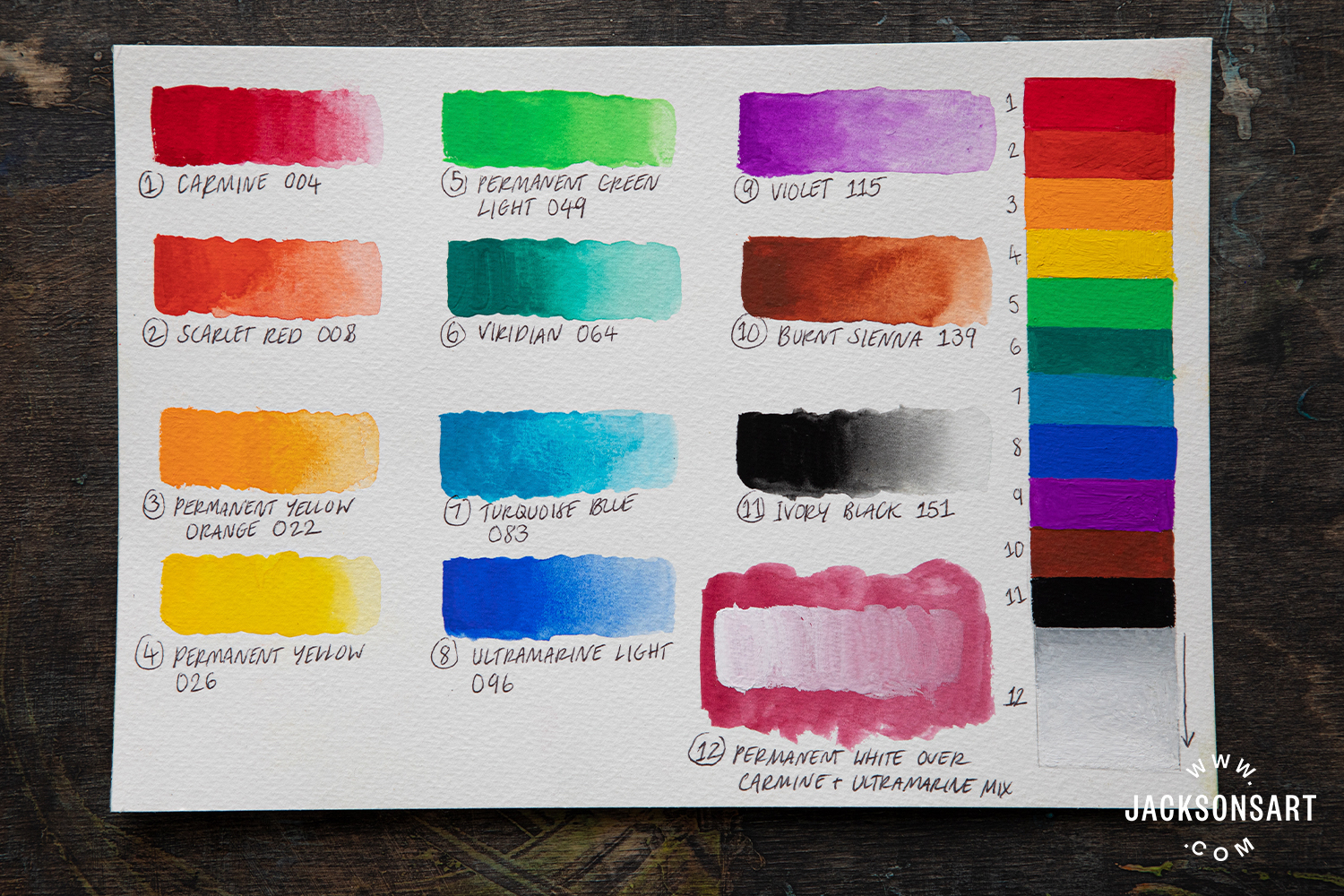
Pigmentation and Finish
To start, I swatched all of the selected colours with water (listed with their shade names on the left), and opaque from the tube (the column on the right). Overall this is a very warm palette, where both of the blues are even warm toned. This isn’t inherently a problem since all of these colours can be mixed to have cooler tones, but the fresh out the tube palette I chose may have benefitted from the addition of a couple of cooler options such as a Raw Umber or Prussian Blue for the sake of variety. All of the colours dried vibrantly and completely opaque with one coat, which is a testament to the quality of pigment ShinHan gouache contains.

Layering and Mixing
The inclusion of an Ivory Black and Permanent White in my palette allowed for tints and shades to be created with ease. On my second test sheet I experimented with these mixed with my two favourite colours in the batch; Violet and Ultramarine Light. Due to it’s quick dry time gouache can be easily layered to various effects, and here you can see I tested Violet with Ultramarine washed on top, Violet and Ultramarine mixed, and Ultramarine with Violet layered on top. Each strip has a different finish despite only using two tubes, showing how a variety of applications can make all the difference with this medium. I then tested a scale of tints using the Permanent White with both colours and a smaller scale of shades with the Ivory Black. These experiments all mixed beautifully with little effort to combine the pigment. Finally, for this sheet I decided to test a wash of the white and black over the already dried colour, which gave a more dynamic effect than the pre-mixed tints and shades.
An observation I made at this stage at this stage was how quickly my water became dirty. Due to the high pigmentation of a small amount of paint, every wash will dirty your water rapidly. If you’re looking to achieve very clean or light colours you’ll probably end up changing your water often. I would recommend working with two jars of water with this gouache to ease this issue – one being dirty for rinsing off colour, and a cleaner one for adding water to the paint.

Gouache with Mixed Media
Another benefit of gouache is that it can be used easily alongside other media, such as watercolour, acrylic, ink, pen, coloured pencil and graphite to name a few. I made a sample here of some of these combinations to show how they hold up on top of the ShinHan gouache. My favourite of the batch was the coloured pencils, since the chalky consistency of the gouache underneath gave it a finish similar to oil pastel.
Studies for Gouache Painting Techniques
Next I painted a couple of studies using the wider palette and a variety of brushstrokes and layering of colours. Gouache can sometimes be pigeon-holed as a designer’s medium, when in practice it has a much wider variety of function as we can see in these quick examples.

For the first study (on the left), I painted the hand in layers of light washes. This can have a subtle, luminous finish if the paper is allowed to shine through. I then blocked in the background colour and layered the red pattern on top. The pigmentation allowed me to decide how much blue I wanted to show through the red with one coat depending how much water I used. This control is satisfying to work with, and is evidence of the quality of pigment ShinHan gouache contains. Next I experimented with a wash of colour over the dried hand to make a shadow. Unlike using acrylic where a wash would not reactivate the paint below, I found that the gouache shifted immediately on contact with the water. With a light touch this movement is minimal, but if you wanted to fully preserve the work below I wouldn’t recommend this technique with gouache. Lastly I added some hatching to the hand using a thin brush, and enjoyed the effect of the drawn line against the wash below.
For the second study (on the right) I wanted to test blocking in the colour opaque. I tried to emphasise the brushstrokes to see how visible they’d be once dry, and they held up nicely. For the sheet underneath this hand, I allowed the colour to naturally bleed into a wash of water. I especially like how this turned out in the top left corner where it dispersed glowingly. Finally, on the top right of this painting I tested wiping away the paint once it dried down with a clean brush with water on it. This is how I created the lighter sphere above the fingers, and think this is a lovely technique for creating subtle highlights, although it would be difficult to wipe it past this tone without damaging the surface of the paper. Hopefully these simple studies convey a few techniques the ShinHan gouache can be used with.
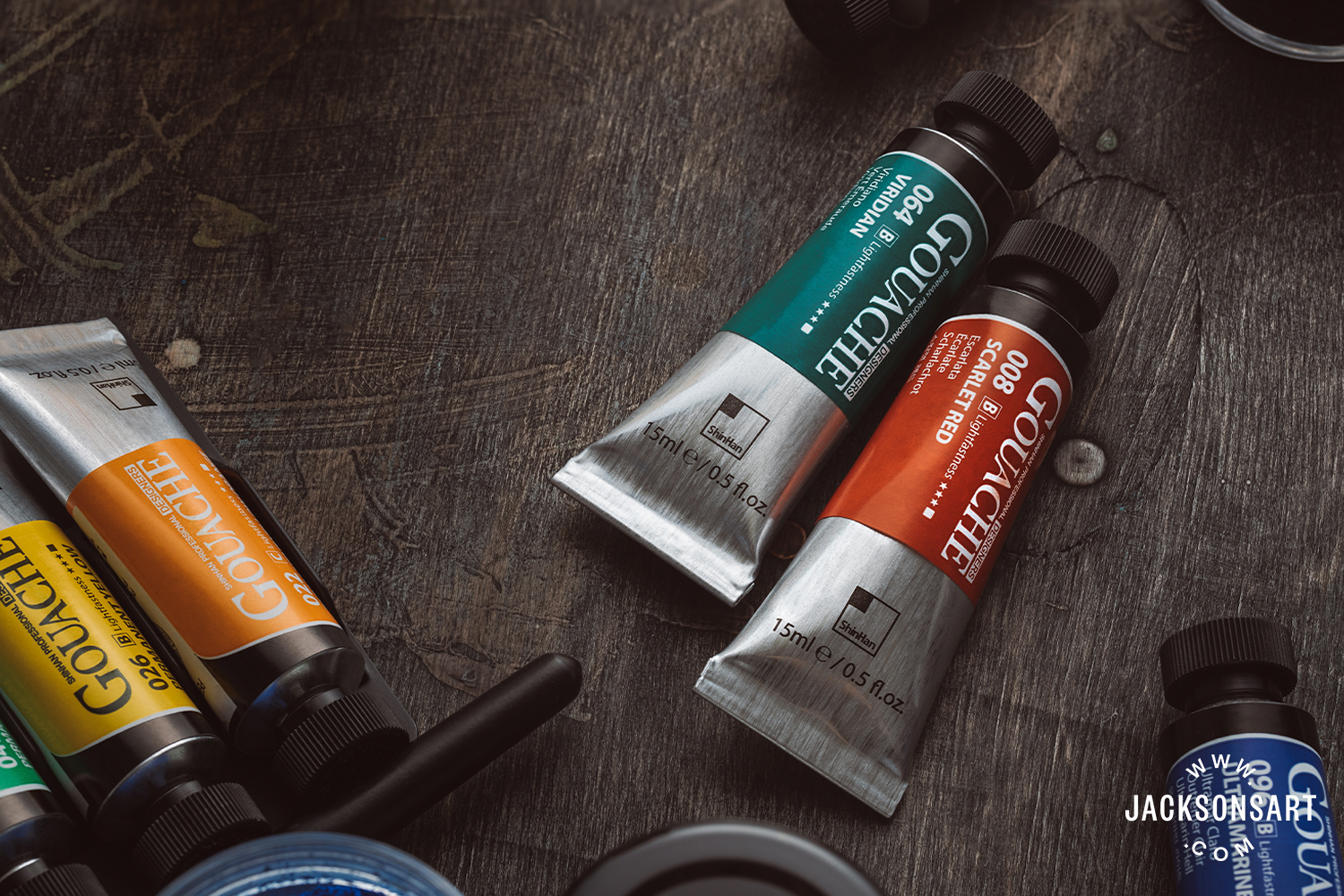
Aside from the quality of the paint itself, the box sets of the ShinHan Professional Designers Gouache are clean and functional, although not as portable as pans of gouache. The inside of the lids are printed with the full list of shades available in the range (a massive 72), which is a helpful addition if you’re already familiar with artist’s colours to see which ones you could supplement this base collection with. If not, this list isn’t so helpful, and would maybe have benefitted from colour swatches printed in a leaflet. Without a box set, the individual tubes are easy to choose from on the Jackson’s shop as they’re photographed with a sample shade for ease of selection.
In terms of value per tube each contains 15 ml of paint which is on the relatively smaller side compared to the fluid volume in other available brands. However, this does make the paints small enough to throw in a pencil case, and the colour pay off is so rich, greater quantities aren’t absolutely necessary. Saying that, if you’re embarking on a large-scale project, this may not be the set for you when there are larger tubes available. With these colours you are essentially paying for the quality of pigment at a reasonable price, not quantity, and that choice depends on your personal priority.

This gouache will perform best on a watercolour or higher gsm paper. All of my test sheets are painted on the Jackson’s Watercolour Block 7 x 10 in cold pressed 300 gsm sheets, and at this weight of paper they curl very slightly under the paint. This could be helped by stretching the paper with gummed tape, but a much lower weight of paper would definitely distort, especially if using a lot of water. Additionally, in terms of clean up, gouache is exceptionally easy to rinse out of brushes with water alone.
Overall, the ShinHan Professional Designers Gouache range provides a flexible palette with excellent quality of pigmentation. Though the tube size is relatively smaller compared to other brands, very little product goes a long way. I’d recommend them to anyone looking for a good quality brand for a curious first attempt at the medium, and to anyone more familiar with it building their own core palette.
5 thoughts on “Review of ShinHan Professional Designers Gouache”
Does gouache “usually contain chalk to
increase its opaque finish” or is this
something cheaper brands do in place of
using more pigment? To my knowledge (and
I did quite some research on this) premium
brands of gouache such as Schminke
Horadam and M.Graham do not add chalk to
any of their colours. It would be helpful to
know if Shinhan use chalk as a bulking and
opacity agent and how this brand performs
compared to the Schminke Horadam.
“Fillers” get such a bad rap. Gouache is
just opaque watercolor: this opacity can
come from either added minerals (ie
chalk or blanc fixe) or extra pigment.
The latter is uncommon (though
Schminke & M Graham are examples).
“Designer” gouache is what the name
implies & wasn’t formulated for fine art,
but just look at W&N’s Designer
Gouache: excellent quality, longtime
favorite of many artists. Chalk (etc.)
also improves the consistency &
performance of many pigments,
brightening some & making others
simply manageable (like phthalos).
Boasting about purity is just advertising;
if you like the opacity & matte finish of
gouache, there is no benefit to ruling a
paint out based on composition alone.
Hi Alma
Years ago I asked Winsor and Newton what made their Designers Gouache opaque and they said they do not use chalk, only pigment. I didn’t expect that answer.
I am Reeta Lambert.! Painted for many
years, also taught, On- Glaze Enamel and
presented a Christening Doll ( completely
hand made and painted the Porcelain parts
myself, to Princess Diana in 1988!, Brigg,
Lincolshire!
The feed back, that I received, was that she
insisted on carrying the Doll on to the plane
herself. Needless to say that I was thrilled!!
I am 84 years old and am still painting in
different mediums.
All Good wishes to those of you, who, like
myself, count the years as “Blessings” and
not Ageing!!
I
That sounds like an amazing art experience!
Thanks for reading!
Comments are closed.