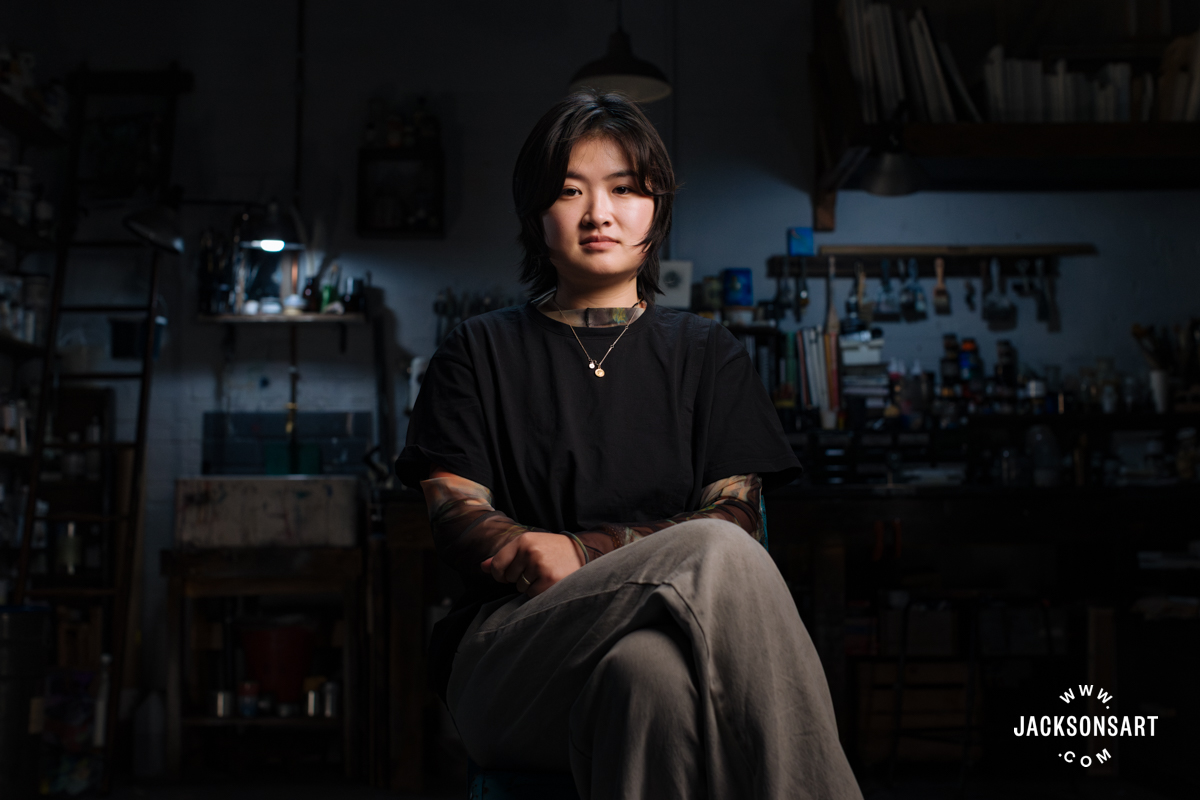
Yiwei Xu is a Chinese-born artist currently based in London. She visited us at Jackson’s Studio to discuss her art practice, her childhood dream of becoming an artist, and the importance of pursuing your calling. Heavily influenced by the transience of nature and the changing seasons, Yiwei uses a palette of rich, saturated colours to capture her emotional response to the world. She conveys the sensuality of the natural environment in soft pastels and oil sticks, abstracting trees and bodies of water with vibrant, organic mark-making.
Contents
0:00 “I am actually immersed in that environment: I am embraced by nature, and healed by nature”
0:32 “The colour you can see in nature is endless”
1:09 “Every time I visit a garden, I feel really alive”
1:21 Introduction
1:42 “When I was very little, I was a huge fan of drawing. I feel like it is part of my instinct”
2:15 “Growing up in China, I got the chance to study traditional Chinese painting”
3:30 “Autumn is one of my favourite seasons; it is so rich in colour”
4:00 “At the beginning of the year, every day is really gloomy. I need to create something really warm and really uplifting”
4:39 “The colour I can’t live without would probably be brilliant orange. It’s so energetic, every time I see it, I can’t resist it”
5:41 “The colour I try to avoid would be white; I need colours with a very strong personality”
6:02 “I sometimes explain my work as abstract work, but actually, I feel like it is also really realistic to my very honest understanding of the subject”
7:22 “Back in my studio, everything feels very different because if I just rely on the memories, something would have changed”
7:51 “I have always had the dream of being an artist”
8:09 “The decision to study fashion design wasn’t 100% my own”
9:15 “If I have so many considerations and so many concerns about what’s going to happen next, I won’t do it”
10:23 “During that process, it also gave me a hint: ‘Yiwei, you’ve got to do something more about fine art’, which is what you really want to do”
11:03 “I use oil pastels and oil bars. I like the urgency of picking up a colour and putting it on top of the paper”
12:35 “Every time I use charcoal, I feel like I’m back to being a cavewoman. I am back to the very original place that I belong to”
13:22 “I used to be told I don’t have a very good sense of colour”
14:36 “Sketchbooks are a free place for me to explore my ideas”
15:35 “After the Royal Drawing School, I decided to be an artist. The first thing I did was find a studio”
16:22 “Before drawing nature, I used to spend a lot of time drawing people”
17:16 “I would stay in the forest all day”
17:59 “Usually, I build up my drawings by starting on coloured paper”
19:25 “I want to make mistakes during the process, and get inspired by those mistakes”
19:36 “I use raw canvas to work with soft pastels. They soak the colour up”
20:50 “Sometimes, I can’t help it, I just add things, and then I realise, ‘Okay, it is overcooked”
21:30 “I take a photograph, and then I use a digital tool. I try to give it a layer of a different colour”
22:00 “I never know if my work is finished”
22:54 “I am not very chaotic, but I am not very neat”
23:47 “When I think, ‘I am going to finish this today’, it sometimes won’t happen”
24:06 “The outside is my studio as well”
24:30 “I use music, and podcasts, and silence. I need all of them for my whole process”
25:27 “Recently, my favourite artist would be Odilon Redon”
27:40 “You have all the abilities, you have all the potential, just follow your heart”
28:27 Credits
Extract
The energy of life can be found easily by wandering in nature or in a city park. Every time I visit the garden, I feel really alive. And I want to express that feeling in my artwork.

Yiwei Xu
Oil bar, soft pastel and oil pastel on paper, 70 cm x 100 cm | 27.6 x 39.4 in
The colours you can see in nature are endless. I have always found it really inspiring just to look at the trees, the branches, or the foliage – everything is happening at the same time. You can feel the wind, the temperature, and the heat from the sun; it’s changing all the time. The colour has its own energy, which I would like to bring together – my artwork needs to celebrate the energy of life. I want to create a sense of immersion, to feel really small, as though I am just among it, and to imagine I’m one of the tree branches or a little piece of leaf.
I’m Yiwei Xu. I’m an artist, and I also teach children’s drawing, and I’m here in the Jackson’s Studio to talk about my practice.

I was born in a relatively small city in China, in Jiangsu Province, which is called Xuzhou. When I was little, I was a huge fan of drawing.

I feel like it’s part of my instinct because my grandpa is a professor and he always had lots of waste paper essays. So I could use the other side of the paper, which was blank. I could spend a whole day with those very simple drawing materials, such as pencils, coloured pencils, and the back of the paper.

In China, one of the things I love most is that I had the chance to study under a traditional Chinese painting artist. I don’t know why my parents sent me to learn traditional Chinese painting. When I started to do more of my own practice, I found the rule of the sense of space is actually quite limited. Asian Chinese painters, they use the long scroll format to compose different sections of the landscape together. So when you are actually looking at the painting, you’ve got to get very close to it and then move alongside the composition horizontally. And that is the way of simulating the feeling of actually visiting that place.

Yiwei Xu
Soft pastel, oil pastel on paper, 35 x 100 cm | 13.8 x 38.4 in
My palette could be described as really autumnal. Autumn is one of my favourite seasons – it’s so rich in colour, and it’s like you can feel the passage of time as well. I think my colour palette is influenced a lot by the seasons; as I walk around outside, I respond to the colours around me in very vibrant, saturated colours. Because no matter whether it is summertime, spring, autumn, or winter, I would like to use the colour not just from reality but also my emotions.

Yiwei Xu
Mixed media on wood panel, 20.3 x 25.4 | 8 x 10 in
At the beginning of the year, that period of time, it feels so long. Every day is really gloomy. And I just feel like I need to create something really warm and really uplifting. Even though it’s quite cold in my studio, I start to use lots of warm colours. Like oranges and also the very bright Lemon Yellow. And I tried to create my own light source in my studio.

The colour I can’t live without is Brilliant Orange. It’s so energetic, every time I see it, I can’t resist it. Sometimes I use a layer of very bright orange as the colour ground for my work. It has a really nice effect; when I give it another layer of, for example, purple or a dark bluish colour – between the brushstrokes or in between the marks, the orange will come through.

Yiwei Xu
Oil bar, soft pastel and charcoal on paper, 70 x 100 cm | 27.5 x 39.4 in
Being an artist, my parents wanted to be very supportive emotionally. But actually, they told me that you need to survive in society, to maybe choose something more practical, so you can find a job and earn money. But I still really wanted to do something related to art or design. So I decided to study art during my high school years, and I spent two years studying drawing and painting very intensively during that time.

I then decided to go to a university that is really famous for fashion design in China, in Shanghai. It was highly competitive to get in, so I was proud of myself, but the decision to study fashion design wasn’t 100% my own decision. That was also partly my parents’ decision.

Yiwei Xu
Monotype and Soft Pastel on Paper, 29.5 x 21cm | 11.6 x 8.25 in
At first, I was quite shocked because I had no idea how to make costumes, how to actually measure the figure of the model, but I did love fashion illustrations. That was one of my favourite classes during my time at university. I was also working for one of my tutors at the same time. She was very supportive and gave me a lot of opportunities to draw illustrations for the fashion collections.

I spent a lot of time drawing fashion illustrations, and I did lots of research about the international fashion illustrators as well. During this time of studying fashion design, I started to explore and get closer to what I really want to do, which was more about drawing and painting.

What are the natural forms of abstraction? In a way, I think form and abstraction sound like a very difficult thing to think about. But I would like to think about it in a simple way. Like every time I observe the natural forms, for example, I’m looking at a fig tree in front of me, and somehow the tree branches itself, they have really interesting forms. They crawl around each other, and then they get very busy, growing together, especially the fig tree that is quite old. And in a way, the form itself is quite abstract. And I would like to be very, very honest with what I can see. And I think that is the way I understand the subject in front of me.

Yiwei Xu
Monotype and soft pastel on paper, 28.5 x 20.5 cm | 11.2 x 8 in
I think being honest is one of the biggest ways to create or connect with abstraction. Because I see the branches abstractly, that impacts my final artwork. So I sometimes explain my artwork as abstraction, but actually, I feel like it is my honest understanding of the subject.

There are also so many conditions affecting the way I look. Because I do lots of observational drawings outside, the lighting changes all the time, and sometimes you’re surrounded by a lot of people. I did a drawing by the fig tree in St. James’s Park. It’s a very beautiful tree, almost like one of the busiest tourist attractions in London, so I was surrounded by lots of visitors and constant noise. That affected the way I looked at and did the observational drawing, because everything felt busy and noisy. The branches in front of me also had a kind of similar form, and I think that’s how I translated my emotions and observations at that moment, very straightforwardly, into my sketchbook.

Yiwei Xu
Soft pastel, gouache on khadi paper 21 x 29.7 cm | 8.25 x 11.7 in
And then I bring my sketchbook back to my studio. So I try to recall not just the trees, but also the whole environment that surrounded me. It’s like a four-dimensional experience or memory that I bring back to my studio. So I think that is the reason why I translate the form into a more abstract way.

After I finished my degree at university, I started to learn more about what I wanted to achieve, so I changed my direction to illustration. I did some research about studying an MA in illustration, not just in China, but abroad as well. I thought that UAL Camberwell College of Arts would be a nice choice for me to continue my studies. It was a wise decision because I met a lot of very talented classmates. And I think it definitely expanded my vision very widely, very strongly.

When I arrived in London, I gradually started to get used to living here, studying, and get used to speaking in a different language. I think it’s also a privilege to have the experience of living in my hometown in China, and also to have the opportunity to live in Western countries. I feel like I’ve got something over there and something here, Eastern and Western, and I’m just standing in the middle of it, able to mix them however I want. So I think that’s a really important experience for me, for my practice as well.

I use soft pastels and oil sticks a lot because I love colour. And with those materials, you don’t really need to blend the colour beforehand; you can use the colour straight away. I particularly like Sennelier Soft Pastels because the colours are vibrant, as well as Royal Talens Rembrandt Soft Pastels and Inscribe Soft Pastels, because they are harder, so it’s easy to carry them outside for sketching. I also have a lot of Jackson’s Handmade Soft Pastels, as they are chunkier than the Sennelier, which means it’s not easy to break them into pieces.

And I love to use oil bars or oil sticks because they break the boundary between drawing and painting. Oil bars also allow me to make marks and textures in a different way because they are very thick and greasy. I love to apply a thick layer of oil bar, wait for it to dry, and then give it another layer so you can actually scratch out some of the areas, and you can see what’s underneath.

I love to use charcoal because it’s a very versatile drawing material. Sometimes I just use the charcoal to create very bold lines and the form of the subject, and I can also kind of smudge it. And I love to use charcoal to create a messy ground on the paper. It’s really easy to carry around as well.

Whilst I was studying in Camberwell, I got the chance to learn about the Royal Drawing School, located in Shoreditch. They offer free places for students in their print room, because I was a big fan of etching back then. So I got the opportunity to visit their drawing school, and I also took part in some of their public courses as well. By the time I stepped into their studio, I was like, “Oh my god, that’s my dream place. I want to be here so much.” And then I noticed, okay, they offer a place for the student who wants to really focus on drawing. They have lots of different approaches based on observational drawing, so I decided to apply to The Drawing Year.

I was offered a place to study on The Drawing Year, and it allowed me to conquer one of my biggest fears – using colour. I took all of the classes that related to colour. My tutor told me that colour is actually a very personal thing; everybody feels colour differently and even the emotions you have at the moment will affect the way that you see the colour. So there are no standards to kind of limit my understanding, and it actually would be normal for me to see lots of different colours, like, different from other people. So I felt like, okay, I am ready to use colour. And that is one of the biggest achievements I’ve got from the drawing school.

Yiwei Xu
Mixed media on paper, 140 cm x 75 cm | 55.2 x 29.5 in
The sketchbook is a free place for me to explore my ideas. So, it’s not just like a recording, what I’m looking at, what I see, but also it’s a place, it’s like a playground, I can mix different materials. I try to explore as many materials or different ways of working as I can. So, sometimes I use a layer of gesso to create a texture on top of the paper. And sometimes I will blend the gesso with coloured acrylic so I can get a colored ground on the paper as well. And then I will use another colour of soft pastel or drawing materials on top of the coloured paper to see what kind of effects I will get.

So, I guess the sketchbook would be like an experimental laboratory, and then every time I look back at the sketchbook, I get some inspiration. I will then bring those techniques to my studio work as well – it’s very strongly connected. I also take photos with my camera and with my phone. Sometimes it’s much quicker and easier to use the phone or the camera to catch some details.

After finishing The Drawing Year, I decided to be an artist. The very first thing I did was find a studio with my classmates. I am an artist; I have a place to do my work, and I’m also involved in the artist community, as I think that’s really important.

The subject matter that I want to solve or I want to achieve for my artist practice is the exploration of nature. This all began with the pandemic. During the lockdown, a walk was an important part of my daily routine. Every time I step into the green area, I feel like, okay, I switched mood from anxiety to a very relaxing mood. I’ve started to realise that nature is very important to me.

So I started to draw trees during that time, a lot of trees. And I love to draw the trees at night because they look so different with artificial lights, like street lamps, you can see the different character of nature as well. I wanted to express my appreciation of healing by nature, and also it’s very easy to access as well, to escape from the hustle and bustle of the city world. So I started to explore the gardens in Greenwich Park, Regent’s Park, St James Park, all of the big, beautiful parks in London.

And you get to see lots of different stories in the park as well. For example, there are so many old trees, like 300-year-old oak trees in Greenwich Park. And you can basically see the passing of time, even though some of the trees are dead already. But you can still see the beauty of life, even in the bark. There are so many different beautiful textures and flows over the tree trunk and the tree bark. So the more I explore the park, the more I can find my inspirations, and it’s really uplifting.

Yiwei Xu
Soft pastel on paper, 28 x 14 cm | 11 x 5.5 in
It’s like a visual vocabulary for my practice, to be honest. And I can see lots of different colours, even when standing in front of one tree trunk. So yeah, I think my practice started with exploring the smaller city, the garden, the city park, and the community park. And then it became like a bigger park, and then it started to expand into a more natural environment or natural landscape.

Yiwei Xu
Mixed media, 60 x 61 cm | 23.6 x 24 in
A very helpful method to get into the mindset ready to start is to do some warm-ups beforehand. Either in the studio or outside, I like to do some blind drawings, which means I close my eyes and just draw some marks. I listen to the environment, and I try to reflect those sounds by just using simple materials like charcoal on a piece of paper. There’s no right or wrong in doing it; it’s like a meditation, and it helps me to really connect to the environment physically.

I love to work on papers. I particularly like printmaking papers because they’re usually thick, and you can be really rough with them because they are really good with water. Sometimes I’ll draw with oil stick, but I will give the paper a layer of gesso to protect it from the oil. I like watercolour paper as well – I tend to prefer a rougher texture.

Yiwei Xu
Monotype and soft pastel on paper, 29.5 x 20.5 cm | 11.6 x 8 in
I also use raw canvas to work with soft pastels and charcoal. And it seems like a really lovely effect it creates together, because it brings up the blurry kind of vague sense or effect of the soft pastels a lot. And every time I smudge the dust into the fabric, it kind of soaks the colour in rather than just staying on the layer of it. But the only thing on the canvas would be that I have to fix it by the end of it, very carefully and with lots of layers. Otherwise, it won’t stay, like it won’t stick on the canvas as much as stick on the paper.

My studio space is not very spacious, but I’ve got two big plain walls, and I’ve got a storage unit by the side of the window. My studio has a few windows because I think natural light is very, very important for my practice. I normally put several works in progress on the wall, surrounded by the sketches I did outside, along with some drawings and completed pieces, because I keep finding inspiration in those previous works.

Sometimes I listen to music or a podcast. But sometimes I need silence. Especially at the beginning of starting the work, I like to listen to podcasts. Some of my favourites are in Chinese, but they basically talk about art history. I love to listen to the podcasts about Asian Chinese paintings as well.

My typical studio day begins with either coffee or tea. I probably will just have a walk around my studio before I actually start to draw anything. So I would just keep an open mind and see what’s going to happen next, and then I turn on my podcast and then start to draw.

Sometimes the outdoors is my studio as well. I love to spend a whole day outside because there’s so much information I can gather.

Recently, my favourite artists include Odilon Redon, a French artist from the 19th and 20th centuries, and also Mimi Lauter. She’s an American artist who lives in Los Angeles. They both have very rich colour palettes in their artwork. Both of these artists, I think, have a really innocent feeling in their artwork, and they use lots of colours and are also very deeply connected with nature. For example, Redon used lots of, like, flowers and mountains, landscapes, subjects, matter for his artwork.

Yiwei Xu
Soft pastel and gouache on Khadi paper, 21 x 29.7 cm | 8.26 x 11.7 in
Mimi Lauter’s artwork is so striking. The first time I saw her work, I think a couple of years ago, she had her first solo show in London at Whitechapel Gallery. She used soft pastel and oil stick for her artwork, and all her work was on paper.

Yiwei Xu
Soft pastel, gouache on Khadi paper, 21 x 30.5cm | 8.25 x 12 in
Another artist who has really had a profound impact on me is Paul Cezanne, because I feel like he is trying his best to be really honest about what he can see. I just feel like something is linked with my practice as well, and also linked to my understanding of some of the Asian Chinese paintings. So I feel like – how do people, or art, manage to depict a sense of change, or capture something so pure and realistic – a true reflection of what we see and observe?

Yiwei Xu
Monotype and soft pastel on paper, 29.5 x 21 cm | 11.6 x 8.25 in
I remember when I was 10 years old, people would ask what do you want to be in the future, and I answered the question – I shouted out being an artist or being a painter.

I wanted to be a painter without any doubt, and with 100% confidence back then. And I want to let my younger self know to keep that idea, you’ll get there, and maybe you have all the abilities, you have all the potential, just follow your heart. And I know something will sound not very practical, but finding yourself, what you really want to do and want to be, is much more important, and once you’re very determined to do it, you will conquer all the obstacles. So keep going, keep working, don’t be afraid.

Further Reading
Inside the Sketchbook of Yiwei Xu
Using Soft Pastels for Observational Drawing
Developing a Daily Drawing Practice with the Royal Drawing School
Shop Art Materials on jacksonsart.com