



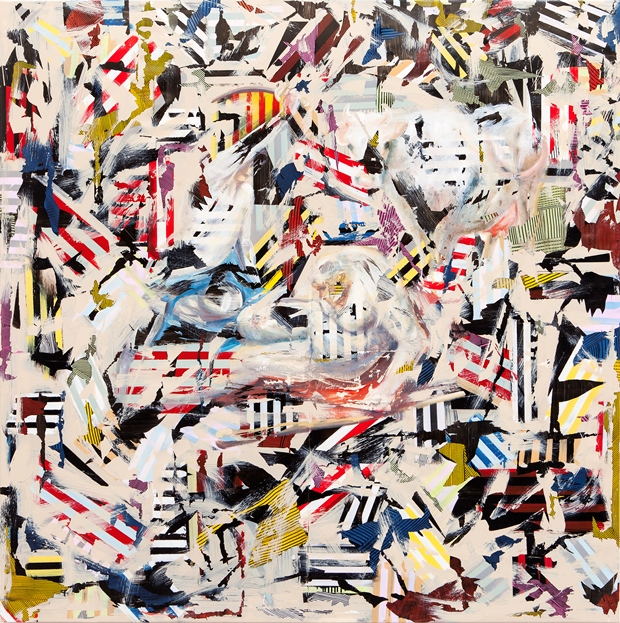
Last year Tina Jenkins won the Threadneedle Prize for Figurative Art for her painting ‘Bed Head’, a painting full of awkward energy, with shocking yellow and black stripes darting across the plastic canvas, splicing into a half present figure, his head a sheet of peeled acrylic painted stripes, hanging from a circular form within the picture. Judges commended the piece on its ‘bold approach to the human form and clever use of material’.We interviewed Tina in the week of her solo show at the Mall Galleries, part of her Threadneedle Prize.

Lisa: You have described your process of painting as a ‘Hysterical act’. What did you mean by this?
Tina: Its not an easy question to answer partly because the question itself is part of the hysteria I’m talking about. It seems to me that by replaying past gestural motivations in painting in the present the process becomes hysterical. I think this happens because the only effective way to replay an action or situation is to completely over identify with it until it becomes your own. The process of doing that renders the process and the result of that process problematic in that it creates a gap between the artists’ own identity as a painter and the predominantly patriarchal history of painting that the artist is referring to. I need to work through and analyse what’s happening here but the long and short of it is, this seems to be a progressive methodology for painting today.

Lisa: We’re intrigued by the materials you use in your work. What sort of paints do you work with and why do you paint on plastic sheeting instead of canvas?
Tina: At the moment I’m using a combination of acrylics – Daler Rowney, Winsor and Newton and Pip Seymour and a mix of acrylic and oil based household gloss paint. I’m not great at organising myself so I tend to mix all sorts of things together, what ever is literally to hand.
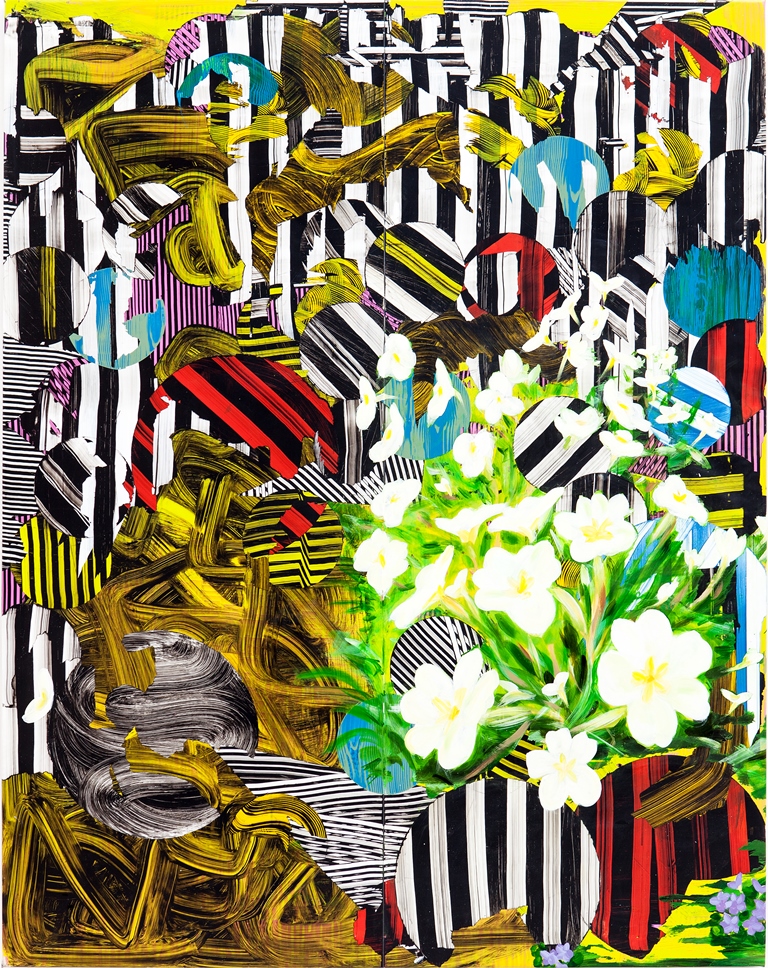
I often ask myself why I paint on plastic, it’s dumb, has a crease like a builders arse and is very problematic but I am able to push my paintings much further on it for example I can completely remove paint from the surface of the painting, I can paint on both sides obtaining a number of different finishes, I can leave parts of the surface transparent, leave paint hanging half on half off and overall I just love the ridiculousness of putting so much work onto something that has no obvious traditional value.

Lisa: Your paintings seem to be aware of the historical context that they are placed in, and for me, when I look at your work I feel it has a bit of a punk aesthetic, it seems to be giving two fingers to the canon of western art history in an attempt to blow it out of the water. Would you agree with this or have I completely got the wrong end of the stick?
Tina: I would totally agree with that although it is just an attempt to blow it out the water nothing more. As painters we all propose to question what it is to paint and seek originality but then we have no choice but to situate ourselves within what is an already approved canon. I like to play around and mess with that canon not because I consider it to be stupid but because it seems like good practice to question authoritative aesthetics and methods.
Lisa: Please can you tell us about your PhD and how it has informed your paintings?
Tina: My Phd is something that comes out of my painting practice not something that informs it, however, that could change in the future, its very early days at the moment having just started it this year but I am finding the process of doing the PhD and the environment I’m doing it in both stimulating and fulfilling.
Lisa: How has winning one of the largest painting prizes in the world affected your work?
Tina: So far it hasn’t, I haven’t had time to stop and think about what I’m doing I’ve just got on with it. Now the show is finally up I’m starting to reflect on what has happened and what I’ve produced and that could have a big affect on how I continue. Winning the prize and the interest in the work in general has been a really positive experience and as such I’ve been able to focus clearly on what I’m trying to do.

Lisa: What is the definition of a successful painting?
Tina: I have no idea. Maybe a painting that’s ahead of itself that continues to improve after its finished, a painting that you can catch up with at some point in the future. I have no way of knowing in the present what a successful work is, I wish I did.
Lisa: Can you describe how you start a painting?
Tina: I usually begin by painting very quickly; I have a compulsion once I start to cover the surface as rapidly as possible. If I have an image, figure or word in my head I’ll get it down straight away, if not I’ll start with a series of abstract marks. Nothing remains intact for long; as soon as the surface is covered I’ll set about destroying the image. As the painting continues it does start to slow down and eventually becomes more considered until the process finally grinds to a halt.
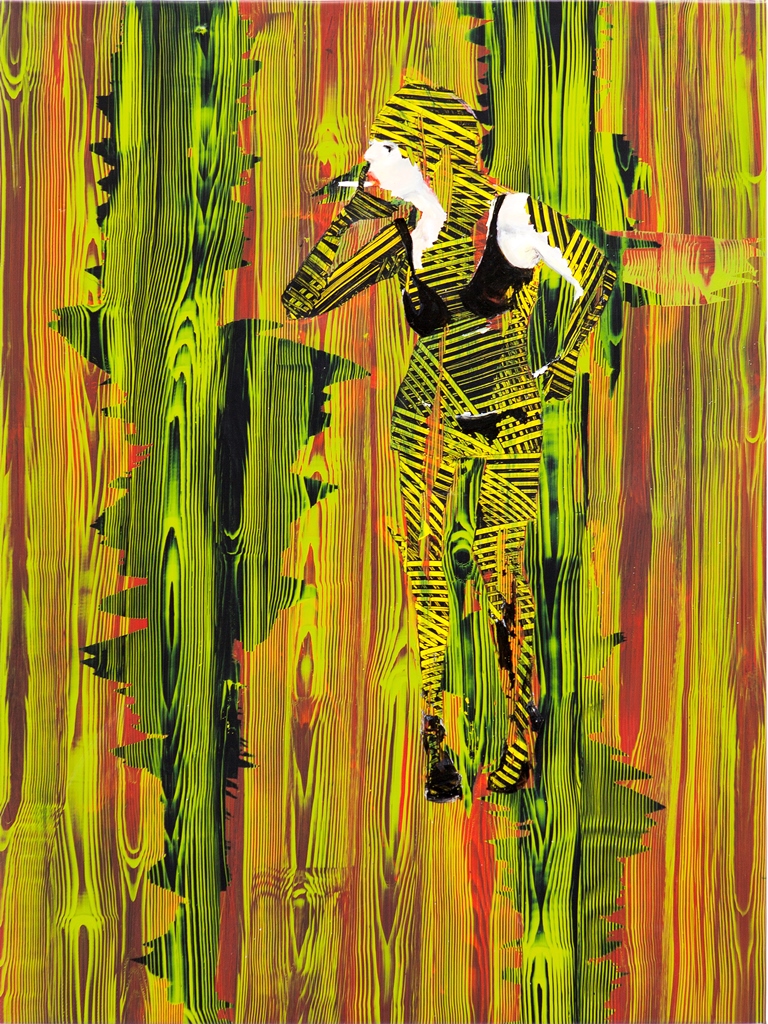
Lisa: What are you exhibiting at your show ‘Hystoria’?
Tina: I’m exhibiting some of the paintings that I’ve been working on over the past 12 months, the majority of which have been painted since I won the Threadneedle prize. They all reflect aspects of the research I am involved with as part of my PhD.
Lisa: Who are you favourite painters?
Tina: My favourite painters changes daily but Dawn Mellor, Jonathan Meese and Dana Shutz are firm favourites this week.
Lisa: Where online or in the flesh can we see more of your work?
Tina: My solo show at the Mall Galleries is on until midday on the 11 April and I have another solo show Transplastic coming up at Cabin Gallery from 8-31st May. I also have a tumblr at http://tinajenkinspaintings.tumblr.com/.
I should get a website up and running soon too so look out for that.

1 thought on “Interview with Tina Jenkins, Winner of the 2014 Threadneedle Prize”
Pingback: Tina Jenkins | Abbie Smith
Comments are closed.