



Cold Wax Painting is a delight for artists who are interested in texture and layering. It means you are painting with an impasto oil paint that is often scraped on, layered and drawn back into. Unlike Encaustic Wax painting you do not need to heat the wax, it comes as a creamy medium that you mix with oil paint or powdered pigment. At Jackson’s we stock five makes of cold wax paste mediums – each made to a different formula. All have beeswax as the main ingredient but each then has either a resin (damar or alkyd), or a solvent (turpentine, citrus or odorless mineral spirits) or both, in different amounts. This means they all perform differently and artists will prefer the one that works best for their particular technique.
As an experienced user of Cold Wax Oil Painting Mediums in her painting practice, we asked Zoë Taylor to give us some feedback on the new Zest-it Cold Wax and Solvent. We wanted to know what characteristics a painter could expect from it and what about it is different to the other makes of cold wax that painters might already be familiar with. Zoë Taylor is a self taught artist who works from a small studio in Worcestershire. Whilst she has always painted, she has only started exhibiting in relatively recent years. She now exhibits widely across the UK and had a very successful solo exhibition last year.
Zest-it Cold Wax, Dorland’s Cold Wax and Gamblin Cold Wax
a review by Zoë Taylor
I use cold wax medium in all my oil paintings. I started by using Gamblin Cold Wax and moved on to Dorland’s Wax. I also paint almost exclusively with tools rather than brushes and this may have a bearing on the results I found with the comparison. When Jackson’s put on their social media that there was a new cold wax supplier on the block, Zest-it Cold Wax, I thought I would give it a go and see what it was like. Jackson’s sent me a small pot of Zest-it Cold Wax together with a small bottle of their Wax solvent.

So this is my impression of the product and comparison with those that I am more familiar with.
Gamblin Cold Wax Medium and Dorland’s Cold Wax Medium are very similar to each other so I was expecting the Zest-it wax to be along similar lines but I was surprised to see that it wasn’t.
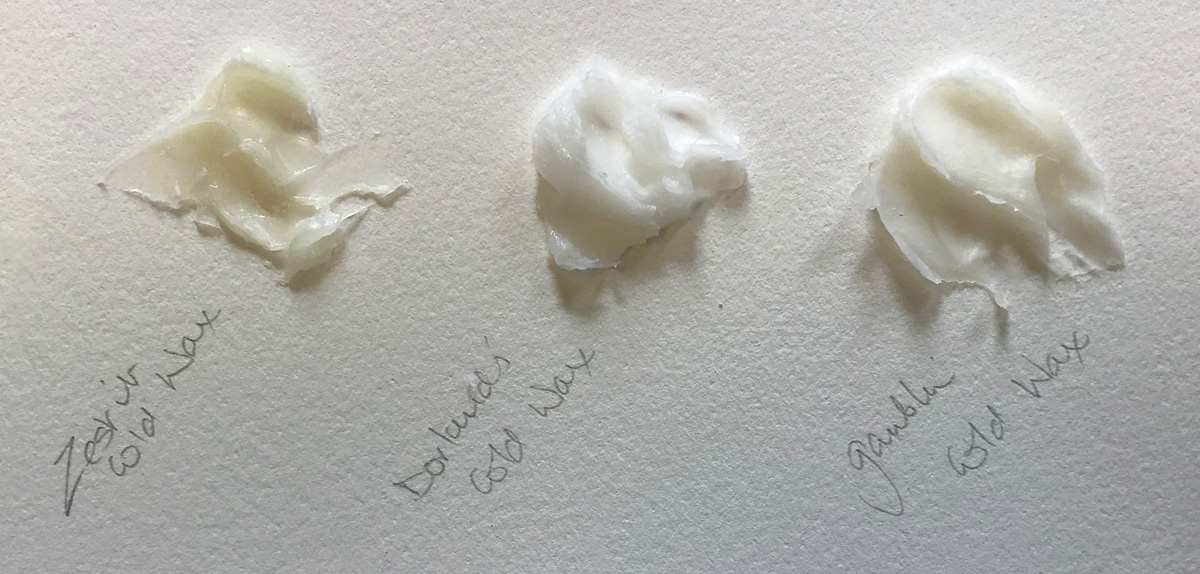
Zest-it Cold wax, Dorland’s Cold Wax and Gamblin Cold Wax
The Zest-it Cold Wax Painting Medium is a much more yellow-coloured product in comparison to the other two. The colour didn’t bother me as you cannot see the colour of the medium when mixed with oil paint. It is much more translucent than the others and has a completely different texture. It’s hard to describe the Cold Wax consistency of Gamblin and Dorlands Wax if you have not come across it before but it is a kind of matt paste which is smooth to spread. The Zest-it Wax has the consistency of petroleum jelly. It is very shiny and appears greasy and somewhat stringy. When you take it out of the pot with a painting knife it is like taking a thick sticky honey out of a jar.
When the Wax is mixed with oil paint you get a very shiny, quite soft result. This is not like the other waxes. I’m used to the wax making the paint thick and quite stiff to use and also to be more matt. So for me and my painting style this was not what I would like to use.
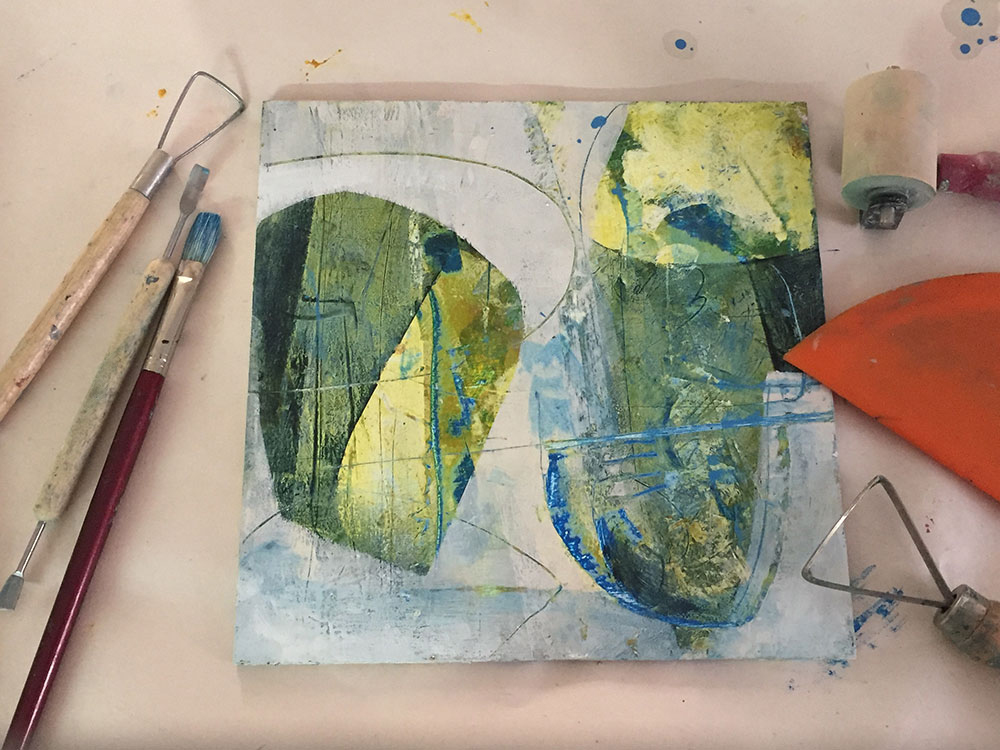
Having said that, I did make a small painting on Arches Oil Paper, just to see how it performed.
The painting finish when it dried was quite nice but more shiny than I would expect from the other waxes. It was just too slick, too shiny and not for me. However, I think that differing painting styles might find a place for this product as the shiny appearance may well suit other painters.

by Zoe Taylor
About the Artist
Zoë tells us about the subject matter that inspires her to paint: “Inspired by our native landscape, I try to evoke those weather filled days that we are so used to in this country. Those days that are more rain and wind than blue skies and sun. The land and weather here in Britain have made us who we are and are intensely emotional, powerful forces that are part of our very soul. Quickly made sketches in the field inform my paintings which are not directly representational but are a mix of responses to place, time and weather. The paintings I produce are rarely of one specific recognisable view but a fusion of surroundings and feelings towards that place. Over the years, and even more so recently, I have travelled westward to the farthest tip of west Wales, to the Pembrokeshire coast. These travels have had a far-reaching effect on my work as I drive through the marches between England and Wales and onward with changing views of the Black Mountains and Brecon Beacons before the land falls down softly, by riverside, towards the sea.”
Zoë Taylor
Jackson’s stock five makes of cold wax mediums
Each has differing amounts of creaminess, shine, odour and drying times. Each recommends different maximum amounts of wax medium added to your oil paint. Read more on each product page.
- Zest-it Cold Wax Painting Medium – available in four sizes.
- Gamblin Cold Wax Medium – available in two sizes.
- Dorland’s Wax Medium – available in three sizes.
- Michael Harding Beeswax Paste – available in three sizes.
- Wallace Seymour Beeswax Impasto Medium – available in two sizes.
Postage on orders shipped standard to mainland UK addresses from jacksonsart.com is free for orders of £39.

10 thoughts on “Cold Wax Medium Review by Zoë Taylor”
I have used Michael Harding cold wax medium but instead of adding it to opaque colours
to create impasto I have added it to transparent colours to create a translucent glaze in a
similar way to scumbling but without using opaque colour.
I have used this and didn’t find it at all
shiny . I found it gives texture and
makes the paint Matt. I didn’t find it
Stringy either .
Hi Karen
That’s interesting.
You can see in the photo of the 3 types that the Zest-it looks shinier and gooier, as she describes, more like petroleum jelly.
If this is not what you have experienced, I wonder if they changed the formula since they sent us the first pots.
We will be having another review soon with the current stock, so that may help.
I also don’t find the zest it shinier – I prefer
it to the gamblin because it actually feels
more waxy and stiff, even grainy if I dont
mix it quite enough. I think the variation
described comes more from the proportion
used. I am just experimenting with carving
into drier wax – its great fun. All of the
types seem to polish well once dry,
(although that can depend on how much
impasto finish has been created.)
I’m new to cold wax medium and have used
it a week ago but the titanium white mixed
in the right proportions with the wax still
hasn’t even started to dry. Will it ever dry,
and if it does can the work be framed
without glass?
Hi Pam
Titanium White is one of the slowest drying oil colours. If you have used a student-grade oil paint in the past you may be accustomed to a white with drying chemicals added, but an artist-grade Titatium White can take 10 days for a thin layer and weeks for a thick layer. Usually, the cold wax helps it dry faster, but it depends on the ratio of paint to CWM that you used.
A cold wax painting does not need to be framed behind glass.
I have just started with CWM and wondering about varnishing it. I use both oil, oil with cwm, acrylic, and oil stick so i get varying gloss and matt finish so wondering if I should finish with a varnish or a cwm layer and how long should I wait to finish the piece?
Hi Cheryle
Just to mention – the acrylic paint should be used only in the layers before any oil or wax are added.
If you want a soft sheen, you can varnish with a layer of CWM and buff it when it is touch dry.
If you wish a glossier surface you can varnish it. In their cold wax book, Crowell and McGlaughlin recommend Gamvar varnish for cold wax paintings.
What would you use the solvent for? I am
looking for a cold wax medium that
doesn’t require chemical interference.
Hi Janice
Solvent is one of the 3 ingredients that make cold wax. Without it the wax would be hard like a candle and not spreadable.
If you would like to use wax without a solvent then you might like encaustic, which uses heat as the solvent.
We have a few articles on the blog about Painting with Encaustic Wax.
Comments are closed.