



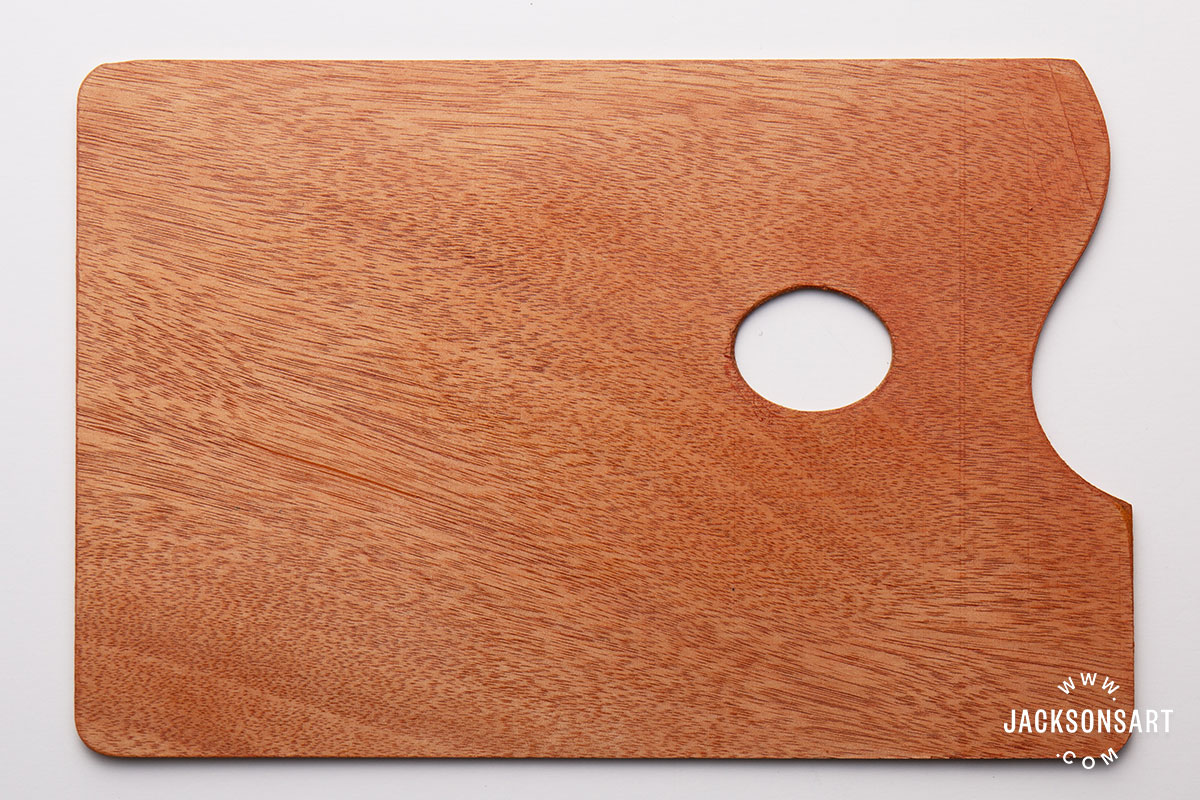
Traditional wooden palettes for oil painting have stood the test of time because they are lightweight and strong and when they have a smooth, hard surface they are a delight to paint with. You can buy a fully-finished palette or an un-finished one that simply requires you to add a few coats of oil to be ready to use. It is a simple process that transforms the wood, is an economical choice and a satisfying activity.
How to Care For a Wooden Oil Painting Palette
One of the advantages of a wooden palette is that it is lightweight compared to glass or a tear-off palette, so you can hold it at the easel if you wish to. It is also more rigid than a tear-off palette, so it doesn’t bend when you press on it. Because the wood colour is mid-value you can see the values of both light and dark against it. A well-cared-for vintage palette is a beautiful thing. A well-used palette acquires a glass-like, smooth finish after many years of painting. The patina of many thin layers of oil will darken the wood slightly and there will be some paint staining to add to the history. If you take good care of your wooden palette will get better each time you use it.
Conditioning a New Palette
To prepare your raw wood palette you can seal it with varnish or oil. Varnish can be partially removed each time you use solvent to clean your palette, so I recommend using oil. When it is dry it is quite hard. You will continue to build up layers of oil that condition your palette each time you use it. When you oil the surface of a wooden palette with a drying oil you are filling the little gaps in the grain of the wood. This creates a smooth surface so your brush hairs do not get trapped in the tiny grooves and get pulled and damaged. It also prevents the oil soaking out of the paints you put on your palette, so the paint sits on top and stays oily. A palette knife can scrape up bits of wood dust if the wood isn’t finished, so adding a finish to your palette prevents that as well.
Drying oils are what are used to make oil paints – linseed, safflower, walnut, poppy – because in a week or so as they absorb oxygen from the air they harden (dry) to a glassy layer. Linseed is a great choice for finishing wood as it is the fastest drying of the drying oils, is the least expensive, most readily available, most flexible and gives a lovely golden glow to a wooden palette.
First, make sure the palette is clean and free from dust and you may wish to sand any rough areas or give it a quick sanding all over.
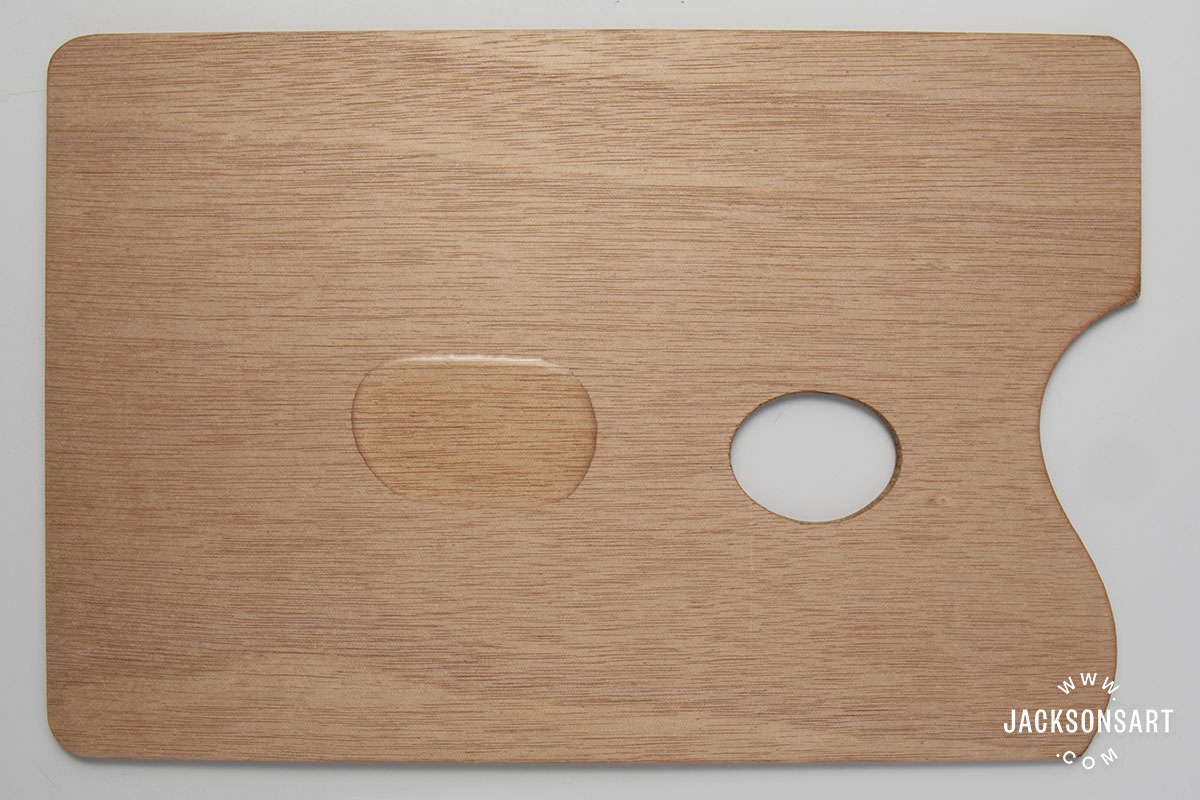
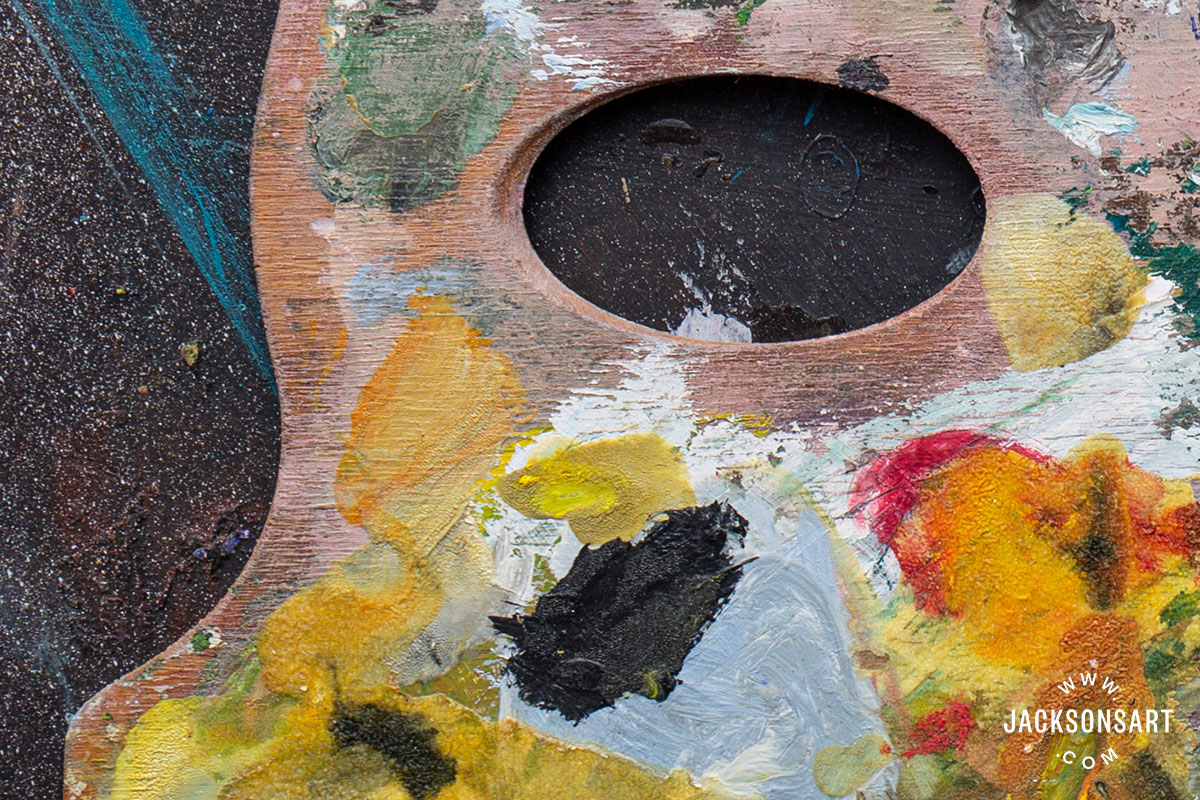
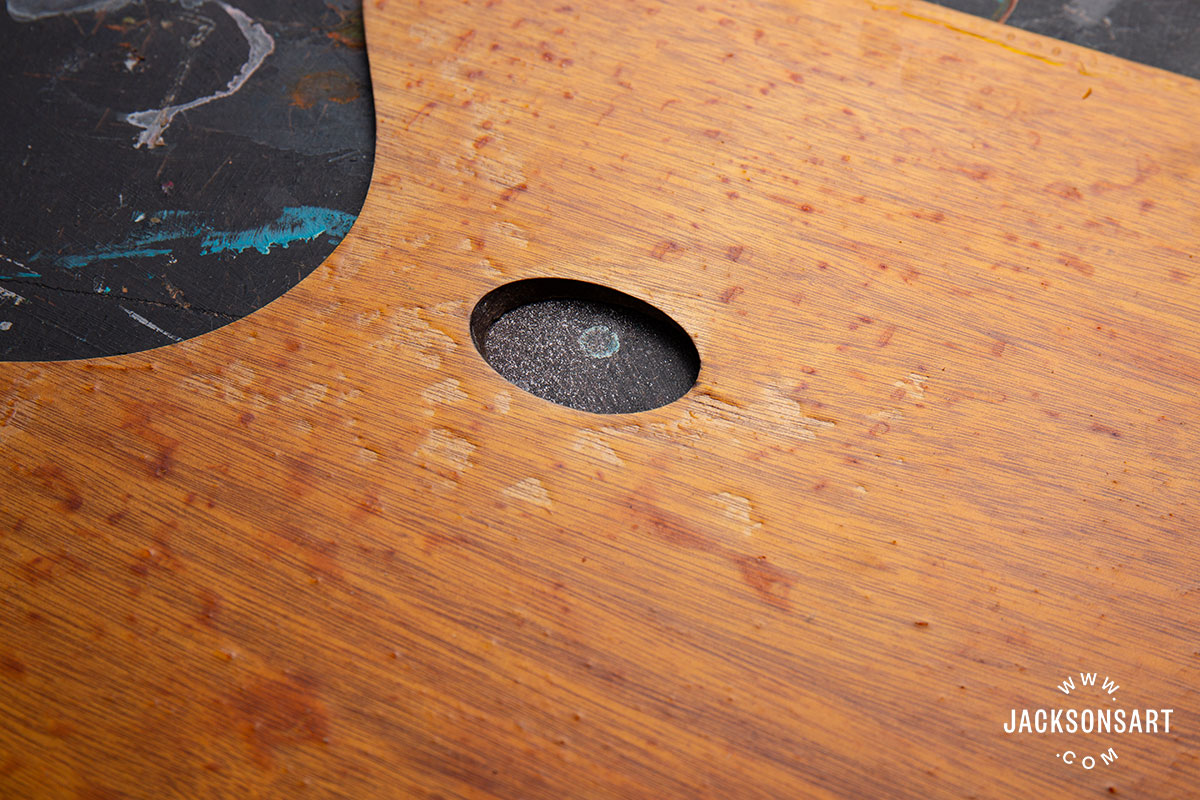
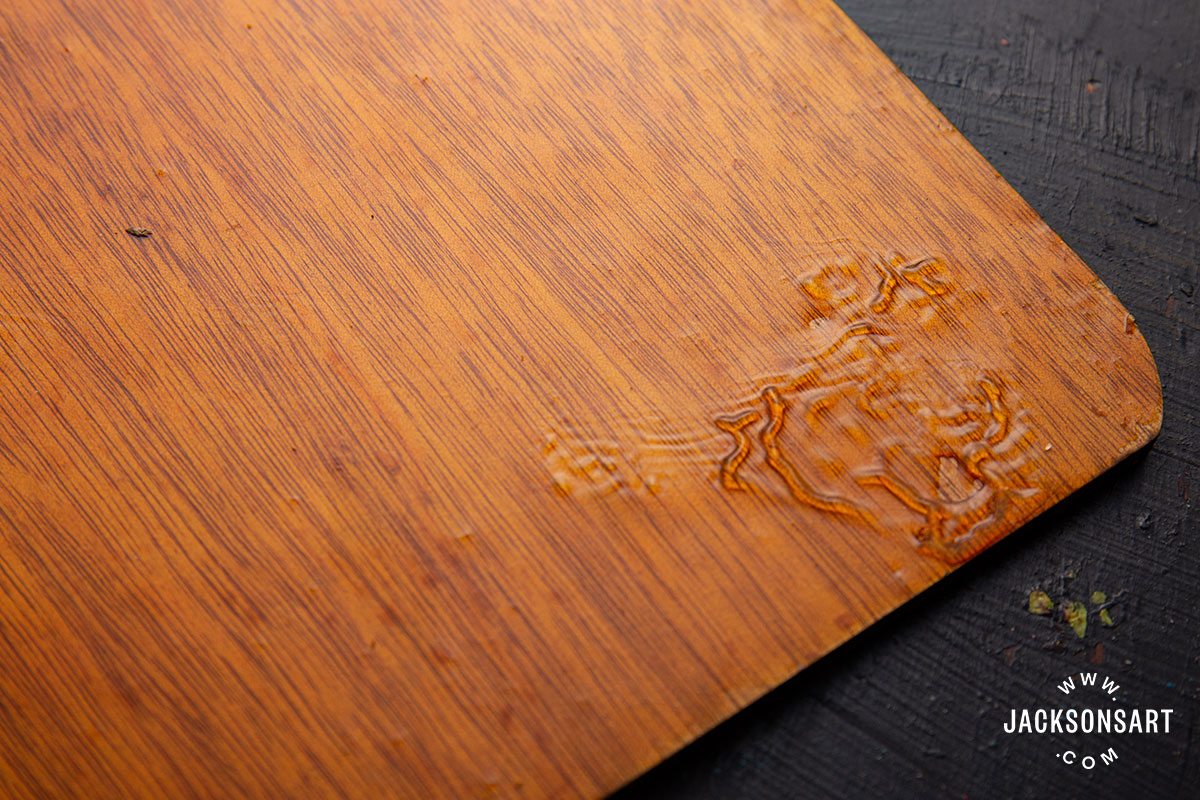
To begin oiling, pour a small pool of linseed oil (a teaspoon or two) in the centre of the palette and with a lint-free cloth (painting rag) rub the oil into the wood until the whole surface is coated and it won’t absorb any more. Only leave on as much as it has absorbed, lightly wipe away the rest. I have tried leaving on a thicker layer thinking it would speed up the process, and it has backfired by wrinkling, leaving little lumps and remaining sticky for years (see the images below). So wipe on only what it will absorb. Wipe it around the edges as well.
Then find a place to lay it flat with the oil side up that is out of the way and protected from dust. I have a set of shelves with my bottles and cans of painting mediums where I slide it in to sit across the tops of the bottles pushed to the back, so it is protected from dust by the shelf above. Or lean it vertically against a wall with the wet side down, protected from dust, like you would a drying oil painting. Check it every few days, when it is touch dry you can repeat the process. Or do it every week on the same day of the week. It will take a few weeks to slowly build up thin layers of oil, but it takes just a minute each time to apply a coating. I do both sides because it helps to keep the wood from warping by having the same amount soaking into both sides.

To not be wasteful of rags or oil I reuse the same rag for the process. For safety, to prevent the not uncommon occurrence of spontaneous combustion of oily rags, I use a quite small cotton rag (4×4 inches) folded into a little pad and I save it next to the palette, open, draped over the oil bottle. A single, small oily rag left open flat is not a potential fire hazard like a large pile of oily rags in a furniture finishing factory is. The key is to not wad it up and trap air in the folds.
When your palette is fully finished it almost feels a shame to get paint on it! But the surface is now sealed from potential solvent and water damage, it cleans up easily and your brush will glide smoothly over the surface as you mix and pick up your paints. Many oil painters will already have an oil in the studio for making painting mediums or to thin paint. It doesn’t take much oil or much time to finish a wooden palette yourself.
This can be done to unfinished wooden painting boxes, like our painting box as well. If you use one of these boxes as a pochade, oiling it also makes it seal much better so the paint on the palette inside is more likely to stay wet until next time.
Troubleshooting Images
Cleaning a Wooden Palette
The key to cleaning your palette is to not let any paint dry on it. At the end of a painting session, if you know you won’t be back to paint for a few days, you should clean your whole palette so it is ready for next time. Leaving paint to harden on a wooden palette can damage it as you will need to do some heavy scraping and then you may need to sand and refinish the palette. If the paint is only partly dry you might be able to use solvent, a palette knife, and a metal scourer, slowly and gently so as not to gouge the surface.
If you are tempted to leave leftover paint on your palette because you don’t want to waste it there are some studio habits that might work for you. Some artists make it a part of their practice to make a ‘palette painting’ at the end of a session, a quick, free painting that uses up all the leftover paint on the palette. These can be really interesting paintings. Some people scrape all the colours up with a palette knife into a ‘palette grey’ neutral colour mixture and use it to tone a canvas for next time. I have a small jam jar of ‘palette grey’ paint that I keep moist with a little oil. It’s quite useful for greying out colours or as a base for chromatic greys. Or you can save your clean colours in small pots like these, where they will last a few days. Some artists leave a thin layer of the gray mixture on their palette to stain it as they are aiming to build up a mid-grey surface.
After you’ve removed most of the paint, then wipe the remains of paint off with a cloth or kitchen paper, wipe again with a solvent or an oil, then wipe it dry. After the scraping, wiping and especially if you have used solvent, the surface of the wood may be a bit dried out and it could use some oil – it’s a good idea to give it a wipe with a drying oil at the end, to keep it conditioned. Each time you clean and oil your palette it adds to the condition. Over the years you will build up a lovely finish.

Wooden Palettes at Jackson’s
- Some wooden palettes do not have a finish, so they are quite affordable.
- Some palettes that are already oiled could still benefit from an additional coat of oil. But it should be enough to oil the palette at the end of each painting session. Jakar Oiled Walnut Palettes
- Some palettes are fully-finished, but oiling at the end of the painting session will keep them in good condition. All the wooden palettes that are available at Jackson’s.
Drying Oils at Jackson’s.
Further Reading
Why is Oil Paint so Expensive?
The Secrets Behind Jackon’s Professional Oil Paint
Jackson’s Akoya Brushes – the Best Brushes Going
Making Your Own Oil Paint With Jackson’s Pigments
Shop Wooden Palettes on jacksonsart.com


28 thoughts on “How to Care For a Wooden Oil Painting Palette”
Such useful information. Thank you.
I’m glad you found it helpful Marie-Claude.
Eu desconhecia este procedimento.
Antes de utilizar a paleta, passar uma
camada de óleo.
Sim, estou feliz por ter sido uma informação útil.
I have two W&N kidney-shaped oak wooden palettes, large and
medium. At the time of buying the large one, it was £30. It had a
scratch on the underside and I got mine for £10. The medium size
cost me £12. The craftsmanship is superb. We don’t see this
today. However, I have several other wooden palettes that were
much cheaper and needed some work on them. I sanded the
thumb hole and edge to get rid of the rough edges which dug into
my fingers leaving red blisters. I had a large rectangular palette
which I lined into squares with a permanent felt pen for mixing
colours from dark to light. W&N used to have a Weather Resistant
Varnish which was a thickish Liquin. I could apply it rubbing it
well in all over the palette on both sides. It needed about three
applications on the mixing side leaving each layer to dry
thoroughly in between. I then took a cloth and polished it when
dry. This made a perfect finish to mix paint on. The Alkyd varnish
does not dissolve into the oil paint as other oils may. Sadly, W&N
don’t make this anymore. I bought mine as a discontinued item at
50p each. Three? 60ml bottles. I notice on Jackson’s list some
very heavy Alkyd products that will do the same, I believe.
Hi Andrew
We do have some superbly crafted kidney palettes, though not oak and they are a bit more expensive these days.
Zecchi and New Wave palettes
You make a good point, some thumb holes are not slanted or smooth enough and a bit of sanding would sort that out.
I like the idea of marking on the palette, that could come in quite useful!
I haven’t heard of the varnish but I will look into getting an alkyd varnish from Kremer as they are a good make.
I will do some tests, because now I’m curious if the alkyd gels will dry hard, I always thought they stayed flexible.
Thanks for your comments!
Won’t the solvent like turpentine effect
possibly eliminate the oil to coat the
wooden palette in the first place? That
would mean you’d have to coat the
palette before every new set of color
mixing right?
Hi Ben
The layers of dried oil should resist small amounts of solvent on the surface but yes, the oil will be partially removed if you use more solvent. The same will happen if you use varnish on the surface. But the oil in the paint itself and the quick wipe with oil after you are finished for the day will keep adding back oil, so it stays sealed and smooth.
Hello, I’ve bought a wooden palette and
when it came I saw that it had some sort
of “plastic-y” surface. It wasn’t smooth at
all so I wanted to treat it with linseed oil
(with a drying agent) coating to get that
smooth surface everybody wants. I
applied the first coating almost a week
ago, it wasn’t excessive or lacking, but
after so many days it is still a little bit
sticky, but it isn’t at all comparable to how
it was when I applied it at first. Is linseed
oil supposed to be applied on “raw wood”
only? Should I keep on going with the
process? When can I apply the next layer?
Hi Raimo
It sounds like the coating already on the palette is preventing the oil from soaking into the wood. When using oil to create a finish the oil that hasn’t soaked in needs to be wiped off.
In your case it might be better to use an alkyd varnish or similar. That might stick to the original surface better. If the oil is still wet you should be able to remove it with solvent.
I have bought an unfinished wooden
palette and so far I might have given it 6
or 7 coatings of safflower oil (i tried poppy
too) and it just sucks it all up every time
but the surface looks and feels dry in less
than an hour. I’m not sure what i’m doing
wrong because i don’t think its very useful
if the wood is still so absorbent.
Hi
If it is soaking oil in that much, it would have soaked all the oil out of your oil paint. So it will be good to get some sort of finish on it.
If oiling isn’t working then you will probably want to varnish the palette instead. We sell some wood varnishes that might do the trick. I have not used them but this one looks like it should work. Polyvine Wood Varnish
I have made several pallets using 1/4″ birch
plywood. I seal them using linseed oil, just
like stated here, works great.
Hi Chris
I have never made one from scratch, that sounds like a good thing to know how to do!
Thanks for the confirmation, that oil works for you, too!
Hi,
I have my new Jacksons palette and am onto
my second coat of Drying Linseed oil. When I
return next day after the second coat it is
touch dry but slightly tacky. Is it ok to now
add another coat? Or wait until the tackiness
wears off?
Thanks
A little tackiness is ok, but the reason you are doing it in layers is so that each one will get to absorb oxygen and harden. If you go too fast the lower layers will be cut off from oxygen and you won’t get the glassy, hard surface you are looking for.
Maybe wait one more day.
Is there any remedy for a palette that has been tacky a long time. Sanding it back and starting from where it turns not-tacky?
Hi BH,
May I ask what is making it tacky – varnish or paint? How long has it been tacky for?
Many thanks
Lisa
I have given 3-5 coatings so far. When do
I know its ready for use? And do I need
to sand the palette before I apply the
next coating?
Hello
You should not need to sand because the layer will be very thin and soaked in.
If you have keep it free from dust as it dries you will have a smooth surface.
Once it starts to build up a shiny, hard surface like glass you are good to go!
Hello, I recently bought a beautiful wooden
Zecchi palette which already has several
coats of shellac and linseed oil on it, and I’m
looking to coat it more myself with some
linseed oil, however I don’t know which one
to buy.. There’s refined linseed oil and
refined linseed stand oil and I don’t know
what the difference is and which one to use.
Many thanks
Hi Melanie
If it is already coated then I would go ahead and start using it.
Wipe it clean at the end of each painting day and then wipe refined linseed oil over it and wipe it all off to finish cleaning the palette, except for faint stains of colour. This will slowly add very thin layers of oil to the palette that will create a patina of use and keep the palette conditioned.
Stand oil is too thick to use for cleaning your palette.
Using oil to finish an unfinished palette is a slow process that takes a long time to dry and build up the layers.
This is a really helpful article. I have a
varnished wooden palette that I haven’t
begun to use yet. What would be the best
way for me to care for that after painting?
Hi Beth
Wipe it clean at the end of each painting day and then rub refined linseed oil over it and wipe it all off to finish cleaning the palette, except for faint stains of colour. This will slowly add very thin layers of oil to the palette that will create a patina of use and keep the palette conditioned.
Does white mineral oil work?
Hi Becky
Mineral oil doesn’t harden. To finish the surface you want a hard varnish or hard dried oil.
Then each time you paint you will be adding more linseed oil from your paints and your mediums. And your final cleaning and conditioning rub of linseed oil that you wipe off, will add more very thin layers of the coating that will dry hard.
Hello!
I recently bought an acrylic set here in Jackson’s to start painting in this medium, it is from the Lukas brand and it comes with a wooden palette, I guess it is not the best wooden palette in the world but I understand that it is for start and practice.
I would like to know if it is possible to prepare this wooden palette with another type of oil, for example walnut oil because at the moment I do not have linseed oil, thank you.
Hi Mari.
If you are using the palette to paint in acrylics you can just varnish the palette with any wood varnish you have.
Comments are closed.