



Make your favourite oil colour into a water-mixable oil colour
with Schmincke Medium W
The most toxic thing about oil painting is the solvent. If you have excellent ventilation, with air constantly drawn out of your workspace so that you never smell your solvent, you might not need to worry too much, but that sort of ventilation is rare. For the rest of us who wish to paint safely with oils there are two options: using low-odour solvent or water-mixable oil paints. The advantage of water-mixable oil colour is not only do you use no solvent, but clean up is much easier with just soap and water and who doesn’t want to spend less time scrubbing brushes.
Until now you had only a few makes of water-mixable oil colour to choose from. With Schmincke Medium W you can turn your trusted favourite oil colour into a solvent-free oil. It is compatible with any artist oil colour. Once dry, a painting created with water-mixable oils is just like any other oil painting and should be treated as such.
Schmincke Medium W is available in 60ml, 200ml bottles.
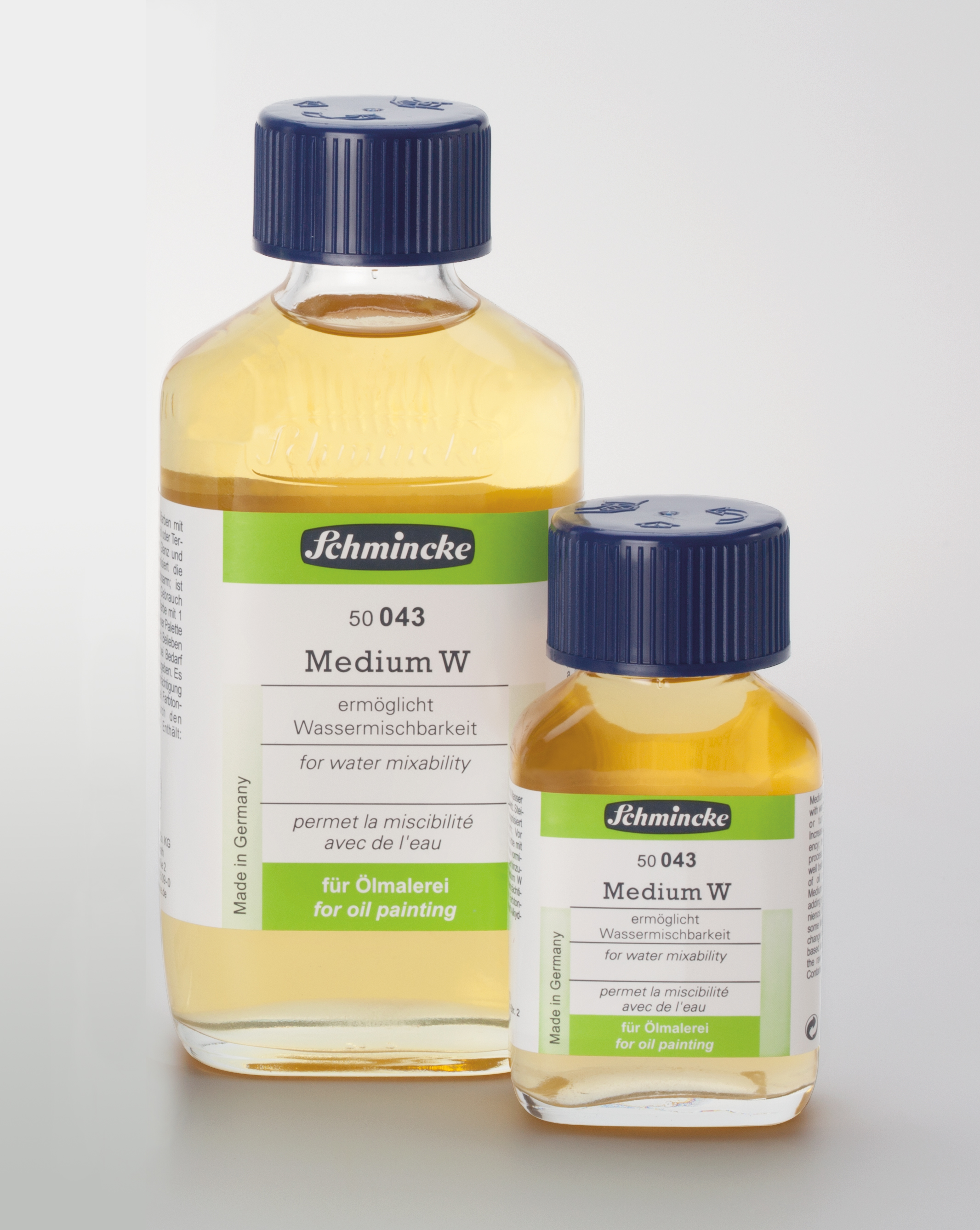
Schmincke Medium W is useful for artists who:
• have allergic reactions to solvents
• work at home in small rooms or apartments and who want to prevent the smell of solvents
• work in poorly ventilated studio spaces
• don’t want to make compromises on the oil colour they trust and use, but want to remove solvents from their workspace
• want an alternative to the available water-mixable oil colours
Using Schmincke Medium W with your oil colour
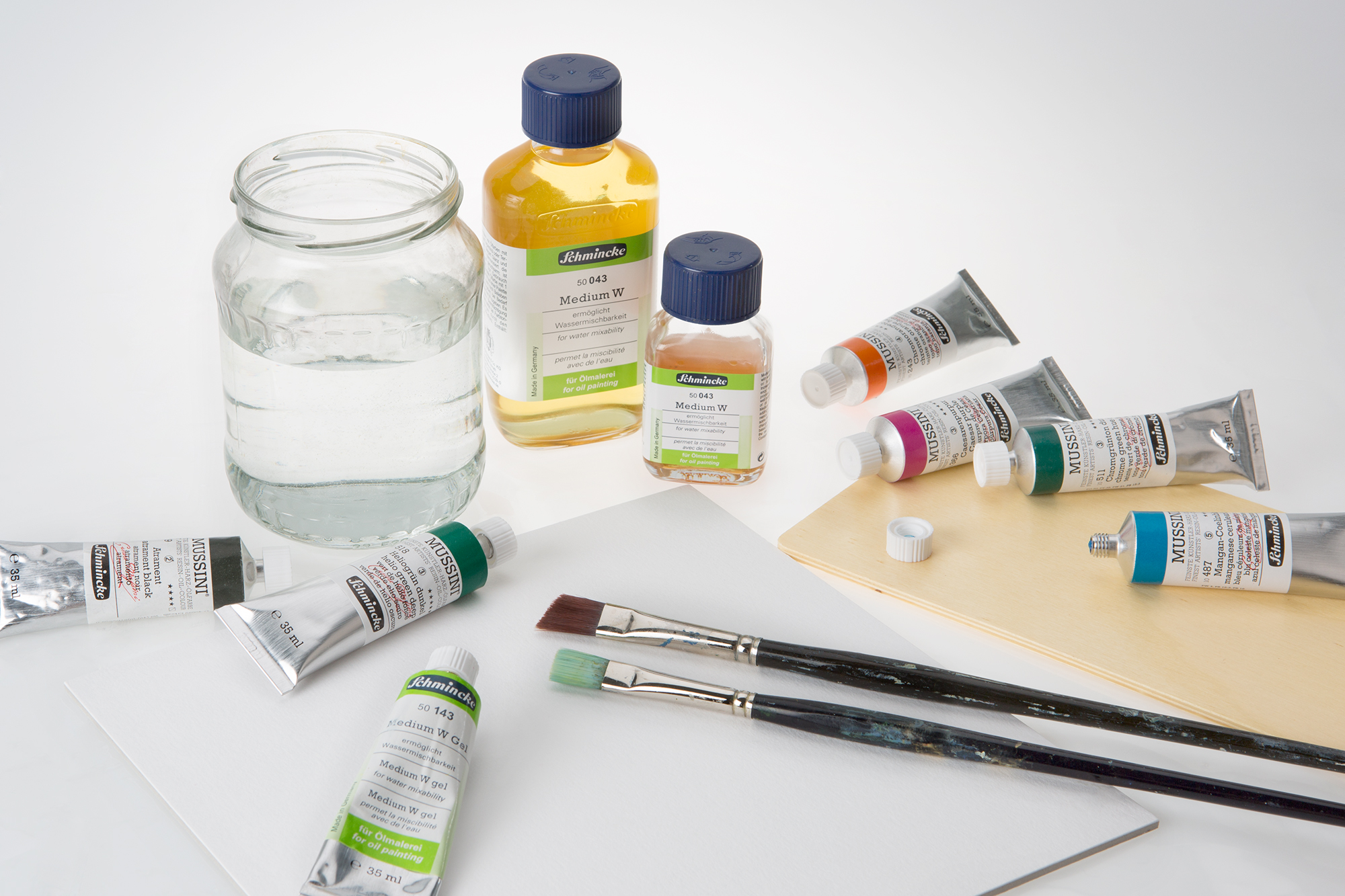
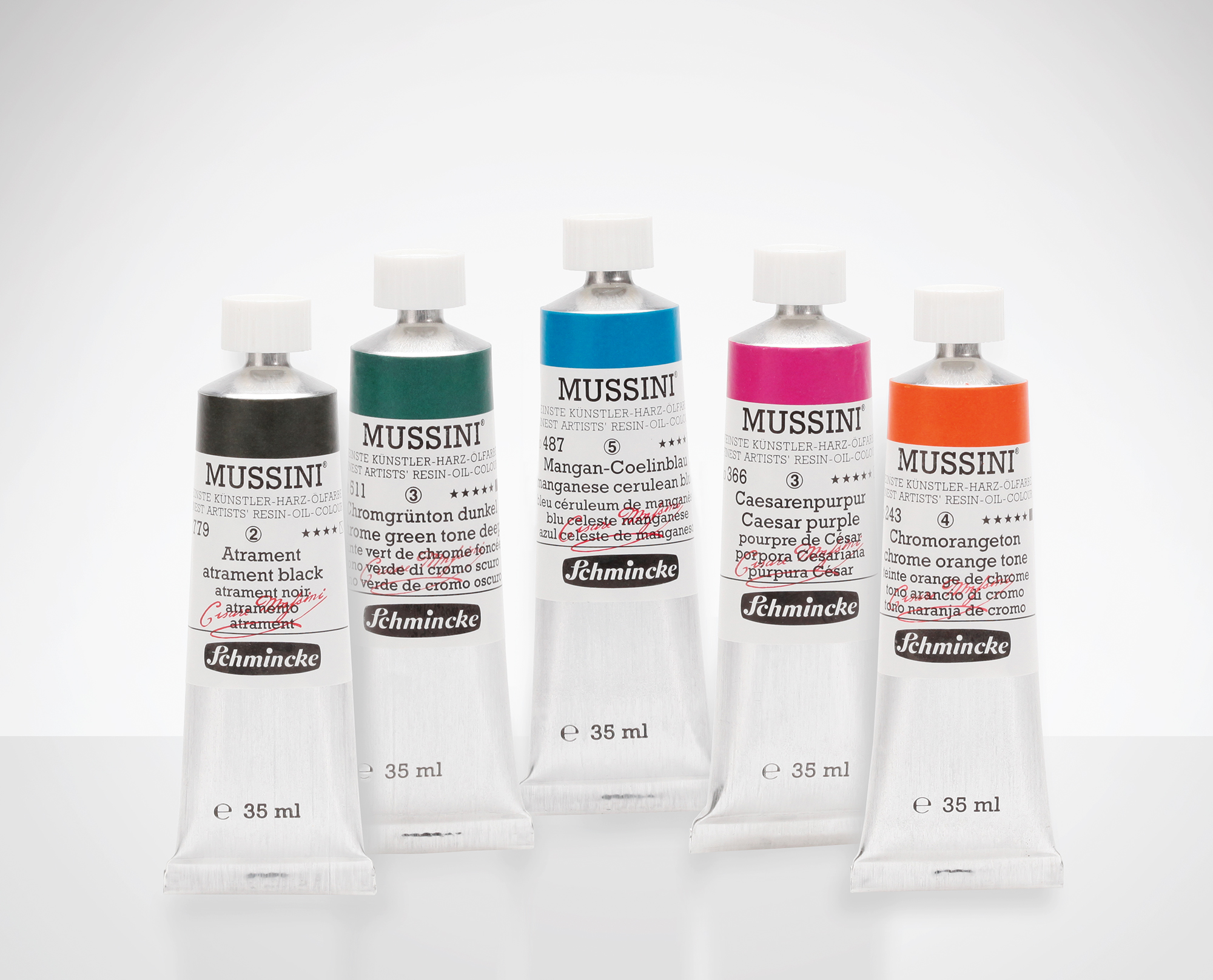
Schmincke Mussini Oil Colour is a resin-based oil paint available in 35ml and 150ml tubes.
It is one of my favourite oil colours because of its luminosity.

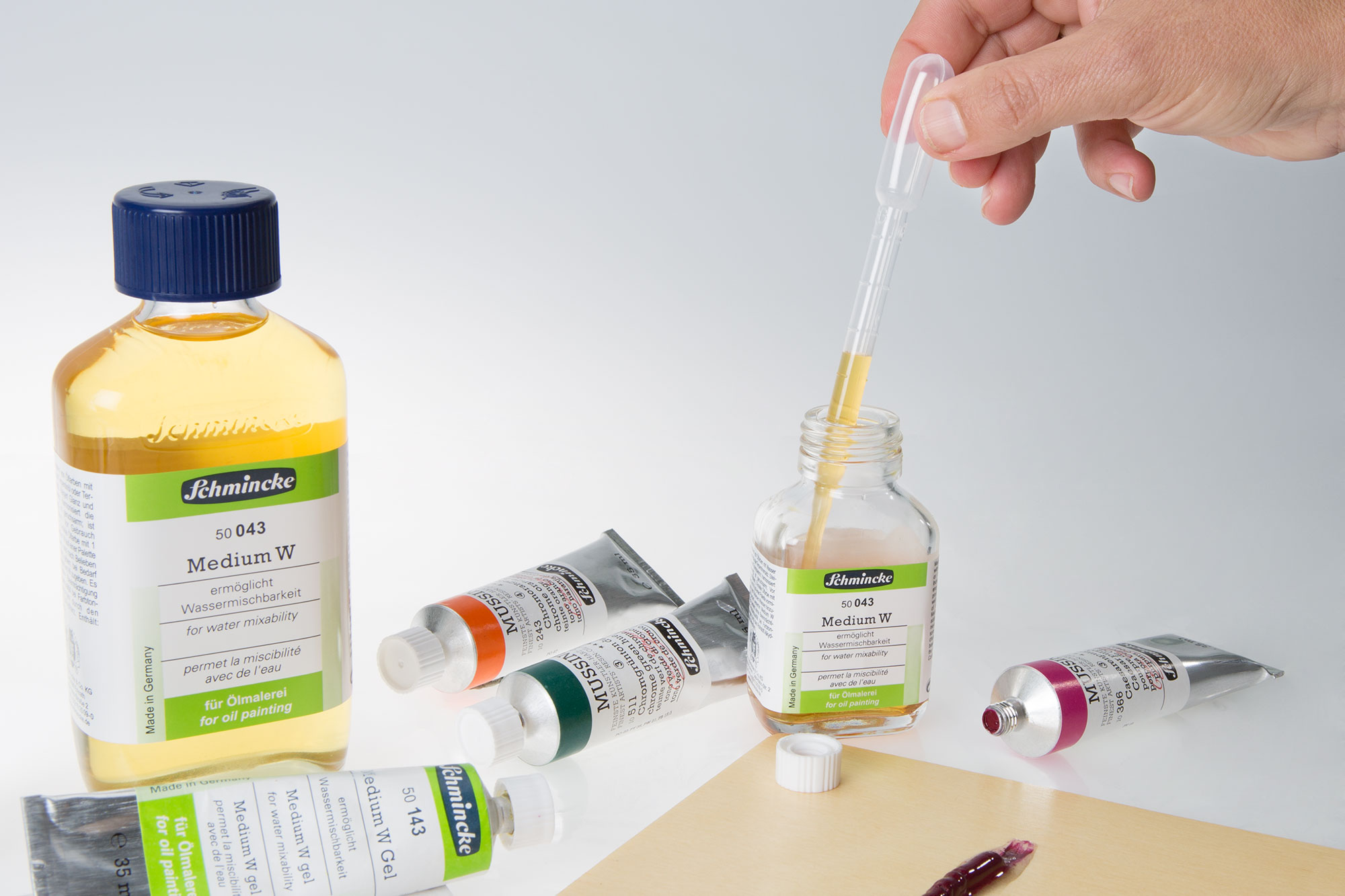
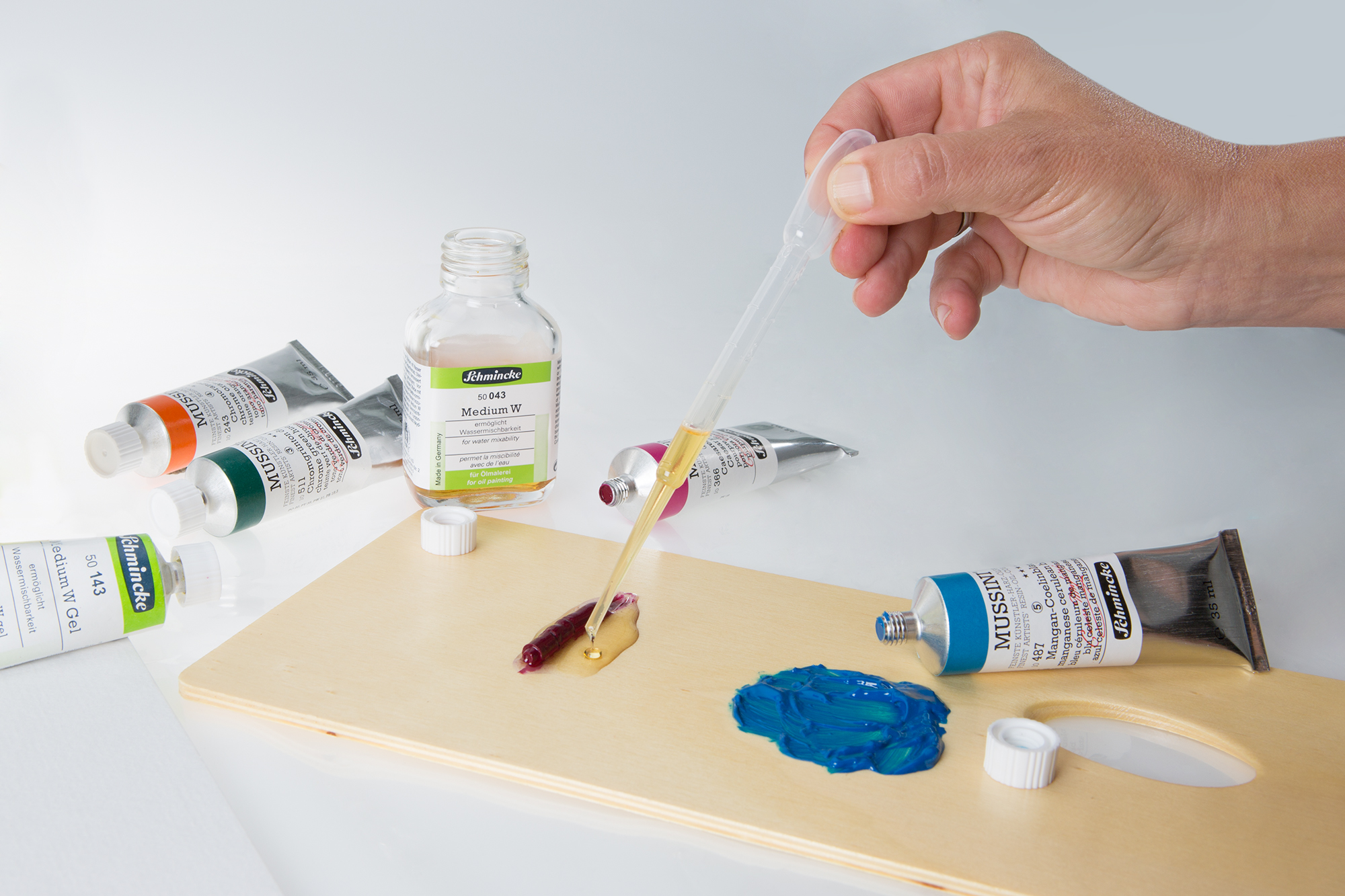

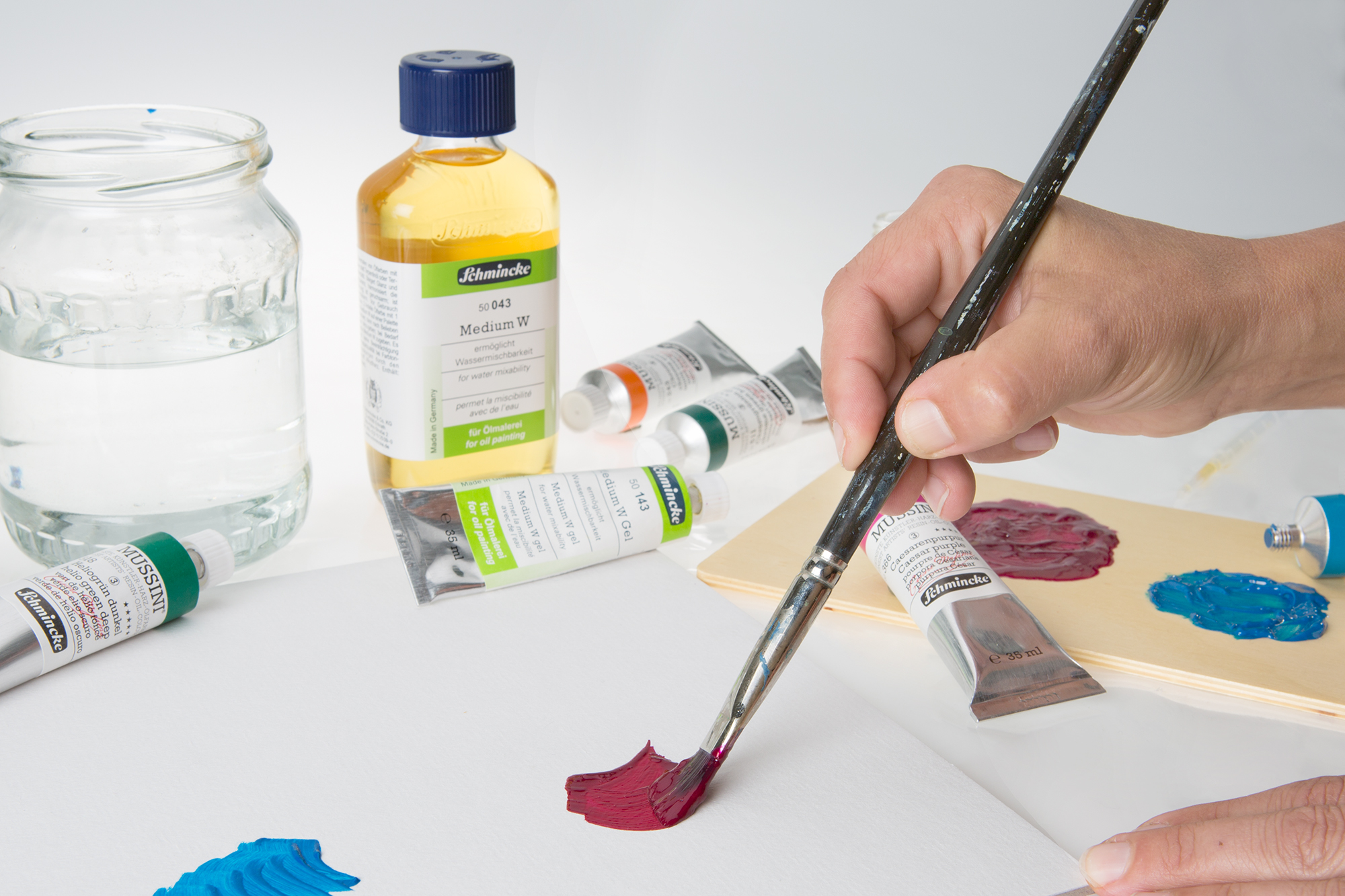

Beside being able to wash up in water a few things will be different:
- your paint will become more quick drying and the drying times of all the colours will even out, will be more similar to each other
- there is a colour shift from wet to dry- the medium plus water creates a milky colour that will lighten the paint colour while wet, some colours more than others, but it will dry back to the original colour. This might be a challenge for some people but many acrylic artists have successfully dealt with colour shift from wet to dry for years.
- I find painting with water-mixable oils a whole new painting experience, you can still blend but it feels different, something like a cross between oil painting and watercolour painting so you may need to experiment with a few new techniques.
- Schmincke Medium W increases the gloss and transparency of oil paint
Schmincke Medium W is available in 60ml, 200ml bottles.
Click on the underlined link to go to the current offers on the oil mediums Schmincke Medium W on the Jackson’s Art Supplies website.
Postage on orders shipped standard to mainland UK addresses is free for orders of £39.

15 thoughts on “Make Your Favourite Oil Colour into a Water-Mixable Oil Colour”
This looks a good product, may give it a try, but can it be used like an ordinary medium, dipping your brush and diluting as you go rather than pre mixing a load of colour?
Hi Dennis
If you can keep you proportions about right, I don’t see why it can’t be used the way you propose.
Let us know how it goes if you give it a try, I’d like to hear.
What about the colour shift mentioned in the product info?
Hi Roy. I mention the colour shift in the article. In the section about things that will be different.
You will find your oil paint is more transparent, quicker to dry with all colours drying more evenly and your colours will dry darker because the water plus medium add a little milky white to your mix that goes away as it dries. This might be a challenge for some people but many acrylic artists have successfully dealt with this difficulty for years.
Hi Julie,
I just bought some of the new gel also a
Schmincke product (same as above).
Could you tell me about the drying time
please? I’ve been an acrylic painter for
many years but am sensitive to solvents
so just getting into the new products.
Very exciting!
Hi Carolyn!
Water-mixable oil paints dry in two stages. First, any water you added evaporates out at a rate similar to acrylics, so pretty quickly. Then it dries like regular oil paint, by polymerisation. The time an oil paint takes to dry depends on the type of oil it is made with, the exact pigment used and if any driers have been added (student-grade oil paint ranges usually add driers to even out the range, so all the different pigments end up drying at the same rate).
The Mussini Medium W makes an oil paint into a water-mixable oil paint. (The fluid one will give you thinner paint and the gel will keep the same body as the original oil.) It’s made with alkyd resin which is faster drying than regular oil paint. If you use the recommended 2 parts oil paint to 1 part Medium W it should speed up drying time a bit, but the actual time depends on how fast the original paints you are using would dry. And of course how thickly you applied your paint.
You will feel a thickening of the paint as the water evaporates from the paint on the palette, so some artists use water-soluble mediums rather than water to thin their paints, then there is no evaporation on the palette. But they get the benefits of water clean up and no need for traditional solvents.
I hope that helps and it would be great to hear your experience of working with the new paints!
Are you saying in second last para that
if I use medium for water soluble oil
with regular oil paint I could get the
benefit of water clean up? If true then
why would any one but the medium W?
I am sure I am not understanding this
correctly.
Hi Gary
I can’t see the paragraph you are referring to. I will edit it to be more clear if you could let me know where you mean.
You are correct, adding water-mixable oil medium to standard oil paint will not make it water-mixable. You use very little medium so it isn’t enough to make a difference.
If you use this medium with oil paint, can
you than use together with e.g. acrylic paint
on the same canvas together – and can you
mix the oil paint with the acrylic on the
palette?
Hi Gerry
No, you can’t mix water-mixable oils and acrylics.
Water-mixable oils are still oil paint. One way to think of them is that they are water-washable oils. The main advantage is that you can clean up without solvents.
You can paint with oil paints (and water-mixable oils are still oil paint) on top of dried acrylics.
The article says that the…”but it will dry
back to original Color.” In above you say it
will dry darker which means darker than
originals? Please explain. Thnx
Hi Gary
In the article and then later in the comments, I am referring to the same phenomenon. As with all water-mixable oil, adding water creates a milky emulsion. As you are painting the colour will look lighter, like it has been mixed with white. After it dries the white becomes clear so the colours darken to the original colour you saw from the tube. So both statements are correct. The appearance of the mixture will darken and return to the original colour.
Thanks for your prompt responses. I
got all my questioned answered. I now
understand. Look forward to using
medium W as I have so many oil paints
left over.
How to I glaze with it -i.e. fat over lean?
Do I:
1) Use more Medium W
2) Will it work with other products like
Holbein Duo Aqua Oil Painting Oil Medium
or
Royal Talens Cobra Water Mixable Oil
Colour Glazing Medium
-are the above mentioned only designed to
work with paints already manufactured as
“Water Mixable” only or are those
compatible with regular oil paints treated
with Medium W
Hi Evan
I asked the technical team at Schmincke and this is what they told me:
The Medium W makes the colour leaner, so begin with a very lean mix of colour with much medium and water and then increase the oil-colour-content in the mix with every layer to follow the fat-over-lean-rule.
There should be no danger in using different brands together but since we didn’t test all mediums, we cannot guarantee that it will 100% turn out as you like.
Please do pre-testing with any new materials, tools and techniques before using it in your artwork.
I hope that is helpful.
Comments are closed.