



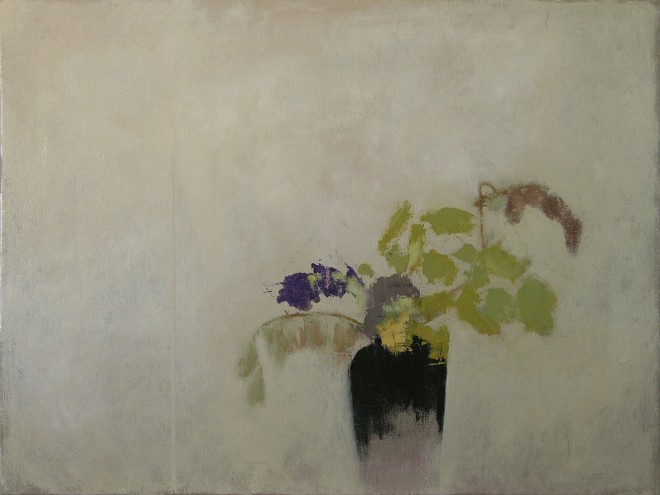
Alan Slater’s paintings are quiet, contemplative explorations of form and colour. Apparent influences stem from abstract expressionism and 18th century Japanese painting. Objects are placed sensitively within the rectangle of the canvas, with negative spaces considered just as pointedly as positive spaces. The paint appears with both texture and luminosity, evoking a real sense of time, space and place with only the most absolute necessary detail.

Lisa: When did you start to paint?
Alan: “At my mother’s knee” sounds clichéd. My interest was encouraged at an early age by my mother who had been to art school when young but who didn’t paint properly until late in life. I began to take art seriously in the early 1970s, painting landscapes ‘en plein air’ when I lived in Derbyshire, as a result of which I decided to give up full-time employment and go to art school.
Lisa: What is your medium of choice and why?
Alan: Over the years I have used many materials, some conventional, some not (for example, tea, coffee, household paint, various types of varnish, wood stains, wax [hot and cold], glue and so on). For some years I used acrylics, and still occasionally do, but my preferred medium now is oil paint. Why? Although both oils and acrylics have advantages and disadvantages, the main problem for me with acrylics is the rapid drying time (I never liked using a retarder) and so the ability to be able to paint wet-on-wet is the deciding factor in my using oils… which is not to say that I don’t, at times, allow layers to dry before overpainting. It all depends on the piece.

Lisa: What does your picture making process involve?
Alan: There’s no simple answer to this question. I spend a lot of time away from the studio looking at paintings I’ve recently made, at older ones, at our garden, and at my collection of vases in order to find something which can give me a starting point for a painting or a series of paintings. Also I have a small notebook in which I’ve been jotting down things people have written that interest me. It’s been with me for 40-odd years and still, occasionally, provides me with ideas. The actual physical process of making a painting begins after I have chosen a motif and decided whether to use a new support or to work over an old one. I apply paint directly to sketch out, roughly, the positions of the various elements of, for example, a vase of [now mostly limp and fading] flowers from the garden. Then the hard work begins. I stop looking at the motif and concentrate solely on the image for quite some time until an idea about how to proceed occurs to me. I am afraid I cannot explain how that then results in a finished piece. Sometimes I need to re-work a piece because the elements do not gel although I am usually happier about the result if the work flows… almost as though, and I know it sounds odd, it is painting itself.
Lisa: What makes a good still life arrangement?
Alan: One word: balance. Applies to all painting not just still lifes. And, just to be awkward… deliberate imbalance appeals to me too.
Lisa: Your paintings have very interesting titles, including a few in Japanese, and many open ended. How do you decide your titles and how important are they to the reading of the picture?
Alan: The titles come from many sources. Sometimes they might be simple titles to describe the image though never to define it (for example ‘bowl of fruit’-type titles), sometimes playful titles or, more often, be an attempt to challenge observers, to get them to think beyond the image itself and about how the image might be interpreted (if that doesn’t sound too nonsensical or pretentious). I don’t decide on a title until I’ve settled down after finishing the piece. I study it very closely and try to find words to express what I see in the painting.

Lisa: Do you have a favourite brand of paints?
Alan: Aha… an easy question. Oil paints: Michael Harding; acrylic paints: Lascaux.
Lisa: How important is the surface that you paint on?
Alan: Not at all important. I rarely paint on fresh surfaces… which will be anything I have handy; linen, canvas, cardboard, wood, paper, mdf and so on… but most often over old paintings. I prefer the latter. They contain the history of their own making which, now hidden underneath the layers of a new painting, add – for me- another aspect to their interpretation.
Lisa: Do you feel that looking at other people’s paintings is important to your practice, and if so which artists inspire you?
Alan: I only ever look at other people’s work when I am not intending to work myself. I find their mark-making too distracting. I couldn’t really say that any artists actually inspire me. I have a large library of art books and have spent very many hours in galleries and museums so, obviously, many of the works I’ve seen over the years have stayed with me. Artists I admire are too numerous to mention although the ones whose work I have images of in my studio include: Manet, Morandi, Bashkirtseff, Valadon, Fantin-Latour, Eakins, Diebenkorn, Hammershøi and others.

Lisa: What are you working on at the moment?
Alan: I am continuing to work with a large black glass vase containing most of the flowers I have collected from the garden this year.
Lisa: Where online or in the flesh can we view more of your work?
Alan: I rarely show in galleries although I shall have some works in a local gallery sometime soon. On-line my work can be found at: www.axisweb.org/p/alanslater or on my blog at: http://alanjosephslater.blogspot.co.uk/

(Header Image: Alan Slater – ‘harmony paradox…’, oil paint on linen, 38 x 46 cm)
2 thoughts on “An interview with Painter Alan Slater”
What an intriguing artist.
Thankyou for the helpful comments, this art is spectacular..and so varied.
A most fascinating article.
Lovely to read your comments Kay, thank you
Comments are closed.