



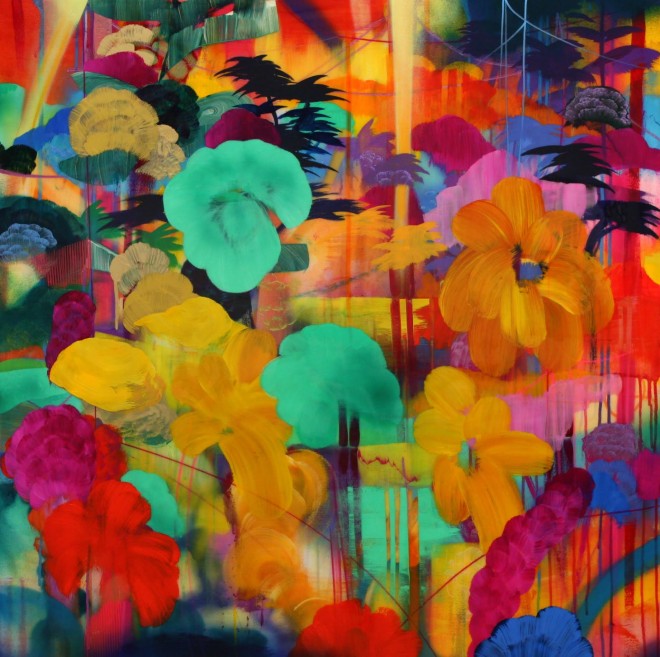
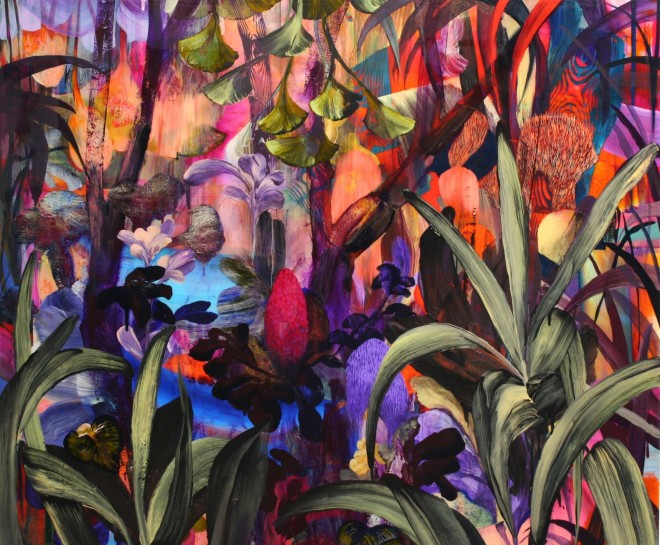
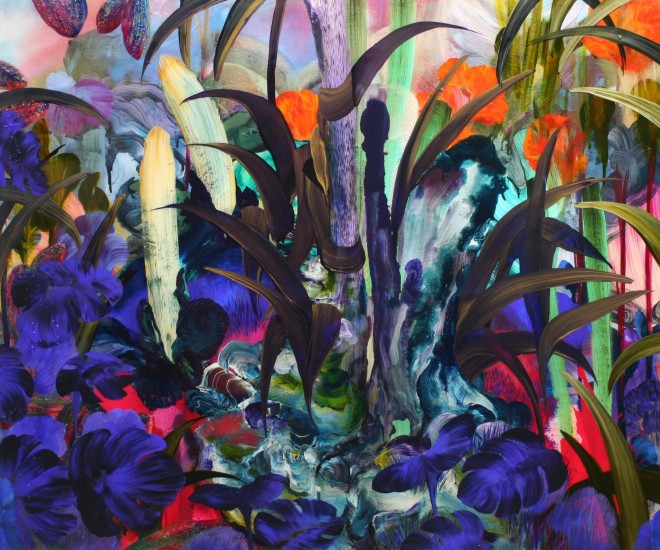
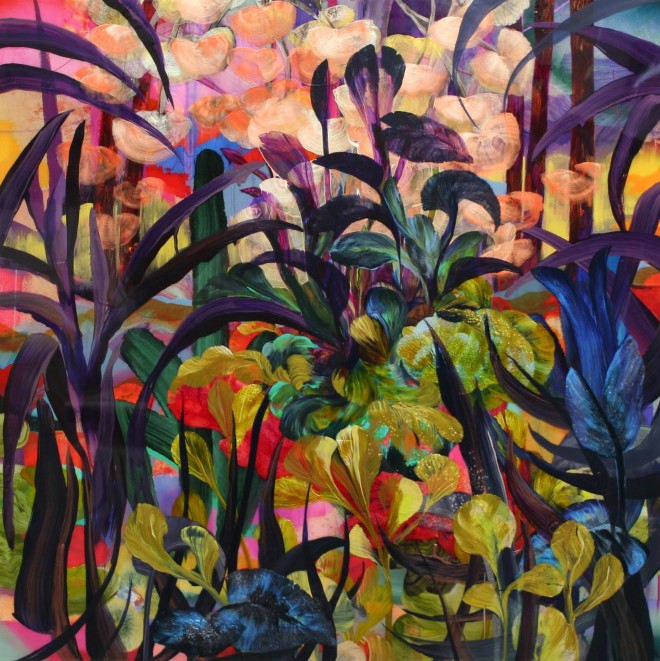
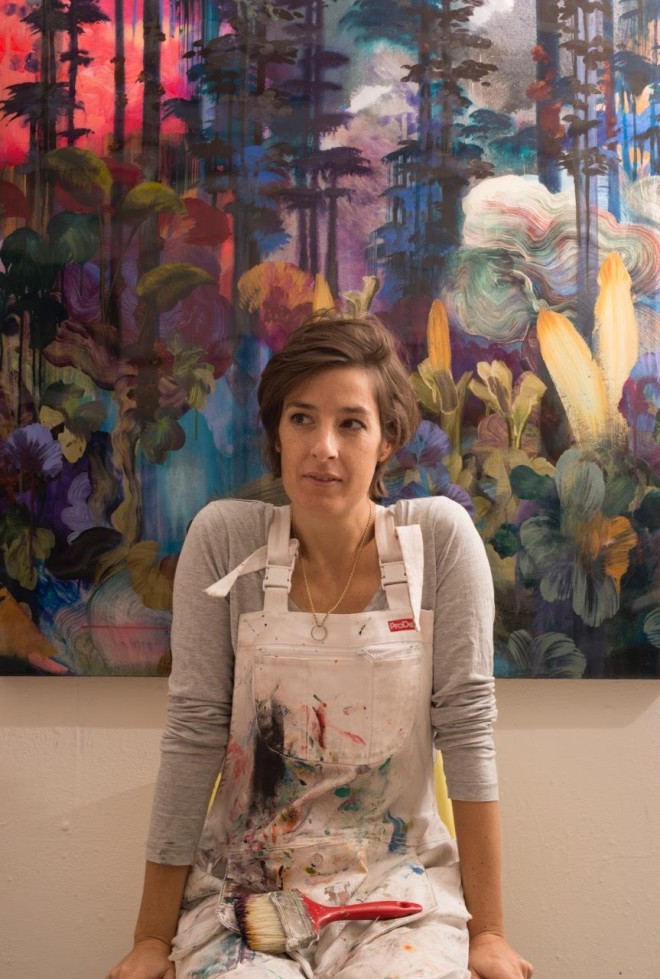
Wonderfully exotic, mysterious, dangerous and seductive, Orlanda Broom’s colour filled paintings are imagined visions of a quietly unsettling paradise. Her work brings to mind the exoticism of Henri Rousseau and the painterly rhythms of Fiona Rae. Through moving paint around on her canvas, she creates fictional plantlife which engages with memories of sun-drenched lands. Layers of resin separate layers of painting, creating a light-box-like effect: light passes through the layers creating an illlusion of a 3 dimensional world.
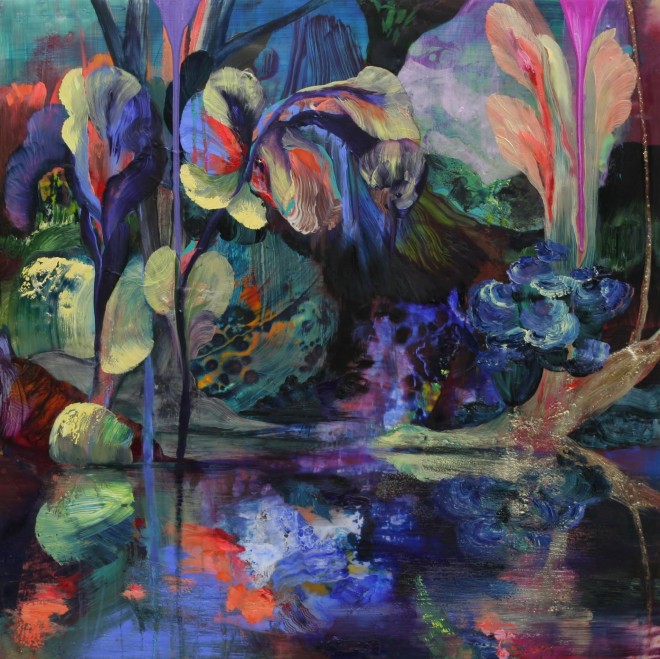
Lisa: When did you discover resin and how profoundly did it affect your painting practice?
Orlanda: I started using resin in my work about seven years ago. I was looking for a substitute for varnish as I could never quite achieve the surface I wanted with varnish & other mediums. Initially I used it in just this way – as a high-gloss finish. It really saturated the colour and I loved the smooth glasslike surface. Over time I changed the way I was working with it – I built up layers of it and so it became a much more integral medium rather than a final layer.
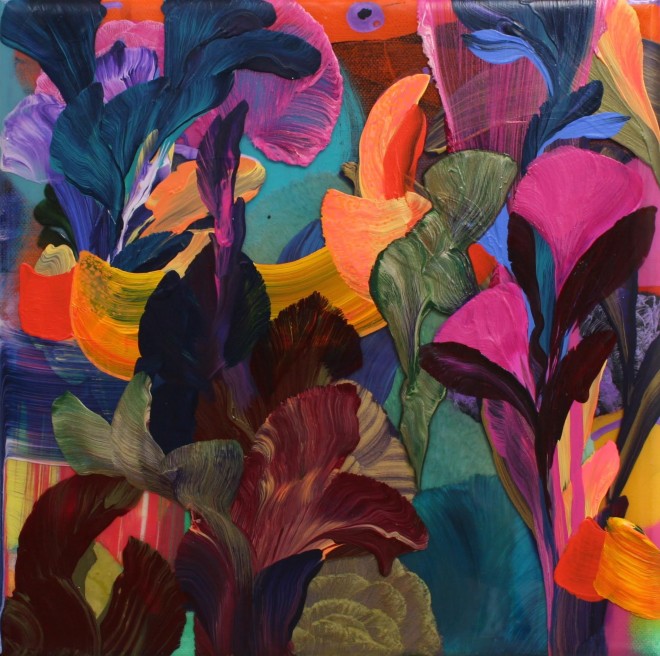
Lisa: The paintings look as if their compositions evolve as a result of moving and shaping the paint on the canvas. Is this how you work or do you work in response to a preconceived design?
Orlanda: The compositions absolutely evolve out of the process of painting, I work out ideas on the canvas and without any finished composition in my head. My paintings have become more and more layered over the years, I like to be quite brutal about blocking out and over-painting in the early stages so that I can get that point where the painting feels like its a kind of ordered chaos and it’s retained its energy.
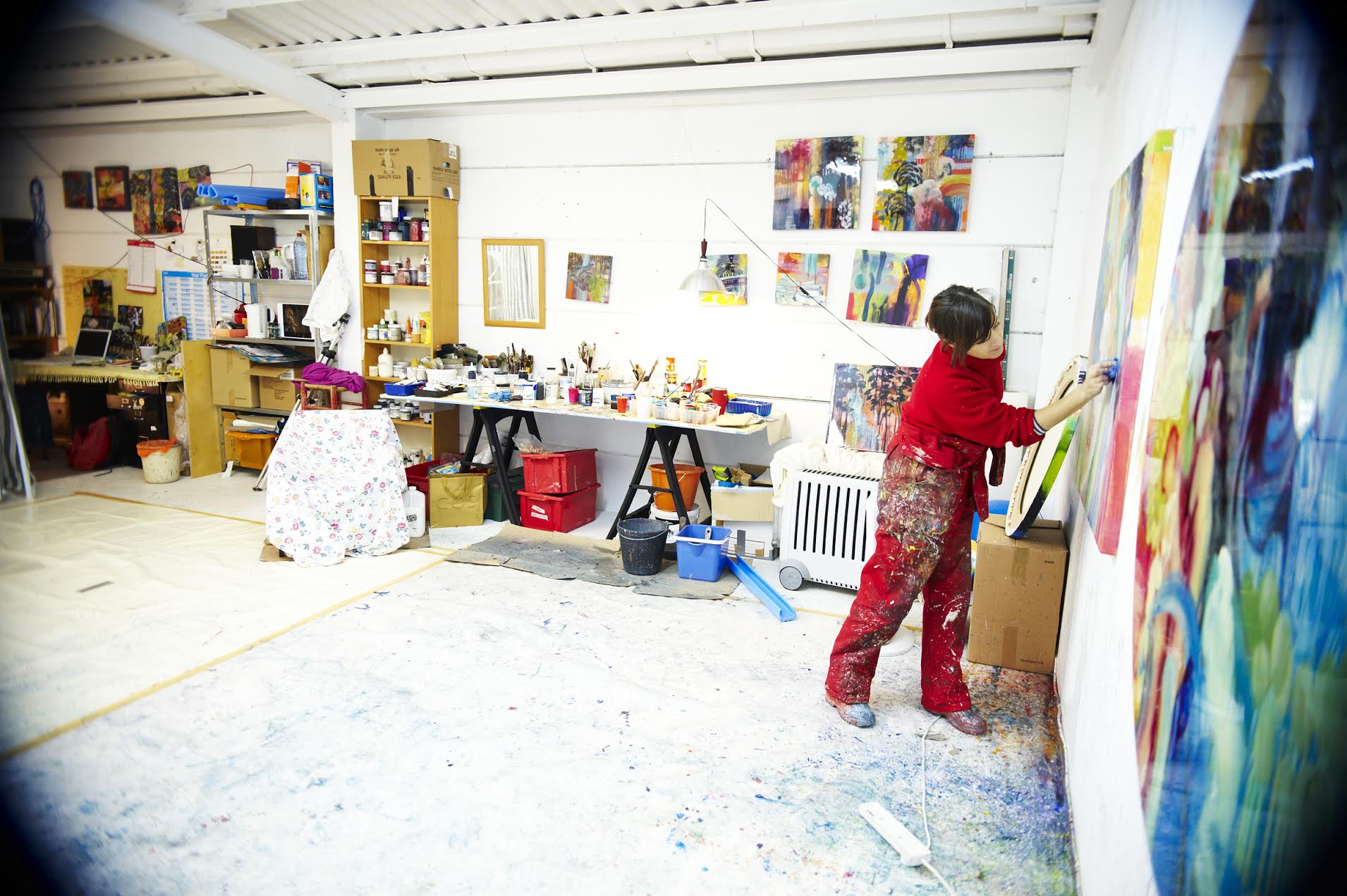
Lisa: Do you need to use special brushes when working with resin and acrylic?
Orlanda: I have a big range of brushes – nice ones for acrylic that don’t go anywhere near resin! Resin is a pouring medium so isn’t applied in that way, you just need a flat edge or disposable brush to spread it across a surface. But when painting with acrylic, I think it’s really important to have lots of different sizes and bristles and not necessarily ‘quality’ brushes – just whatever is going to give you a variety of marks.
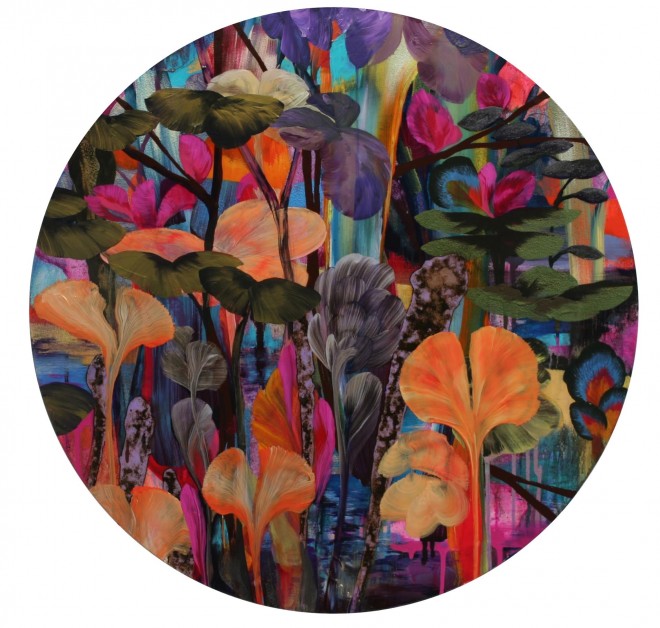
Lisa: Is the resin applied separately to the paints or are they mixed together?
Orlanda: In my work the resin is applied separately although it can be mixed with colour.
Lisa: Which brands of acrylic paints do you favour and why?
Orlanda: I especially love Golden Fluid acrylics, they have such a high-pigment content meaning the colours are really rich. But I’m not loyal to any one brand, I use Liquitex, Jacksons own-brand, Lascaux; quality is very is important – you don’t want low grade colours that will fade! Robersons metallic paints are very nice too. It’s good to use different brands – all the paints have different properties.
Lisa: What inspires your paintings?
Orlanda: My work follows certain themes and ideas… for example the oxymoron of a beautiful parasitic plant or conveying a sense of abandonment somewhere that on the face seems like a paradise. For inspiration as a starting point I have a lot of photographs from places I visit; I have family in Tobago and go into the rainforests there to take photos as a reminder (I don’t work from photos as such). Here, I go to Kew Gardens (not far from my studio) to sit and draw in the hot-house! But inspiration comes from all sorts of surprising places, even in city light pollution, the colours can be very beautiful!
Lisa: Do you ever have days in the studio where nothing seems to go to plan, and if so how do you overcome these?
Orlanda: Yes, I do but I think they are necessary in many ways. When I feel I’ve ruined a painting I’ve actually regained the freedom that I had when I started… and there’s always something to salvage. It’s the way I work best really… but probably leave it until the next day if it’s really bad and you feel like you want to put your foot through it.
Lisa: What conditions are essential to a productive day in the studio?
Orlanda: I tend to work best in the afternoon/evenings when I have got all of the other things I have to do out of the way. The studio is my office as well as workspace, and unfortunately there are lots of admin type things to do with a days work when I’d rather be painting. The best way to get focused is to turn the phone/computer off, put headphones on and ignore everything else. A warm studio is also essential for me – I’m always moaning about the temperature in the Winter! Resin is fussy about temperature too – conditions have to be right for it to set properly.
Lisa: How do you see your work developing?
Orlanda: I’m always on the look out for new mediums or to change scales/formats. I recently started using oil paints again after a long, long break since college days.
I have little experiments with other projects such as light boxes and I think everything you do as an artist informs your practice. I couldn’t really say how my work will develop but I’ve always been wary of getting stuck into a way of working.
Lisa: Where online or in the flesh can we view more of your work?
Orlanda: I have some work online with New Blood Art http://newbloodart.com/artist/2626/orlanda-broom
I regularly exhibit in London and anyone can sign up to news about shows, open studios etc. via my website http://orlandabroomartist.com/
Orlanda Broom is on Twitter (@Orlandabroom)
and Facebook too (https://www.facebook.com/Orlanda-Broom-128924407134305/)
2 thoughts on “An interview with Orlanda Broom”
MAGNIFIQUE TRAVAIL ET GRANDE INTENSITE bravo pour
les liens en spiritualité ……où peut on trouver vos oeuvres
..je suis fan .
Her work is fantastic isn’t it?
Head to Orlanda Broom’s website here – https://orlandabroomartist.com/landscape
Many thanks
Lisa
Comments are closed.