



New Botanical Ultra Smooth Paper is here!
There has been much talk about the change in the texture of the Fabriano 5 paper from St Cuthberts Mill, with the result being due to a change in the machine which was used to create it. As an important supplier of artist papers, R.K Burt wanted to continue supplying artists with paper that matched the former smoothness of the Fabriano 5 and have done so by releasing a new paper.
And so we have the new Botanical Ultra Smooth Paper.
As soon as we received samples we knew we had to send it to botanical painters to see how they got on with it. First to give us her review was botanical artist and a councillor of the Society of Botanical Artists, Amber Halsall.
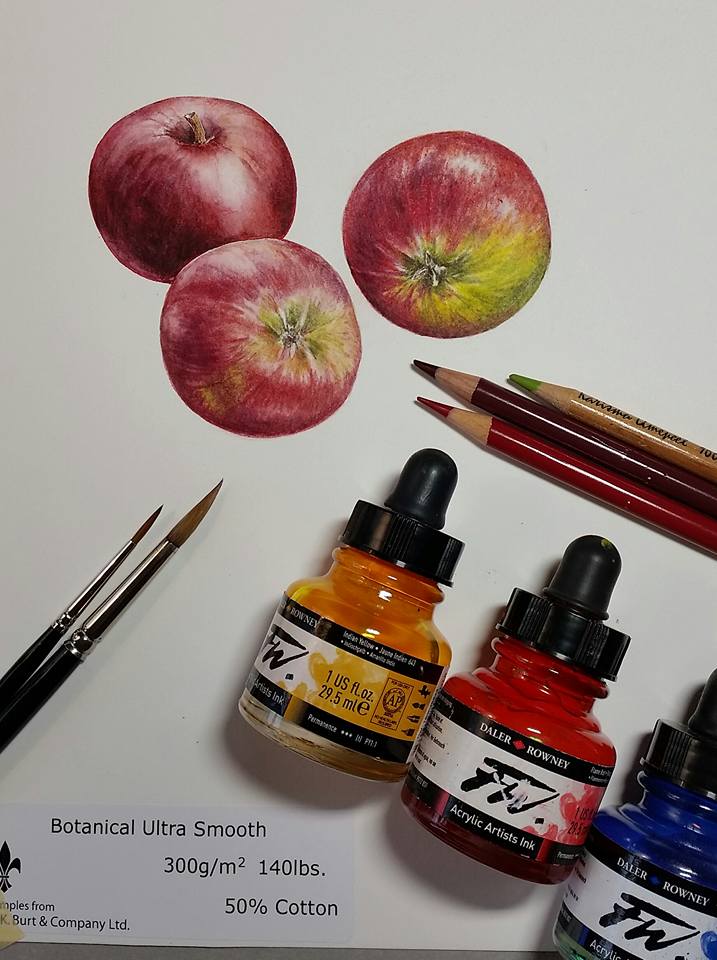
1. Top left apple, watercolour.
The paper took 2 layers of the initial wet wash well but a third was too much and the colour started to move. Colour was reasonably easy to lift out. Switching to dry brush I found the paper was smooth enough to show detail well and easy to paint sharp edges except where the paper had been damaged by erasing pencil marks. My colours overall did seem to be fairly dull on this paper despite of its ultra white surface.
2. Bottom apple, Acrylic ink and coloured pencil.
Colours appeared flat. By putting a wet substance on the paper first and then adding a dry medium it changes the surface of the paper and you need a fairly robust paper to make this technique successful. Unfortunately this paper did not pass the challenge for this test as the surface started to break down after 2 layers of pencil making it hard to burnish or add more colour.
3. Pure coloured pencil, right apple.
The surface for coloured pencil felt like a cross between Bristol Board and HP paper, the pencil seemed to slide a bit but that is normal for a surface similar to Bristol board when you are using many layers of wax pencil. Again I had problems with the surface breaking up after 3 layers unless I was careful. Quite a lot of pencil dust was produced leaving a trail of colour that is easy to smudge and make the paper dirty. However as the pencil sits on the surface of the paper the colours remained nice and bright and the layers were easy to blend together. Lifting out colour was reasonably successful but again there was a danger of damaging the surface of the paper.
Summary
The delicate nature of the surface of the paper, presumably caused as it is only 50% cotton made this a difficult paper for me to work with. I like to draw my outline in pencil first and I found the erasing on this paper damaged it quite considerably (though for a Botanical artist I am fairly heavy handed! ). Also (possibly because of the sizing?) I couldn’t seem to get the paint to layer as successfully for as many layers as on my current paper. As this paper contains whiteners there are some issues about its longevity too, a problem for some fine artists. With other more robust HP papers in the market place this is not a paper that has impressed me enough to recommend it as an alternative to something like the Fabriano Artistico or the Canson Moulin du Roy I currently use. I don’t know how it would compare price wise to other papers on the market, presumably it is at the lower end as its 50% cotton but I would probably only use it myself for sketchbook paper.
Next we asked Botanical Artist Fiona Wheeler for her comments:
On first inspection the paper had an appealing white colour and smooth surface.
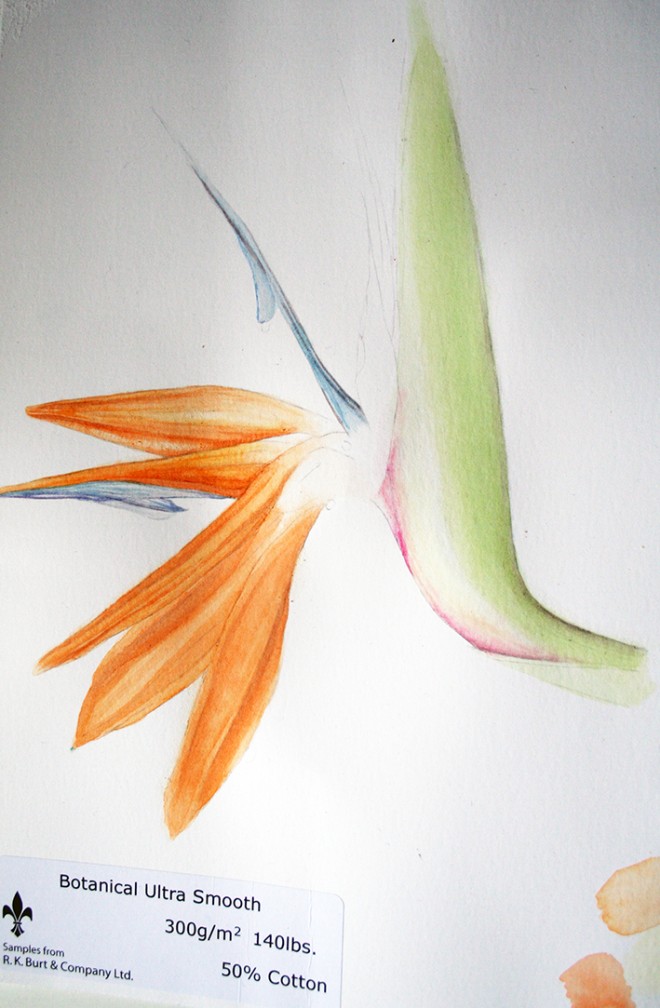
I did not stretch the paper and after sketching out a flower lay down an initial wash of clean water. After a minute I added a wash of orange which set into the paper nicely with a clean edge. I wetted the edge of the wash to blend in with no problems. I allowed the paper to dry before adding further washes. Unfortunately, after a third light wash the paper started to break down. “Dry brush” work didn’t seem to cause too much problems. However, lifting out areas of paint with a wetted flat brush on the petals also proved too much for the surface to cope with.
I decided to abandon the painting at this point as I am more used to a paper that is able to cope with numerous wet washes and layers of dry brush work (I do tend to punish the paper!)
As I understand it, this paper is an alternative to Fabriano 5 which I have never used due to its 50% cotton content. I have always used Fabriano Artistico heaviest weight HP as it is (was?) which is 100% cotton and is a very robust paper.
In conclusion I would say that the Botanical Ultra Smooth is adequate for preliminary work but it is just not durable enough for finished artwork.
Botanical Artist, Illustrator & Tutor Dianne Sutherland has also tried the new paper, here are her thoughts:
Botanical ultra smooth is a HP paper similar too Fabriano Classico (5) with the same 50:50 cotton:pulp and it performs in a similar way. It’s also very white – a bit too white for my liking – and contains optical brighteners, for these reasons I wouldn’t use this paper for paintings. Technically it is ‘archival’ however the inclusion of brighteners is not measured in ISO paper testing. Having said this I might use it for illustration work where longevity isn’t an issue but a clean white surface is required.
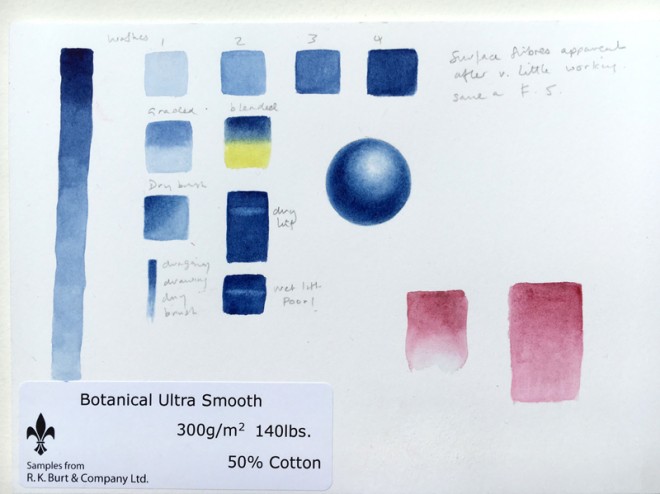
In terms of performance: as I say similar to Fabriano Classico but a touch smoother, colour is bright and clean, however the surface doesn’t hold so well for multiple washes and dry brush work and unlike a 100% cotton paper it starts to release fibres, no doubt due to the pulp content. Overall I’d say it’s a good enough student quality paper or illustration paper, if you’re looking for a very smooth white surface.
Finally, just back from the Society of Botanical Artists Annual Open Exhibition, artist Shevaun Doherty has kindly given us a real in-depth review:
In recent months, there has been a discussion amongst artists about watercolour paper. Many botanical artists, like myself, use the Fabriano Artistico Hot Press paper, but changes to the manufacturing process have left a lot of them dissatisfied. St. Cuthberts Mill, a British company, has recently brought out two new papers which could provide an ideal alternative- Saunders Waterford HP and the Botanical Ultra Smooth. So, when Jackson’s Art contacted me and asked me to try out the new Botanical Ultra Smooth paper, I immediately said yes. I still have a reasonable stock of the old Fabriano Artistico, but I have heard a lot of mixed reports about the Botanical Ultra Smooth. I was curious to see just how this new paper performed.
The paper arrived and true to its name, it is very smooth … deliciously, enticingly smooth. It’s also very white, much whiter than any of the other papers that I have here. It is being branded as being quite similar to Fabriano Classico, which is the paper that SBA Diploma students are given, and one with which I am quite familiar. Although the Fabriano Classico is okay, it is only 50% cotton, and so the paper surface can’t take a lot of abuse. Fabriano Artistico on the other hand is 100% cotton, and so stands up well to wet washes, lifting and the occasional scrubbing.
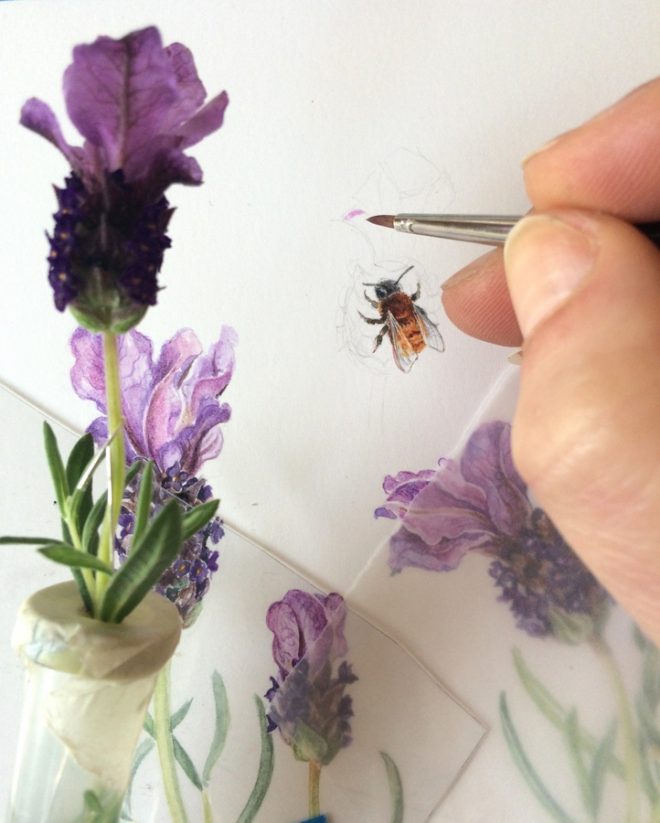
With an open mind, I decided to paint a sprig of Spanish lavender on the Botanical Ultra Smooth. I have to say that I was pleasantly surprised. The paint went on well, the colours were very crisp and clear, and I could lift the paint quite easily. There was almost no bleed (as happens with softer papers), so it was easy to paint really fine details. That’s just as well, because Spanish lavender is covered with lots of really tiny dark purple flowers. The showy purple sepals on the top of the lavender needed wet washes and smooth blending in order to achieve the translucency, but again I had no problem.
I don’t know whether it was the warm sunshine and scent of lavender in my studio, or simply the pleasant experience of painting on the silky smooth surface of the paper, but I decided to keep going. As it was Earth Day, I added a rare bee to my painting, the Tawny Mining Bee. Again, I had absolutely no difficulty rendering the fine details on the paper, which made me appreciate the paper even more.
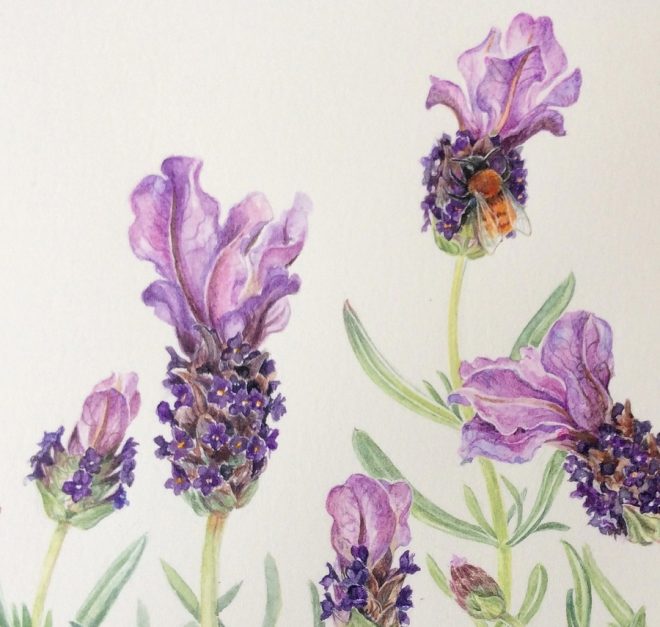
So one lavender sprig soon turned into a dozen. In fact, I would have kept painting, but ran out of space!
Just to compare, I decided to see how the lavender fared on my favourite Fabriano Artistico paper. The biggest difference really was the colour of the paper. I actually prefer the softer creamier colour of Fabriano, but really that’s a personal choice. Still, I think that the Botanical Ultra Smooth stood up well as a comparative paper for artists.
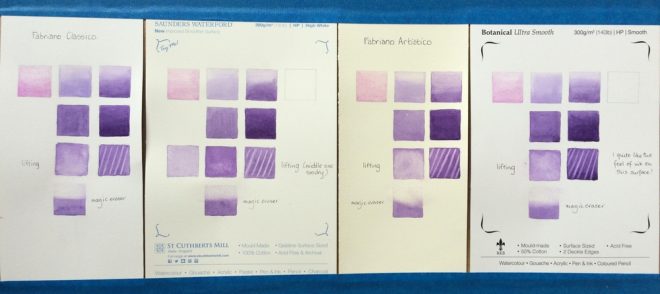
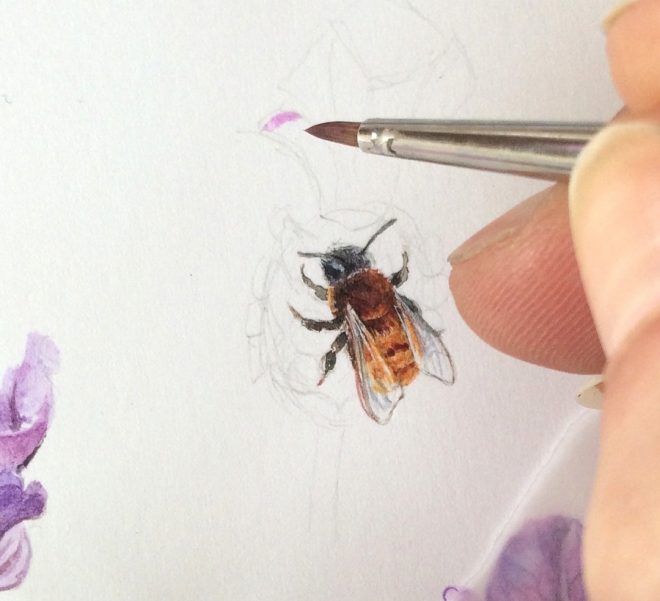 Finally, I decided that to be really fair, I should do a non-scientific test on all four HP papers- the Fabriano Classico, Saunders Waterford, Fabriano Artistico and Botanical Ultra Smooth. All of the papers are 300gsm.
I began with a wash of Cobalt Violet, which I often use in my first washes. It’s a great colour (ideal for reflected lights) but can be a bit difficult to handle because it granulates. The Botanical Ultra Smooth took the washes really well and gave the cleanest brightest results, which is unsurprising given the whiteness of the paper.
I then did washes of Winsor Violet (Dioxine), and tried lifting and scrubbing with a stiff brush and also using the magic eraser. It’s a wonderful pigment, but has a tendency to stain. Woe betide the artist who drops their brush loaded with this paint on their paper! The magic eraser is a great help, but really abrasive to the paper surface.
Here are my results, rated 1 (best performing) to 4 (worst performing)-
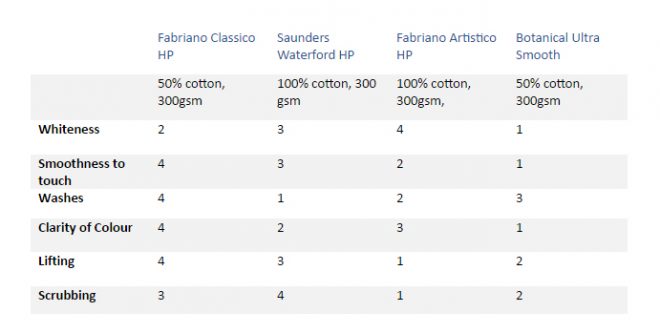
Conclusion:
The Botanical Ultra Smooth was actually quite a surprise to me. I had a lot of reservations about trying this paper out, particularly because of the 50% cotton content and the whiteness of the paper. However, it was really nice to paint on and gave great results. It is considerably smoother than the other papers, which makes it an ideal paper for rendering fine details. I noticed too that writing in ink on it was a lot nicer than on the other papers, and so I imagine that it would be ideal for scientific illustration. The paper surface stood up quite well to scrubbing. Although I still love my Fabriano Artistico (and am smug in the knowledge that I have a good stock of it), I would recommend this paper, particularly for illustration work.
Shevaun’s Facebook Page: https://www.facebook.com/shevaundohertyart/
Follow Shevaun on Instagram: @shevaundoherty

2 thoughts on “New Botanical Ultra Smooth Paper”
I tried the St. Cuthberts Mill Botanical
Smooth, and whilst it’s the smoothest paper
when dry, when I wet the paper and stretch
it, the surface becomes much more textured;
more so than every other hot-press paper
I’ve tried. As I use a lot of water with my
paint, and so always need to stretch the
paper first, the Botanical is entirely unsuited
to to taking detail. I wonder if anyone else
has the same experience…
Hi John,
Thank you for your comment and for sharing your experience – that’s really interesting. I’ve got a couple of sheets on order (a sample size sheet and a large sheet) which I’m going to test and see if I get the same result as you. I normally work quite dry with watercolours so the detail aspect for me isn’t usually an issue as the paper doesn’t tend to get that wet. I’ll stretch it as you do and see what it looks like texture wise and let you know.
All the best,
Christine
Comments are closed.