



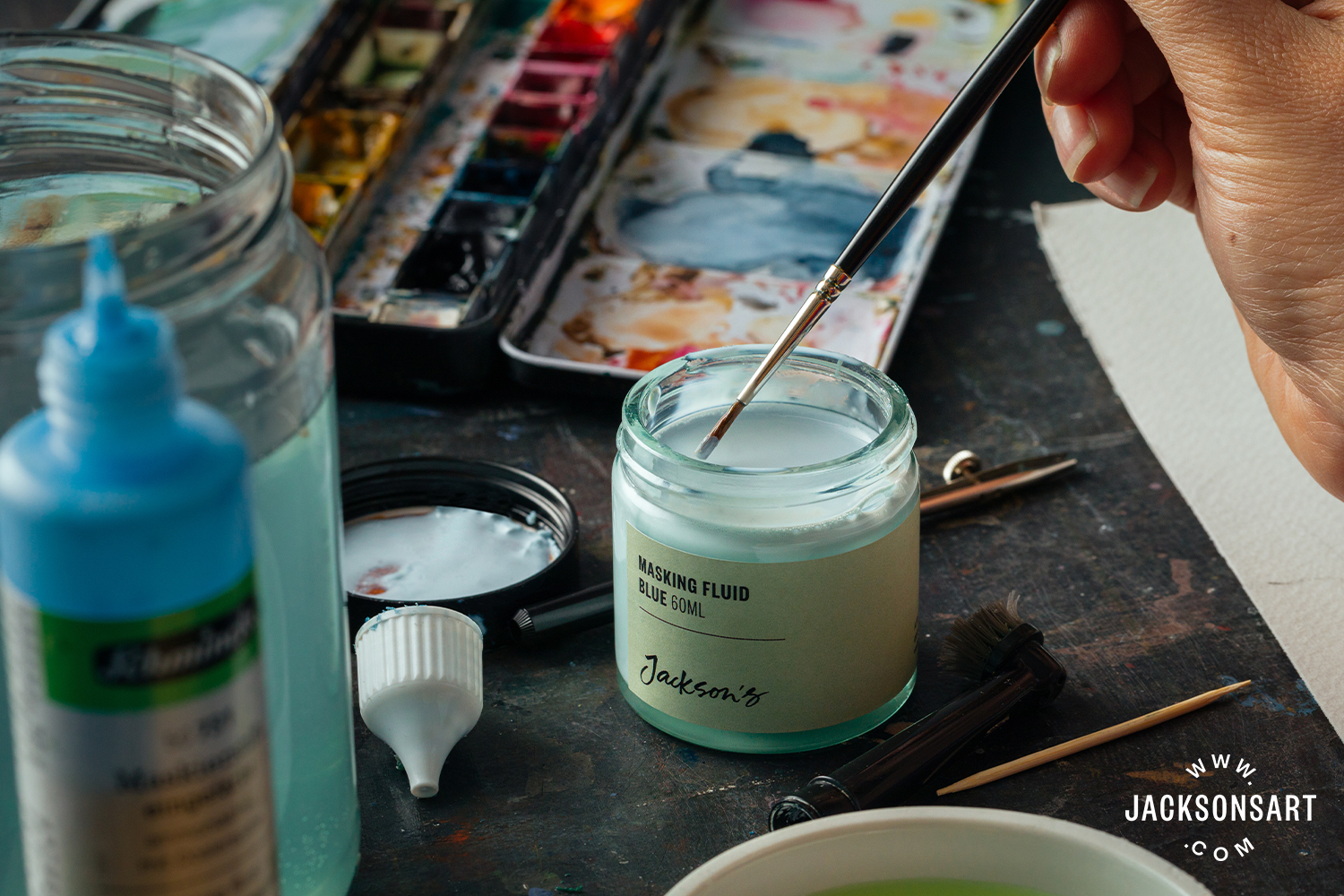
In watercolour painting, unlike other media, the whites are not added as paint but are reserved areas of the paper that are not painted on, so the white is the colour of the paper. Masking fluid is a liquid latex-based product that is very effective at keeping small areas and thin lines white when painting on watercolour paper. The rubber prevents the paint from reaching the paper and is peeled off to expose the white paper left untouched.
The masking fluid can be applied in many ways, almost any tool will work. You may use a brush, a ruling pen, a dental pick, a Colourshaper applicator or a special Masquepen or Super Nib which is a needle that gives extremely fine lines. (The Super Nib comes with an empty bottle that is for filling with water, attaching the needle to the end and squirting the water through the needle tip to clean it when finished. Do this straight away or the needle will be very difficult to clean.) If you need splattered white dots you can flick the masking fluid from an old toothbrush.

If using a brush you might want to keep one inexpensive brush to use exclusively for masking fluid because the latex might not come out completely when you are finished. One trick to make it easier to clean your brush is to wet the brush thoroughly and wipe the hairs over a bar of soap or dip it into washing up liquid, making sure that the hairs are thoroughly coated right up to the ferrule and then use it to apply the masking fluid. Wash the brush thoroughly immediately after use.
Masking fluids come in different tints so you can see where you have painted it. The places that masking are most useful are small white areas or lines within a large even wash of colour, like sailboat rigging against the sky, where you don’t want to paint around areas and interrupt a smooth wash.
The paper must be dry when you apply the masking fluid. If it is wet the masking fluid will soak deeply into the paper rather than sitting on the surface. The paper will usually tear off with the masking fluid when you attempt to remove it when you are finished. The same problem occurs if you dilute the masking fluid when you use it. Shaking the bottle will introduce air bubbles and if applied the bubbles will pop during drying and leave unprotected spotty areas.
Wait until the masking fluid is completely dry, at least five minutes, before you paint the watercolour. After you have finished your painting and it is completely dry you can then remove the masking fluid. Some artists rub with their finger or a putty rubber to get it started. The artist Kory Fluckiger shows in his book Watercolour for the First Time how he paints a patch of masking fluid the size of a penny on a corner of his palette when he starts painting and later when it is dry he rubs it into a little stump and uses this, as the masking fluid sticks best to itself. Get a corner to pull away and then lift this away from the paper and it should pull away in thin stretchy strips or sheets.
Remove the masking fluid as soon as possible after the painting is dry. The longer the mask is left on the paper the more likely it will be to adhere and be harder to remove. Also, the colouring in the tinted fluids can stain the paper if left on for a long time.
After you have mastered using masking fluid you will be rewarded with those lovely sparkling whites in your watercolour paintings.

Note: All of the underlined words in the articles are links to those items on the Jackson’s website.
How To Use Masking Fluid, Masquepen & Ruling Pen by Jackson’s Art Supplies



8 thoughts on “Using masking fluid”
help the masking fluid keeps taking the top layer of paper of when i try to remove it the paper is not wet and the masking fluid is dry and only been on the paper for 3 hours what have i done wrong its driving me mad help
Hi Diane
What we discovered in our recent masking fluid comparison tests: http://blog.jacksonsart.co.uk/?p=6702
is that some brands are a bit easier to remove than other and that it is best to remove the masking slowly with gentle rubbing, which worked better than pulling it up like a string.
Also big blobs and thickly applied areas are more likely to tear the paper. We decided the best approach to applying the masking fluid is to have a balance: apply it as thinly as possible because the thinner it is the less likely it is to tear the paper but thick enough to prevent the paint bleeding through.Soft paper is more likely to tear so rough paper is worse, whereas hot press is better.
I hope this helps.
Can masking liquid be used on silk or
fabric to prevent paint from going
beyond the outline as in batik? And does
it Dry clear and wash out if necessary.
Hi Linde
Masking fluid isn’t the right choice for silk painting. There is a specific product made for masking the outlines in silk painting called gutta.
Most gutta is permanent, made to stay as part of the design, so it comes in many colours. There are a few guttas that are removable, like the AV and the Pebeo clear guttas that wash out.
Pebeo make it in a tube with a fine tip and call it an outliner. The AV gutta comes in a small bottle and they call it a contour resist. The Marabu is in a tube with a fine tip and is called Contours and Effects (we will no longer be stocking Marabu and what we have left is all that we have).
Silk Painting Gutta Outliners at Jackson’s.
This link includes the AV Transparent Contour that washes out.
Pebeo also make a clear one that washes out.
after removing masking fluid can i paint
over the surface that was under the
masking fluid?
Hi Samantha,
Yes absolutely, no reason why you cannot paint in areas that once had masking fluid applied to them.
Many thanks
Lisa
Hi, unfortunately I didn’t flush water
through the applicator needle immediately
and now I can’t squeeze any fluid through it,
despite soaking. Also, the needle is so thin
that I don’t know what to use to clean it.
Help! Any suggestions welcomed
Hi Kate
Masking fluid is liquid latex rubber. If it dries in the needle nib you could try pushing it out with a pin or some fine wire. I looked it up and someone says they soak their nibs in solvent overnight and that dissolved the plug.
It might be easier to buy a new one and if it is the regular pen you clean the needle out while it is wet with a pin and if it is the super nib you clean the needle by blowing water through it while it is wet, using the empty bottle provided with the pen.
Comments are closed.