



The Guest Artist section is a place for artists to talk about their work, techniques and materials. I am sure that one artist explaining how they solved a problem will help other artists and I hope that a community evolves where artists will assist each other with their artistic dilemmas, share ideas and technical information as well as make connections and give each other friendly support.
To join the conversation please add your comment below. It will be great to have some interaction!
Here today to share her art with us is Jenny Oldknow who paints in Derbyshire, UK. Thanks Jenny!
JA: Please tell us a little about yourself.
JO: I live in Belper in Derbyshire, and I am married with three children. I work from my home studio – maybe ‘studio’ is a bit grand – I have a table and two shelves at my disposal in the corner of the dining room! I love my little work area though. It is right next to north facing patio doors which let in lots of light, and I have the company of my family and chocolate labrador as I paint! It enables me to keep an eye on the kids too! My husband has offered me a summer house in the garden or a garage conversion for a studio space, but to be honest I love being inside the house with everyone else. If I had a studio anywhere else I would never use it! I like the commute and the fact I can paint in my PJ’s or at 1:00 am if I want to!
I have always enjoyed art, but started painting seriously in 2006, after my children were born. I experimented with every medium, subject and style available, until discovering my real passion was painting in watercolour. A lifelong love of animals naturally led to them becoming a favourite subject, but I have recently started to experiment with more abstract work. I have a visual disorder (a form of macular degeneration called Best’s disease) and although it only affects me minimally at present I anticipate my journey into abstraction will develop further in the future as my art responds to the changes in my eyesight and I will produce more abstracted work as a result.
I have a Diploma in Drawing & Painting which I did with the London Art College. It taught me the right way to do everything, and now all I do in my art is break the rules! It gave me a good grounding though, and I am glad I did it. I sell my paintings through galleries and to commission.
JA: What materials and techniques did you use in making the art work you are showing here?
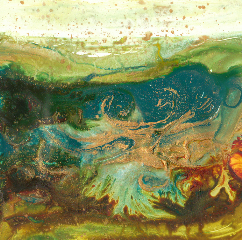
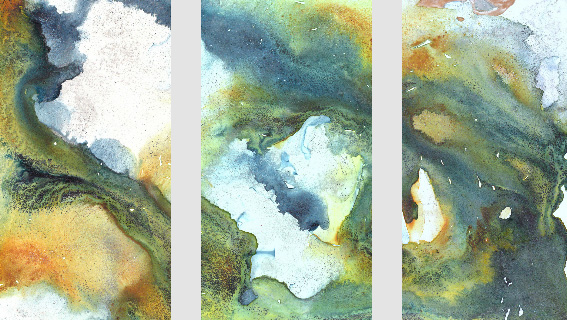
JO: The animal paintings were all painted on extra-rough textured 200lb watercolour paper (Jacksons handmade eco paper), and the abstracts were both painted on ultra smooth synthetic paper, similar to Yupo, called Lana Vanguard.
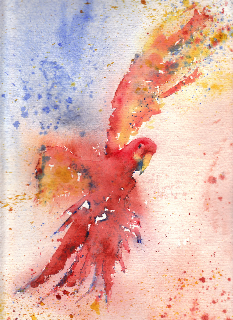
I mainly use Winsor & Newton artists’ quality paint, which I buy in tubes – the bigger the better, and W&N do these great big 37ml sizes! Until recently I only used a low intensity palette of colours (including naples yellow, transparent yellow, quinacridone gold, burnt sienna, perylene maroon, caput mortuum violet, neutral tint, Payne’s gray, prussian blue, indigo and sepia), but I have been experimenting with a more vibrant palette (including Winsor red, alizarin crimson, cobalt blue, french ultramarine, cadmium yellow and cobalt turquoise light), as you can see in some of the paintings shown here, most notably in the painting of the parrot. I also use Schmincke gold and silver watercolour paint, especially in my abstract work, such as in ‘Dalley Lane’.
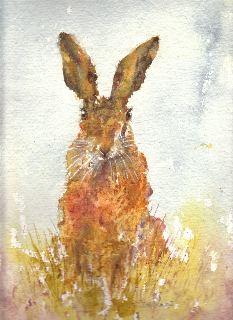
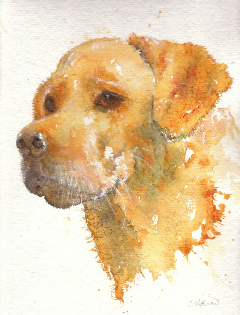
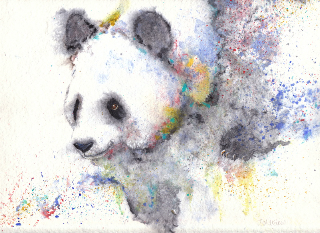
I used the low intensity palette of colours for the abstract triptych, the hare and the yellow lab painting and more vibrant primary colours for the parrot, the abstract ‘Dalley Lane’ and a mix of the two for the panda. White gouache is used for adding small white highlights, such as in the eyes. I don’t use any masking mediums; I just use the white of the paper for larger white areas.
For much of my work I use round kolinsky sable brushes in a range of sizes from a size 4 to a size 14, and synthetic riggers too to drop paint into smaller areas where I want more control.
Like most artists I have a lot more materials in my ammunition, but these are my favourites. I also use things like sticks (bamboo and ones from the garden!), granulation medium, salt and clingfilm to create the effects I like. One of my ‘secret’ weapons for adding interest and texture is rubbing a watersoluble pencil on sandpaper over wet areas of a painting to give a lovely speckled effect. I use both watersoluble graphite and coloured pencils to do this.
I generally work using a range of techniques, including wet in wet, and wet on dry. A characteristic of my work is the use of paint splatters which I create by flicking the paintbrush or by using an old toothbrush. I used most of these techniques to a greater or lesser degree in all these paintings you see here.
JA: What challenges (if any) did you face in making this work and can you give other artists any tips for solving similar problems?
JO: The main challenge I face in my more figurative animal paintings is to know when to stop. I do not like to achieve a too ‘polished’ result in my work, but it is always so hard to know when to stop. I always think that the next brushstroke will complete the painting, but 20 brush strokes later the painting has gone too far and in my opinion it is ruined. A practical tip is to wash off paintings which I am unhappy with under a running tap. The paper can be then used again, with just a ghost of the original image showing to work with. Another tip when painting figuratively in a loose and expressive style, is to stop as soon as you can see what it is you are painting! I should have this tip pinned above my painting table as I often forget this myself in my eagerness to achieve that ‘perfect’ painting! To me though, the perfect paintings are those that leave detail to the imagination, and deceptively look like they have been painted in two minutes! I will continue to practice what I preach!
The abstracts on the other hand did not throw up any major challenges, as they rarely do, and I think this is because I painted it with no preconceptions of an end result. The aim is to play with pigments, brush strokes and effects, although in reality, both the abstracts shown here were painted with very few ‘effects’, the paint effects seen are purely a result of using the smoother synthetic paper.
JA: Please tell us something about the idea behind the work you are showing here.
JO: The main aim when I am painting animals is for the viewer to be able to see what it is, but without it being a slavish copy of a photographic image. I have a great admiration for artists who paint in a photorealistic style, but that is not for me. I try and capture the character and essence of the subject. This is especially shown in the painting of the parrot, ‘Red Flight’ where I utilised the flowing vibrant colours and paint splatters to show the movement of flapping wings and feathers. I often start from the eye and nose area, which is the part I depict with the most detail and work out from there, getting more abstract as I work outwards, sometimes incorporating a mottled background, or no background at all. I dislike painting detailed backgrounds in my work as I always want the animal itself to be the centre of attention and focus, and try and keep backgrounds more abstract and ambiguous.
When creating pure abstract work, I have no idea of what the painting will look like. I choose pigments and go from there. By using the synthetic paper, rather than traditional watercolour paper, I find the painting almost creates itself, as the paint flows freely across the paper, creating wonderful effects. This is so unique as it almost ‘repels’ the watercolour, The watercolour takes a while to dry as it lies on the surface, not absorbing into the paper like it normally would. I love painting abstractly on this kind of paper, but painting the animals on it just doesn’t work for me; I don’t like the results when I paint abstracts on traditional watercolour paper either. I never enjoyed painting abstracts in oils or acrylics as much as they just didn’t flow enough. I like the way that watercolours almost paint themselves if they are allowed to!
JA: How does this work relate to your artistic practice, how you approach art over-all?
JO: I guess my approach to my artistic practice is one based very much on experimentation. I want to grow as an artist and I feel that I could never get bored of experimenting with watercolours. It offers such a wide range of possibilities that I have not discovered yet.
Even my most figurative work has a large abstract element to it and this is something I want to develop even further – I am always playing with how I can most successfully incorporate the abstract effects I discover into my work.
JA: Do you have any art advice you would like to share?
JO: Practice, practice, practice. Books and DVD’s are great, but there is no better way to improve your painting than just doing it as often as you can. And it is very important to enjoy doing it. Use the mediums you enjoy using, the colours you like and paint the subjects that inspire you. As for working in watercolour, I have already said it, but it is worth repeating – DON’T overwork it! Stop before you think you need to. Most of the time I approach painting with the attitude of ‘playing’ then if it works (which it is more likely to do) then that is great and if it doesn’t work then it does not matter.
JA: What is your favourite art material?
JO: Definitely Winsor & Newton Artists’ Watercolours. If I had to choose just one colour it would be Sepia!
website – www.jennyoldknow.com
blog – www.jennyoldknow.blogspot.com
twitter – @jennyoldknow
facebook – Jenny Oldknow Art
email – jenny.oldknow (at) btinternet.com

3 thoughts on “Guest Artist: Jenny Oldknow”
Pingback: Jacksons Eco Paper now in GIANT sheets | Jackson's Art Blog
Jenny, What a wonderful article! I really enjoyed reading this as it goes to show that to produce fantastic art its not necessary to have spent half a liftetime getting qualifications and degrees. As a teenager I used to paint often, in oils mainly, and then it stopped. I’ve been hankering after painting again, I’m now in my mid fifties, but seem to lack motivation. I have a shelf full of art books but still find myself thinking rather than doing. Keep up the good work.
Thanks Barbara! There have been times in the past when I wished I had a degree, but not anymore! I am at a point where I am happy with how my career is heading, and the Diploma I did helped consolidate the theory and provide a focus for my practice. It has also helped give my students confidence in my teaching abilities, but I would probably have done no worse without it.
It is never too late to pick up the brushes! I run a weekly class for a small number of students, maybe there is something similar offered near to you. Many of my students would never paint outside the classes, so it gives them an incentive to get the paints out regularly!
I am starting some online courses soon too, if you are interested then email for more details! Good luck with your artistic journey!
Jenny
Comments are closed.