



The usual choice of palette for laying out your oil paints and mixing the colours is either a white palette, a traditional brown wooden palette, a glass palette or a pad of disposable vegetable parchment sheets. Each has its advantages. We also have grey paper, grey wood and grey glass palettes if you prefer a neutral colour to judge your colour mixing against. Our clear plastic palette can be useful for taking to the easel and seeing the colours held up against the painting. If you mix up large amounts of paint for impasto painting or large paintings you might use plastic jars, jam jars or takeaway food boxes to mix and store your colours.
A White Palette
The advantage of a white palette is that many artists start off with a white canvas and so can judge the colours in the same relationship to the white.
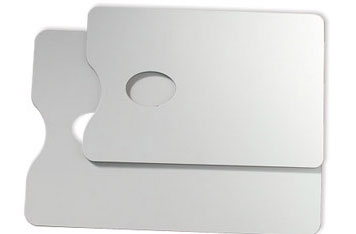
White palettes can be plastic, melamine-style or ceramic (though ceramic is usually for watercolour). Wood palettes can be kidney shaped or rectangular, with a thumb hole and a cut-out for the fingers to hold a few brushes. The tear-off palettes come with a cardboard back that keeps the stack of paper palettes stiff for holding when standing at the easel. Some are bound on two sides to the pad so that they don’t blow in a breeze if painting outdoors.
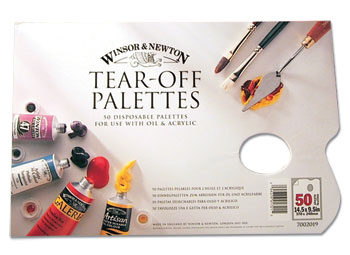
Disposable palettes are very convenient, especially for painting en plein air.
A Wooden Palette
If you use a toned ground it might be better to use a wooden palette as the brown will allow you to see how your colours will appear on the medium tone as opposed to on white. It is also useful for seeing colours correctly when any painting is underway and is no longer primarily white canvas.
Some of the wooden palettes are the only kind of the three types that arrives with you in an absorbent form. You will need to condition it – seal it to make it less absorbent of the oil paint. The way to do this is to use a rag and rub linseed oil into the surface, a little at a time until each bit is absorbed. Keep doing layers of this until no more oil will absorb.
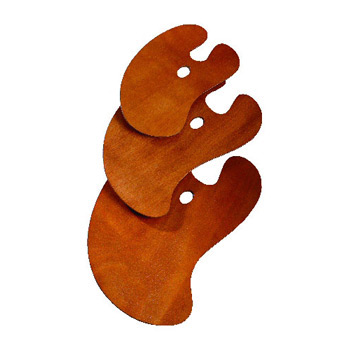
A Clear Palette
Glass palettes are a favourite for keeping on your painting table as they can be cleaned easily and you can put a sheet of paper underneath in the colour of your choice if you wish to judge your colour mixing against a toned ground. The clear acrylic palette is good for holding up to the canvas and seeing through, to judge your colour mixes against what you have on your painting already.

Click here to go to the The Full Palette Department on the Jackson’s Art Supplies website.
Update:
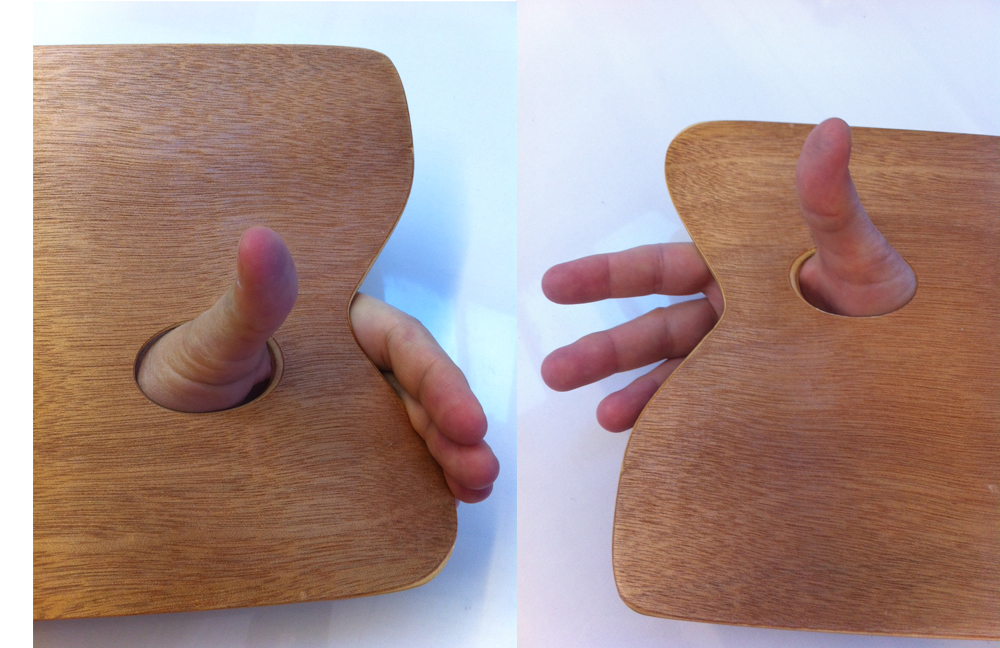
After a discussion on our Facebook page I checked to see which palettes could be used by left-handed artists. The problem is the beveled edge in the thumb hole, if you switch most palettes to the right hand for left-handed users the bevel is very uncomfortable.
I found that the rectangular wooden palette we stock has the thumb hole almost in the centre so you can swing it around rather than flip it over, so the bevel always stays upwards. This means the bevel works in either hand.
Further update:
We now stock wooden palettes by New Wave and Zecchi for left-handed oil painters.



7 thoughts on “Choosing an Oil Painting Palette”
I’m just trying oils for the first time and this was a very handy break down on palettes. I didn’t even know about the tear off kind. Thanks
The wooden palettes that you sell made by New Wave art do
not need conditioning in the way that you describe here. The
surface of these palettes are so well refined and polished
that they make cleaning up a joy. Honestly if you’ve struggled
to keep a wooden palette clean you need to try one of these!
Also an interesting new addition to the ‘New Wave’ family is
the TIMBr pad – a disposable palette pad made with brown
sheets rather than the usual white.
Hi Haidee-Jo.
Yes, I love the New Wave palettes, they are top of the line! A very nice finish. And a superb shape, quite easy to hold.
The do-it-yourself finish mentioned in this blog article is only required on the inexpensive, unfinished wooden palettes, not the New Wave palettes that have already been finished for you.
These unfinished palettes are an affordable alternative for those artists that have a smaller budget for tools and materials.
Many artists also don’t mind doing the hand-finishing themselves to save money, it is quite satisfying rubbing the linseed oil in every few days until you have a gorgeous, glassy finish!
I am a new artist. I started with acryllics
and used one of the masterson system
((close lid) palettes to keep my paints
wet for up to a week. I am using alkyd oil
now and am struggling to keep them wet
and not dry out in about 48 hours. How
do you keep oils from drying out?
Hi Janet
Keeping oils wet is the struggle of all oil painters.
If you are using alkyds they are made to be fast-drying and will dry on the palette or painting in as few as 8 hours. So you have it even worse.
Most oil painters only put on the palette what they will use in 1 day. If you have leftover paint at the end of the day there are a few things you can do. You can use it up in a quick, free ‘palette painting’ that many artists find a good winding down exercise. You can scrape it into a grey sludge jar with some added oil to use as a neutral grey. You can use it to tone canvases for another day. You can put it in a palette box sometimes for a day or 2. Or try cling film or similar. I use a dumpling box.
If you are concerned about mixing up the same colour the next day, remember that there is no colour shift from wet to dry like in acrylics so it’s pretty easy to mix the same colour again. Writing notes about which colours you used in the mix can help.
Just a quick question. I need to paint
steel to give it a look of vanished wood
Hi Bonnie
I’m not sure what information you are looking for.
Comments are closed.