



Winsor & Newton Liquin oil painting medium is a fast-drying alkyd medium that comes in five thicknesses for different effects. You mix a small amount with your oil colour to thin your paint or thicken it and it also speeds the drying time. It halves the drying time of conventional oil colour (touch dry in 1-6 days depending on colour & film thickness). It dries transparent but some people have found it yellows over time so you may want to avoid using it with whites or keep the proportion of Liquin that you mix with your paint small, although Winsor says it does resist yellowing. Mixing alkyd in with your oil paint helps it be more crack-resistant, flexible and tough.

The Liquin Fine Detail is the most fluid. This quick drying, gloss medium is ideal for fine details, glazing & blending or to produce a smooth surface picture.
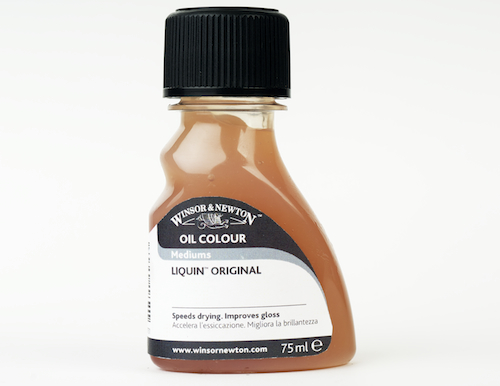
Liquin Original (formerly known as “Liquin” and “Wingel”) is the next thickest in the range. This reliable favourite is a general purpose semi-gloss medium which speeds drying, improves flow and reduces brush stroke retention. Good for glazing.

Liquin Light Gel is thick in the bottle but as you stir it will become more fluid and then it thickens up again when it sits (this characteristic is called thixotropic.) This quick drying gloss medium offers a slight gel that brushes out smoothly and is ideal for artists looking for a non-drip effect when mixed with colour. Good for glazing.

Winsor & Newton has two different products to safely thicken oil paint for heavy brushwork or for painting with a palette knife: Liquin Impasto and Liquin Oleopasto.
A few years ago Liquin Oleopasto was discontinued and Winsor & Newton brought out the Liquin Impasto to replace it. But many artists told them the replacement was too different and so the Oleopasto was brought back. They now work side-by-side to achieve different results.
What they have in common:
They are both quick-drying, translucent, gel oil mediums made with an alkyd base, used as mediums in alkyd painting as well as in oil painting impasto techniques. Used as an extender for oil and alkyd paint they give a translucent effect. This means they also make nice glazes. They also provide bulk for the paint. They dry to a crack-resistant, flexible, tough and virtually non-yellowing film that can be varnished in the normal way.
The differences:
Liquin Impasto is stiff, it retains crisp textures and brush strokes without any visible levelling. It also allows more blending time as it doesn’t dry quite as fast as the Oleopasto. It dries to a uniform semi-gloss/satin sheen.
Liquin Oleopasto has a soft gel consistency so there is some levelling of brush and knife marks, it retains the marks, just not crisply. It dries more quickly than the Impasto so the paint feels thicker quickly. (Those artists who complained about it being replaced said things like the Oleopasto had more “brush drag”, and that was important to them.) The quicker drying allows rapid overpainting. It dries to a uniform semi-matt finish.
Click here for a video explaining all the Liquin products.
Click on the underlined links above or the images to go to the Liquin products on the Jackson’s Art website.
The Oil Painting Department on the Jackson’s Art website.


26 thoughts on “Liquin Oil Painting Mediums”
Do you stock the old style W & N bottles as shown in the top photo ?
The new ones are really really hard to open & I refuse to buy them.
Thanks for pointing that out, I didn’t realise we had used an old picture.
No, I’m afraid we just stock their current stock.
Have you given them some feedback on your problems with the lids? They would probably value the feedback. Here is their contact: http://www.winsornewton.com/about-us/contact-us
belated reply
I discovered if I cut off the black
part of the lid, it removes the
‘child/adult’ safety mechanism.
The inner part of the lid becomes the
new normal lid
Bob
I took a workshop where we first used
acrylic paint for basic picture structure
then glazed over it with Liquin. When
artwork dried we finished final work
with oil paint. I’m use to spray
varnishing all my oil work . Can I still do
this in this type process to finish the
work. It brings back the best of the
colors of the work which is my favorite
thing painting.
Hello
Yes, you can spray varnish an oil painting that has an acrylic underpainting just as you would any oil painting. The oil varnish works on oil or acrylic.
Yes, varnishing really does wonders to a painting sometimes, doesn’t it!
I have to do that. Now that I’m older, I just can’t open
them. I accidentally learned this when I broke a lid off,
trying to open it with pliers.
I have a large amount of Liquin which has thickened to the point that I need to thin it a bit to enable me to use it. What is the recommended solvent ?
Thank you
Hi Irv
I have checked and found out that White Spirit or Sansodor will bring your Liquin back to life and will make it thinner.
I hope that helps.
Dear Julie,
I work with Liquin Fine Detail for my oil paintings. And quite a large quantity of it has started to thicken. Instead of Sansodor, can I use distilled turpentine to thin it. And what proportion should this be used in,
Hello Sripriya Mozumdar
I have sent a message to Winsor & Newton to double check my thoughts and will get back to you as soon as I hear from them.
Hello Sripriya Mozumdar
I double-checked with Winsor & Newton and yes, turpentine will reconstitute Liquin as long as it has not turned solid.
I have found all alkyd mediums will solidify if exposed to air, even the air inside the bottle. I haven’t found a good solution to this for myself, the best I have found is to pour a thin layer of solvent on top to act as a barrier, sort of like a liquid cling film.
You might find it a little difficult to mix a thin liquid into a thick liquid. I have found that it is easier if you do it in advance of when you need it and turn your container upside down every few hours and let them dissolve into each other.
The proportions are up to you- add the amount required to thin it to the original consistency.
I hope that helps.
Dear Julie, thanks for taking time and effort to reply to me.
Over the last few weeks, I have tried the following with varying results:
1) I poured out a small quantity of Liquin Fine Detail (the amount I would need for a day or two worth of work) and thinned it with Sansodor (which u had earlier mentioned). Let it rest for 5 minutes and then begin working. While the fluidity of the medium is restored, I find that the paint mixed with this Liquin is drying up too quickly on the pallette. So within 1.5 hours of work, I have paint that has become far too thick to work with.
2) Since my Liquin is just slightly thicker, I also attempted using it without Sansodor. Even then it seems to be thickening too fast for comfort.
Is this the expected response or am I doing something wrong. My logic tells me that whether Turpentine or Sansodor – since both are fast drying, they will end up fastening the drying action of Liquin,
In my situation (I do photorealistic paintings with high detail), and I use Liquin for its faster drying as compared to Linseed oil; the current rate of paint drying or thickening or palette is proving difficult for me to work with.
Is the only solution here to junk this bottle of Liquin and buy a fresh one.
Alternately, I am half-way through with my first layer. Can I safely switch to Linseed oil without it affecting the integrity of the half-done layer.
Kindly share your views
Regards
sripriya
Is Liquin original mixable with Gamsol or
other OMS in a 50/50 ratio for washes
and underpaintings?
Hi Ingo
Yes, alkyd mediums can be thinned with odourless mineral spirits and I have thinned them myself at least 50%.
They also benefit from the addition of a small amount of OMS each time you use some alkyd medium from the bottle. The procedure is to add it and shake the bottle so it combines, it doesn’t work just to have a layer of solvent on top. I have found that it actually backfires if you let the solvent just sit on top. If you don’t add some solvent as the amount of alkyd medium decreases in your bottle, the medium will harden in the bottle as more air is in the empty space.
I hope this helps!
Hi Julie
Can I use Liquin Original to oil out a
painting?
(I have used Liquin Original as the medium in
this painting).
Hi Donna
Yes, you can. Remember to not use a lot and wipe away any excess.
Can I use liquin original mixed with oil
and then mix into cold wax? I am aiming
for greater transparency and misty
effects …
Hi Val
Adding linseed oil will slow down the drying time considerably and then it will no longer be Cold Wax, which is used in the way it is because it is fast-drying. Adding oil will make it a wax medium, but not Cold Wax. See this post for mediums that contain oil that were tested alongside the Cold Waxes – Sally Hirst Compares Cold Wax Mediums.
Gamblin Cold Wax contains Galkyd, which is a fast-drying alkyd medium similar to Liquin.
You can add Liquin to Cold Wax without adding oil.
And you can add lots of Liquin if you want to make it less waxy and more transparent.
If you want to make it have a more flowing consistency you could use the least viscous Liquin, the Fine Detail.
Hope that helps.
I added a small amount of linseed oil to
the oleopasto to slow down the drying, but
it slowed it down way too much. Is this a
bad chemical reaction or will it dry
eventually? I was also using Williamsburg
iridescent paints.
Hi Linda
It can’t be a chemical reaction because your paints have linseed oil in them.
But more than a drop or two of linseed oil can make the paint take weeks or months to dry.
If you are using the Oleopasto to make your paint matt then adding the linseed oil will also make it more glossy.
If you are using it to thicken the paint then adding the oil will make it more liquid. Is the paint not thick enough on its own to accomplish what you are trying to do?
How does the proportion of liguin
original to oil paint vary as the painting
commences, in order for the lower layers
to dry first, should you use less
progressively, or just keep it the same.
Or is either ok.
Hi Amanda
Winsor & Newton say to keep it the same.
“Fat over lean
Each successive layer needs to be more flexible than the one underneath. This can be done by adding more medium to each new layer, which makes it more flexible than the previous one and stops the painting from cracking. Think of the rule as “flexible over non-flexible”.
Winsor & Newton offers a range of mediums to help create this flexibility within layers. One of the most commonly used mediums is Liquin Original. Using it means there is no need to keep on adding oil to your colour.”
I hope that’s helpful.
Hi Julie,
Need help . Been using first bottle of
Liquin ,however contents got hard (
could actually use about only 50% ) over
time.
How best to store as I stay in India with
warm interiors of Delhi.
Also the cap opening is a nightmare
considering sometimes, you need to take
some Liquin out to add to another paint
after finishing one section.
Thanks to advise,
Best regards, Vijay
Hi Vijay
I used to have the same problem – all alkyd mediums will get hard in a few months when air gets into the bottle. It isn’t just your climate. The solution with all the alkyd mediums (Liquin, Galkyd, etc) is to add some white spirits each time you remove some of the medium. Add just a bit, about the equivalent of 1/4 of what you have removed, and then shake it very well. It won’t work if you don’t shake it, a layer of solvent just sitting on top will actually make it go hard faster, it must be mixed in. This will keep your medium from getting hard but will slowly dilute it a bit, so that the very last of the bottle will be a bit less thick.
The lid being stuck on can be solved by keeping a rag near your Liquin and wiping the rim before you reclose it. So, each time you pour out the medium you need, wipe the rim, add a splash of solvent, put the lid back on, and shake well. If you keep the rag and solvent with the Liquin it will just take a moment to do and becomes a habit.
Actually, it’s the “childproofing” of the lid that’s my
problem. The “press down and turn” is almost impossible
for me, now that I’m older. I cut the outside lid off, then it
will open naturally. I love using liquin.
Hi Anna
They changed to those hard to open bottles a few years ago and lots of people find them difficult.
I didn’t realise you could cut the outside lid off. Thanks for the tip!
Comments are closed.