



The new High Flow Acrylics from Golden Artists Acrylics have caused a lot of excitement. These very fluid colours have the same high pigment concentration as the heavy body and fluid colours that Golden do but they are as fluid as ink. It is not the same as adding water to the heavy body or fluid colours to make them the consistency of ink, because the colour would be much weaker. If you would like to use full-strength colour in a very fluid format for drawing with pens, painting with refillable markers, airbrush or painting then the Golden High Flow Acrylics might be just what you are looking for. From fine line detail work to broad strokes, High Flow Acrylic has an ink-like consistency that lends itself to a wide range of techniques.
Golden High Flow Acrylics are replacing Golden Airbrush Colours, but they are not simply a re-labeling of that line, they are a whole new formula of paint.
As Golden say: “Built from the ground up, High Flow Acrylics are based on completely new formulations that use a different set of binders, a broader range of pigments, and come ready for use in a much wider scope of applications. At the same time, for the vast majority of the colors we were very careful to maintain the excellent sprayability that artists had come to rely on when using the Airbrush Colors in the past. That said, when wanting to explore some of the newer offerings that use fairly large pigment particles, such as the genuine iron oxides and mica-based iridescents, some adjustments to tip sizes and techniques might be needed.”
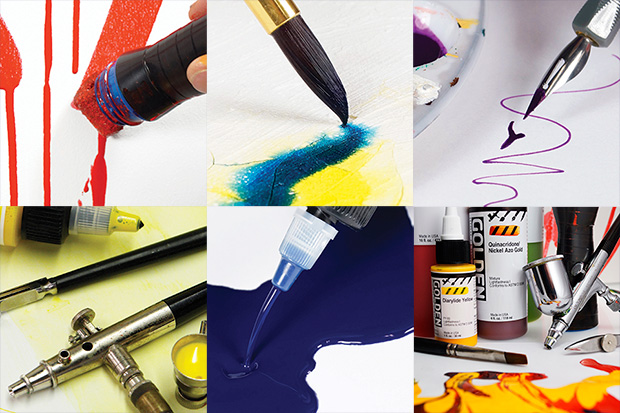
Golden High Flow Acrylics in refillable markers
Golden have done some testing with the new HFA in refillable markers and have a few recommendations that you might find helpful:
“Marker blanks come in a variety of sizes with a variety of tips and can be filled with High Flow. Be sure that the marker blank comes with a bearing or barundum to help agitate the paint when shaking (as the empty Montana markers we sell at Jackson’s do). Overall the Iridescent colors worked in the markers and created a consistent mark for about one week before requiring increased priming of the tip. The Fluorescent colors worked in the markers for just under a month. With the exception of Titanium White and Titan Buff, which required more priming after several weeks, the rest of the colors worked beautifully for the next several months with a few exceptions. The heavier mineral pigments, including the Transparent Red Iron Oxide, Yellow Oxide, Raw Umber, Ultramarine Blue and Raw Sienna needed increased priming and shaking prior to use. After roughly 3-4 months most of the markers still work and work well although they do require increased shaking, priming of the felt tip (depressing prior to writing) and in some cases a slight wetting of the felt tip (quick dip in water). It is highly recommended to change the felt tip when needed and to purchase marker blanks that allow for tip replacement.”
Read more about the new High Flow Colours (including some more technical information) in their Just Paint newsletter.
Click on the underlined links to go to those products on the Jackson’s Art Supplies website.
As always- standard UK shipping is free with orders of £39 or more and just £3.95 for orders under £39.



4 thoughts on “Golden High Flow Acrylics”
When using Golden High Flow in an airbrush, is it
recommended that the Golden High Flow be mixed with
water?
Hi Dennis
From the Golden website:
“Thinning is readily accomplished by simply adding water. Adding over 20% water begins to change other properties. Using a blend of Airbrush Transparent Extender and water can thin the paint and maintain the paint’s integrity. Adding only Airbrush Transparent Extender increases transparency and lowering the pigment amount but does not think the High Flow Acrylics.”
Read more on their site:
https://www.goldenpaints.com/technicalinfo_highflow
Hope that helps!
Hi there, can I use GHF on rubber, plastic? And have it been
cracked overtime?
Hi Tony
Thanks for your question. This is the official line from Golden Paints:
‘Non-Porous Substrates: When working on non-absorbent surfaces such as acrylic sheeting (PlexiGlass®, Acrylite®, etc.), Mylar®, and Duralar®, the HFAs may be applied without a primer. It is important to remove contaminants like fingerprint oils and release agents, and test each substrate prior to use. Because HFAs and other paints take longer to dry on non-porous substrates, some thin mediums and paint layers may crawland not lay evenly on recently applied paint layers.’
So basically, so long as the surface is grease free and dry the paint should adhere to it. Paints will not crack over time, so long as you do not add over 20% water to the colour.
Hope this helps
Thanks
Lisa
Comments are closed.