



Spanish Windmill
by Dirk Schmitt, Cologne, Germany
Step-by-step oil painting tutorial.
Materials
• Painting ground: painting board or canvas
• Various bristle brushes, lint-free cloths
• Schmincke Mussini Oil Colours in Titanium Opaque White (10103), Indian Yellow (10223), Madder Root Hue (10343), Ultramarine Blue Light (10491), Sap Green (10526), Natural Burnt Sienna (10661), Natural Burnt Umber (10666) and Attish Light Ochre (10656)
• Mussini Oil Medium 1 (for thinning)

Step 1
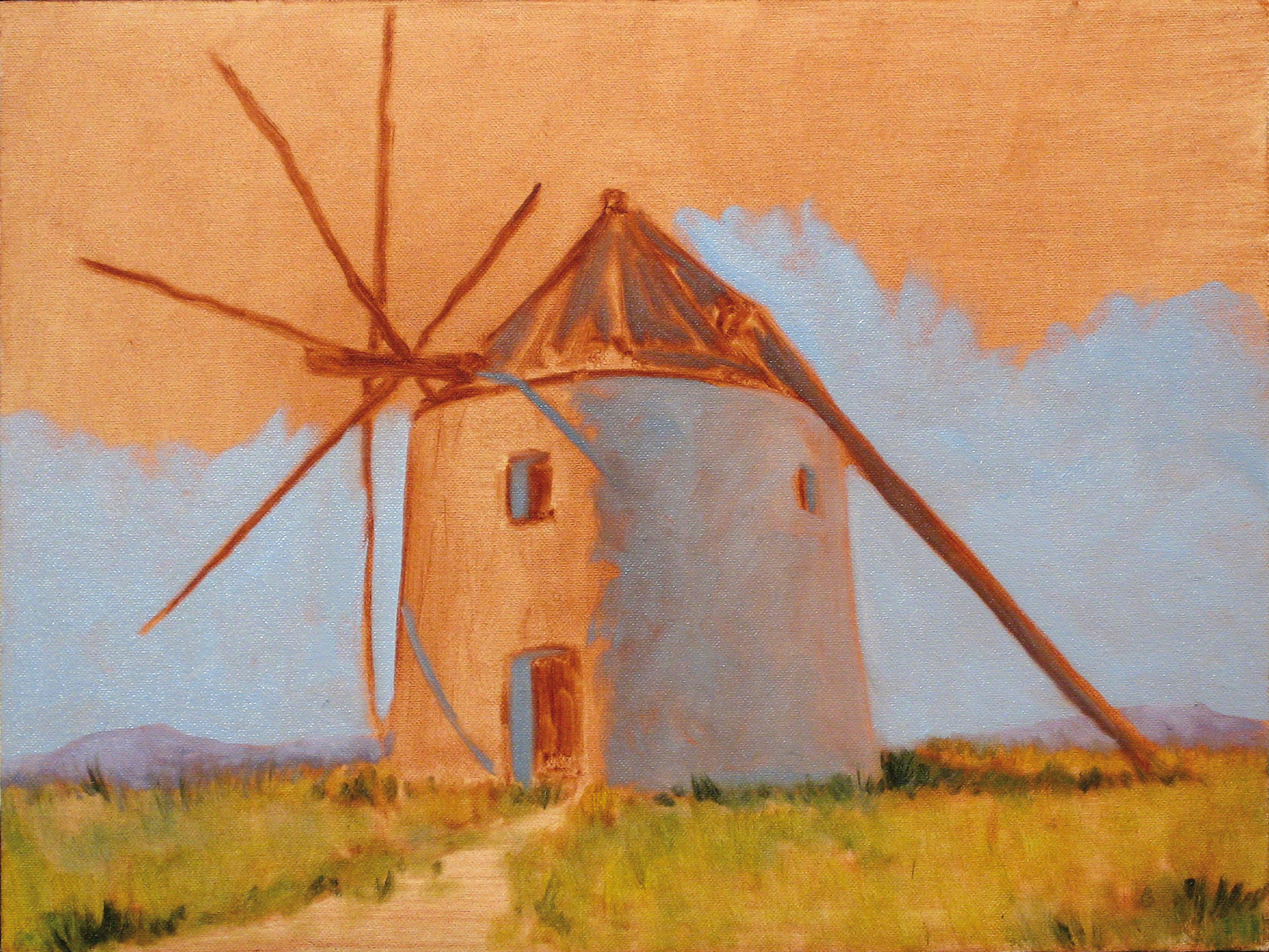
Thin some Natural Burnt Sienna using MUSSINI® medium 1 until you have obtained a solution that is almost like water. Apply this evenly to the canvas using horizontal and vertical brush strokes. After allowing it to dry for about 10 minutes wipe the paint up using a lint-free cloth so that a light reddish brown colour remains. This layer of paint is called underpainting. It is different from priming using coloured ground because it is applied using a translucent shade onto a white background. The white shining through lends brilliance to the paint which is later added on top of it (the light reflects from deep within the picture), the translucent shade adds a uniformity of tone to the colours used (light reflecting from the surface). Draw the mill with a bristle brush using thinned Natural Burnt Sienna.
Step 2
Paint the effects caused by the mill’s own shadow with a mixture made up of Natural Burnt Sienna, Ultramarine Blue Light and some Titanium Opaque White. Paint the wooden beam on the right in a similar manner. Thin a small amount of Sap Green and paint the grass within the shaded section of the building. Mix the same shade of green with a little Indian Yellow and paint the grass on which the sun is shining using short vertical strokes. Make sure that at each stage the paint is applied very thinly.
For the grasses’ shadows choose a mixture of sap green and a little Natural Burnt Sienna. There should however be a preponderance of the green paint.
Paint the mountains a light violet which you make by mixing Ultramarine Blue Light, Madder Root Hue and Titanium Opaque White.

Step 3
Paint the sky a light blue made from Ultramarine Blue Light and Titanium Opaque White. Begin below at the horizon and keep adding to this mixture a little more ultramarine as you work your way upwards into the sky. Again you should make sure that the colour is not applied too thickly. Add a little MUSSINI® medium 1 to the mixture, but there should be less added than with the underpainting. Heed the rule “fat on lean”!
The colours being painted on top should always be thicker than those that lie beneath. This prevents the drying from being uneven and the formation of cracks in the individual layers.
The part of the windmill, which is lying in the sunlight, is painted using a mixture made from Attish Light Ochre and Titanium Opaque White. Using a clean dry bristle brush apply paint to the side of the mill wall which is in shadow. Most of the lane can also be painted using this same colour.
While the paint is still wet apply pure Titanium Opaque White to the lightest part of the dome. Use the Titanium Opaque White for the edges of the roof sections, the window sills, the highlights on the sails and for the parts of the lane that are glistening. Emphasise some of the bright grasses with a mixture of Titanium Opaque White, Attish Light Ochre and Indian Yellow.
Paint the brighter shadows of the turf along the lane with a mixture of Ultramarine Blue Light, Natural burnt Sienna and Titanium Opaque White. Use this colour also for the door and window jambs.

Step 4
For all dark areas e. g. the recesses for the doors and windows, the shadows cast by the mill and the large beam mix together Ultramarine Blue Light and Natural Burnt Umber to produce a warm black.
Finally paint the lines between the segments that make up the sails with Natural Burnt Umber using a fine hair brush.
Information on MUSSINI finest artists’ resin-oil colours
• The artists’ natural resin-oil-colours which are unique throughout the world
• Based on old masters’ formulations
• 101 colours + 7 gold shades offering the ultimate in brilliance and purity – including 64 single-pigment colours
• 42 shades are exquisite translucent colours
• Balanced drying process
• Tension-free and durable colour-layers
• Premium artists’ pigments in the highest concentrations
• Maximum possible light-fastness
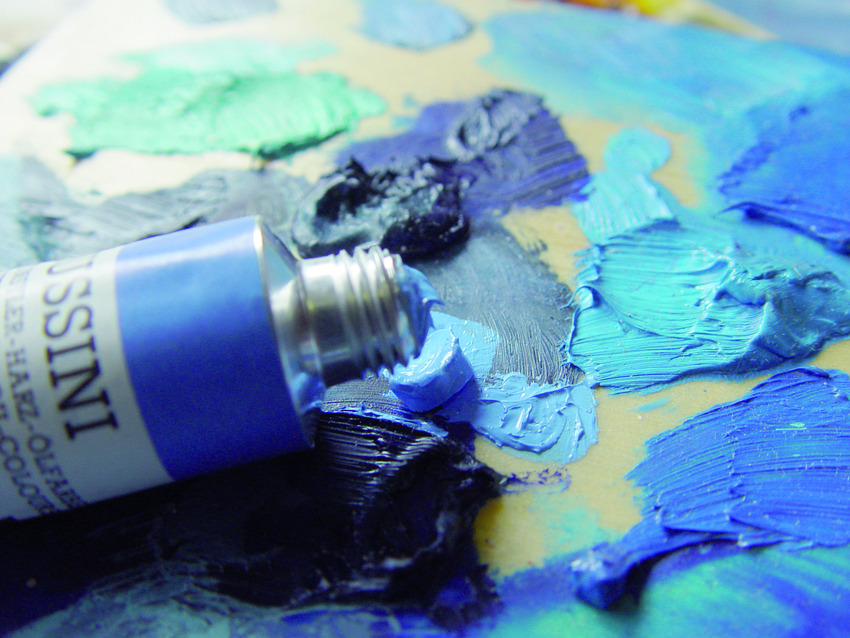
MUSSINI® – unique throughout the world!
MUSSINI® are unique artists’ colours produced by means of a particularly sophisticated manufacturing process to meet the very highest requirements. They contain only the best traditional artists’ pigments as well as several outstanding newly developed artists’ pigments, each in the highest possible concentrations and in pure form.
These outstanding formulations result in artists’ colours of the utmost brilliance and purity, which also mix more readily than premixed colour tones based on a limited selection of pigments.
Schmincke employs more than 250 different artists’ pigments, almost 100 of which are contained in the MUSSINI® range.
Thanks to the particularly extensive range of glaze pigments, their fine processing and the specially adapted formulations, MUSSINI® provides for fine glaze colouring with outstanding brilliance, luminosity and light depth.
Old Masters Oil Painting
The uniqueness of these finest professional artists’ colours stems in particular from the adoption of the old masters’ practice of combining selected artists’ oil with natural resin. On the basis of many years of scientific experience in the field of artists’ colours, Schmincke continues to use a broad and diverse scope of artists’ oils, which it combines with the most suitable natural dammar resin. The amount of dammar resin solution which is added depends on the oil requirements of the pigment concerned.
The use of different variants of linseed oil purified by means of highly sophisticated processes also predominates in the MUSSINI® artists’ resin-oil-colours. However, other artists’ oils, such as safflower oil and sunflower oil, also possess properties beneficial to colouring applications which – when optimised with the requisite expertise – further enhance the formulations.
So-called auxiliary agents and additives are also used, though in minimal and individually dosed amounts. These provide for the consistency and fineness which is required for colouring applications and ensure a harmonious drying process for the oil colours. Pigment and a linseed oil are simply not sufficient to make a good artists’ oil colour.
Schmincke’s research efforts are always aimed at eliciting the full brilliant potential of the artists’ pigments in all their individual variations while at the same time maintaining a harmonious overall range. This offers the artist absolute freedom to combine and mix the artists’ colours of his choice.
What distinguishes the unique MUSSINI® natural resin-oil colours from the best and finest “pure” (resin-free) artists’ colours, such as or other comparable fine artists’ oil colours?
As a result of the largely self-compensating chemical and physical drying process, MUSSINI® dries more evenly from inside, too. The increase in volume resulting from the chemical drying process which begins on the surface via oxygen uptake is largely compensated by the solvent content in the dammar solution which evaporates from inside. The microscopic evaporation pores enable oxygen to penetrate more effectively into the inner layers, thus providing for more even drying of the surface and inner layers.
This, in turn, reduces the danger of wrinkling and surface tension during the drying process. The dammar fractions which are finely incorporated in the solutions are enclosed by the drying artists’ oils and enhance the brilliance of the colour layers. Works by old masters which have been preserved in far better condition than many works by more recent Impressionist and Expressionist masters attest to the durability of such resin-oil artists’ colours.
Click on the underlined link to go to the current offer on Schmincke Mussini Oil Colours on the Jackson’s Art Supplies website.
Postage on orders shipped standard to mainland UK addresses is free for orders of £39 or more.

1 thought on “Spanish Windmill oil painting tutorial”
I want to paint this!
Comments are closed.