



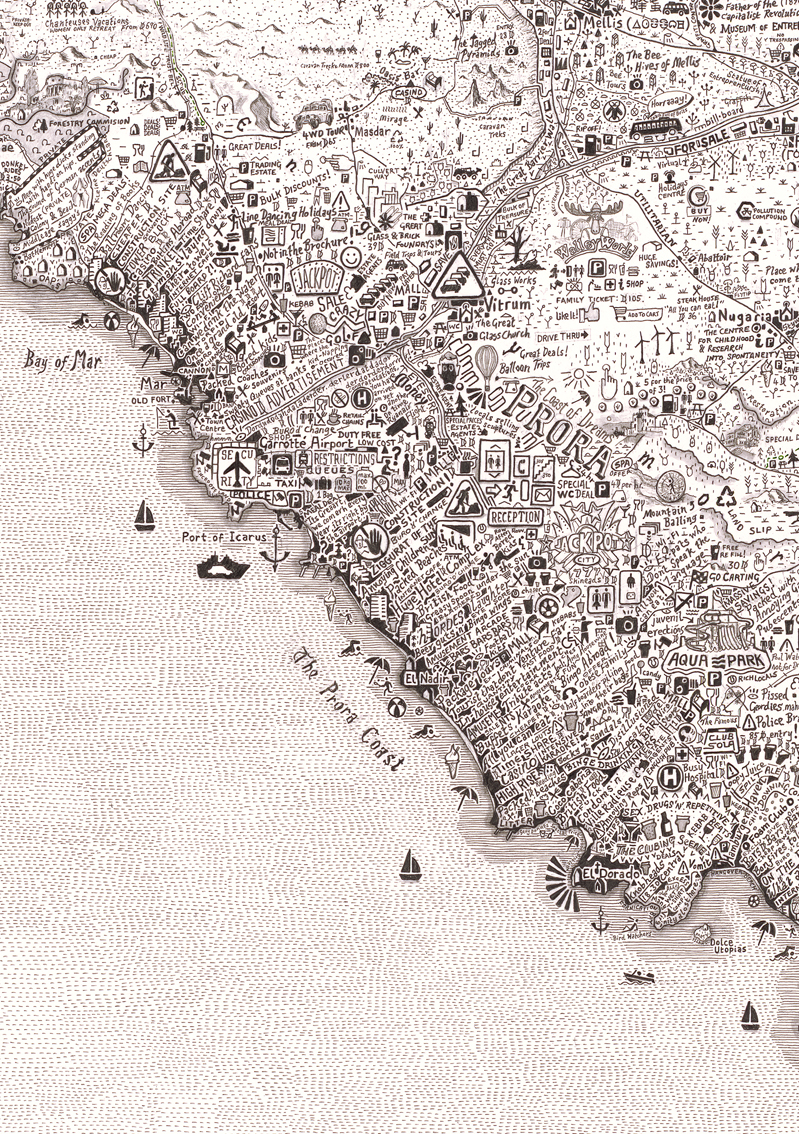
Stephen Walter’s work is an investigation into obsessive drawing techniques, semiotics, the glory of maps, and where landscape is seen a receptacle for meaning. Each work is an intricate world in itself. The maps are a tangle of words, symbols and drawn elements where cultural residues inhabit certain locations. These in turn make up a complex of autobiographical references, epithets, hidden associations and wider contradictions. The landscape works draw the viewer’s gaze from grand viewpoints into the emersion of microscopic detail. They observe the reoccurring patterns found in nature, and the graphic forms passed down from one generation to the next, over long periods of time.
Through drawing, painting, photography and printmaking, he explores the phenomenon of personal and collective experiences of place – both real and fictional. The inner view and its mark-making processes are forced to mingle with the shared space of the outside world – its culture, politics and its relational aesthetics – what he likes to term as ‘inherited histories’. It is in this middle ground where Walter’s sensibilities lie.
Lisa: Many people think of drawing as a meditative practice, quiet and contemplative. Surely you don’t agree?!
Stephen: I think it can be – However I’m not sure you can say that for everyone. I wouldn’t describe De Kooning’s and Giacometti’s drawings as quiet or meditative. Painting can also be approached as meditative, depending on the person. I like the friction that drawing gives to the substrate and the way it exercises the mind, where painting appeals more to the senses.

Lisa: Can you tell us a bit about the Subterranean map and the concerns that you are dealing with in it?
Stephen: In parts of the The Square Mile, there lies over 30 feet of layered human history. At the top, lies the street level of today and at the bottom, the remains of Roman Lundinium. The ground, especially in London, is a palimpsest – a document that is continually being rubbed out and re-written upon; built over and largely forgotten. London Subterranea shines a light on this clandestine world.
Lisa: How do you go about developing ideas for drawings? Do you keep a sketchbook?
Stephen: Yes, I find its best to draw a test before hand then go straight to the main work. I do a lot of this prep scribbling on papers I throw away.

Lisa: Can you describe the importance of historical accuracy in your work?
Stephen: Historical accuracy is important – things need to be double-checked. It is also the case that what is deemed historically accurate is not always what is deemed most important in Culture. Reputations and stories and perceptions all form part of inherited histories. Even the place name histories of most areas of London are inconclusive.
I think it is important to record epithets that are telling of a place, not always or necessarily ‘accurate’. However, it is important not to be whimsical.
Lisa: What sort of things irritate you in the studio and how do you overcome them?
Stephen: Loneliness – Radio
Cold – Radiators and woollen hats
Lisa: How do you go about collecting information for your maps?
Stephen: Reading mostly. Also watching and asking.
Lisa: Do you have any favourite art materials that you could not do without?
Stephen: Graphite

Lisa: Does the process of drawing ever reveal anything to you, or is it a case of, you have an idea, you execute it, job done?
Stephen: Of course the process reveals something in the making, that’s the whole point! Its important for me that I don’t just go through the motions even though I have an established formula at the moment for many of my maps. This is one of the reasons I am working on a body of Landscape works, away from the maps. I am not a production line…
Lisa: What would you be if you weren’t an artist?
Stephen: Nothing

Lisa: Where online or in the flesh can we see more of your work?
Stephen: www.stephenwalter.co.uk – You can sign on to my mailing here and will be most welcome at the come to the shows advertised.
Permanent displays at – Charles Lamb Pub, Islington; Bluecoat Gallery, Liverpool
Accessible Public Collections incl: Victoria & Albert Museum; The British Museum; The British Library; University of Manchester Library Collection; London Transport Museum
or Google me…
A new book, ‘Subterranean London: Cracking the Capital’ by Bradley Garrett and Will Self, with illustrations by Stephen Walter, is out September 2014. More information here


2 thoughts on “Drawings from Stephen Walter’s World”
Pingback: Ten Drawing Articles from our Archive - Jackson's Art Blog
Pingback: Ten Drawing Articles from our Archive - Blog
Comments are closed.