



Pete Monaghan’s recent paintings portray a number of filling stations located in Wales that have become derelict and redundant, superseded by petrol pumps incorporated into the huge modern hypermarkets run by Tesco and Morrison’s. In this interview Pete Monaghan tells us more about the project and what drew him to these images of decay and nostalgia.

Lisa: Can you tell us, in a nutshell, how you became an artist?
Pete: Coming from a large family I had to get a “proper” job on leaving school. I went into engineering with the intention of landing a job in the drawing office, my reckoning was that “at least it’s drawing”! I re-trained in technical Illustration after completing my apprenticeship.
As soon as I was a competent technical illustrator I returned to life drawing classes and workshops to enhance my figure drawing skills and as soon as I could draw figures competently I began taking courses in watercolour painting, then acrylic painting, and, after some years of moderate success and much frustration, I returned to university to do an MA in fine art which gave me a framework within which to explore afresh and ultimately define my own style.
Lisa: On your blog there are some great photos that you have taken of the subject matter you end up painting. It’s clear that many of the filling stations are beautiful to look at in photographic form – a wonderful sense of nostalgia. How does painting the subject help you to communicate your vision (as opposed to simply presenting the photograph?)
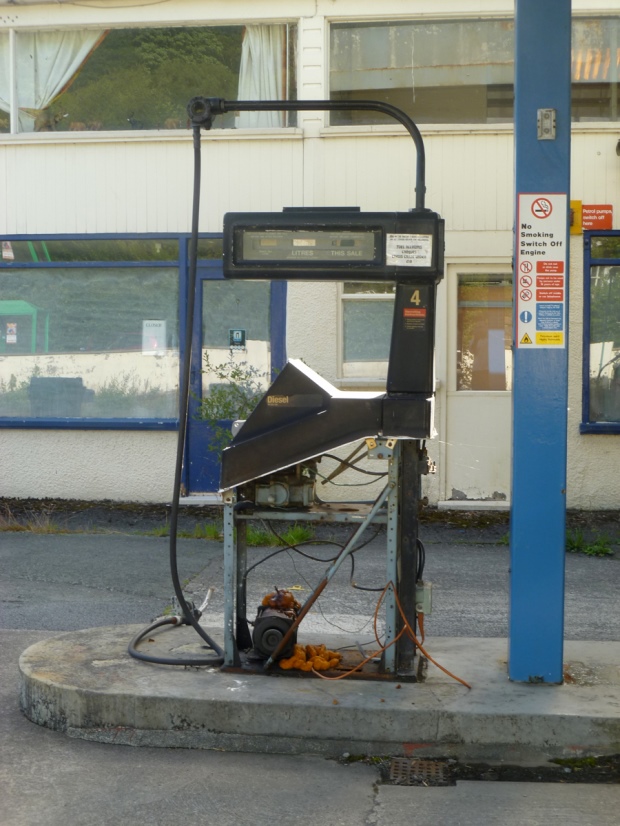
Pete: I think initially it’s the drawing that’s important. I take photos as a form of reference but when I’m painting the sketches done on site are far more valuable in that they have already that distillation; i.e. I’ve been selective in the drawing, the photo shows everything. The painting takes things a step further, I have the freedom to move shapes in order to find a good composition, tension within the composition is something I aim for.
Lisa: Your paintings to me have a strong sense of weathering, or ageing about them. First the weathering of these dilapidated filling stations, and then the manner in which the paint is applied seems to echo and reinforce the sense of a process having occurred – time passing etc. Do you see this as the main idea behind your work?
Pete: Many of the older, independent filling stations have workshops attached which evolved from the village blacksmiths. I was aiming to capture the feeling of dirt, grime and accumulated debris associated with these places. At the same time I was interested in graffiti and urban art and also the japanese art of “wabi-sabi” which finds beauty in decay but also in modest and overlooked objects. The architecture of filling stations is usually quite modest; “shed architecture” perhaps, and yet when they close, often to be replaced by some faceless form of architecture, I feel a small part of identity is lost along with them.

Lisa: What materials do you work with to create your paintings and how do you select which processes to carry out on each painting?
Pete: Acrylics (Golden or Liquitex) I often collage maps and corrugated cardboard into the paintings. I also use crayons and acrylic markers and acrylic spray paint.
I like to think it’s an intuitive decision as to which materials to use. I paint in relatively short bursts then let the painting dry and draw into it again, then paint over the drawing. The painting can to and fro in this sort of dialogue for quite some time before it arrives at a satisfactory conclusion.

Lisa: How do you select colour for your paintings?
Pete: My strength is in line and maybe composition, I don’t feel that I am intuitive with colours so I carefully pick them out and try to push them. I use a limited palette of cobalt blue, burnt umber, burnt sienna, a basic yellow (cadmium), cadmium red, black occasionally and bucket loads of white…and my favourite colour; green-gold.
Lisa: You mention on the blog the fact that big companies like Tesco are now setting up filling stations by hyper and mini-markets, thus rendering many of these old filling stations redundant. Are you therefore aiming to make a political statement with these works?
Pete: It’s not just that fact that renders these places redundant, although one would struggle to find a thriving independent filling station close to a Tesco’s or Morrison’s filling station, there are other contributing factors such as improved car reliability and economy. I try to think of it as an observation rather than a judgement.

Lisa: How do you envisage your work developing?
Pete: I am still searching for the “essence” of place in my paintings. That may be the angles and shapes of architecture but in a reduced form. It could take the form of one single line running through a painting defining something, then running straight onto the next painting. White will continue to play a vital role; how much to cover up, how much to disclose. I like Rauschenberg’s “white paintings”, not sure that I’ll ever get that far though!
Lisa: Can you describe your working space to us?
Pete: My studio is a long room on the ground floor of our house a former cowshed and hayloft. A stack of paintings at the north end next to the pink and green cow looking out of the window (she’s not real!). Painting stuff and drawing board in the middle opposite a large west-facing window, paint splattered floor. Then comes “clean area” with computer and printer, then a small kitchen area by the south-facing window. Surrounded by bucolic landscape; farms, horses, cows, dogs, tractors, occasional views of the Alps on a good day.
I also retain a studio in Aberystwyth in the gorgeous, gothic Old College on the seafront.

Lisa: What kind of surface do you like to work on?
Pete: On wooden panel, I don’t like the “give” of canvas. I use plywood which is then primed and sanded to give a smooth starting surface if I’m beginning with drawn lines.
Larger pieces are braced on the back.
Lisa: What are you working on at the moment?
Pete: I am currently struggling with still life drawings and paintings of some of my Dad’s old tools, he was a mechanic. I usually have various paintings on the go simultaneously, that prevents me from becoming too precious about any one in particular.
I’m working towards a solo show at Oriel Kooywood Gallery, Cardiff in February 2015.

Lisa: Where online or in the flesh can we see more of your work?
Pete: On my website www.petemonaghan.com and on my blogs: rustyfillingstations.wordpress.com and scragglylines.wordpress.com, in the flesh at the Kooywood Gallery in Cardiff, at Hadfield Fine Art in the Cotswolds and Quantum Contemporary in London.

Pete Monghan’s Filling Stations Project was generously supported this year by the Arts Council of Wales.

3 thoughts on “Pete Monaghan: Paintings of Petrol Pumps in Decay”
First time for me seeing such different watercolours.
I like the looseness and suggestion rather than detail.The
paintings also show a vibrancy, illustrating how much can
be done with only a minimal colour box. While they suggest
a carefree aproach, l suspect carefull consideration in the
initial drawing.
Thanks for these comments Ken, very perceptive! I think you are right with regards the drawing. I firmly believe that with a really clear intention (set by prep drawing), a painter is free to really explore the excitement of any painting medium. When the idea is less clear the painting can suffer.
Thanks for commenting Ken!
They are actually acrylics although it is very much a
watercoloury style.
The drawing IS carefully considered and yet I often lose the
drawing completely under layers of acrylic and then draw
back into the wet paint. The composition is important and
may well change/morph/be amended many times throughout
the painting.
Comments are closed.