



Do you have an acrylic painting which is not working, possibly because the colours aren’t quite right? Instead of storing it or disposing of it, you might want to try layering on new colours using heavy body and fluid colours.
The advantage of painting over an old work is the the texture of the original painting can be used to let fluid colour pool and by highlighting the raised parts you can create a new abstract textured painting. You can utilize the existing structure and colour layers while creating a new painting because you do not have to coat the old painting completely before creating a new one, instead integrate the existing structures and let the old colour layers show through in parts. By choosing colours that contrast with the original colours (in this case cool blues and violets on top of the existing warm oranges and yellows) you can create a vibrant painting.

Improve a textured acrylic painting you aren’t happy with by altering the colours using Schmincke Finest Artists Acrylic PrimAcryl and Aero Color Professional Finest Acrylic Ink.
You will need:
• An old, textured acrylic painting on canvas (the structures in the painting on our sample are made with modelling paste fine and coarse, silk paper, sand and various colour layers)
• A few Schmincke PrimAcryl Acrylic colours and Aero Color Professional colours, here: Indigo, Ultramarine, Magenta, Ivory and Titanium white
• A few brushes for acrylics
• Cloth, spray bottle filled with water, palette
• A final varnish for acrylics

used to build up texture

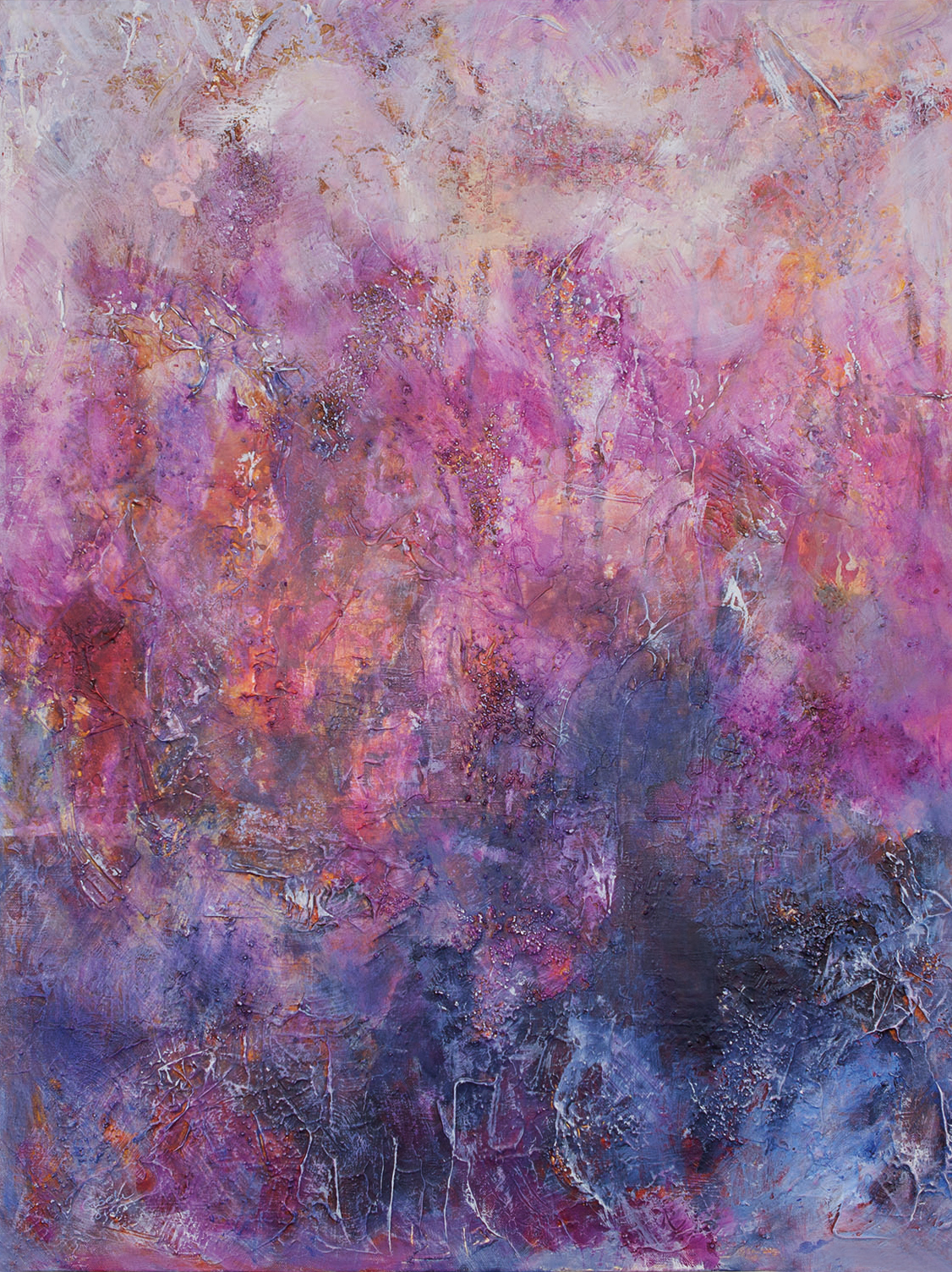
The painting in our example was painted over from the bottom to the top. Starting with dark blue shades of Indigo and Ultramarine, applying them either purely, or thinned with water or mixed with a little white. Magenta was added to get a bright flow of colours from bright Magenta to Violet blue. For a slight colour change you do not have to clean the brush in between; you can gradually change the colour by adding more colour as you go. In the middle of the painting you can see a dominating magenta application. Be careful not to paint over all the old colour layers. You can create a richer surface if you let the old structures and colours show through (the orange, brown and yellow tones in the example). The painting becomes lighter as we move upwards by using Ivory and Titanium white with a hint of Magenta. To achieve a colour flow in some parts, you can spray a little water on the wet colour; excess water can be removed with a cloth.
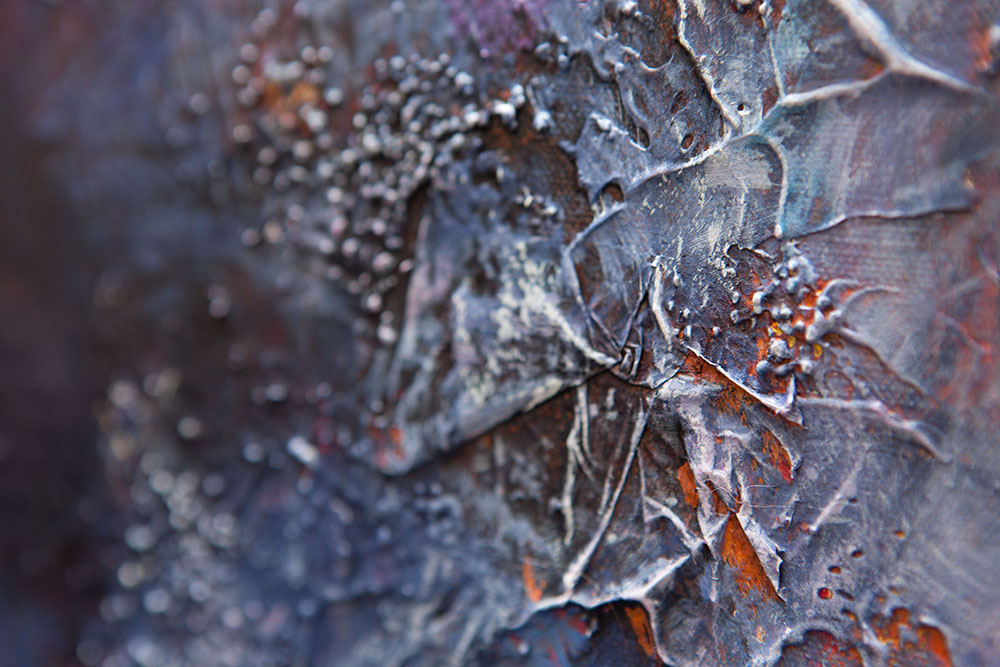
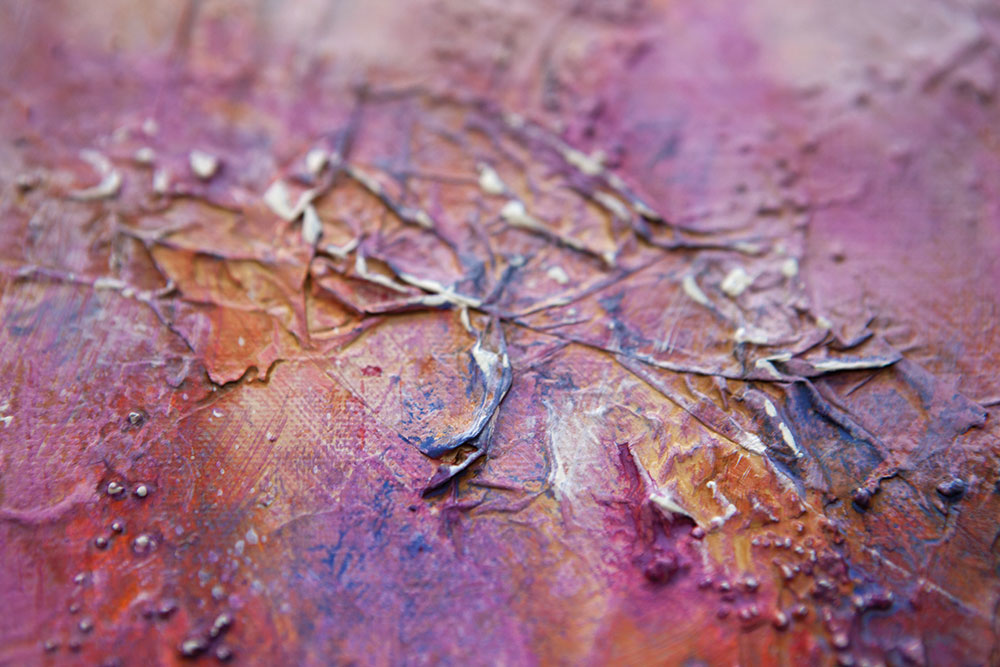

After these fluid layers have dried (you can use a hair dryer to accelerate drying) the raised parts of the painting can be highlighted with a little colour using the heavy body PrimAcryl or the fluid Aero Color and a dry flat brush. When the painting is fully dry, you can use a final varnish to protect its surface.

Click on the underlined link to go to the Schmincke brand department on the Jackson’s Art Supplies website.
Postage on orders shipped standard to mainland UK addresses is free for orders of £39.



8 thoughts on “Improving a Textured Acrylic Painting by Changing Colours”
Can I do the same with sn oil on
canvas?
Hi Alicia
Yes, you can paint on top of an old oil painting with transparent oil colours to modify it. You might find that a well-dried oil painting is quite glassy and the new oil beads up on the surface and doesn’t adhere properly. One technique to combat this (the one I use) is to cut an onion in half and rub the juice over the entire surface, crushing the juice out of the onion. Wait a few minutes and then wash it away and dry with a lint-free rag. This will alter the oil, making the top surface a little more porous (I assume it is the sulphur, so a mild acid).
If you have an old acrylic painting that you wish to modify by painting transparent oils over the top you will want to be sure that there is no removable varnish on the painting. If there is removable varnish, then when someone is trying to clean the painting in the future they may remove the varnish and everything that is on top of the varnish. So remove it now and then you can paint on the acrylic with oils. Some people worry that acrylic is not porous enough for the oil to get a good deep grip and they like to give the whole acrylic painting a thin coat of matt medium to give some tooth before they paint on it with oils.
Hi @ Jackson art .com I have a
acrilyc painting of Marilyn
Monroe , I’ve been told it very
good took me 3 weeks with a
small piece of cardboard. I would
really like to make this into
different coulour s for different
people’s needs and colour
interests , I’m not sure u saying I
can make my painting better for
framing and produce different
colours girls love it a sits in pink
haha but if u can magic it up for
me or let me know what I can do
to help be very much appreciated
Hi Stuart
This article was about improving a mediocre abstract painting by painting over it with new colours, essentially making a new painting but letting some of the old painting and the texture show through.
If you wish to make variations of your painting in different colour schemes the main thing to be aware of is the light or dark values of the colours you choose. So if you wish to change your colour scheme but keep the same sense of volume and depth you will need to choose different colours but with the same value for each area. If you wish to make a blue area a red area next time but otherwise change nothing else then you will need to mix a red that has the same value as the blue. If you were to photograph them both and then make the image greyscale, they would look almost the same colour because they are the same value of grey.
I hope that helps.
Hi Alicia, I have a large abstract oil painting.
I love it but we have moved and the only wall
that will take it is one that is across from a
window and the painting has 2 very large
silver streaks through it. They shine so much
that is all your eye goes to. Is it possible to
paint over or at least dull the shiny silver
streak?
Hi Catherine
If the painting is valuable I would ask an artist to alter the painting for you, rather than doing it yourself.
Yes, you can paint another colour over it or a transparent colour that dims it down.
New oil paint will not stick to well-dried oil paint, it will bead up and not flow smoothly or crack and flake off when it dries. So a light sanding of the area to give it a tooth will help.
Be aware that if you wish to alter the artist’s work it could change it in ways you don’t expect. If you change the silver, then perhaps the rest will look too dark, for instance.
It is probably varnished so the new paint will have a different sheen than the old paint and you may want to have it re-varnished afterwards.
I hope that helps.
Hi, great article. I have an acrylic
painting and I would like to change the
colours in a small part of it (I want to
change red for magenta, and tone down
mustard yellow to a more neutral shade).
It is not a textured painting. Is it
possible to just paint over those parts? I
really don’t want to ruin the whole
painting…your advice would be most
appreciated.
Yes, in acrylic you can easily paint over just parts.
Comments are closed.