



This year, my linocut print ‘The Chain Gang’ was selected for the Royal Academy Summer Exhibition. Unlike exhibiting a painting in the show, having a limited edition print selected by the panel of Academicians can present quite an operation of logistics, especially if like me, you haven’t actually finished printing the edition at the time of the show opening! Here’s an account of my experiences.
I have entered work into the Royal Academy Summer Exhibition 4 times in the past, with mixed degrees of success; everything from a straight rejection to ‘selected but not hung’ (the most frustrating one!) and the huge honour of being selected. This year I put in a painting and a print; you can enter a maximum of 2 works. The painting was rejected in the first round and I didn’t hold out much hope for the print as it was rejected last year – however I wanted to try again, because it was a piece I was really proud of at the proofing stage – pretty much my favourite print that I’d produced in recent history.
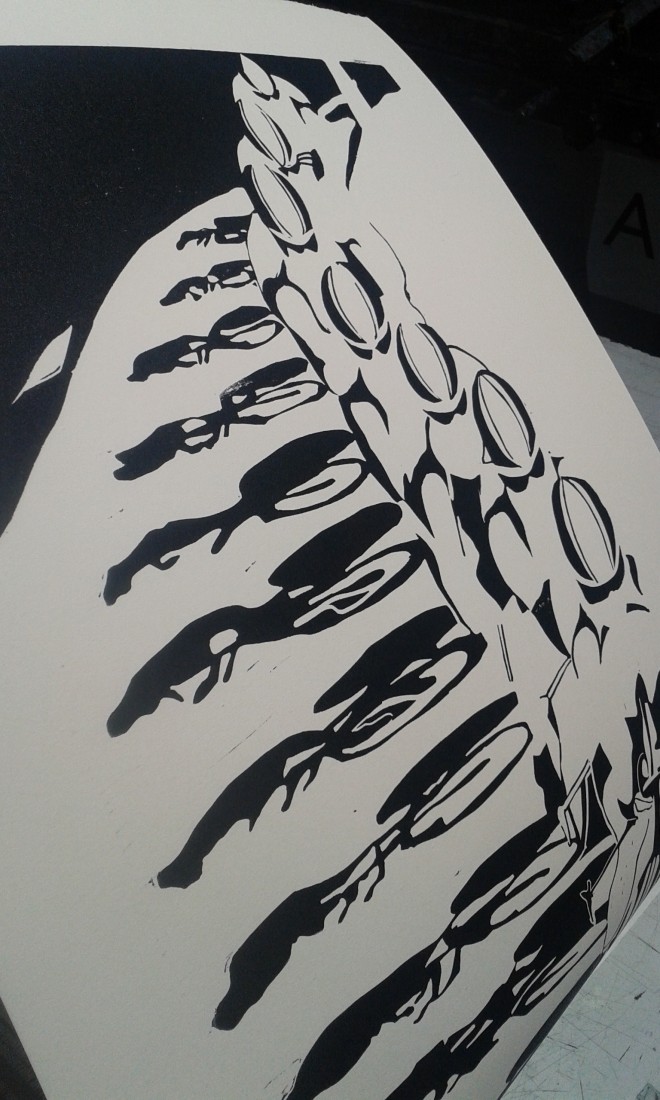
The Chain Gang depicts a line of cyclists shooting down a road. It is a linocut print made from 3 separate tiles that have each been carved for a separate colour (not quite brave enough for reduction lino cuts!). I printed it using my favourite Old Holland Oil Colours: Indian Yellow Orange Lake Extra and Warm Grey light, mixed with Georgian Oil Block Printing Medium, over the top of the darkest colour, a mix of Caligo Relief Ink Black and Prussian Blue. The print is on Fabriano Rosaspina paper in the ivory shade – a really tough paper that I love to use because I feel it shows up the characteristics of linocut really well – everything from the lovely surface textures to a subtle emboss, created by the pressure of the Albion Press I use.
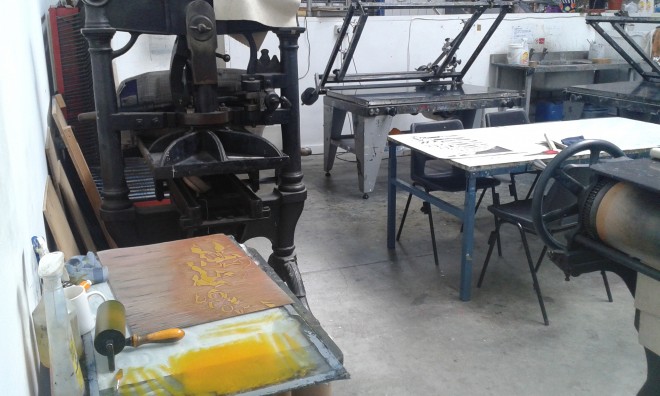
I chose to make the Chain Gang an edition of 75 as a gallery dealer once advised me that it was best to stick to relatively small numbers for linocut print editions – anything under 100 ideally. 75 is possibly the maximum size edition I would like to make as it’s not too much so that the printing feels like a chore. However I do love the process of editioning and would not rule out bigger editions in the future. I have noticed consequently that many printmakers I admire make much larger editions so I don’t think there’s a rigid rule about this.
Although it’s not wholly necessary, I do prefer to allow each colour to fully dry before printing the next because I think the end result tends to be more crisp and clean. To allow the colour to fully dry takes about a week. Due to limitations in storage I printed the edition in batches.
The whole process of the Royal Academy selection is pretty agonising, and one finds oneself constantly saying ‘wouldn’t it be good if I just got over the next hurdle’. When you finally hear you’ve got in it is a truly exhilarating feeling, but one that is combined with ‘I hope I’m not tucked in a corner where I won’t be seen’ and ‘I hope I sell at least one’.
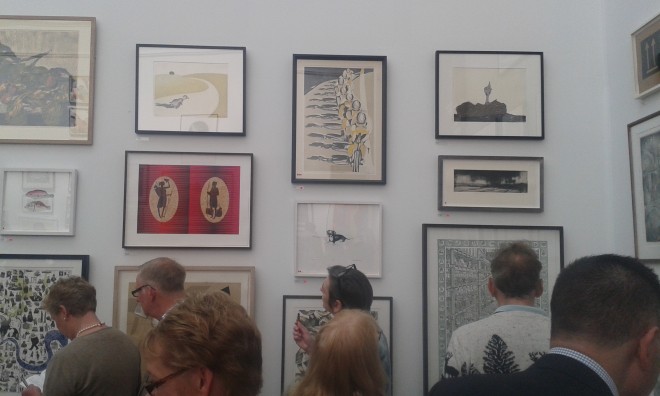
For many, exhibiting at the Summer Exhibition is a first taste of being exhibited in a public gallery, and for me it was my first experience of selling work to those that were not friends or family! When I heard that the edition had sold out, I realised that it was absolutely crucial that I had an efficient system in place, one that would ensure prints were all of the same very high standard and delivered safely. I’m a firm believer that a bad review spreads a lot faster than a good one, and that it was essential that each buyer was absolutely delighted with their purchase.
I decided that the first important rule was not to rush work. It is imperative that you the artist are proud to be sending out each and every print. Although you get the odd exception, generally people are very understanding and patient, and what’s a week’s extra wait for a lifetime of pleasure from a print? If any customers did try to hurry me along for work I intended to remain calm and explain thoroughly that one of my linocut prints actually takes 3 weeks in total to make, and that each colour is printed individually by hand – it’s easy to forget that not everyone realises this.
The Summer Exhibition takes 30% of the sale price, and it is up to you to collect your 70%. They send you the information on who has made purchases, so that you can request the remaining payment. I found it easiest to construct a standard email/letter which I sent to everyone, and logged everything in a spreadsheet, so’s to keep track of who had paid, who hadn’t, who I had posted prints to and who was still waiting. This side of the process took a lot longer than I anticipated, although I found mailchimp invaluable for creating an informative email to send en masse.
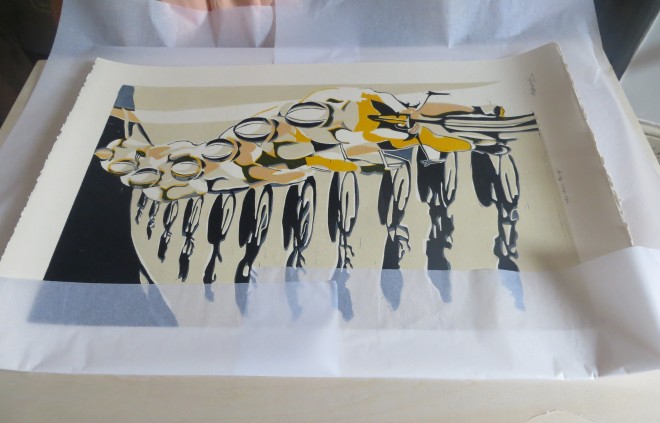
The next conumdrum to fathom was the actual posting and packing. I have found my ideal packaging method finally, and it involves this: Firstly, prints are sent in a sturdy cardboard tube. A thick wall and a wide diameter ensure that they don’t get squashed in transit, and don’t curl up too much. My cardboard tube of choice is from Defendapack. I roll each print in a few sheets of tissue paper, followed by a sheet of glassine, which makes the wrapping water resistant. I feel it’s nice to attach a small thank you note with contact details on to each print just in case anyone needs to get in touch. I use Royal Mail Signed For service so that prints can only be received with a signature.
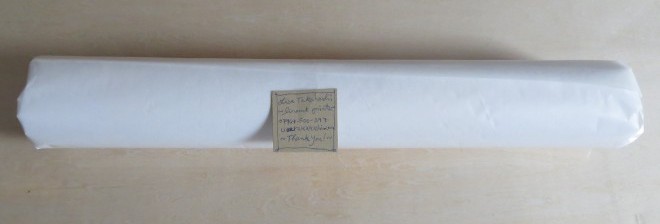
I have been amazed at the number of considerations required when showing a print at the Summer Exhibition, and hope that sharing some of what I have learned may be of use to anyone that finds themselves in a similar situation. If you have any other related tips please let us know!


2 thoughts on “Lisa Takahashi on exhibiting Original Prints at the Royal Academy”
As a keen cylist I love The Chain Gang …..a striking composition and worthy of any exhibition!
Aw, that’s so nice of you to say! Thank you!
Comments are closed.