



Róisín Curé draws whenever she can in order to capture the memories, thoughts and feelings that make up who she is and the world that she lives in. In this interview Róisín tells us why sketching is so important to her.
Lisa: How and when did you become an artist?
Róisín: Even though I draw or paint nearly every day and see the world in terms of capturing it in line and colour, I don’t consider myself an artist and I feel weird describing my occupation as such on forms and the like. It doesn’t make sense because I would have no difficulty describing people in history who have done what I do as artists – Andrew Wyeth, Dürer, any number of them. Other people seem to have no difficulty calling themselves artists. Maybe I’m overthinking it. I’m a drawer, but that sounds like something you keep your knickers in. (Sounds like you should read my article ‘What Gives You The Right To Call Yourself An Artist?‘! – Lisa)

When did I become the thing a lot of people call an artist? I sold my first commission (a series of four flower paintings) when I was fourteen, to a woman named Mrs. Comyn, who told me she wanted to be the first person to have bought my work. Fabulous lady. But it started much earlier, when I first got my hands on Asterix and Obelix, so I must have been about six. I was obsessed with the beauty of the girls in the stories, like Panacea and Mrs. Geriatrix, and I longed to draw them myself, but no matter how I tried they were never quite right. Funnily enough I never for a second wanted to draw Asterix or Obelix. To this day creating strip cartoons is at the very core of my practice, and while I definitely consider those art, I don’t get nearly the same response to them as I do to my sketches from life. Oh well.
So if there is a word to describe people who draw their world in strip cartoons in a funny way then that’s what I am. Once, I was turned down by an agent for being too like a very famous and redoubtable lady strip cartoonist, as they were her agent too.
I have to give credit to my parents, who bought us all those Victor, Beano, Dandy and Action comics – not to mention the Asterix and Tintin series – and took all eight of us to endless galleries and exhibitions. Eternally grateful, Mum and Dad.

Lisa: What’s the best bit of advice you’ve ever received with regards to drawing technique?
Róisín: I got no help with drawing whatsoever in NCAD (the main Dublin art college), except one line during a life-drawing class. One of my classmates criticised my work, saying it was “so stylised.” The tutor said it didn’t matter if it was stylised, only whether it was right or wrong. I was only seventeen and it meant a lot to hear him say that. Most of the subsequent advice I’ve received has come from books, since my formal art education stopped after that one year in art college.
When I discovered Tintin I quickly developed a deep yearning, a hunger, to draw as well as Hergé. So, years later, I bought every biography on him I could find, in the hope of discovering his secret. I learned two things: he didn’t draw everything, but had a big team. He was also not the best drawer when he started (look at Tintin in the Land of the Soviets): what on earth had made the difference? When I considered that he had to produce a weekly strip for the magazine he worked on, it began to make sense. My conclusion was that it’s simply huge amounts of practice that makes you amazing at drawing. I know that drawing has become like writing my signature now – it’s fluid, easy and accurate with very little conscious effort. But it’s taken decades to get here. It’s always down to the same thing – look properly and be honest about what you see.
That leads me onto the next bit of “advice” I received: it came in the form of Danny Gregory’s book Everyday Matters, which my mother gave my for my birthday one year. In it he talks about drawing any old thing, with no regard for importance or aesthetics in the subject – or for that matter, in your sketch. That, combined with my opinion that beautiful drawing would come with practice, meant that I really started sucking diesel in terms of progress. Reading that book was my watershed: it’s definitely my “before” and “after” moment. Then, when I discovered the urban sketching movement through Gabi Campanario’s book The Art of Urban Sketching (another present from my mother), I joined the online community and I have never looked back. Thanks again, Mum.
I nearly forgot – and this is one of the best bits of advice I’ve ever had: one evening Sir Quentin Blake came on the telly. I was glued to it, wondering if he would share his secrets. He did – and very openly. Such a generous man. He said he draws whatever he is drawing very roughly and then puts a sheet of quite heavy watercolour paper on top, and puts them both on a lightbox, so he can only just see the line underneath, and then uses a fountain pen for the final drawing (I think). In this way he has a guide for size and shape but is still able to create a fluid and real line, or words to that effect. I have worked like that ever since for all my cartoons and illustrations.

Lisa: Do you have a particular work of art that you are most proud of and if so, what qualities does it have?
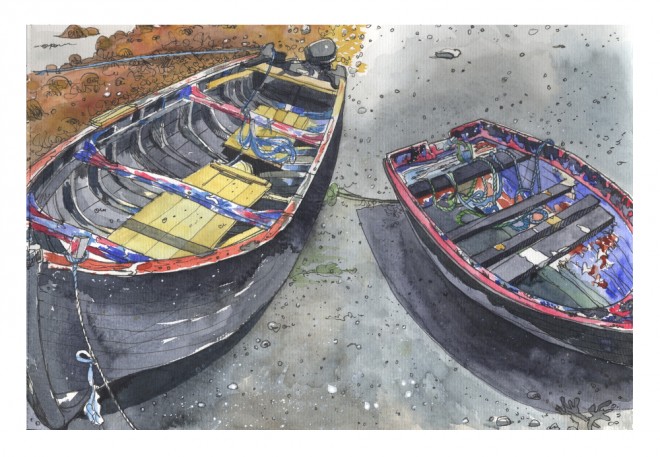
Róisín: I love most of my paintings (at least the ones that were done on location) but there is one that comes to mind. It’s a painting of a field-stone well in a field near my house. Not only does the subject matter sum up everything I love about our area – its tranquility, the way incredible beauty is just lying around casually, the fact that you can wander into a working field no one bats an eyelid…but in terms of the drawing itself, I would say that I was guided by the inspiration of the subject from start to finish. I used my Kuretake brush pen and achieved the fluid, beautiful line I am always chasing; the palette is divine, just greens, a few specks of orange and indigo blue; the composition is perfect (which is a fluke, since I just drew the outline that was there); the water is just right…you could lose yourself in thought staring into it. It’s the only painting I have framed just for me.
Then there’s my cartoon called Bad Dog, about a dog who takes his foolish owners for a ride. It’s very funny and the drawings are exactly right, if I say so myself. I particularly like the pink triangles for noses that the foolish dog owners have – they seemed just the sort of noses those kinds of people would have (it occurs to me that I’ve had my moments as a foolish dog owner myself, and my nose is a pink triangle – oh dear).
Lisa: What do you do if you feel you have no ideas?
Róisín: It doesn’t happen very often but if I feel sterile I do one of two things: go to a café or something and see if there’s anything good to draw, or, if I’m at home, I make a recipe for the website They Draw And Cook. As long as you follow the format you can draw anything at all and I think they accept pretty much every illustrated recipe. The fact that you have two constraining elements, the size and the recipe, is enough to get your creative thing going. I find that unless I have some constraint I short-circuit and can’t draw anything. As they say, I like a tight brief.

Lisa: How important is sketching today?
Róisín: Now you’ve got me started. I never could have predicted the effect that sketching has had on me, or on the sketchers I know. Oh my goodness the list is endless. This is what I think: in this rushed life of ours it provides a way to “be” in the moment and savour it. Then again this is a bit of a contradiction because you enter a state of altered consciousness when you sketch what’s in front of you. There is something about stepping out of your “thinking” brain on a regular basis that seems to fix it. I guess people who meditate know what I’m talking about. On a much more straightforward level, you end up with beautiful memories that are simply not comparable to photos – when I look at photos I become nostalgic for time that is past and gone, but a sketch makes me feel very warm and fuzzy and happy. The memories that a sketch kick-starts are far more rich than those provided by a photo – people talk about remembering an ant carrying a crumb of bread at their feet as they sketched, or the scent of a woman’s perfume as she passed, or the chime of a clock. It’s all very weird. And of course you make lovely friends through sketching, and you’re never, ever bored.
So in summary I think sketching is a huge healer (I hate that word so I’m really sticking my neck out here) and a wonderful way to reclaim what’s beautiful about our lives, and to assuage our deeply human need to be creative. It’s very satisfying, you achieve a marvellous sense of achievement, and it’s accessible to everyone – you don’t need to set time aside for it. I have so many public transport sketches, and waiting-at-bus-stop sketches. I used to have a fear of flying – I still do – but now instead of thinking “We’re going down!” I think “The plane better not land until I’ve finished.”

Lisa: What are the ingredients of a good sketch?
Róisín: A good sketch must reflect real life, whether landscape, cityscape or human life. I don’t care if it’s amateurishly done – I just want to feel reality. I hate polished “sketches” that are done with photos, I don’t see the point. It should ideally be done at a sitting, or at least in the same light conditions. Personally I love the inclusion of people or at the very least birds and other animals. Cars are good – but not when they look as if they are about to mow you down. I would rather a pathetically-drawn excuse for a car drawn quickly and from life (see mine, they are absurd) than a superbly-executed vehicle that has been drawn from a photo. Same for people.
I cannot but take this opportunity to say the ingredients of a bad sketch include nearly anything done on a tablet. It’s the computer-y look of the marks that I cannot abide. They often seem very pleased with themselves, which I also hate, but I’m guilty of that myself most of the time so it’s not really valid.

Lisa: What are your favourite sketching materials?
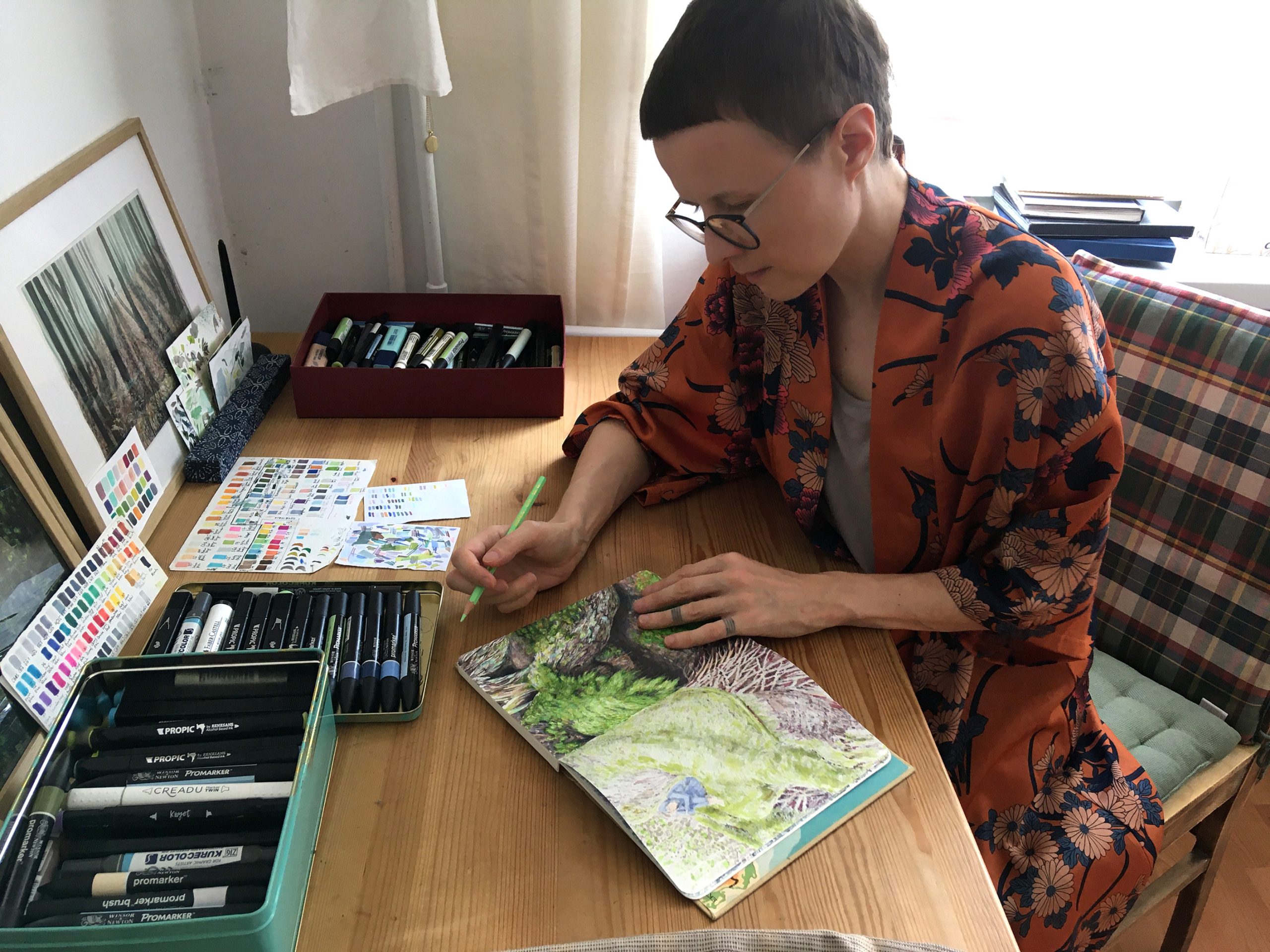
Róisín: My Kuretake sable-tipped brush pen. My Platinum carbon pens. My Namiki Falcon pen. Grey, black and sepia waterproof ink. 2B and 4B pencils for cartoons.
Lisa: Which sketchers do you most admire and why?
Róisín: I have Danny Gregory and Gabi Campanario to thank for changing my life. Quentin Blake for overall genius. In terms of beauty it has to be Felix Scheinberger for his colour, his confident mental-ness and his quirky line. Posy Simmonds for her mastery of line in general. Marina Grechanik for craziness and capturing real life. Andrew Wyeth for his beautiful everything. There is a sketch by Rembrandt of two women helping a toddler to take its first steps which is one of the most beautiful sketches I have ever seen, basically for the reasons which I’ve talked about already (capturing life as it happens, memories etc.)
Lisa: Is there any difference between a sketch and a drawing?
Róisín: I suppose if there is a difference it is that a drawing may be done in the studio from a photo, and a sketch is generally done from life, and in one sitting. I do use the terms interchangeably but I probably shouldn’t. A sketch implies energy and immediacy whereas a drawing is more thoughtful.
Lisa: Where online or in the flesh can we view more of your work?
Róisín: In the flesh – right now, in Gort Public Library, Co. Galway, until 17th October. At my home in Galway, by appointment. On my website, roisincure.com, where I tell stories to go with my sketching experiences…a very indulgent and enjoyable practice. You won’t find my work in any gallery in Dublin: the most recent one I spoke to told me that they don’t take anyone who hasn’t had an award. This was without looking at my work, which suggests they don’t have the confidence to decide whether something is good or bad themselves.
3 thoughts on “Róisín Curé on Art and Urban Sketching – Interview”
Hi Róisín,
Just to say your work is excellent and inspirational,
Keep up the great work,
Mark C.
This is a fantastic interview. Thank you.
Oh those idiots in a Dublin Gallery don’t
know what they missed out on! Sketch
with Roisin, is such a great site to visit.
Comments are closed.