



An art trail is a great way of promoting the art, craft and design being made in your local area. It’s also a great way to meet fellow creatives in your area, and with multiple open studio events happening at the same time, there’s bound to be a bigger incentive for people to visit. But what makes a good art trail? Does social media really help? Does having other events such as raffles and live music enhance or just get in the way? And what are the absolute essentials for making sure your art trail is a triumphant one?
What makes a good art trail?
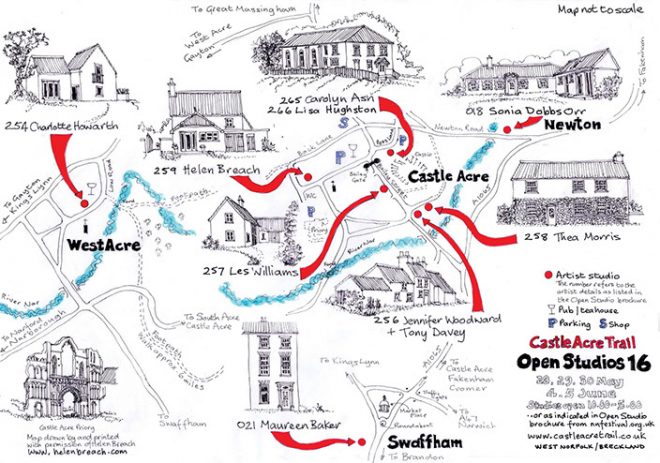
An organised art Trail is a good Art Trail! ‘As a group we share the tasks of designing flyers, sourcing printers, getting our own website going and distribution of brochures and publicity’ says Helen Breach, a sculptor and participant of Norfolk and Norwich’s Castle Acre Art Trail (www.thecastleacretrail.co.uk). ‘As a trail we produce our own flyer which is in addition to the Open Studio brochure for the whole of Norfolk. The flyer is very important as it acts a guide for anyone coming to the trail and provides easy to read information about the artists. The costs of the flyer is shared between us all’. For this kind of level of organisation to occur, it’s inevitable that you’ll need someone in charge who is dedicated to keeping communication to an optimum, and who is able to exercise assertiveness and to delegate effectively. Your workforce needs to be enthusiastic about the operation, so have meetings early and encourage everyone to say their bit. Knowing who will be participating in the art trail and what their strengths are is crucial – you can then assign responsibilities to those who have the right skills and enthusiasm for each task. During your first meeting decide on the best mode of communication, and if there are those who aren’t keen on emails or social media (or whatever you decide) make sure they are not isolated – ensure someone is responsible for keeping everyone in the loop by giving those people a call, or else the sense of teamwork will subside and despondency may creep in.
How important is it for venues to be in close proximity on an art trail?
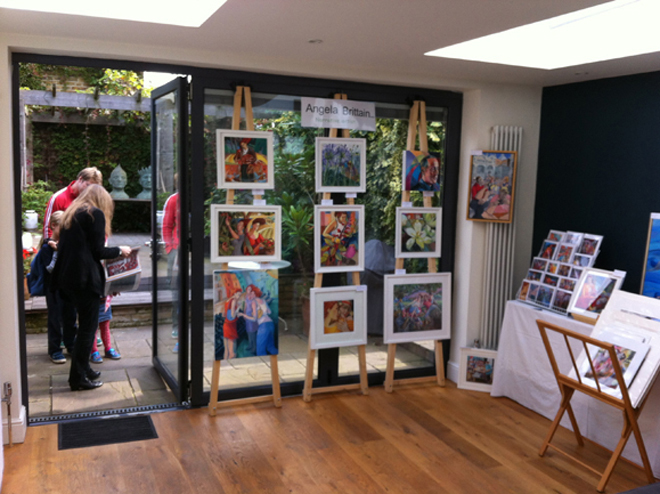
Depending on whether the art trail is a largely urban or rural one, there are probably 2 answers to this question, and it all really hinges on whether the public are likely to attend the art trail by car or by foot. Angela Brittain, a narrative painter and participant of the Horsham Open Studio, explained ‘In Horsham we have a mixture where some are close to the centre of town where it is possible to walk whilst others are further out and require a car. I think the draw for people to make the effort is whether the artists who are further out look interesting or not or if they are known from previous years’. The Steyning Arts Summer Art Trail agreed; ‘You get more casual foot fall in venues that are in close proximity to one another but with good publicity, emailing contacts and word of mouth you will still get genuinely interested people coming to view’. It’s clear that so long as the word gets out with regards who and what is showing as part of the event, close proximity is not everything. Have a really striking flyer – try to show examples of the work that will be exhibited or failing that have some very descriptive text. The flyer or guide is what will inspire your public to come and see what the art trail really has to offer, and they will travel if they feel that they will be rewarded for their efforts!
How important is diversity of work in an art trail?
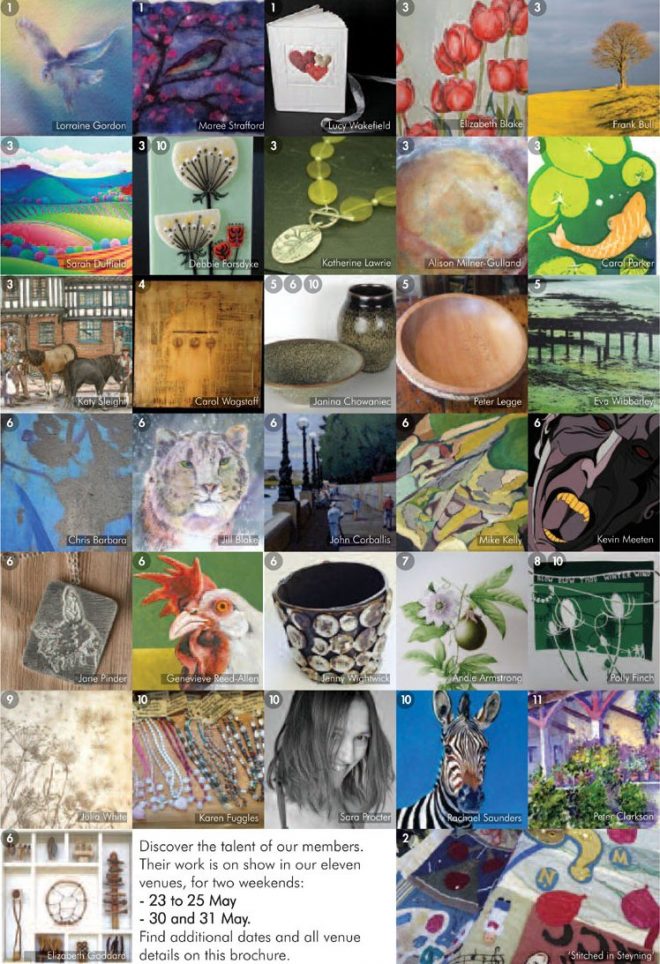
Diversity, although something that should be celebrated, is not an essential ingredient to a good art trail. What is more important is an emphasis of the creative talent in your area, whatever it may be. The folk at Steyning Arts told us ‘It can work both ways. [We’ve had] venues that feature jewellers, ceramicists, sculptors, painters, textile artists etc. which have been very successful. [There’s also] a house that specialises in printmaking. That can also be diverse as it includes etching, lithography, screen printing, linocuts, collagraphs etc’. If you have lots of artists taking part and a few venues that will operate as shared spaces, it’s probably a good idea to have diversity in each shared space if you want to maximise foot-fall. However saying that, if you have an inordinate number of ceramicists (for example) in your area, it could also work to put the same media artists all together in one venue to attract those with an interest in that particular artform.
What does your art trail to do publicise the event and what approaches of publicity are most effective?
Artist and write Lynn Parr, who participates in the Ceredigion Art Trail, was impressed with the lengths that the organisers have gone in the past to getting publicity. ‘The people who run the CAT are very good at publicizing the trail, with half-page articles in the weekly newspapers, and pieces in regional magazines. They have also started putting out a directory of artists, which is available at all the visitor information centres, shops, etc’. Angela Brittain from Horsham Arts Trail explained that they too also feel publicity is vital, although that doesn’t mean it always gets noticed! ‘Our art trail is publicised in the local press, flyers through doors and in shops & public places, posters in the town, press releases to local publications and church magazines plus on all the online places that publicise art events. We have also done local radio and selected magazines like Sussex Life although lead times are long. We have a market stall the week before the event when we give out flyers. We send out sponsorship packs and try to piggyback on sponsors’ activities. It’s hard to say what is most effective as when we ask people where they saw about us they have usually seen several of our pieces of publicity plus looked on the HAOS website because they know it is coming up. It has to be said that despite strenuous efforts to reach as many new people as possible we still have people who see the balloons and signs on venues on the day and say they haven’t seen any publicity!’
Do as much publicity as time allows because the more publicity is seen the more likely the event will be remembered by passers-by. And most importantly, remember to let the Jackson’s Art Blog know so we can put it on our events calendar!
How important is the delegation of responsibilities when organising an art trail and why?
As any well seasoned Arts Trail organisers will tell you, enthusiasm can wane if you find yourself doing the same jobs because no one else has expressed any enthusiasm. ‘After a few years of being very involved, the main movers and shakers start to resent how it is taking their eye off the ball where their own work is concerned’ says Angela Brittan. This is why communication is key – as soon as despondency creeps in its time to shake things up a bit and let others have a go at trying new responsibilities. Lynn Parr told us ‘The first year of the CAT there were too many cooks, and nothing got done. Now there is a chairman, as well as a committee, things are much more organized’.
What makes the best kind of art trail exhibition venue?
Arts Trail venues are delightfully varied and can be anything from a living room to a church hall. Keep an open mind when thinking of a venue for your arts trail event, but also think too of the important practical issues. Lynn Parr pointed out that venues should be ‘Places with access for all – so no flights of stairs, or having to park miles away. Luckily, most of us on the CAT are in rural locations with plenty of parking and access for wheelchairs etc. The venue should also have plenty of light and space to display the work properly (it is a selling event, after all). In Bath we had a lovely garden where we put sculptures, and were lucky enough to have lovely weather, so had hundreds of visitors who stayed long enough to look at the work more closely and buy. Angela Brittain adds ‘A relaxed atmosphere where people feel they are welcome and some refreshments tends to make visitors linger longer. If it’s an out of town venue then instruction on where to park and a good map reference all help’. Steyning Arts Trail told us ‘Some venues are in beautiful homes with fantastic gardens and scrumptious teas, these are certainly a draw to the general public but demonstrations and specialist knowledge are a great incentive also. A print workshop I know has some amazing Victorian printing presses, artists at work and workshops available as well as fantastic cakes. It can’t get much better than that!’ And it’s true – demonstrations, activities that visitors can try out and talks all add to the attractiveness of an open studio event, not to mention refreshments!
What’s the best way to communicate important information about the art trail to your public? (loos, food, drink, directions etc)
The joint top priority along with publicity is clear information for the visitors. Budget for the designing and printing of a handy map that can be distributed to local shops, cafes and libraries so that they double up as flyers, and immediately visitors can know exactly where they can get food or pop to the loo while on the art trail. Put a printable version on your website too. If you can, put signs up around the area directing visitors to studios and enlist some approachable stewards that can point people in the right direction.
If you can take on board all this advice you could well have a successful art trail on your hands!
Have we missed any other important ingredients for a good art trail? Be sure to add your comments below!
The Castle Acre Trail, Norfolk starts on the 28th May 2016 and will be open for 3 consecutive weekends (28th,29th,30th May and 4th, 5th, 11th and 12th June). More information at www.thecastleacretrail.co.uk
The Steyning Arts Summer Trail will take place on the 28th – 30th May and 4th – 5th June. More information at http://www.steyningarts.co.uk
Horsham Artists Open Studios Arts Trail takes place on the 9th, 10th, 16th and 17th July. More information at http://www.horshamartistsopenstudios.co.uk/haos-art-trail-2016/
The Ceredigion Art Trail 2016 takes place from 30th July – 29th August. More information at Ceredigion Art Trail
Very many thanks to the following contributors:
Helen Breach, Artist and Designer – http://www.helenbreach.com
Steyning Arts Summer Trail – http://www.steyningarts.co.uk/
Angela Brittain – http://www.angelabrittain.co.uk/
Lynn Parr – http://www.lynnparr.co.uk/
Header Image: Sculpture Garden At Lynn Parr’s Open Studio in Bath, 2011
5 thoughts on “What Makes a Good Art Trail?”
Hi Lisa
The Leigh Art Trail will be 20 years old next year. I did it for many years, and I’m back this year as a guest artist. My favourite venues are always the home and studio venues. Here’s a video from 2013, when we had our artist friend Ida Trier visit from Denmark to exhibit, alongside Karen Christensen, Andrew Haines and myself. This year’s trail starts next week (Saturday 4th – Saturday 11th June – http://www.leigharttrail.com)
http://www.simonkirkfineart.com/blog/category/leigh%20art%20trail
Love this video, thank you for sharing!!
Hi Lisa,
I would like to add a few points from my experience of participating in CAMAT (Cookham and Maidenhead Arts Trail) and Bucks Open Studios.
Many people love to go to venues where the public can see the artist’s workspace and if possible, see them demonstrating. It helps visitors to understand the process of creating the art and adds to the enjoyment to see spaces they would not normally be allowed to enter. It also facilitates some interaction and discussion between the visitor and the artist rather than just looking round. (Offering refreshment is also a good way to break the ice and start a conversation.)
From experience, I would recommend for artists to share a space, (preferably with those who work in a different medium). It benefits both the participants and the public. For many years I took part in Bucks Open Studios on my own. One problem was not being available to talk to visitors when there were several groups looking round, security was another as I have work on display in the house as well as the studio, or in the case of no visitors, found it difficult to get on with things, whilst waiting for the door bell! If you share a venue with others, you can share the duties and the costs, and your time with visitors, e.g. talking without interruption whilst someone else answers the door. You are more likely to attract people to come and it is more enjoyable all round. Sometimes it is easier to talk about other people’s work rather than blowing your own trumpet so it can be mutually beneficial! The visitors will have a more interesting experience if there is diversity. I am a painter and usually have a ceramicist and a jeweller or sculptor showing at my house. By introducing sculpture to the garden, it encourages visitors to go up to look at the studio at the end of the garden. Visitors might feel less inhibited in entering someone’s venue if there is more than one participant showing work.
The Cookham and Maidenhead Arts trail (CAMAT) will take place on 17th and 18th September 2016. http://www.camat.org.uk
I enjoyed reading this for additional
inspiration. Our tourism group LETi won a
Scottish Thistle Award for the BLiSS trail
of art and architectural installations in
central Scotland. Please look us up. We
have since progressed to offering a free to
download app and audio tour for a more
immersive experience. Stories are told by
artists and others in our communities.
Wow Kim that sounds like a really great way to make an Art Trail really alive. There are so many stories and histories that are often untapped in an area. Great to do this and I will definitely look you guys up!
Many thanks
Lisa
Comments are closed.