



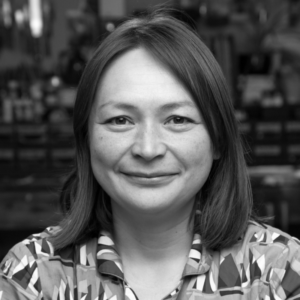
Clare Celeste Börsch, formerly a public arts administrator, is now an International, Berlin-based artist who uses paint and collage techniques to build imagined worlds filled with flora and fauna. In this interview we delve deeper into Clare Celeste’s practice, to find that sometimes the creative journey ends up actually being the destination.

Clare Celeste Börsch
Mixed Media on Canvas, 220cm x 160cm, Photo by Mar Martin, www.akutestudio.com, copyright of the artist
Lisa: Can you describe the appeal of working with found images for you?
Clare Celeste: I enjoy seeking out images from unlikely sources. I peruse tucked away thrift stores, give-away piles, and flea markets. I enjoy finding something long forgotten and reimagining it as something new.
I compare my treasure trove of images to a paper cabinet of curiosities. I have perused the collections of natural history museums for decades now. This visual knowledge about natural history and taxonomy feeds into my work.

Lisa: What has been your creative journey to the point where you are now with your work?
Clare Celeste: I used to paint and used collage as a way to plan my paintings. Then one day I realised I liked the collage more and never went back!
I begin by collecting, cutting out, and sorting images. I later create series and large works in focused sprints. These bursts of creativity feel, at the time, very intuitive and I get into a flow. But the labour and planning that went in beforehand allow them to happen!
Collage also seems a very appropriate medium for me given my life story. Having grown up all over the world, my life has been a collage of sorts. For me, it makes sense to collage a Brazilian butterfly next to a North American flower. In my mind, they are intrinsically connected.

Lisa: You mentioned you had been in Australia completing a commission – what was the commission, how did it go and can you describe the challenges faced when working to commission?
Clare Celeste: A wonderful arts nonprofit organisation in Australia called Form commissioned two site-specific works from me. The curator, Katrina Longo, found me via Instagram. It was a wonderful and uplifting experience. The arts community in Perth was incredibly supportive.
This was a new challenge for me as I had to plan the works in Berlin. I designed, packed and prepared all the materials and images in Berlin. I then completed the site specific works in Australia.
I was nervous about pulling off two large works in an unfamiliar setting in such a short time frame. In the end, my planning paid off and everything turned out well!

Lisa: What’s the most important object in your studio?
Clare Celeste: My image collection! I have them carefully sorted and stored in boxes. I organize them by type. The boxes have labels such as “reptiles and amphibians”, “tropical flowers”, “roses”, “succulents”, and of course, “snakes.”
Lisa: In one of your Instagram posts, you describe your creative practice as being a tiger that appeared in a dream. Do you think about the tiger a lot, is the manifestation of your creativity as an animal helpful to how you think about your practice?
Clare Celeste: I do think about this dream often. I had this dream when I was 18, almost twenty years ago. I didn’t realise that the tiger represented my creative practice until this past year. This was a main impetus for focusing on my work. When I hit a dry spell and work is scarce, I remember that dream and the tiger and it reminds me to keep going.

Lisa: Is there always the same set of stages that you go through when creating a collage, or do things change according to what happens on paper/canvas?
Clare Celeste: My process has changed over the years, but these days I always begin by thinking of colour composition. When I make a new installation, for instance, I first go through my images. I select imagery based on colour. As a first step, I create large color gradients across my studio floor. This is what lends my installations their strange and hallucinatory look. They are nature, but in hyper-color.

Clare Celeste Börsch
Mixed Media on Canvas, 60cm diameter, Photo by Mar Martin www.akutestudio.com, copyright the artist
Lisa: Do you have any strategies for clearing the mind and achieving focus for a day of creativity?
Clare Celeste: This is something that I did well before I became a mother. I would often going for a long hike or doing a yoga class before sitting down to make artwork. These days time feels scarce but I manage to squeeze in a home workout and then a hot shower at some point each day. Getting my heart rate up and sweating clears my mind. Sometimes this means doing 7 minutes of HIIT before I dash off to my son’s daycare.

Clare Celeste Börsch
Mixed Media on Canvas, 220cm x 160cm, Photograph by Mar Martin www.akutestudio.com, copyright of the artist
Lisa: What does the colour black mean to you?
Clare Celeste: To me, the color black represents the night and the unknown. In an artwork, it creates depth and makes the colors luminous in contrast. I love old Dutch paintings. Light becomes so much more interesting when contrasted against darkness. This quote by Henry Beston captures my feelings about the color black:
“Learn to reverence night and to put away the vulgar fear of it, for, with the banishment of night from the experience of man, there vanishes as well a religious emotion, a poetic mood, which gives depth to the adventure of humanity. “

Clare Celeste Börsch
Mixed Media on Canvas, 80cm diameter, Photo by Mar Martin www.akutestudio.com, copyright the artist
Lisa: Can you tell us about the relationship between your installation works and your two-dimensional works?
Clare Celeste: The installation works are an outgrowth of my two-dimensional works. I wanted to “walk into” my collage work and have been pushing and exploring this idea for several years now. After my three-dimensional installations, working on paper feels like a holiday. The installations are much more labour intensive and physically demanding. But I would like to move more towards installations in the coming years. I enjoy creating immersive spaces. I want work that draws people in and momentarily transports them somewhere surreal.

Clare Celeste Börsch
Mixed Media Installation, dimensions variable, photo by Trevor Good www.trevorgood.de, copyright of the artist
Lisa: Where online or in the flesh can we view more of your work?
Clare Celeste: I will be doing a pop-up installation in the Fall in Berlin, so stay posted!
You can find me online at clareceleste.com. I share everything related to my creative process on Instagram, @clarecelesteart.
I also have some commercial work that is currently available for viewing. The interactive mural I created for the Scribblers Festival is great for kids and teaches them about the importance of bees to our food supply. That work is up until mid-summer in Claremont, just outside of Perth.
I have a large collage commission hanging in the lobby of The Hub, a new residential building in DC. There is also a three-dimensional collage at the family space Piperita in Berlin and an illustration coming up in the new edition of Good Company Magazine.
A great way to stay in touch and keep up with my work is to sign up for my quarterly newsletter (sign up form at the bottom of the page on the linked URL).

8 thoughts on “Creating Immersive Spaces – An Interview with Clare Celeste Börsch”
What a wonderful, creative person. Love the
colorful fauna and flora against the black
background.
Incredibly beautiful artwork. Clare Celeste’s colour arrangements
are so appealing!
Hi these are so beautiful. I did wonder
however how Copyright effects Clare. I
have been told by a Copyright lawyer
that you have to ask permission for ALL
images which are not your own – even in
collage.
Hi Lesley,
This is a very interesting point. I shall contact Clare and see if she has the answer. However I do know that copyright lasts for 70 years after the life of the artist so when working with very old images a lot of them are copyright free.
Thanks
Lisa
Hi Lisa & Lesley,
So, when I create commissions, I always
use either images with open copyright (I
use Pixabay a lot, and donate a small
amount per image directly to the
photographer) or I use images with expired
copyright. There are thousands of
beautiful naturalist illustrations that are
free to use. 🙂 Many are available for free
online through archives and I print them
on recycled paper.
But, to be honest, when I create work for
myself or just for pleasure, I do not worry
about copyright and simply enjoy mixing
images. But for work that I am paid for, I
am very aware of it. Hope that helps!
That’s really interesting, thank you Clare for taking the time to give this explanation.
Good to hear firm Clare, re: copyright. that
was my question too, esp. with so many
images!
Thanks Alison!
Comments are closed.