



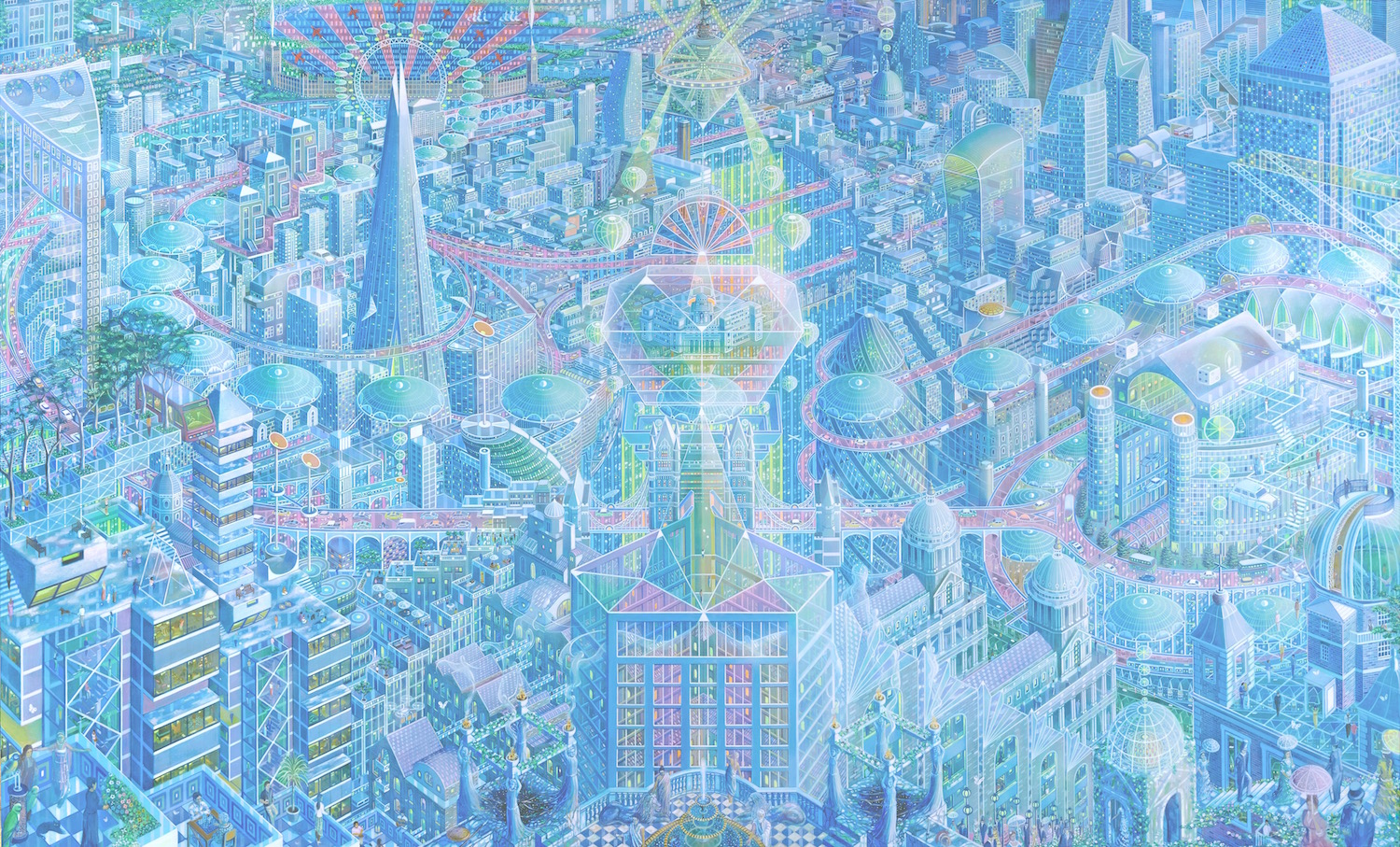
Caio Locke won the Landscape/Cityscape/Seascape Category Award in Jackson’s Open Painting Prize 2019 with his futuristic vision of the big smoke: Metropolis London. The large scale painting is one in a series of fantasy futures by the artist, that depict the faceted outcomes and aesthetic possibilities of what could be, blending pre-determined structural forms and free-flowing intuition. We spoke to Caio, to find out how working in paint informs these utopias and how he brings them to life.
Above image: Kingdom Crossing, 2006, Caio Locke, Acrylic on canvas, 150 x 120cm
Caio Locke
Acrylic on canvas, 155 x 255 cm
Photo by Sylvain Deleu ©
Clare: Tell us a little bit about your artistic background/education.
Caio: I’m mainly self-taught as a painter. From a background in aquatint and dry-point etching, my move to painting was first to symbolism and bold colour, adapting form to convey a metaphysical, interconnected energy. I painted intermittently over old canvases whilst working on other things. When painting was absent, I had the sense something profound was missing from my life.
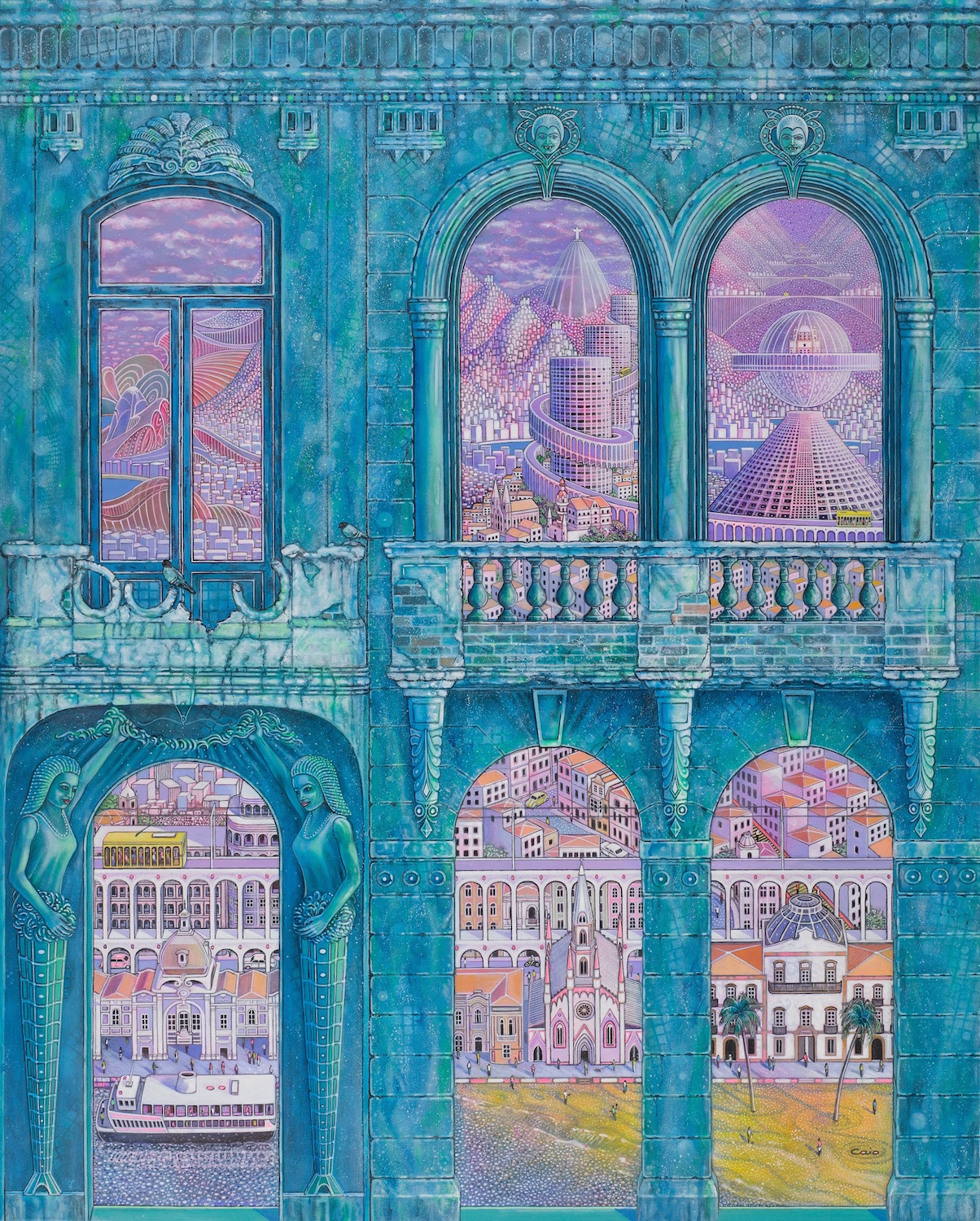
After a year without painting, I travelled to Rio and was encouraged to paint again. I chose the view downtown and across the bay to Niteroi, perching the canvas on a window ledge in the hills of Santa Teresa. Just trying to catch the shapes and energy of the city for those hours rekindled my fascination with painting and this new subject matter.
Caio Locke
Acrylic on canvas, 152 x 122 cm
Clare: Could you describe your practice?
Caio: Cities provide an endless resource for playing with imagination, space, ideas, time and depth, but, I’m increasingly moving through familiar architectural form, place and symbols towards freeform, abstracted, subliminally resonant shapes, as a means to find a deeper symbolism and a meeting point between the manmade and natural. I paint parallel or ‘parareal’ realities, atemporal mediations between reality and dreaming perception. I attempt to find a synthesis between the outer world that is shared and the inner world that is seemingly experienced alone.

Caio Locke
Oil and acrylic on canvas, 152 x 254 cm
Clare: Many of your works are painted on a large scale and have quite structured geometric compositions. How do you prepare and begin work like this?
Caio: I tend to sketch out the image using graphite, charcoal, chalk or pastels, often on paper, then on canvas. ‘Metropolis London’, for example, was sketched out loosely on paper then more precisely as under-working with chalk on the canvas. I decide on the base colour and build up in washes of diluted acrylic. For later phases, I opt for paints that retain their consistency and spread evenly into the pores of the canvas for an even tone finish, before accentuating highlights in areas of light.
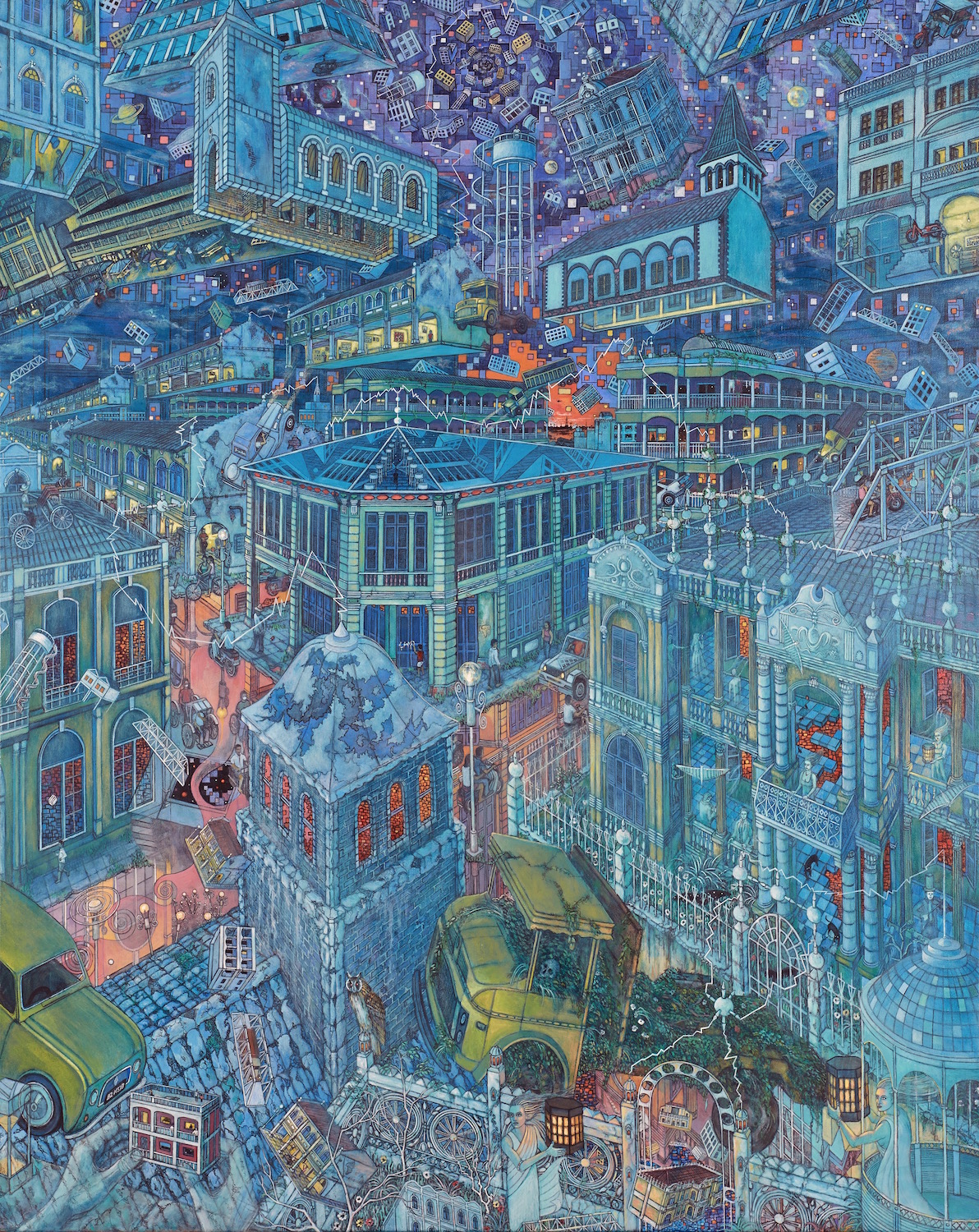
When working in oils, I plan more carefully, whether through sketching on paper, digitally or both. Ordering the composition, there are options such as isometric, traditional perspective, including or disregarding vertical perspective, curving or multiple points. For complex pieces, it is possible to have multiple angles converging on different points along the horizon, but it creates a deeper sense of harmony to limit the variance. There are also zones of detached space, voids of ambiguous space or optical depth suggestions.
Caio Locke
Acrylic on canvas, 150 x 120 cm
Clare: I find it interesting that the futuristic theme of your work is offset by the method with which it is created, specifically, that you depict future utopias with traditional mediums. Could you talk about why you use traditional media to do this?
Caio: There is no conceptual limit to what can be done with paint and canvas. Painting can transcend its own materiality yet is the ideal method for bringing the potential of future worlds, or retro-futures, into the material present. Dystopian projections are ingenious but may engender more of the same, so I feel the need to convey this in the way you see.
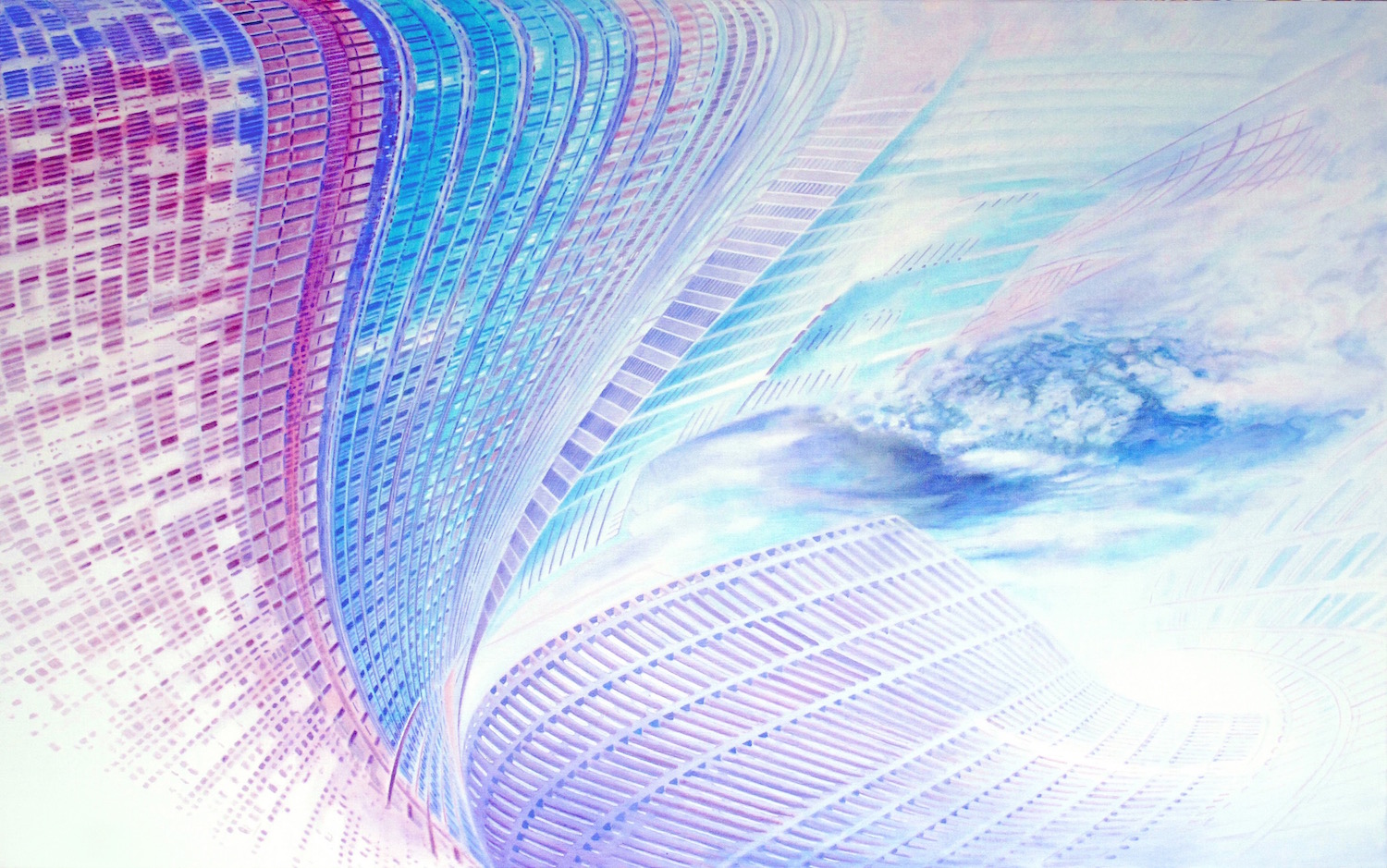
Conjuring these spaces within the age-old tradition of painting connects them to the ancient classical, like a bridge or circle via the present. Through the ‘Icarus’ paintings, I am trying to channel ancient myth into futuristic geometric perspectives that soar above present-day mental confines.
My preoccupation with issues of environmental and ecological destruction and climate change resonate with the myth of flying too close to the sun, man’s wings of melted wax and falling from the skies as the sea rises. Yet in the last of the seven in the series, despite everything, it is the irrepressible spirit or soul of Icarus that like the sun lives on.
Caio Locke
Oil on linen, 100 x 160 cm
Clare: In regards to your process, you write, ‘Working in acrylics or oils, the process takes me to a threshold between free-flowing intuition on the one hand and communicable rationality on the other.’ Where do acrylic and oil sit on this working spectrum?
Caio: Sketching on or off canvas can only take the process so far and the act of applying paint is needed to unlock the idea. There have been times when I painted ideas as they arrived by means of fast drying acrylics. This method is an adventure, allowing for a degree of improvisation as the composition conveys something I may not have consciously hit upon. At that point, I bring in a tighter technique to convey the idea.
When the composition relates to a place, I am more constrained by the need to make things identifiable. With oils, much of the experimentation is at the planning stage but there is still plenty left to work out on the canvas. The slower drying time means more time to manipulate the elements. Here, I focus on single, powerful, concepts like in my New York series. Working at speed with acrylics there may be a more sweeping, otherworldly quality as different ideas connect during the process.
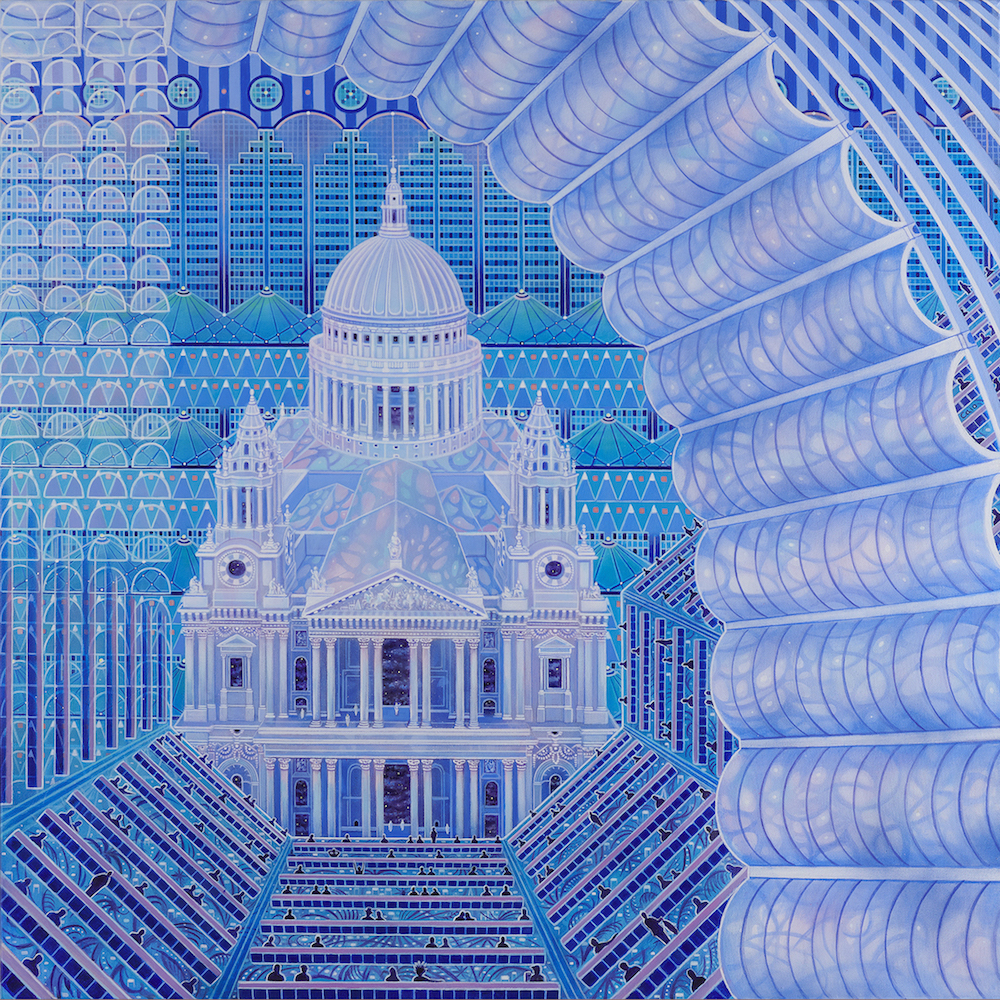
Caio Locke
Acrylic on canvas, 100 x 100 cm
Clare: You depict many textures co-existing on the surface of your paintings—smoke, steel, glass, feathers, marble and plant life—do you maintain a regular practice of sketching and observational drawing? If so, how often and in what format? (eg. notebook, iPad etc.)
Caio: I sketch from life, but more often from the mind. I also trawl through my photos and memories to see if they trigger something. But I prefer to work structures, people and nature out for myself, altering or imagining them into the compositions. My preference for observational studies, including life drawing and sometimes portraits, is for Derwent soft drawing crayons and conté pastels on coloured, textured paper. When it comes to initial ideas for paintings or designs, I often use notebooks with grid layouts before scaling up to larger sketchbooks.
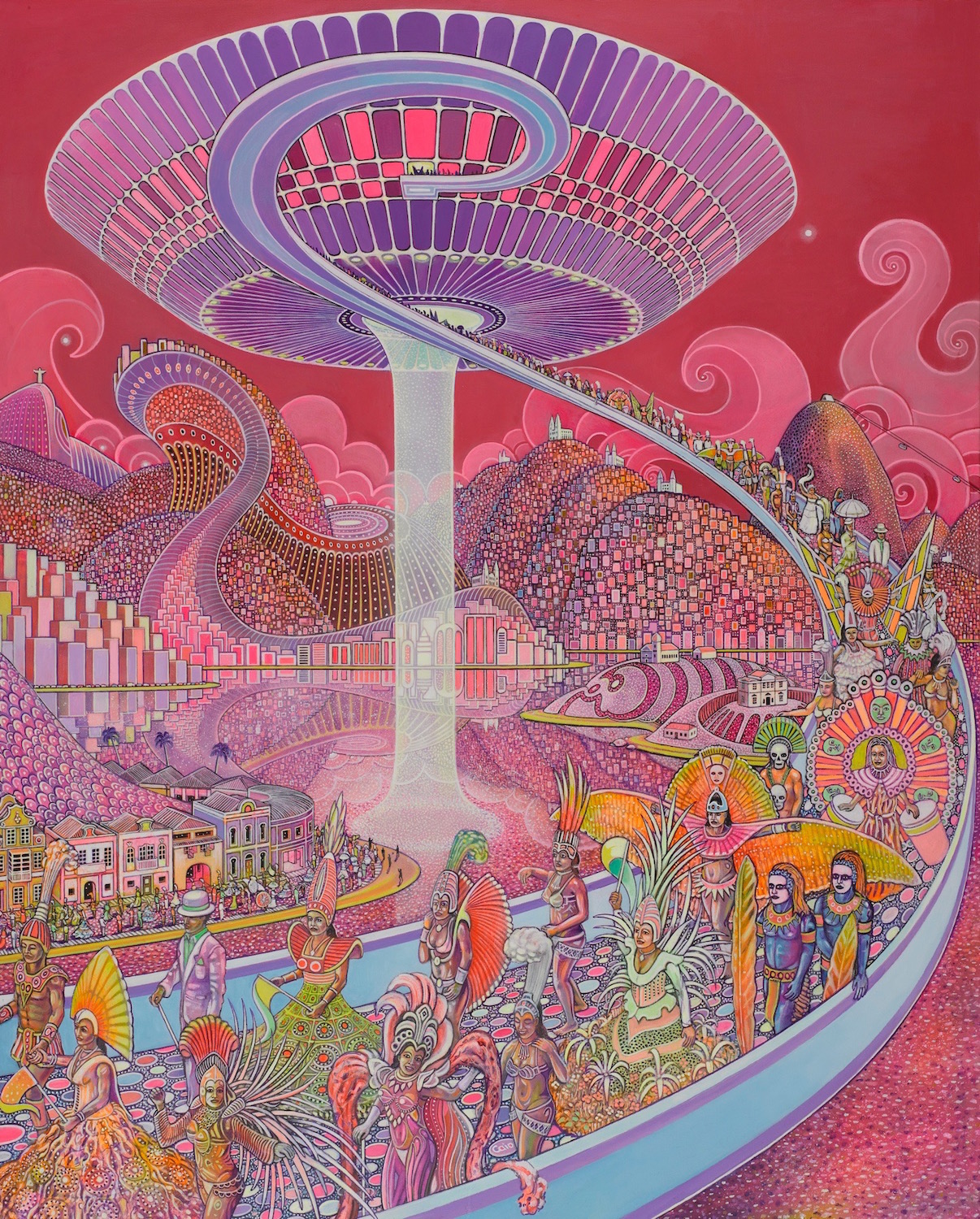
Caio Locke
Acrylic on canvas, 152 x 122 cm
Clare: What are your art influences? Who are your favourite contemporary artists?
Caio: With Van Gogh, you feel the imperative energy of every brush stroke as if he imagines it to be his last, his subject matter mirroring his inner intensity. With Gauguin, the search through myth and folklore for something that is only ever tangentially visible. The Lithuanian composer and painter Ciurlionis touches on this otherness, as do Rothko’s paintings transcending time like gateways to another dimension.
I was recently struck by the vast stillness in an exhibition of paintings by the Norwegian artist Harald Sohlberg. In architectural terms, it is the works of Escher, De Chirico, the structures of Oscar Niemeyer and the cosmic USSR architects. For contemporary art, although very different from my own, Olafur Eliasson’s Weather Project installation at the Tate Modern with its mirror sun left a profound impression. Seeing then looking up the work of Agnes Denes too, especially her wheat fields in downtown Manhattan.
I’m drawn to paintings with a unique sense of space that transcend the immediate present like those of Gordon Cheung or Toby Ziegler. Major influences also lie in the civilisations of the past, such as the visual impact of seeing the temples in Angkor and making a trip to see other temples half buried amidst the surrounding jungle. More recently, it was the pyramids of Teotihuacan.
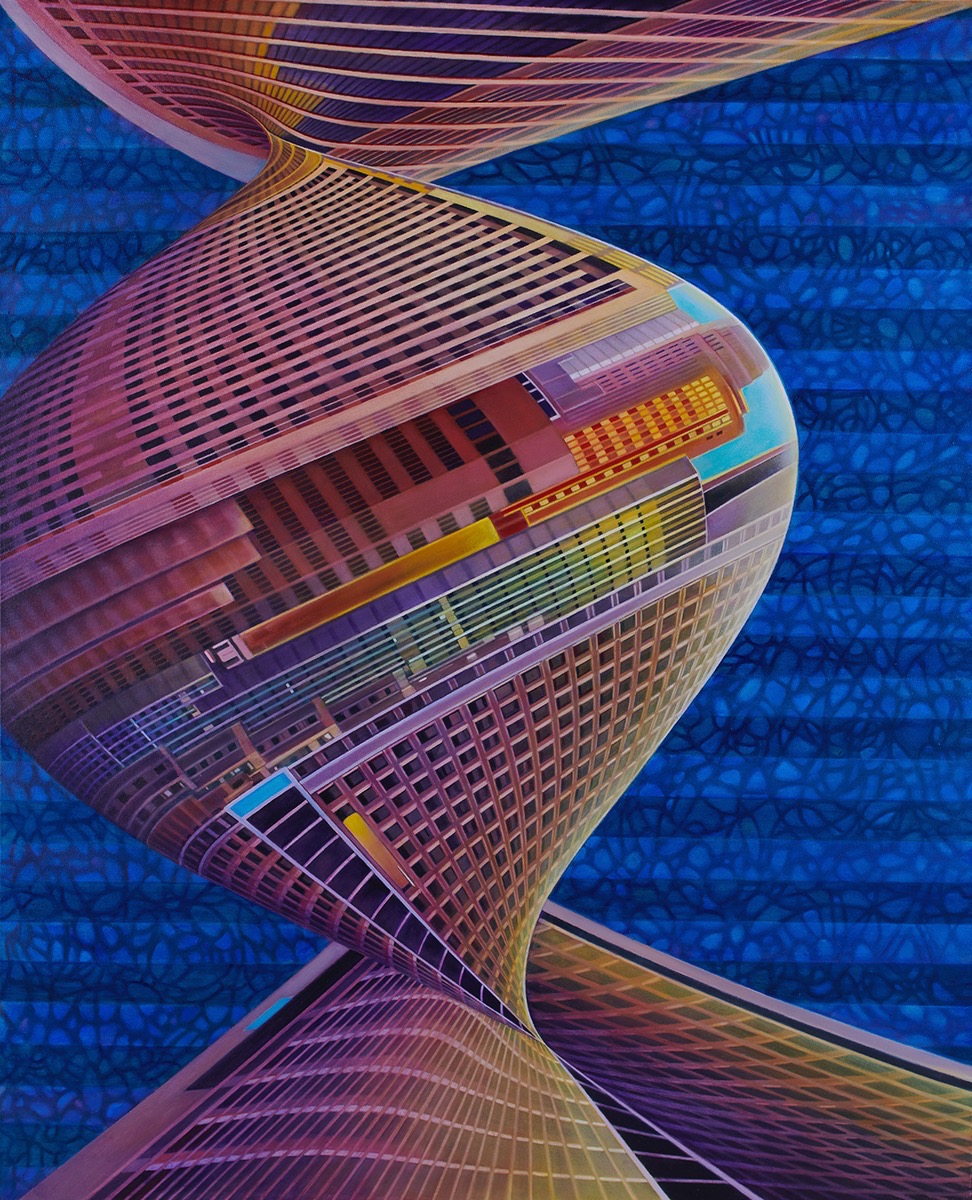
Caio Locke
Oil on canvas, 152 x 122 cm
Clare: What is your favourite artist tool?
Caio: The mind’s eye.
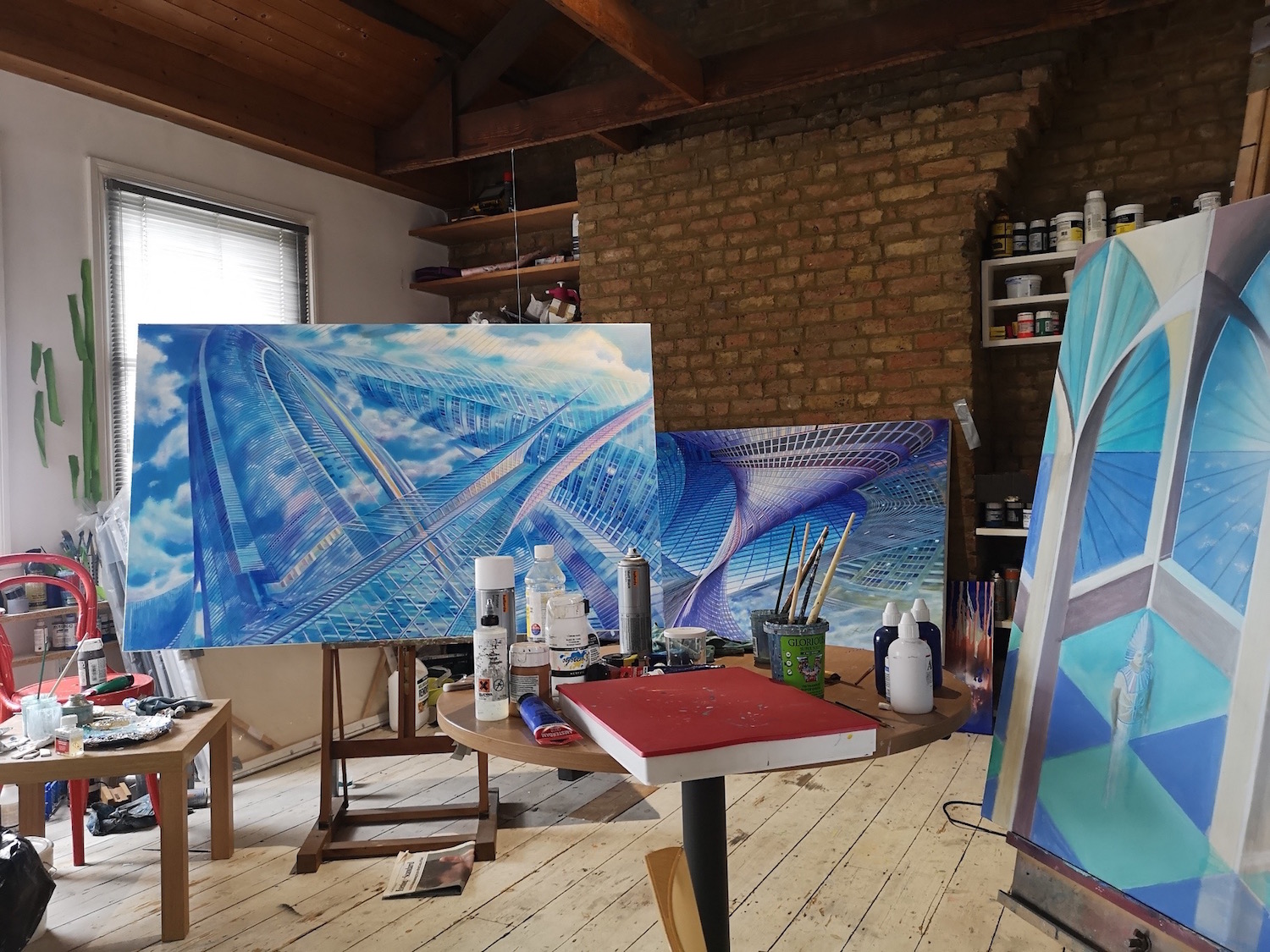
Clare: What makes a good day in the studio for you?
Caio: No admin, no worries or distractions, not too hot, not too cold, just the whole day to get completely lost in work. The best is when there is nothing to stop the flow. But, there are those days when something pent up can lead to a breakthrough and a new direction so you can never rule out the usefulness of a bad mood.
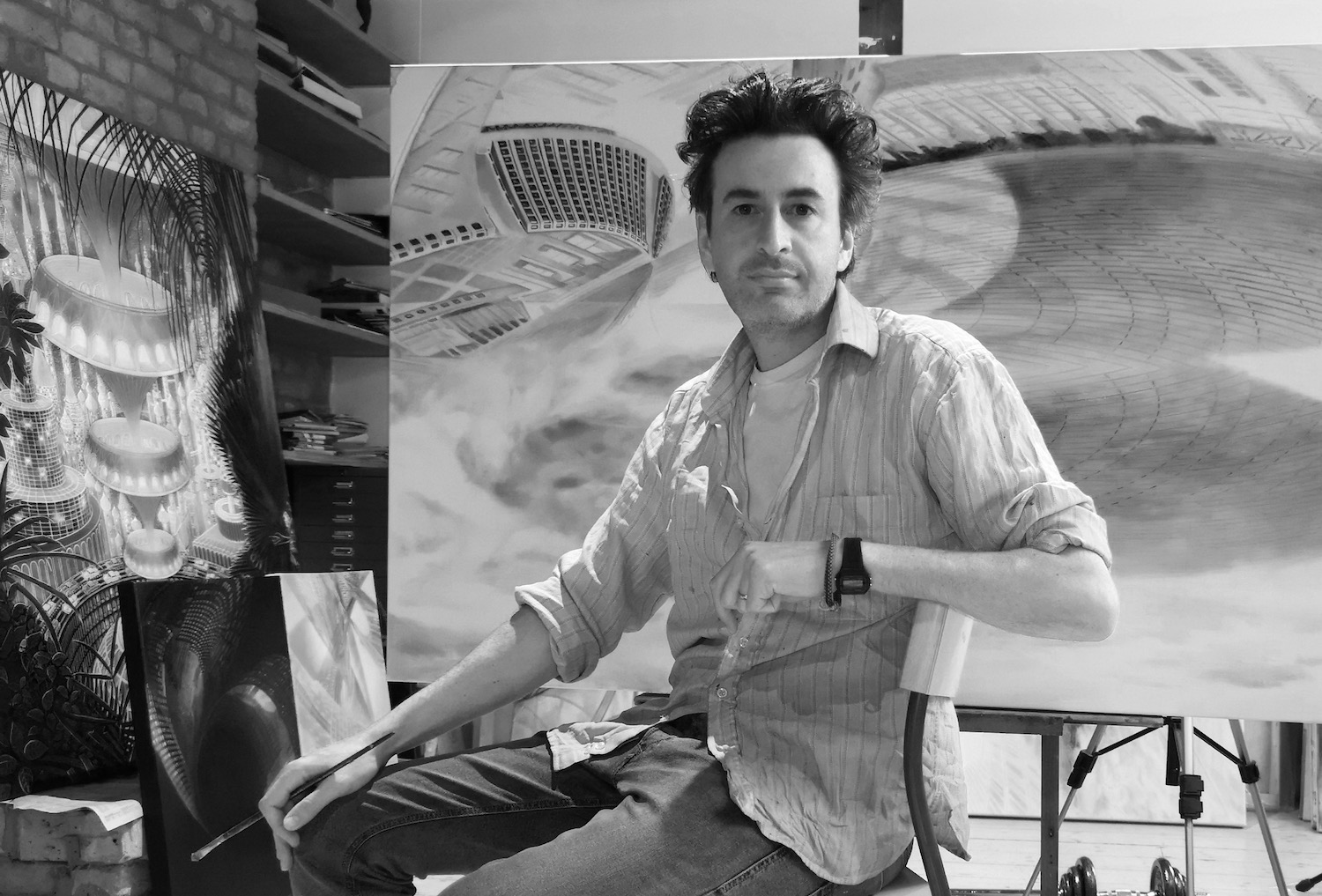
Clare: In the studio – music, audiobook, podcast, Radio 4 or silence?
Caio: All of the above, depending on what phase I’m in – I use noise cancellation headphones. Silence when I need a breakthrough. Audiobook, podcast or Radio 4 Extra when I know what needs doing but it involves long bouts of concentration so I can listen with one side of the brain and work with the other. I like music when everything is flowing fast, normally when the piece is coming together and I’m in the final phase.
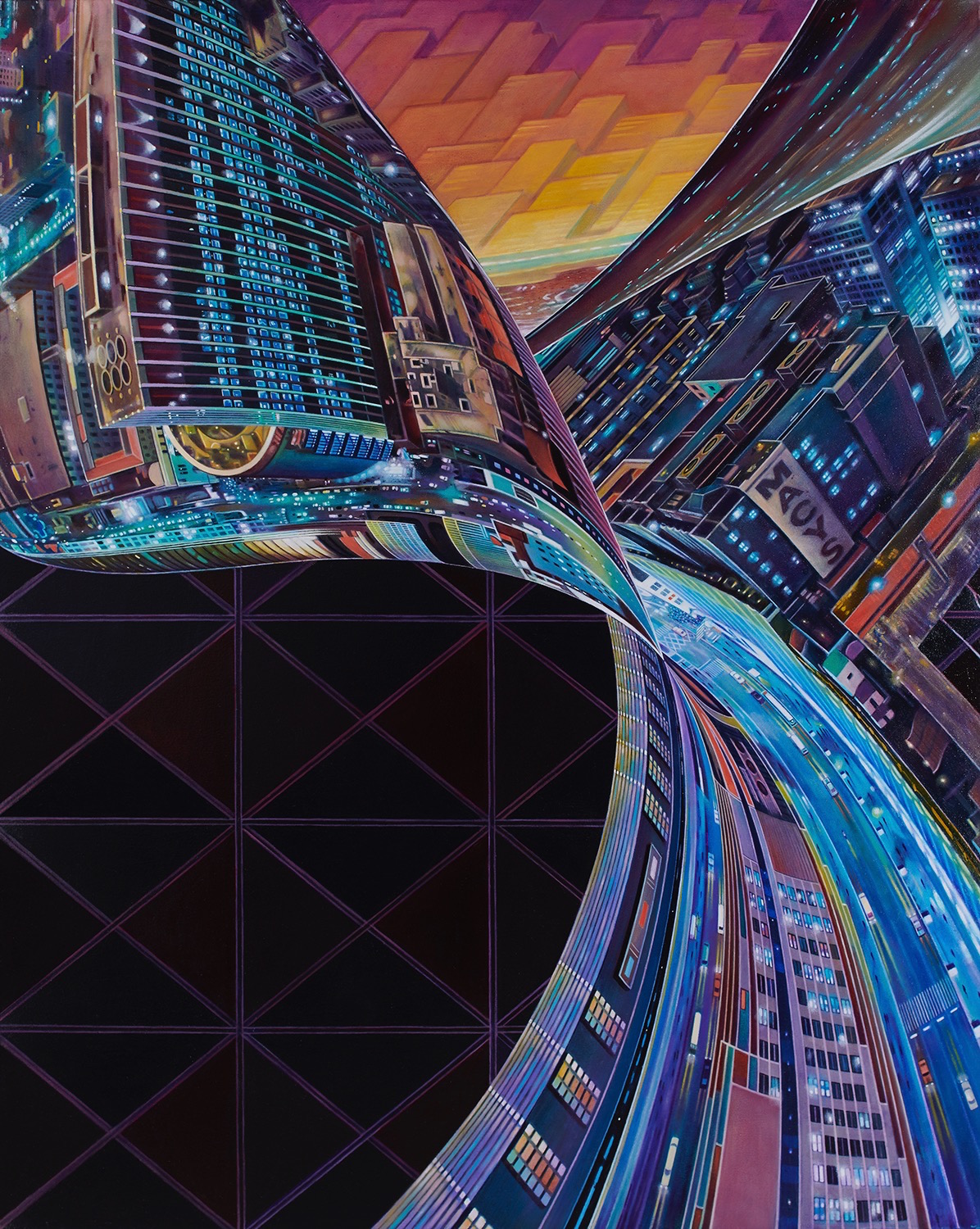
Caio Locke
Oil on canvas, 152 x 122 cm
Photo by Sylvain Deleu ©
Clare: What is coming up next for you and where can we see more of your art or online?
Caio: I’m collaborating on a virtual reality project that would ideally form part of a future exhibition to include the ‘Icarus’ paintings. This will create an immersive VR version of ‘Metropolis London’ that will allow for exploration of the ‘parareal’ painted environment. I’m also preparing to work on a large-scale exterior installation in London based on a painting.
The best places to see more work and find out about current projects are:
6 thoughts on “Caio Locke: Painted Utopian Futures”
Incredible, evocative, maybe scary, work
Awesome arts!
It blows up your mind!
It really is awe-inspiring work. Thanks for taking a look!
Many thanks
Lisa
Such interesting information. Great blog. I
love your work and yours great photos
I like it
Wow, this looks amazing. I’ve never seen
such creative paintings before. It would be
great to get to an exhibition with such works
of art.
Comments are closed.