



The paintings and drawings that Tim Patrick creates are the visual outcome of a deep contemplation of faces, places and memories. Having trained at the University of Brighton and the Royal Drawing School, Tim has regularly exhibited his work in the years since, and recently completed a residency in the city synonymous with the whole canon of art history: Venice. In this interview I asked Tim about the materials he most enjoys working with, how to prepare for painting away from your studio, and he explains why an open mind is so important when going on an art residency.

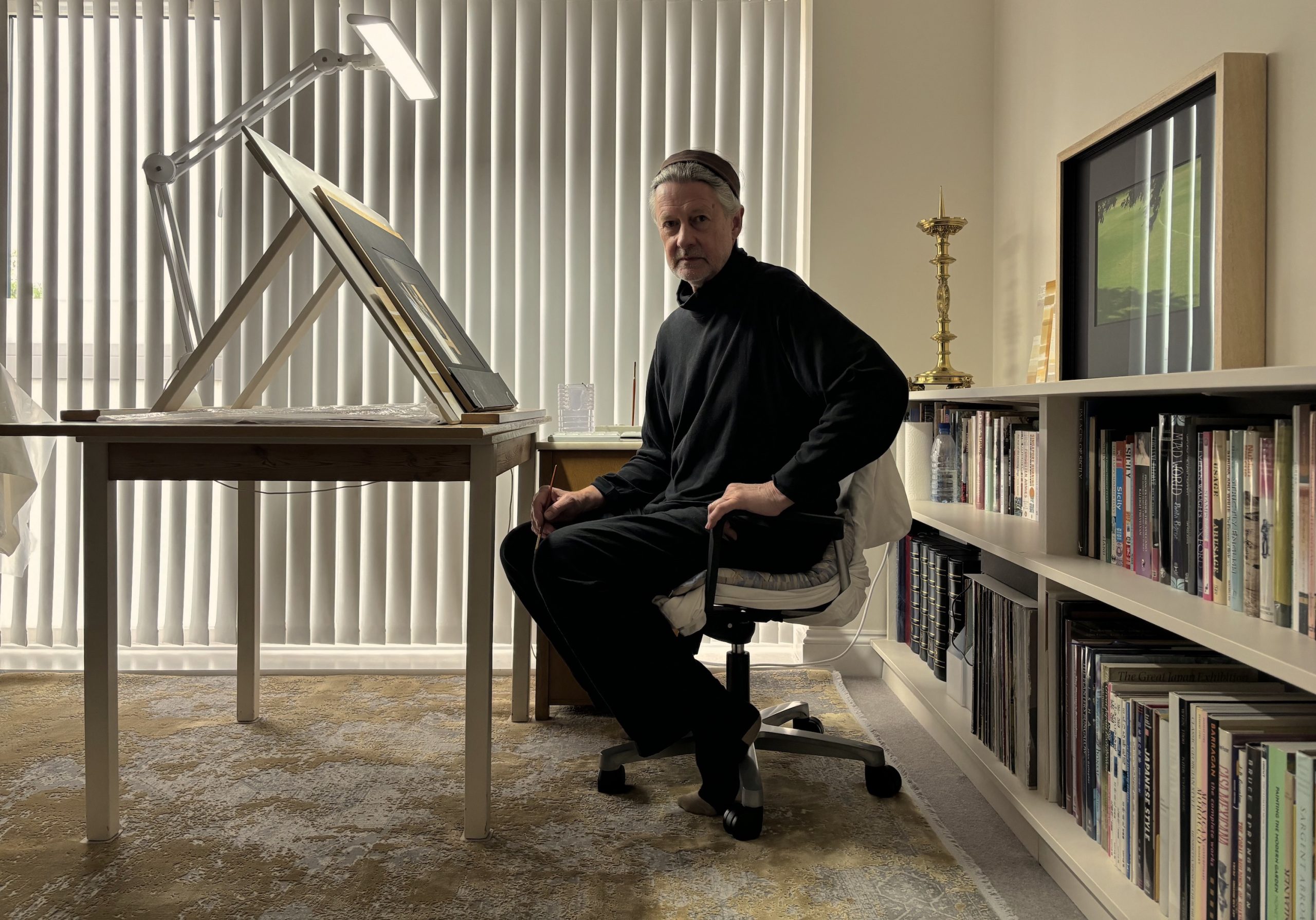
Tim Patrick working from direct observation (photo: Simon Richards)
Lisa: Can you describe the experience of going on the residency – and in particular, what impact being somewhere else had on your work?
Tim: The more I make work, the more aware I am that encounter with place is in fact what I am excited to explore. Being somewhere else actually facilitates the creative process for me. A mixture of excitement, nerves, and an eagerness to achieve something in particular whilst being open to the encounters one might have, are what I mostly felt in Venice.

Studies on paper by Tim Patrick (photo by Simon Richards)
Lisa: How did you plan for the residency, and indeed, how do you plan for an experience that has an element of the unknown about it?
Tim: The unknown was I guess, precisely what I was looking to find. That element of encounter, being so important in my work, excites me to paint. I tend to try and find a balance between living with a place and encountering something new each day. As the residency progressed, I focussed on something intimate, an interior of the palazzo where I was staying. In the afternoon, I would venture out into the city and revitalise that sense of unknown, making studies of people and places. So it’s really a balance for me, grounding myself with something close to me, and then trying to discover something new to counteract this.

Awning
Tim Patrick
Ink on Paper, 21x25cm, 2019
Lisa: Talk us through the lines of enquiry of your residency – the works appear very intimate and quiet – and there’s a lot of linen!
Tim: It was a really interesting brief – I’d been invited by the Royal Drawing School, to the home of Eric and Maxine Reynolds, Palazzo Arrigoni, as Artist in Residence for the now biannual In:Visible Gardens event. It’s an initiative of Maxine’s to encourage the building of community links amongst the dwindling locals of Venice, and bring the people who care for the city together. This year, Villa Herriot on the Giudecca island was made available for local interest groups to hold an afternoon together sharing activities. What happens in Venice is representative of so many unique places in the world – it’s mystique and character being simultaneously what edifies the city and what condemns it – there are so many tourists that the city is losing its core people, those who’ve made and run it. It feels that despite the crowds, there is a sense of vacancy; Substantial relationships with the place are replaced by earnest but casual encounters. The pictures I made focus more on this aspect of vacancy. I was thinking of the drawings of Tiepolo (Giovanni Domenico, there were two…), his satirical take on the people of Venice, and thought that I might have explored this. Instead, that vacant, hollow aspect of the city was what I was keen to express. Shop fronts, awnings, the spaces that people moved through though would outlast them, are what excited me to paint. The Italian word for empty, ‘Vuoto’, is a word that springs to mind, its vowels are an almost onomatopoeic sound expressing this emptiness. Venice, Vuoto.

Bathroom
Tim Patrick
Gouache, Ink, Watercolour on Paper, 56 x 76cm, 2019
Lisa: I’m also interested in the relationship between your faith and your artwork. Is painting an expression of your religious faith, or a spiritual act in itself?
Tim: I really like that an aspect of this transcends the work – I don’t try and put my faith necessarily into my painting or drawing, but I think somewhere not far beneath the surface, it is really present in my mind. Not necessarily specific images, but more of a feeling of what I look for when trying to express and idea about a place or a scene. I think I consider my paintings and drawings as spaces for contemplation, carving out a room for thought on a wall.
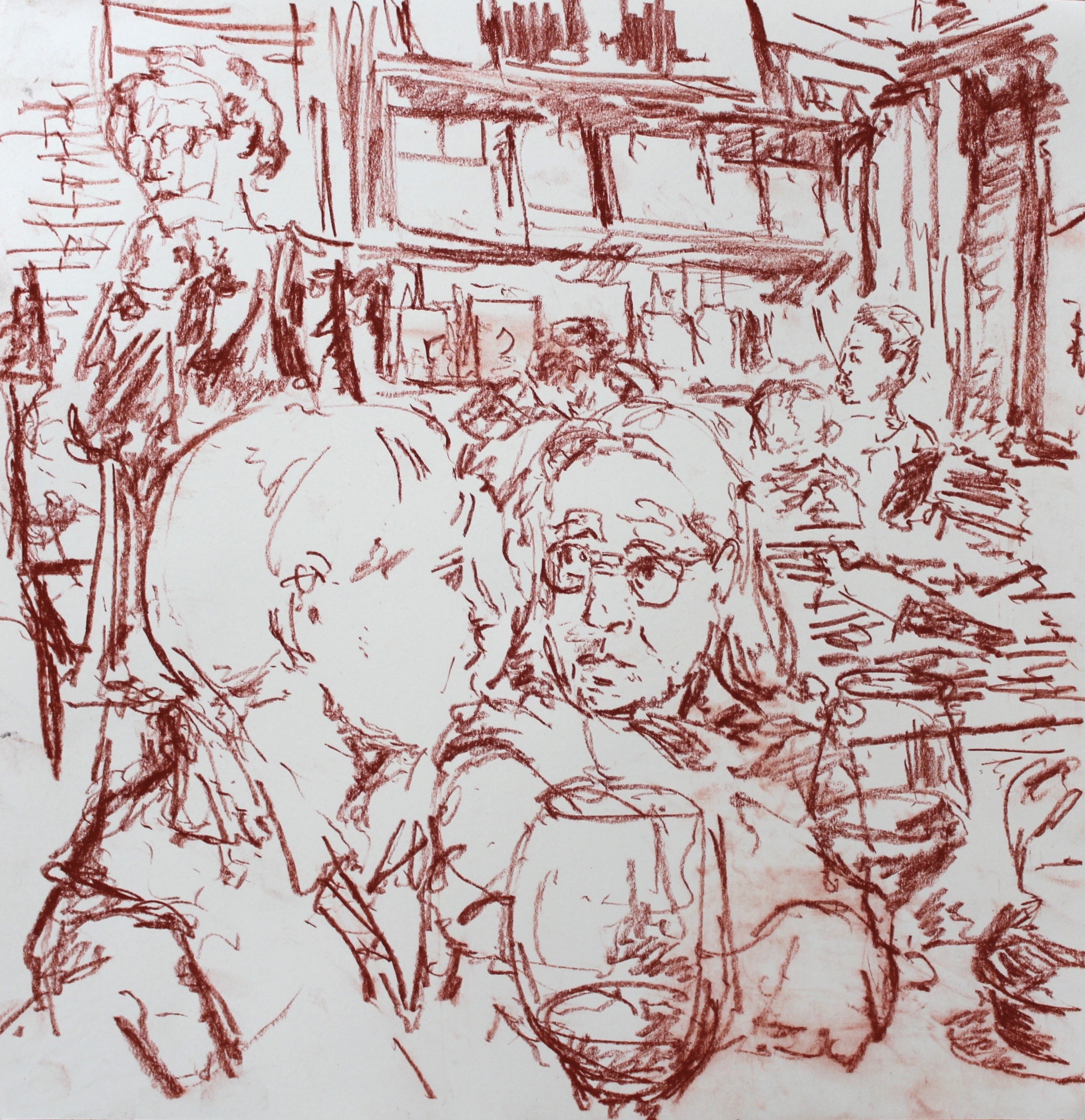
Drinks at Sullaluna
Tim Patrick
Pastel on Paper, 27 x 27cm, 2019
Lisa: Venice has been a course of inspiration for so many artists throughout the history of art – did you have to make a conscious decision to try and block all of that out, so you could focus on what responses you had to the city?
Tim: Being in Venice was a super strange challenge – being exposed to a place that you feel you know already or hold a picture in your mind of. So many images spring to mind of what the city is like and how I expected to find it. I went there with a strange pre-knowledge, like I was expecting to know it already. But more and more as I work, whether in the studio or away, I find that I am driven by encountering place, either directly, or working from memory. Either way, I find a feeling of being foreign to somewhere, of being alien to a place, really excites me to see it afresh, and encounter it anew. I tend to try and find something really intimate about the place I’m staying in – the bathroom, or a corner of the house that is otherwise not considered. This tends to bring me to focus on being really present to the place, and hopefully seek out a new encounter.
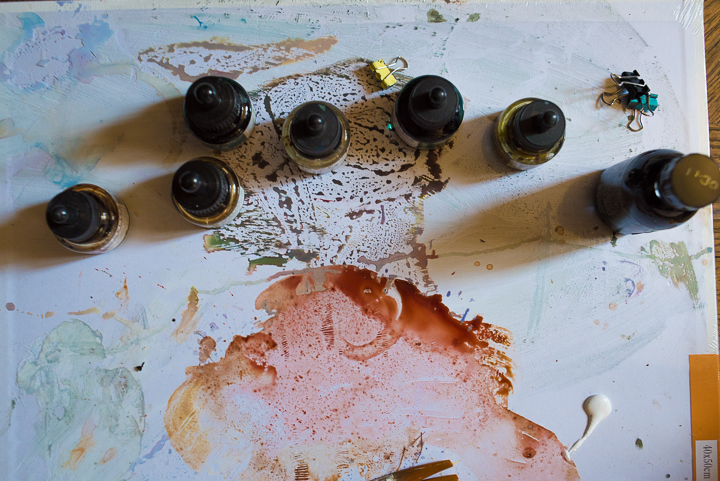
Ink in all its stained glory (photo by Simon Richards)
Lisa: Please could you talk us through the media you chose to work with in Venice, and the qualities they lend to the work.
Tim: I made work mostly in ink, gouache and pastels. I’d recently begun to make work using these beautiful Shellac inks by Sennelier -they’ve got a real richness to them, and for me, drew some parallel to the drawings of Tiepolo, a famous Venetian painter and draughtsman who worked in ink also. I like that thought that whilst his Goya-esque drawings in ink focused on the foibles and eccentricities of the Venetian people, mine were interested in a sense of absence, vacancy in the city, of the spaces that people occupied and lived in. His populated, mine sparse. I drew also in red sanguine and pastel – I love so many master drawings that were made in this way, and for me, this was a way of drawing appropriate to the place I was in.

Plein Air Watercolour Studies (photo: Simon Richards)
Lisa: How have your experiences in Venice influenced your work since you have returned?
Tim: The time I spent there really revitalised my work – I think sometimes you can become too familiar with your practice, with how you approach a subject. Time there was like jump-starting the creative process, making me react and respond with more spontaneity than I’d normally carry into the studio. I’m looking forward to, to developing some of the ideas I had there into my studio work, and seeing how they pictures might start to talk to each other.

Reflecting on a whole collection of Plein Air Studies of Venice (photo: Simon Richards)
Lisa: What advice would you give to someone going on a residency – how do you ensure that you hit the ground running?
Tim: Being prepared to be open is a good way in! Going with too much baggage or expectation, can really stifle things. I found that being ready to meet the place openly was important. On a practical level, making sure you’re prepared, with the materials you expect to use, and not bringing a million things you won’t use! They say necessity is the mother of invention, and I think when you limit yourself, both in terms of material and place, you can find some interesting solutions.

Plein Air Sketching in Venice (photo: Simon Richards)
Lisa: What do you plan to do next?
Tim: Immediately, I am making plans to show the work made in Venice in London. Beyond that, I am beginning a new body of work, particularly works on paper, continuing in gouache, ink and watercolour. These are really based on memory of places and people.

Plans in the Garden
Tim Patrick
Pastel on Paper, 42 x 29cm, 2019
Lisa: Where online or in the flesh can we view more of your work?
Tim: Online, my website has much of my work, though also on Saatchi Art and the Royal Drawing school website also:
www.timpatrick.co.uk
https://www.saatchiart.com/tim_patrick
https://royaldrawingschool.org/artists/drawing-year-alumni/tim-patrick/#2
Beyond that, I am aiming to show the work made in Venice in the next few months, and a
substantial solo show in 2020.

Tim Patrick (photo: Simon Richards)

3 thoughts on “Tim Patrick Reflects on Venice Residency – Interview”
Thanks for a fascinating article- really
enjoyed reading about your adventure and
love your relaxed style.
Great, Tim, really accomplished
drawing. Can I ask how one gets a
residency in Venice or Paris. I did
one some years ago in Collioure for
the Charles Rennie Macintosh
Association and agree with how you
tackle a new environment. Best wishes
Douglas.
Love your work and creativity. Keep up the fantastic work!!!
Comments are closed.