



Jarvis Brookfield is an artist living in Leicester, UK, whose practice celebrates a reverence for nature and the depths of the human experience. Here he writes about creative block and what can be done to overcome it, providing some useful exercises and techniques along the way.
Overcoming the Cunning of Creative Block
by Jarvis Brookfield
At least once we’ve all experienced the strange phenomenon we commonly call ‘creative block’, aka white page fever, aka writers block. A project fails or comes to an end and our creative spark has now dwindled into dimly flickering candlelight, under the darkness of a night sky. And I confess, I’ve given up on paintings, painted over paintings, even ripped and slashed a canvas off its stretcher, doing more damage to my fingers in the process (lesson learned). However, the truth is that creative block is a psychological state, brought on by a lack of clear understanding about how creativity works.
The first most fundamental thing all artists and creators should understand about creativity is that all ideas already exist. All we must do is show up. For example, have you ever been walking, cycling, or simply sat down looking into space when an idea or solution to a problem you’ve been having, spontaneously presents itself to you? In part, this is what I’m referring to. And, the beautiful thing about that, is that you do not have to wait. You can consciously create those moments through understanding basic principles and cultivating simple habits.
As a quick exercise, grab a piece of paper and a pen or pencil and ask yourself ‘when do I, or have I experienced, a creative block?’ Think back and when you see it, write it down. For me, it used to come several days after I had completed a painting. This often took the form of pangs of self-doubt, feeling depressed, procrastinating, and eating more than I should be. A road to nowhere good.

Nevertheless, I am going to share with you several principles, ideas, and practical exercises to help you create new habits that can resolve and may even eliminate the problem of being creatively blocked.
To start off, here are several guiding principles, that through repetition may help to create a larger sense of possibility, creativity, and confidence, diminishing the fear of failure and performance anxiety in the process. At the end of the principles section, I’ve provided several creative exercises that you can turn into regular habits.

(Sister Corita Kent’s Rules [The Immaculate Heart College Art Department] lettered by David Mekelburg)
Never work for results
It’s natural to have an intention of what you’d love to make, but let go of your attachments. Working for results creates unnecessary suffering. Instead, be as present as possible. When you feel yourself getting tense or stressed about your work, it’s because you’re attached to how you think it should be. We’ve all been there. Nonetheless, when you feel yourself thinking too far ahead or becoming tense, breathe in and out, slowly and deeply, 5 – 7 times. Focus on the present moment. Allow yourself to enjoy the sounds, smells and sensations of your chosen tools as they make contact with your work of art.
The quality of intention on the object of attention will bring about the desired results. – Deepak Chopra.
Physical exercise
Artists predominantly work inside. Some of you may have the pleasure of a larger studio space or create work outside. For those who do not and sit down a lot, this is especially important. I recommend creating a regular and consistent exercise routine. Start simple with daily walks and then perhaps more intense exercises a couple of times per week.
According to a recent Harvard study, running for 15 minutes a day or walking for one hour reduces the risk of depression. You might also find that solutions to problems present themselves to you more frequently as you become consistently physically active.
Work on what you find most difficult
What is the one thing that you always see, without fail at life drawing classes, other than a nude model? Headless bodies, handless arms, and footless legs, right? People often avoid these parts out of a fear of failure. Fear is natural, but the issue with it is that it grows the more it’s avoided.
We naturally want to avoid pain as its biologically hardwired into us. However, by regularly facing what is difficult and problematic such as anatomy, perspective, colour temperature, or whatever you’re curious toward but often avoid, you will begin to develop a stronger sense of confidence, resilience, and the ability to take risks.
Nurture a healthy relationship with drawing
Drawing is such a primitive and basic form of expression, which goes back for a time immemorial. We’ve all heard people say, ‘I can’t draw’ and this may be their truth, but largely this isn’t the reality. They just have an image in their head of what they think drawings should look like and believe it to be true.
Have you ever watched a child draw? They are carefree, they scribble, mash every colour together and even stab the sheets of paper! Essentially this is what you want to do. The key is that you don’t need to draw anything specific. Just simply scribble for 5 – 10 minutes every day and by doing so you’ll naturally develop a healthy relationship with yourself and your unique sense of creativity. The interesting thing about this is that it’s a one size fits all. The entry point is as simple as a mark-making tool and piece of paper.
Morning pages
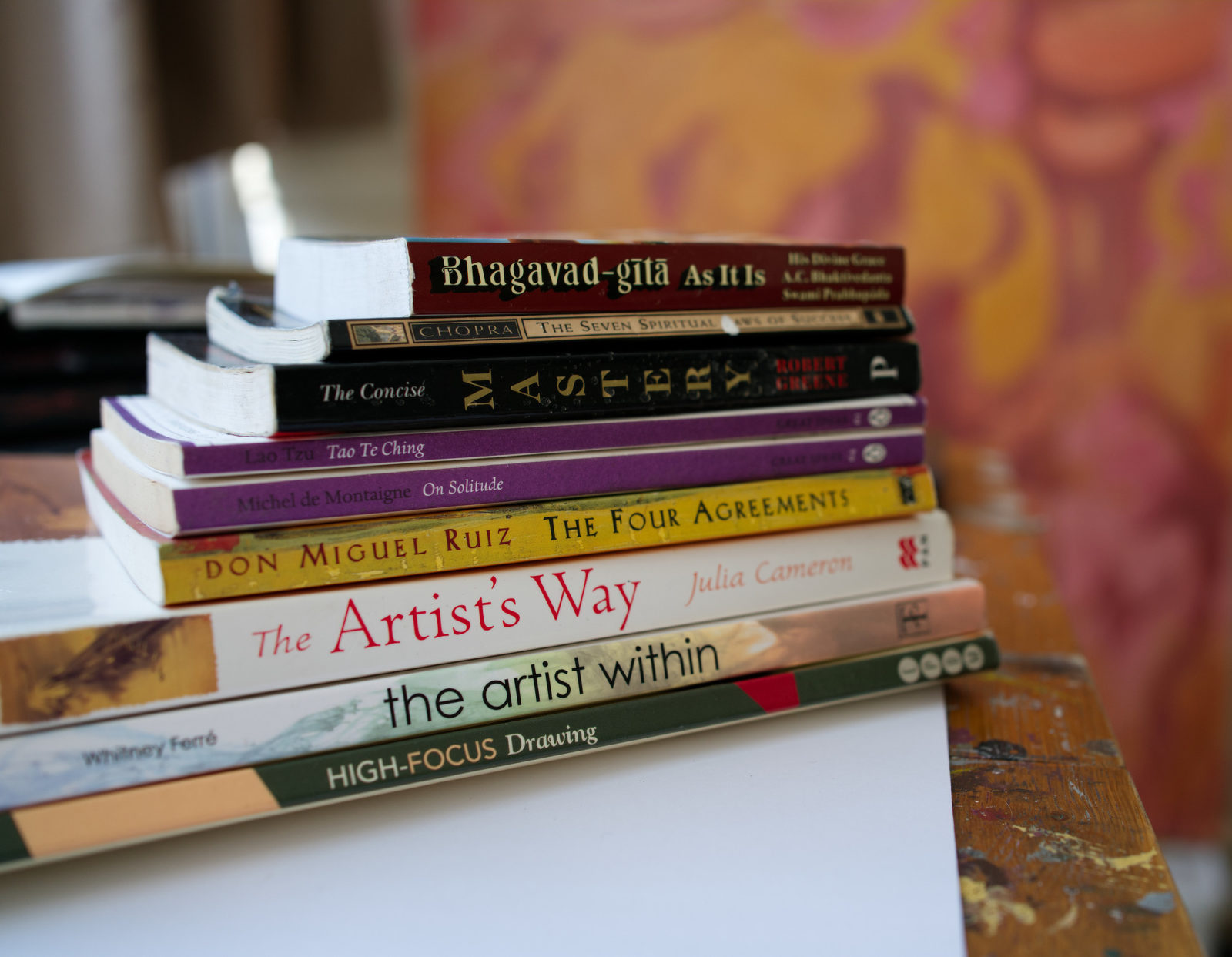
This is an idea I picked up from a fantastic book called The Artists Way by Julia Cameron. I am sure many of you are familiar with this book and/or have heard the term morning pages. For those who haven’t, here’s what it is. Write 1-3 pages of longhand writing, on anything that comes to your mind, and do not censor it. To name a few benefits, this process, of pouring out your thoughts, puts us in touch with our centre, helps to resolve personal issues (can contribute to blocks) and access the source of your creativity.
Over time it lessens the volume of the inner critic who says ‘oh I am not good enough; I can’t draw or I’m terrible at …’. Julia goes into far more detail than I have here, so I’ve provided a link at the bottom for you to learn more.
Fill the creative well
Filling the creative well is basically about absorbing more of the things that inspire and intrigue you. This can be in the form of visiting charity shops and hunting for art books or objects. Visiting museums. Gathering images on the internet and saving them to a board on Pinterest. Cutting out images that you love from magazines and filling your sketchbook. Drawing from life. Reading stories and listening to music, or watching movies that you love, and so on.
Be sure to schedule a few hours every week for this and do your best to stick to it. Consistency is key. I like to see this as a reward and usually spend my Sunday’s doing a variety of the above.

Start another project before you finish a new one
This is critical and one of the most important principles for avoiding the pitfalls of creative block and its unhealthy symptoms. I picked this idea up from a film writer named Dr Ken Atchity in a YouTube video called Understanding Time, Work, and Creativity. It’s such a simple, and since having personally adopted it, profound idea.
Often the depression experienced after finishing a project can be unnecessarily painful and is a place that many artists struggle to get out of, some of which never do. This is often the seed of a creative block. The premise for this idea is that, as you switch between two, three or four projects, regardless of their size, you inadvertently invigorate your enthusiasm for the other. And, if one project fails, you have another to fall back on. So, if you’re currently coming to the end of a project, hold the line! Start filling the creative well and get started on another.
Creative Exercises:
The key to having these work for you is to schedule at least 1-3 sessions per week. Incorporate these into your studio practice while keeping at least 1 or 2 principles in mind. Early in the morning or just before you start working on your project is an optimal time. You can have a dedicated sketchbook for these exercises.
Not only will these help diminish the fear of failure, but they will also provide you with a stronger sense of confidence and put you in touch with your unique sensibilities. Even if you don’t draw it’s important to understand that creative energy is universal. The only difference is the clothing it wears i.e. what makes you, you.

Things you will need:
- Pen or pencil
- Blank piece of paper
- Timer
Exercise 1: Blind drawing
- Set a timer for 5 minutes.
- Close your eyes and draw.
- There are no rules as to what you draw but keep your hand moving for 5 minutes.
Exercise 2: Scribble like a child again
- Set a timer for 15 minutes.
- Draw freely and Let yourself scribble like a child again.
- If this feels uncomfortable, great! Draw that feeling.
- There is no need to draw anything specific. The key is to be free in your drawing.
- Scratch the pages, draw things that you think you’re not supposed to, there are no rules except to draw for 15 minutes.
Exercise 3: Draw a memory
- Set a timer for 15, 20 or 30 minutes.
- Bring any memory to mind.
- Draw it.
- It doesn’t have to be representational. Focus on the feeling whether good or bad. Pick one that perhaps, repeats itself in your life.
- Do not censor it however silly, painful, or not so savoury it might be. After all, it’s up to you who sees it.
- You may get the most out of this exercise by picking uncomfortable or difficult memories.
- The Artist’s Way, by Julia Cameron (More on Morning Pages)
- The 7 Spiritual Laws of Success, by Deepak Chopra
- Drawing on the Right Side of the Brain, by Betty Edwards
- Meditation for Artists – The Automatic Drawing Technique, Stan Prokopenko – YouTube Video
- Dr Ken Atchity, Understanding Time, Work and Creativity – YouTube Video
- Elizabeth Gilbert, TED – Your Elusive Creative Genius – YouTube Video
These simple exercises have little to do with art. They’re more importantly about cultivating a healthy relationship with yourself that inadvertently will aid and empower you in your creative endeavours. It can be surprising how quickly you’ll feel a shift in your perception and how you experience your creativity.
In light of the current situation we all face, hopefully reading this has been enjoyable and insightful. It can be challenging to maintain our creativity and productivity but remember, life is a journey, see it as a quest and focusing on the process is key. If anyone of these speaks to you, embody it, and transform it into a new habit or perception. I’m sure that you’ll experience a positive change in your practice as a result.
Thanks for reading and until next time, all the best and never quit creating.
Resources:
Keep up-to-date with Jarvis Brookfield’s work on his website and Instagram – @jarvisbrookfieldart.
Further Reading:


20 thoughts on “Jarvis Brookfield on Creative Block”
This is a great article and thank you for
including it on this site which I daily
visit. Constructive habits do help
mitigate creativity blocks and preparing
for a few projects during a given time
may inpire further ones.
No problem, I’m glad you found it enjoyable. I agree as I think its such an underrated aspect of being creative which is, as you look into the careers of successful artists, something which they all speak about.
I think a no fail way to overcome creative
block is to always be planning the next work
(even if just mentally) before the current
work or series is finished.
I couldn’t agree more Marta. I remember hearing about this on a video, where the screenwriter spoke about how, as he walked along the beach, he would think about and visualise the story.
Thanks for writing on some of
your experiences and giving starting
points for us. A form of creative block
for me is not lack of ideas or intention
but using sidetracks to block actually
attentively ‘producing’ by not snatching
time away from daily chores. I can start
with your exercises.
No problem Isobelle and as you said this is a starting point. For instance, managing time and social media/ distractions are things that I would have gone into but felt that this post might go on for a bit too long! and creating a balance between all the other aspects of life while being creative can be challenging, but hopefully, you can find or even better, make a few gaps here and there for these exercises. thanks for reading Isobelle.
Great article. I’m an artist and university
senior educator in the fine arts myself and
actually apply many similar methods I invent
myself with my students. Thanks for the
great links!
Thank you. That’s great, I feel like in the educational system at least where I studied, this was rarely discussed so I’m happy to hear that you’re doing this for students Ruth. And no problem, I hope that the principles expressed will be helpful to you for many years to come.
This is enormously helpful. Thank you!
I’m glad you enjoyed it, Christine.
Very sensible advice, good to know it’s not just me that struggles.
Glad you enjoyed it, Colin. And we all do but have become masters of deceiving our selves and the world.
All of these articles are so interesting and
appropriate to my practice and education
profession.
Thanking you for your inspiration.
No problem Cathy. I’m pleased to hear that you enjoyed reading it.
Very helpful post.
Jarvis, you star! You echo so many of my
negative thought processes in your article
and you give ideas on how to let go and be
freer without too much pressure and
expectancy of perfect results which stop us
in our tracks before pencil or paint hits the
surface! I’ve taken on board some proactive
suggestions that really appeal to me. Its
becoming obvious that being present and
rediscovering playfulness and exploration is
the start of the creative process.
The books you recommend are all excellent.
Thank you!
A must keep article. To be shared.
I am excited to try out some of these tips! I
struggle with creative block every other
month.
You helped me so much as a writer’s
conference newbie with the same advice you
just wrote. And when I was a college
journalism major, our prof told us the same
for newspaper writing. Thanks!
It’s a very important thing like emotional
burnout. One in four people will struggle
with mental health at some point in their
lives. And with the coronavirus pandemic
and troubled economy, many are in crisis
right now. Thanks for such a useful article,
which helps to overcome it, providing
some useful exercises and techniques
along the way.
Comments are closed.