



Laura Boswell ARE’s woodcut and linocut relief prints interpret the timelessness of the english landscape with her unique aesthetic. Drawing from ancient Japanese print techniques as well as mid-century graphic design, Laura’s vision is distinctly hers; fusing delicate and sophisticated palettes with gentle brushmarks and deliberate, graphic shapes. In this interview Laura shares some of the ideas behind her work, the materials and processes she most enjoys working with, and the ways that she shares her knowledge with her online community.

Road to Rosedale, evening light, 2020
Laura Boswell ARE
Woodblock, 475 x 190 mm
Lisa: Can you give us a brief account of your love affair with relief print? When did it start and how would you describe the creative journey you’ve been on with it since?
Laura: My love affair with lino really started in my last year of art school when I was the only student of my year to specialise in printmaking. Alone in the print studio, I chose lino because I’d tried it at school and it seemed familiar. It was a very short love affair as I stopped printmaking when I left college and went to work in the photographic industry. I only went back to printmaking (and art; I hadn’t drawn or painted since college) in 2005 when friends made me a long term loan of an Albion printing press, perfect for relief printing. It was then I started my printmaking again and began my artistic career.

Birch and Winter Sky, 2020
Laura Boswell ARE
Linocut, 510 x 430 mm
Lisa: You have been known to create both linocuts and japanese woodcuts, and use both waterbased and oil based colour to create your prints. Can you tell us why you work with both processes and the different types of ink – what advantages do they each have?
Laura: I was very fortunate to train in Japan and have done three residencies in all to study traditional water based Japanese woodblock printing. The process is a multi-block one using brushes to apply watercolour paint in combination with rice paste onto the wood and the work is hand printed onto damp paper. Characteristically it is a subtle and refined method with many layers and washes of colour. In contrast my linocut is a reduction process, cutting away at one piece of lino layer by layer, destroying the block as I create the work. For this I use oil based printing inks applied to the block using a roller. When I began using both methods, they produced very different results for me: delicate and painterly for the japanese woodblock and bolder, more graphic prints from lino. However, that has changed a great deal now with both techniques meeting more in the middle for me. The lino is now much more subtle, I often work with upwards of a dozen or more transparent layers of ink, while the Japanese woodblock has become more graphic in style, though still very subtle in colour. I wouldn’t say one has any advantage over the other. Both are fabulous, demanding, flexible ways of printing!

Sunset, Tennyson Down (from 14 Views of the Isle of Wight), 2013
Laura Boswell ARE
Japanese woodblock, 1220 x 720 mm
Lisa: You have spent time in Japan and the influence I think really comes across in your work. Do you think the very English landscapes that you tend to base your prints on particularly lend themselves to a more eastern approach to image-making?
Laura: I’m always amused by my Japanese-ing (if that can be a word) of the British landscape. I think I have always admired artists who in turn were very influenced by Japanese art and, once I started studying Japanese woodblock myself, I was delighted by the Japanese aesthetic first-hand.
I did a commission some years ago for the NHS on the Isle of Wight and created ’14 Views of the Isle of Wight’, huge Japanese woodblocks over a metre across with an undeniably Japanese feel. It was a deliberate subversion of iconic British views into ‘Japanese’ prints and it was huge fun to fill a health centre with these unusual versions of the Island. I would say that the kind of landscapes, up in Scotland or the North or England, that I work with tend to be very austere and translate very well to simplification and a more Japanese compositional approach. When I work with my local and lush Home Counties landscape these prints usually have a huge nod towards the travel posters of 1940s and 50s Britain which is another of my go to sources of inspiration for composition.

Water Meadow Morning, 2020
Laura Boswell ARE
Linocut, 500 x 400 mm
Lisa: You are incredibly generous with your knowledge – you regularly share what you are up to on your social media platforms, and more recently have brought out the brilliant Ask an Artist podcast with painter Peter Keegan…and during lockdown, created some fantastically informative videos about your printmaking. Why is teaching so important to you and is it difficult to balance the time you dedicate to sharing information with the time you need to make your work?
Laura: Teaching can be a monster and I have taken a bit of a step back with classes and no longer teach one to one. My Ask An Artist podcast with Peter Keegan, produced by my husband Ben under the guise of The Talented Mr B, is a joy. Peter is a fantastic co-host and together we are able to discuss the ‘business’ side of art which is something that we both think is very important. From the start we wanted to address the audience as we would a good friend, with pragmatic and simple advice of an approachable sort, giving out the kind of help we both wished we had when we were starting out as professionals.
Once lockdown started I felt very strongly that this was a unique time and that we’d all be accountable for how we handled the crisis. I decided very quickly that I wanted to offer a daily insight into my work and effectively invite everyone who wanted to visit into my studio. I imagined a daily minute on Instagram, but in my husband’s hands the filming became a complete tutorial series of forty or so films called #linowithlaura. Suddenly we had a community with people tuning in and chatting with each other as well as with me. I hope when all this is over, I’ll be able to say that we did something useful and constructive with our time.

Just completed, High Falls, drying out in the drying rack at Laura Boswell’s Studio
Lisa: Can you describe a regular day in the studio for you?
Laura: I tend to try to divide days into office days and making days, so if I am in the studio it will be to work on a print. I would probably start at about 8.30am and work through until about 7pm with a break for lunch. I usually work on a single print at a time, but might be sketching and jotting down ideas for others as they occur to me. I tend to lose track of time a bit, but I do try and post updates of work in progress to social media if I think it is interesting. Making the #linowithlaura films has been very different and I confess a bit stressy at times having Ben juggling all the film equipment in the studio and having to present as well as work!

Laura carving a block for Japanese Woodblock printing
Lisa: Having watched your videos, I know you have a lovely studio complete with a fantastic Albion press. Can you give us a verbal tour of your space , and why it works for you?
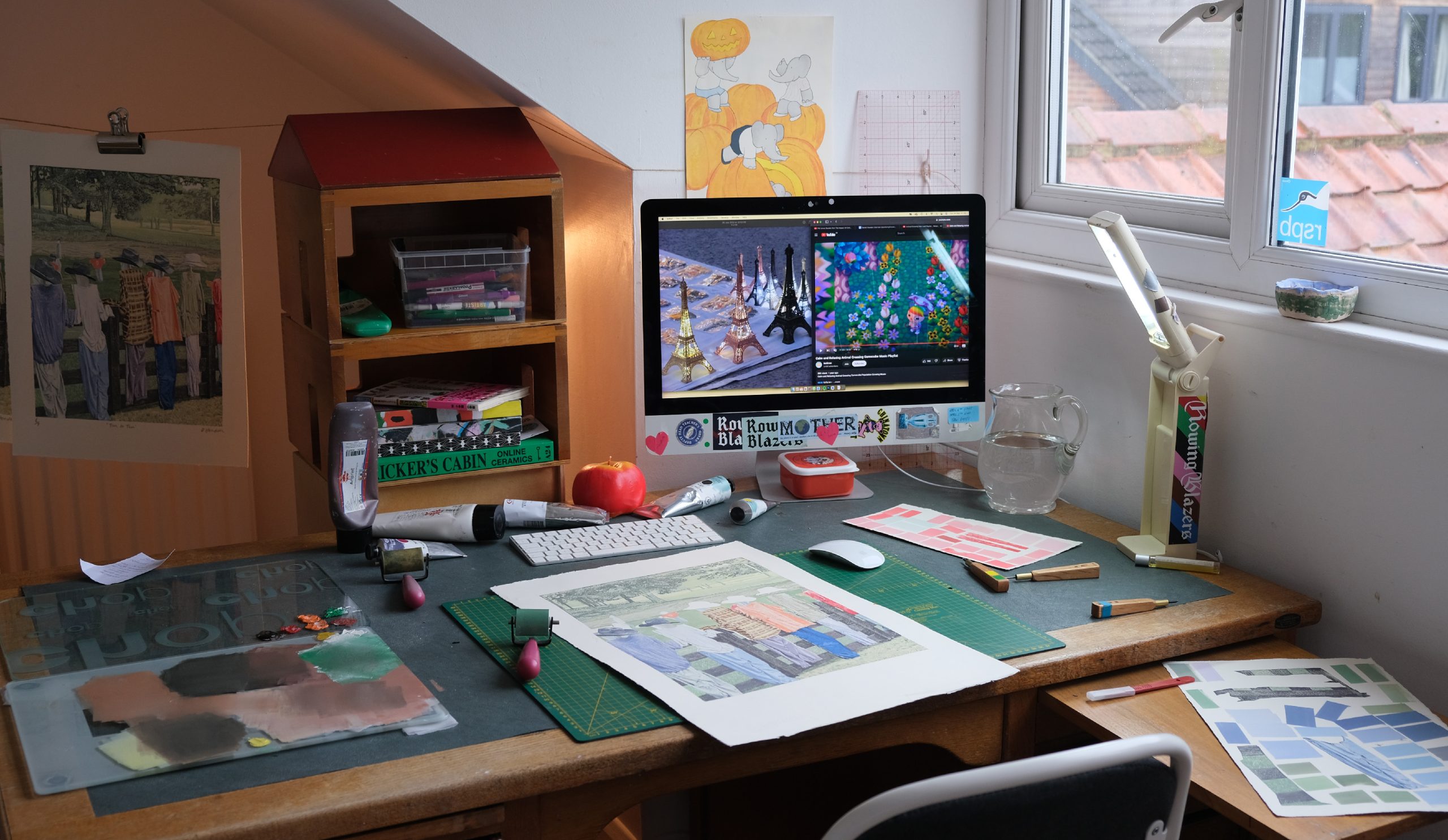
Laura: The studio is about 5m x 7m and houses two Albion Presses on one long side with a big shelving unit to store all my books and teaching equipment. On the other side of the studio there is a wide bench running the whole 7m length and this houses a big sheet of glass for mixing inks (an old glass shower door) and is where I sit to draw and cut blocks. Underneath I have storage and my plan chest. There’s also three or so metres of under desk storage for framed work which is in racks and protected by hessian sheeting. We built the studio ourselves and were able to design it to be a very comfortable workspace with everything at the right height (I’m tall) and with the way I work in mind.

Laura Boswell, studio images – Linocutting tools, inherited from Laura’s mother in law and her mother in law’s father!
Lisa: What’s your lino preference? Vinyl, softcut, battleship grey or…? Also could you describe your favourite papers that you like to work with?
Laura: I will only work with battleship (traditional artist’s lino) because I use the brittle snap at the end of every cut as part of my mark making. I couldn’t mimic the stroke of a brush or cut away around the extremely fine details I do with a material that needed the tool to cut into the material and also to cut out at the end of the mark. I also worry that a softer easy-cut would squidge detail in my press – I’m often left with a filigree of fine lines at the end of a print and the stiffer traditional lino will hold up under printing and give me crisp detail.
When it comes to paper, I usually use Fabriano Rosaspina for my lino and I love the Awagami Paper Factory’s Shiramine washi which comes on a roll. For our film series I used Awagami’s very lightweight KitaKata paper with a beautiful deckled edge.

Laura’s prints always start with a drawing. These come from sketching in the landscape, photography and quite a bit of artistic license. The idea is to evoke a place rather than replicate it.
Lisa: I’d like to mention mark-making, because you are a master of making prints that incorportate hugely expressive – yet very subtle – brush marks that you clearly have had to carve to give the illusion of being impulsive, and then in other prints you print trees that have a very graphic quality, almost like spider’s webs….and then in other prints such as ‘Winter Meadow Morning’ the prints almost take on an 19th century watercolour-type quality, with very gentle english pastoral trees and swaying rhythms…all combined with very sensitive colour blends. How does this all come together?! Is it pre-meditated in your drawing and designing, or does some of this happen as you work on the block? Do you think your intricate cutting skills are still improving with every print or is it a technique you mastered fairly early on in your training?
Laura: One of the fascinating things about making the #linowithlaura series was the ability it gave me to observe myself through the camera as I worked on a reduction linocut print. I begin with a drawing in pencil, no colour, and then work my way through the reduction process, adapting my plans and deciding what to do next on the basis of the layer I have just printed. Watching the films I can see myself going back and forth and constantly changing my thoughts as the print develops. The same is true of my Japanese woodblock. I do proof the blocks (it is a multiblock process) and check alignment, but the colours I use and the way that I print the edition very much happens as I go. As for the cutting skills, like all other aspects of printmaking, I think I learn and improve the more I do. I like the Japanese viewpoint that we are all on a constant upward learning curve and improving our depth of knowledge and experience the longer we work.

Laura’s relief printing inks rolled out and ready for use
Lisa: How has lockdown impacted upon your creative practice?
Laura: The big impact has been losing all the bookings I had for shows, festivals, exhibitions and teaching, plus the closure of all galleries. In turn this has had a big impact on my ability to work in terms of concentration and just general sleeping etc. The films we are making at the moment and working with the podcast have been a real lifeline and focus for my creativity and I know in turn they have helped people with their stresses in lockdown. We very much want to make more films and have started a GoFundMe appeal to raise the money to do so. We plan to do a series of tutorials looking at printing without a press and exploring a design idea for a print executed in various different ways if we can. We have also been asked to film a complete series of tutorials for Japanese woodblock, but that is a huge undertaking and very much depends on funding.

High Falls, 2020
Laura Boswell ARE
Linocut , 440 x 590 mm
Lisa: Where can readers view more of your work, your videos and the podcast?
Laura: All my work plus resources and an on-line shop and gallery are at my website www.lauraboswell.co.uk. My films go out on YouTube at Laura Boswell Printmaker and I post to Facebook and Instagram .
If people would like to help us to make more printmaking videos and hit the target to make a complete series on Japanese woodblock, there’s a donate button on my homepage and my GoFundMe is here

Snow on the Moors along to Hawnby, 2020
Laura Boswell ARE
Woodblock, 475 x 190 mm
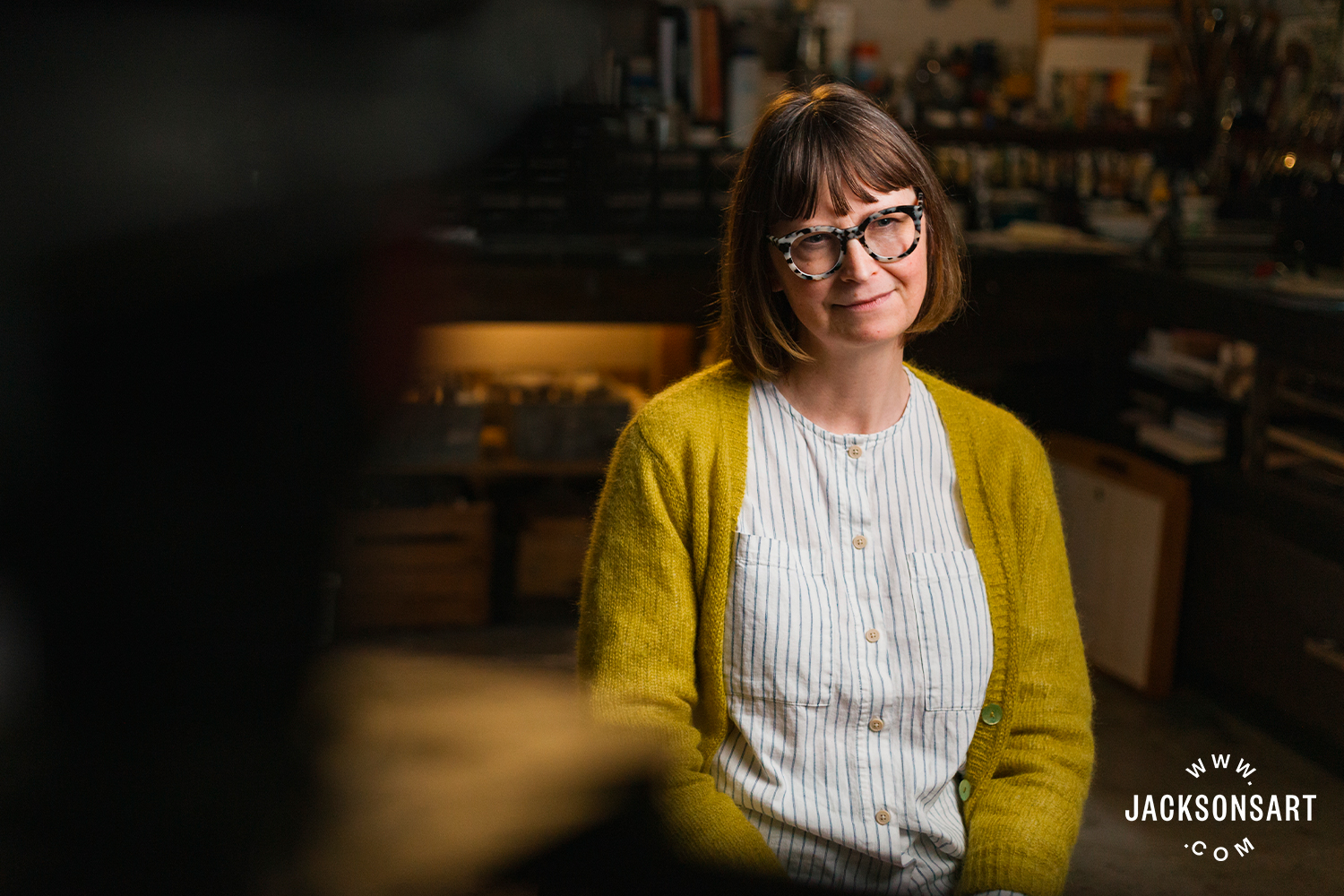
Header Image: Laura Boswell in her studio
4 thoughts on “Laura Boswell: Interpreting the English Landscape in print”
I found this very interesting as I know next
to nothing about printmaking and seeing
linocut artists on Landscape Artist Of The
Year piqued my curiosity as it looks like such
fun and I think I’d love the tactile nature of
doing it & will definitely try it soon. Laura’s
work is very beautiful & I had no idea you
could achieve such colour and detail from
linocut or block work printing – it seems like
a very long drawn out process but also quite
satisfying. I recognised Lisa’s name from
LAOTY. Many thanks from Brisbane,
Australia for this interview (I am madly in
love with watercolour painting and rarely
look at or read about other types of media).
Thanks so much Magdalena! Hope you enjoyed LAOTY!
Best wishes
Lisa
very interesting art work
Absolutely beautiful woodcuts and prints and paintings. I
love Japanese art, so I find it an interesting alternative to
the usual methods of doing a landscape.
I shall look out for this artist’s work from now. By the way,
I’m just someone interested in art who sadly has no talent
in that direction, just appreciation.
Comments are closed.