This month, we look inside the sketchbook of Andrew Torr, winner of the Jackson’s Art Prize 2024. Here, Andrew shares how, through his sketchbook practice, he investigates compositional ideas for his paintings, how he keeps his drawing skills sharp, and the benefits of working on sketchbooks with a toned ground.

Inside the Sketchbook of Andrew Torr
I have four or five sketchbooks on the go at any one time but my go-to in the studio is a hardcover, ring-bound, A3, Winsor & Newton heavyweight cartridge pad. The hardcover is important; it means that I can use the pad on my lap or a table top but I can just as easily put it on the easel and draw or paint onto it vertically. The heavyweight cartridge 170 gsm means I don’t have to worry too much about abusing the paper with whatever media I’ve got to hand.

The paper surface is delicate enough for the finest pencil work but it will also survive the wettest watercolour wash or Auerbach levels of charcoal scrubbing and erasing. This all means that I can move very quickly between media without much fuss; if something occurs to me while painting on a large canvas for instance, I can just pick up another medium and try out an idea on the pad without having to down tools and rearrange my workspace. I also keep a handful of other sketchbooks. Each one of these will be a different size and format and a different paper stock.

I have an A5 version of the heavyweight pad that I carry with me when I’m out of the studio. The stout cover allows me to use it easily even when there’s no table top and the spiral wire binding means I don’t have to wrestle with the cover – it’ll just fold over on itself. I carry a propelling 2B pencil and a fine liner pen to use with this pad but, if I’m on holiday or on a long enough journey, I will take a small travel box of watercolour pans and a couple of brushes.

I prefer a propelling pencil to a traditional wooden pencil because I don’t want to have to continually use a sharpener. Like nearly every other painter, I have that disease that means I can’t leave an art shop without picking up something new (or even something that I already have!) and propelling pencils are my particular vice. If I’m going on a particularly long trip, I’ll take as much as I can carry: The A3 pad, pencils, sharpeners, erasers, watercolours, ink pens… the kitchen sink.


Recently, I’ve also been using a Strathmore Toned Gray 9 x 12 in sketch pad. This has been particularly useful for both the ‘Nocturnes’ series and the ‘Estate’ series; the nocturnes because the sombre tones of these paintings is already suggested by the warm grey paper and the estates because I can pick out those white surfaces and lines on the houses from the dark ground in a quick abstracted way that informs ways to proceed with the large paintings. This is a good illustration of how I use sketching to investigate composition and rhythm in the large paintings.

I will simplify and abstract the lines and structures in the sketches down to their most basic shapes with the aim of emphasising these basics. This way, if I begin a large painting and start to get bogged down in description and dressing, I can refer back to the sketches to remind me of those basic, broad underlying elements – the compositional decisions that hopefully make the work interesting.

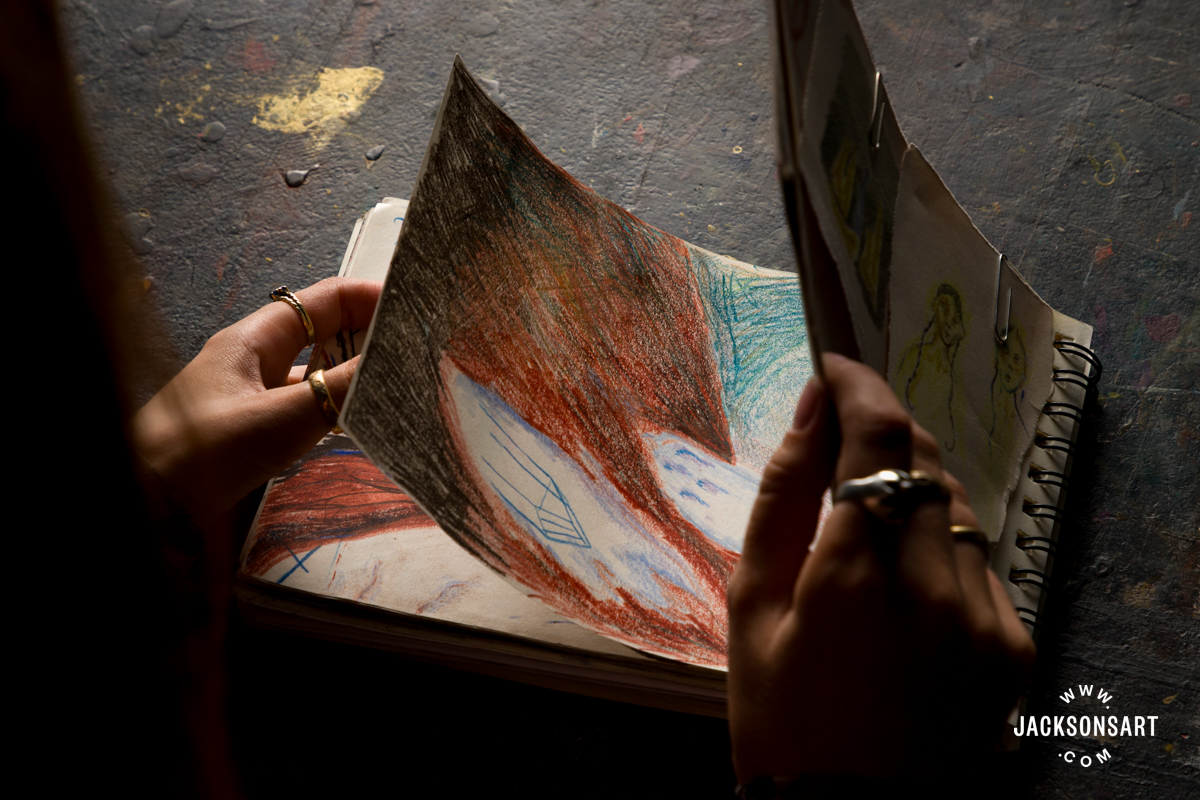
I find having an oil sketch pad useful too. When I was much younger, these were the surfaces that I would paint on regularly while dreaming of being able to afford to paint on canvas. I still like having them around to experiment with oil paint techniques and new colours. The surfaces are ready-prepared and stout enough to take the oiliest paint or the thinnest glaze without buckling. When they’re dry (and if they’re useful), I will often paste these experiments into my current bound sketchpad for reference.

Recently I have been experimenting with new basic primary colours, particularly the way that commercial printing uses CMYK additive colour theory and how that might inform painting in oils. An oil sketching pad is great for experimenting with new colour and techniques, particularly if something occurs to me mid-painting but I don’t want to risk ruining weeks worth of work on a whim.

Lastly, I regularly use loose, square format Khadi paper for watercolour sketching. Although not strictly a bound sketch pad, I use lots of this to experiment with colour and texture, particularly with the nocturnes and the Thames bridges series I have painted. Its rough texture and unbleached cast makes the results pleasingly unpredictable. In this way, the studies can suggest ways of progressing that can be surprising – using gold leaf on some of the nocturnes came from this process. That the paper is already square is also really useful; since 99% of all my paintings are square format.

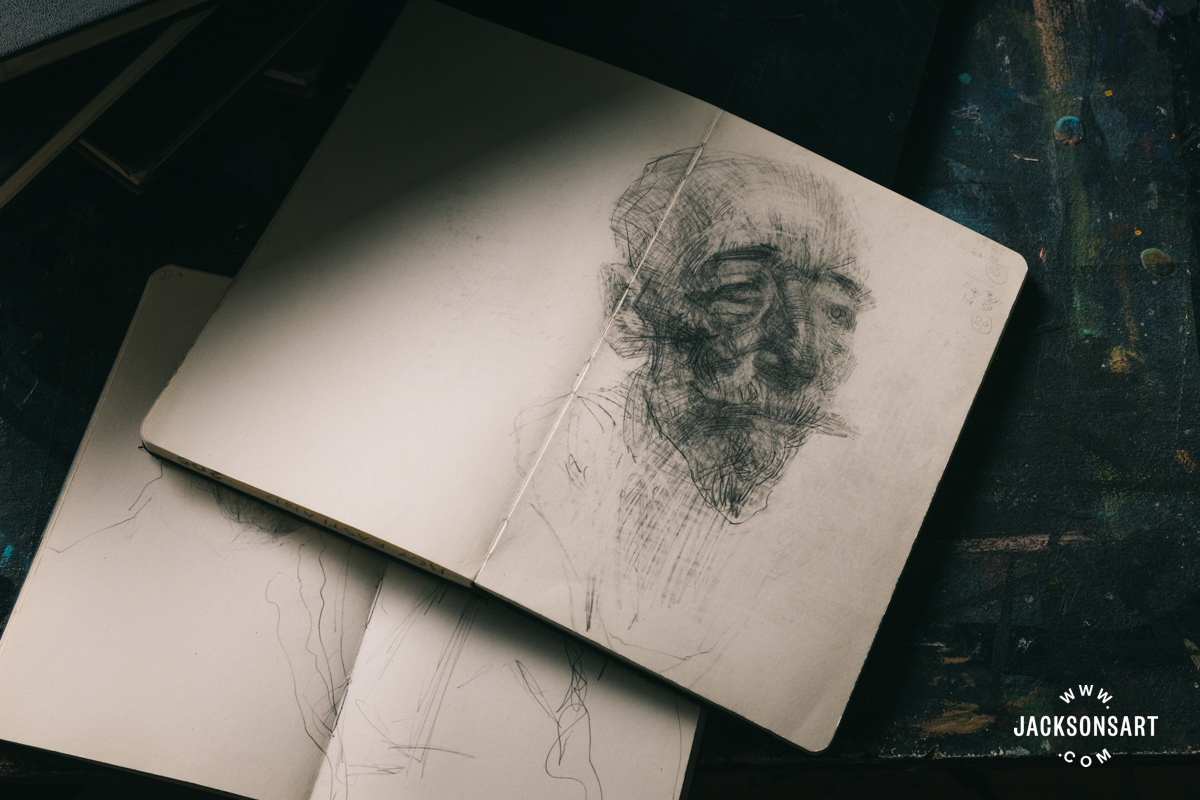
Sketchbooks give me a place to mix things up a bit and disrupt my usual methods but, conversely, they are also a place to go back to basics and keep my drawing chops up. In among the pages of trying new processes and crazy approaches, whether it’s with new colours, different media etc, you will find a series of traditional observational drawings in graphite pencil – trees or apples on a shelf or drawings of family members and pets.

These are always great ways to hone and discipline my hand and eye and a good lesson in rigour that can be carried over into the bigger scale work that I make. When you have a singular reference object like a simple apple there’s nowhere to hide your shortcomings. If you can’t find some equivalent in graphite of the shape, volume and weight of an object like that what hope have you got with more ambitious work?

Like a lot of painters, I’ll also use it to write down any thoughts that occur to me as I work. A lot of these notes feel incredibly profound and insightful at the time but when I read them back days later, half the time they’ll make no sense and I’ll wonder whether I should ventilate the studio better.


Materials
Winsor & Newton Spiral Sketch Book A3 and A5 – 50 pages 170 gsm
Strathmore Toned Gray sketch pad
Arches Huile Oil painting paper 300 gsm
Khadi loose handmade paper rough
2B and HB 0.5 mm Propelling Pencil
KOH-I-NOOR 5.6 mm clutch pencil with different leads
Winsor & Newton Professional Watercolour half pans

About Andrew Torr
Andrew Torr lives and works in London.
The recent subject and focus of his work is the city’s open spaces at night.
He is currently represented by the Liminal Gallery.
Watch Andrew’s Jackson’s Art Prize 2024 Interview
Further Reading
Which Titanium White Oil Paint Dries the Fastest?
Monotype Printmaking for Beginners
How to Create the Best Digital Photographs of Your Artwork
Review of Jackson’s Indian Ink
Shop Sketchbooks on jacksonsart.com