



Andrew Torr won Jackson’s Art Prize 2024 with his oil on linen painting Estate, which we look forward to exhibiting at Bankside Gallery in July.
In this interview, we chatted with Andrew to find out more about his body of work, artistic journey, his interest in estates as a subject, and how it felt to realise he had won First Prize.
Interview with Andrew Torr, Winner of Jackson’s Art Prize 2024
Contents
0:00 Introduction
0:40 “I have three favourite subjects”
1:32 “The landscape of the housing estate says something political”
1:59 “Nostalgia and melancholy”
2:19 “I make paintings about paint”
3:11 “There is an underrepresentation of the housing estate”
4:19 “I’m drawn to a classic colour palette”
4:32 “There’s not one way to begin work on a painting”
5:00 “I’m not bad with Photoshop, which might send some painters screaming!”
5:23 “The push and pull of painting reminds me of 90s guitar music”
5:57 “My interest in art started when I was very young”
6:12 “After my accident I wasn’t sure what I was going to do”
7:10 “You need to be in the studio whether you want to be there or not”
7:46 “Knowing when a painting is finished is wholly intuitive”
8:09 “If you know what the end product will be, there’s no point in doing it”
8:57 “When I found out I won Jackson’s Art Prize, I couldn’t speak”
9:34 “Don’t worry about rejection’”
10:07 “Have confidence in what you’re doing”
10:20 “I’m looking forward to being a judge for next year’s Art Prize”
10:43 “Still finding beauty in the lines of the estate”
11:28 Credits

Andrew Torr
Oil on linen, 120 x 120 cm | 47.2 x 47.2 in
“What I saw is if you look at those housing estates, the eaves and the windowsills and stuff like that, they have this lovely kind of rhythm. The subject matter is almost incidental; it’s a way of discovering what paint can do.”

There are certain things that painters don’t think they can address or paint, especially really contemporary things. You need a language to be able to get in there to look at it.
What I saw is that if you look at those housing estates, the eaves and the windowsills and stuff like that have this lovely kind of rhythm. The subject matter is almost incidental. It’s a way of discovering what paint can do. I think there’s something there and I’m glad that Jackson’s Prize thought so too.
I’m Andrew Torr, I’m a painter living and working in South West London and I was lucky enough to win Jackson’s Art Prize 2024.
Andrew’s Body of Work
I have three favourite subjects that I’m working on at the moment. The first one is a series of paintings which are nocturnes around the commons and open spaces of London. The light pollution is obviously horrific. It’s that kind of yellow sodium light, the old-school lights. You get those kinds of white LED lights and then there’s so much building work. You get the red as well. So you get this incredible kind of colourscape above your head. That then led on to the Thames paintings. I don’t know if you’ve ever tried to paint water but it is fucking difficult. It keeps moving. It’s just, it is tough. The surface is one thing but actually, the undulations and the movement are made by these things. Big old forces going in, whether it’s the tide or whether it’s the wind or whatever it is. Sometimes it’s more successful than other times but that’s painting. The third is the estates.

Subject Matter and the Estates
I have always been interested in the housing estates that now form a major part of the subject matter of the things I paint about. That landscape, which is so kind of ubiquitous around the UK, as a subject matter, it says something political about the UK at the moment and about the world in some kind of sideways way. I didn’t say that as a tourist. I was born on a housing estate like that and like I say my parents live there. I mean people that have seen the paintings that I’m making at the moment kind of talk about nostalgia and talk about a melancholy kind of air about these things and I get that. There is something a little unlovely about those places. The painting that won Jackson’s Art Prize this year, Estate, works on the same level. I still go and do wreckies around there and try to find the perfect place to do it. I’ll take hundreds of photographs and sketch around the estates.
What I don’t want to do with any of these is paint the scenes of things. The primary thing is that they’re kind of paintings about paint. You know it can be so unmanageable sometimes. It does stuff that you don’t want it to do. I don’t think there’s any reason why anybody should use paint or you know painting is not necessarily the thing. It’s not better or worse than anything. It’s just a language. It’s a language that I really like. It’s a way of discovering what paint can do and paint really has a relationship to subject matter but you want that balance between the thing described or depicted and how you depict it and what processes you use. You want to find that nice balance between the two and I think there’s something there.

Estates
I think they are English paintings. St George’s Cross in that painting is something I made up. I think it’s important because they’re all over the place. I think there’s something about that kind of patriotism that is connected to issues with immigration at the moment and stuff. I don’t want to kind of over-egg it. You know a big shift has happened in those places, particularly in that estate. I know that they’ve all gone and voted conservative for the first time in their history. That’s a big shift and I think something’s happening in there and I’m not saying that my painting can carry any of that information but it’s just I think that that aesthetic, that vernacular architecture carries all that stuff with it at the moment. I don’t want people to think that I’m looking back on it in any kind of negative way at all. The thing’s there and that’s interesting. Most of the population of the UK live in places like that now and there is a certain under-representation of that place. It’s not the driver for me painting those things but why shouldn’t people paint them and make them a worthy subject matter for painting?
Art Materials
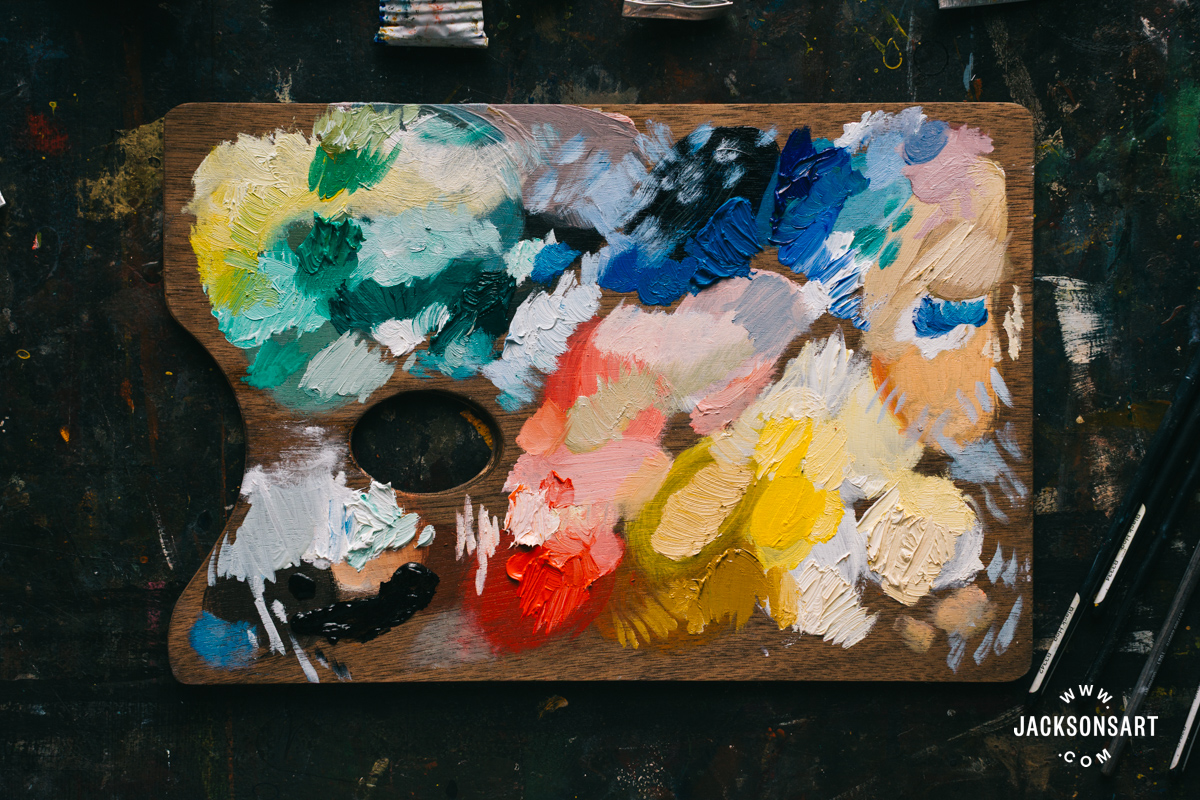
I genuinely get drawn whether I like it or not to the full-on earth colours like Sap Green, Burnt Umber, and the warm cadmiums for red and yellow, almost like a classic kind of palette. There’s no one way to begin work on a painting. I like to work on an incredibly smooth surface. I will gesso the hell out of linen. I could do like ten coats of gesso sanding between and all that sort of stuff. When the canvas is like cartridge paper that’s when I really like it. What you didn’t know when you gave me Jackson’s Art Prize was that the painting is on a Jackson stretcher and they’re brilliant. If I think it wants a ground I’d do that.
I will often work from a series of photographs and it might be a kind of patchwork of different photographs that give you a different perspective. I’m not bad with Photoshop which I think might send a lot of painters screaming, like kind of how dare you, but it’s another tool. I kind of layer it so that I can work out how that rhythm might work across there. What it reminds me of is I was a big fan of kind of 90s guitar music and so like there was this aesthetic of being loud quiet loud. That push and pull between those two things I think is really similar to the way it works in painting. You get a really lovely crisp edge and I’ll work with masking tape to get that edge as well like a lot of painters now. I will also cut out stencils. The paint’s working on its own terms. You get a nice music with that. You get a nice I don’t know what that is but it’s kind of wordless, you know it’s difficult to describe. It’s just the thing that makes you think ‘yeah’.

Artist Journey and Career
My interest in art and painting started when I was very young. I basically spent all my time in the art room. Then I went from secondary school to do a degree at Wimbledon. I got a studio in the East End in Cable Street. Like a lot of people who paint, I had to have a secondary job and I was working at a restaurant and I had an accident in the restaurant and I managed to nearly lose my hand. Cut all the tendons to my fingers and the artery and all the nerves and it was really really grim. I was basically out of action for three years with follow-up operations and stuff like that. Lost the studio and wasn’t entirely sure what I was going to do. I started a job at London Marathon and I continued to paint through that time but obviously took a back seat. I left London Marathon six years ago because I was in a position to go back to painting full time and that’s what I do.

Andrew Torr
Oil on canvas, 30 x 30 cm | 11.8 x 11.8 in
How Andrew Approaches Painting
After my accident, I definitely made a conscious decision to work in particularly oil paint. So I get up at 7:30 every morning. My wife’s a teacher and she has to be up and out and get off to work. I get up at 7:30 every morning to make her a coffee before she goes out and that is my way of getting myself up and out of the pit and painting. And I definitely give this advice to anybody who is thinking of a career in painting – you need to be in the studio whether you want to be there or not. Sometimes I’m not sure what I’m going to work on. You know there’s that thing where you’re not entirely sure where you’re gonna start, what your starting point is but get in the studio and get working because something will come out of it.
How Andrew Knows When a Painting is Finished
I think it’s wholly intuitive when you know when a painting is finished and I think that’s true of anybody who really knows what they’re doing. I mean I wouldn’t be so disingenuous as to say that I don’t know what it’s going to turn out like. I mean I’ve got a subject matter and so I kind of know what’s going to be involved in there and I have an idea of the way colours will work through experience and whatever but if you know what the end product is going to be there’s kind of no point in doing it. You’re just going through the motions. You want to surprise yourself. You can end up not sure whether what you’ve done is right. You don’t see it objectively in a way that you see other people’s paintings and I don’t know why that happens and that’s the worst one. You get to a point where it’s doing things that you find uncomfortable. Now you can either think ‘Well I better rectify that and make it like what the painting should be’ or you could turn them to the wall in the studio and let them fester for a week or so and then look at them again. I can often think ‘What were you thinking?’ and then I carry on working out, but you can go back to them and think ‘Oh blimey that’s really interesting’ because something different is happening.

Winning Jackson’s Art Prize 2024
When I found out that I’d won Jackson’s Art Prize I was told that I’d won and I genuinely couldn’t speak for four or five seconds which is a long long time on a phone call. I couldn’t find words. It was such a fabulous surprise. The quality of artists and the work that Jackson’s prize attracts year after year is always really really high. Genuinely won’t forget that phone call because it was so weird. It was not that I was trying to search for words. I kind of just lost it a little bit which was great.
What I would also say to people, especially if they’re just starting out is don’t worry about rejection. There is such an element of chance involved in these things and I don’t mean that the judges will just choose something on a whim. I think that genuinely there are days when a judge will choose a painting over another painting because of what’s happened to them because of the light in the room, because of all sorts of factors and it doesn’t in lots of ways reflect on the quality of what you’re doing that you might not get selected at all. If you’re confident in your work and you should be, if you’re not genuine, you shouldn’t be doing it. You have to have some confidence in what you’re doing and how it stacks up against what painting is.
Are you looking forward to being a guest judge next year?
I am really looking forward to being a guest judge for next year’s Jackson’s Art Prize because it’s such a broad church yet the quality is still great. By the time you get down to the shortlist, I should imagine it’s really really difficult to slip a cigarette paper between two paintings that you really like or even five paintings that you really like.

Andrew Torr
Oil on linen, 50 x 50 cm | 19.6 x 19.6 in
What’s up next?
The Estate paintings being such a new kind of novel thing to work on are still really fruitful. Why would anybody paint the unlovely estates of rural and semi-rural England and try and find something beautiful in those lines and those little marks? A really good side effect of it is that the subject matter is unusual. It’s not unusual because it’s incredibly common but it’s like oh you’re painting those so it’s kind of easy in a way. I’m fine just to work on the paintings that I’m working on at the moment and see what happens.

Interviews with Past Winners of Jackson’s Art Prize FKA Jackson’s Painting Prize
Melissa Ling, winner of Jackson’s Painting Prize 2023
Lorena Levi, winner of Jackson’s Painting Prize 2022
Miranda Boulton, winner of Jackson’s Painting Prize 2021
Ruth Murray, winner of Jackson’s Painting Prize 2020
Iain Nicholls, winner of Jackson’s Painting Prize 2019
Shop Oil Painting on jacksonsart.com


4 thoughts on “Meet Andrew Torr, Winner of Jackson’s Art Prize 2024”
Thanks for sharing this. I enjoyed the
interview, and I like what I’ve seen of
Andrew’s paintings.
Congratulations, Andrew!
These paintings are truly beautiful! Well
done for winning!
What wonderful work and you are so enthusiastic and humble.
Thank you for sharing this.
Well done Andrew! Lovely painting
Thanks for drawing attention to the
geometry and pattern in these scenes of
ordinary life. Also fir being honest about
using photoshop!
Comments are closed.