Fresh bouquets, blossoming meadows, and burgeoning gardens bring colour, joy, and life to our everyday worlds, so it’s no surprise that flowers flourish in art history, both as objects of beauty and metaphorical devices. In this article, I investigate the symbolism behind a selection of blooms, tracing the roots of their meaning from religion and trade to loyalty and secrecy.
The Art Through Symbols series explores the interpretation of symbols throughout art history – whether cultural, religious, folkloric, or personal. Each article analyses a selection of artworks before offering an art-making tutorial inspired by the symbol for you to try.
Contents
White Lilies and Red Carnations – Virtue, Innocence, and Love
Victorian Flower Messages – Floriography
Tulips – Dutch Still Life and Tulip Mania
Lotus – Divinity, Rebirth, and Purity
The Four Gentlemen – Chinese Flower Symbolism
Sunflowers – Loyalty, Friendship, and Conflict
Roses – Romance, Death, and Sleep
Interpreting Flowers
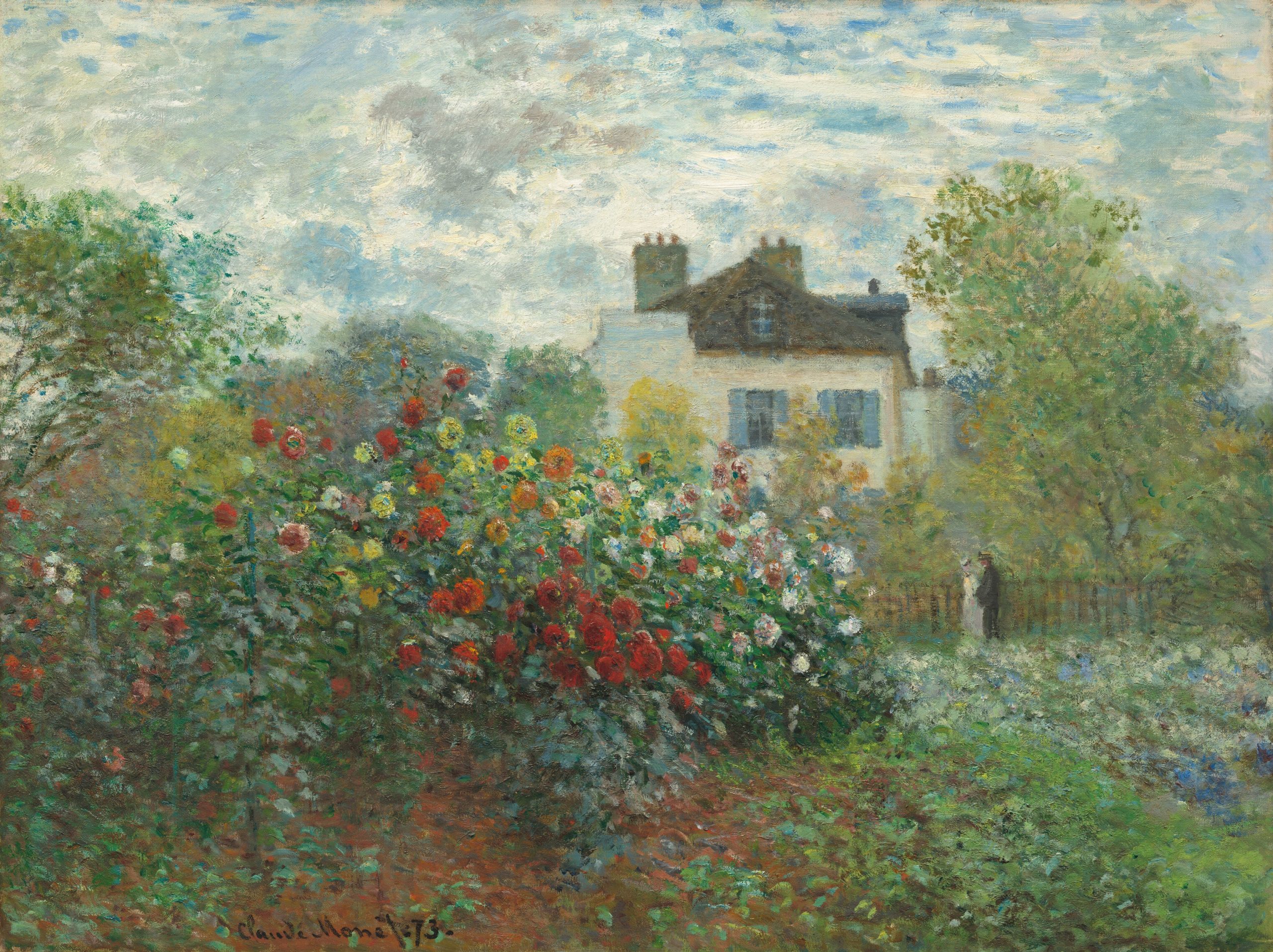
Claude Monet
Oil on canvas, 61 x 82.5 cm | 24 x 32.5 in
National Gallery of Art
“I must have flowers, always, and always.” – Claude Monet
Across art history, flowers have communicated emotional and symbolic meaning to viewers, despite how obscure these symbols might seem to contemporary minds. We have moved beyond the prudish era of sending discreet messages through symbolic Victorian bouquets, yet the layered subtlety of the practice remains appealing for its quiet intimacy. The same can be said for the solemn weight of Dutch botanical still lifes, which fill us with awe through their exquisite craftsmanship and beautiful detail, while also being tinged with themes of death, trade, and prosperity.
An overwhelming number of the world’s most coveted paintings include flowers in some capacity – from those floating alongside the tragic Ophelia in Millais’ painting, to the evocative emulations of colour and texture in Monet’s Water-Lilies, and the verdant carpet of flowers beneath the feet of the gods in Botticelli’s Primavera. Visionary artists of the 20th century also maintained deep connections to florals, from Georgia O’Keeffe’s unforgettable, immersive, vulval blooms to Hilma af Klint’s assertion that plants are spiritual beings in her occult modernist paintings.
Regardless of the individual symbolism that specific flowers hold for each artist, they seem inseparable from the artistic expression of our emotions, desires, and awe in beauty. Many artists have relished in their gardens and the opportunity to repeat flowers as recurring motifs in their work. Perhaps the romance associated with flowers naturally lends itself to the artist’s spirit – offering subliminal reassurance through their constant cycles of rebirth, growth, and creation.
White Lilies and Red Carnations – Virtue, Innocence, and Love
In Christian art, the Annunciation depicts the moment when the angel Gabriel visits the Virgin Mary to tell her that she is expecting the Son of God. Gabriel and the Virgin are often depicted holding, gesturing towards, or standing beside a vase containing a species of lily called Lilium candidum. Native to the Balkans and the Middle East, their tall stems bear multiple grand flowers – sometimes three – which can represent the Holy Trinity. The large white flowers came to symbolise the Virgin’s spiritual purity, but have also been interpreted as representations of the Immaculate Conception, delivered as a gift from God. The popularity of the lily in depictions of the Virgin led to the flower being colloquially referred to as the ‘Madonna lily’.
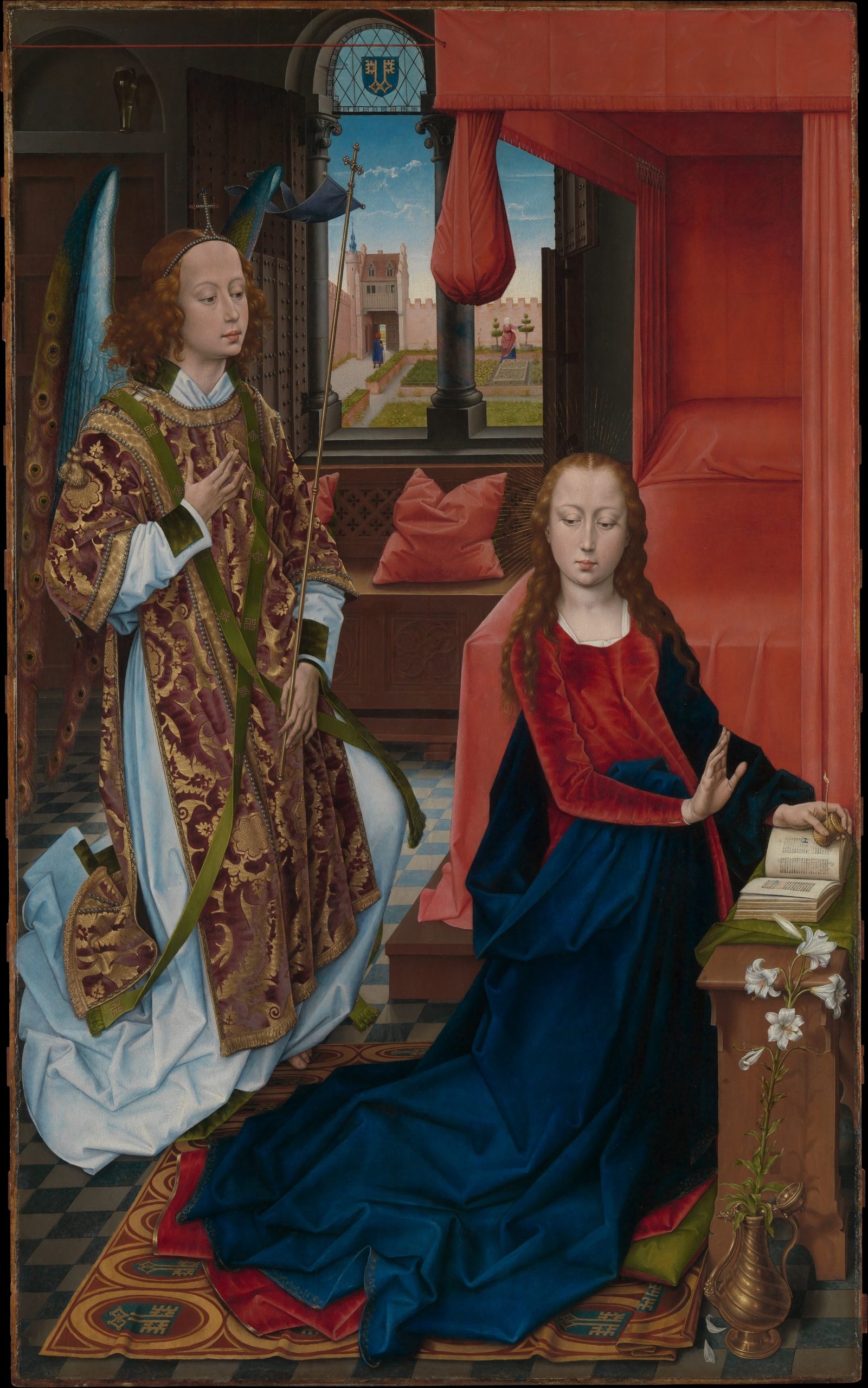
Hans Memling
Oil on wood, 186.1 x 114.9 cm | 73.3 x 45.2 in
The Metropolitan Museum of Art
John Singer Sargent first exhibited his controversial painting Madame X in 1884, which damaged his reputation as an artist, as the subject’s provocative dress and pose were perceived as indecent. In the aftermath of the backlash, he travelled to England and joined an artist community in Worcestershire, where he painted his famous Carnation, Lily, Lily, Rose. The influence of his contemporaries is evident in this painting, from its Pre-Raphaelite romanticism to the Impressionist en plein air technique used to execute the work outdoors. Together, these elements combine to create the painting that would revive his career. Here, the lilies and carnations invoke the purity associated with the Virgin Mary, though in this instance, they create an atmosphere of childhood innocence. Altogether, the flowers in the work suggest fragility, femininity, and youth.
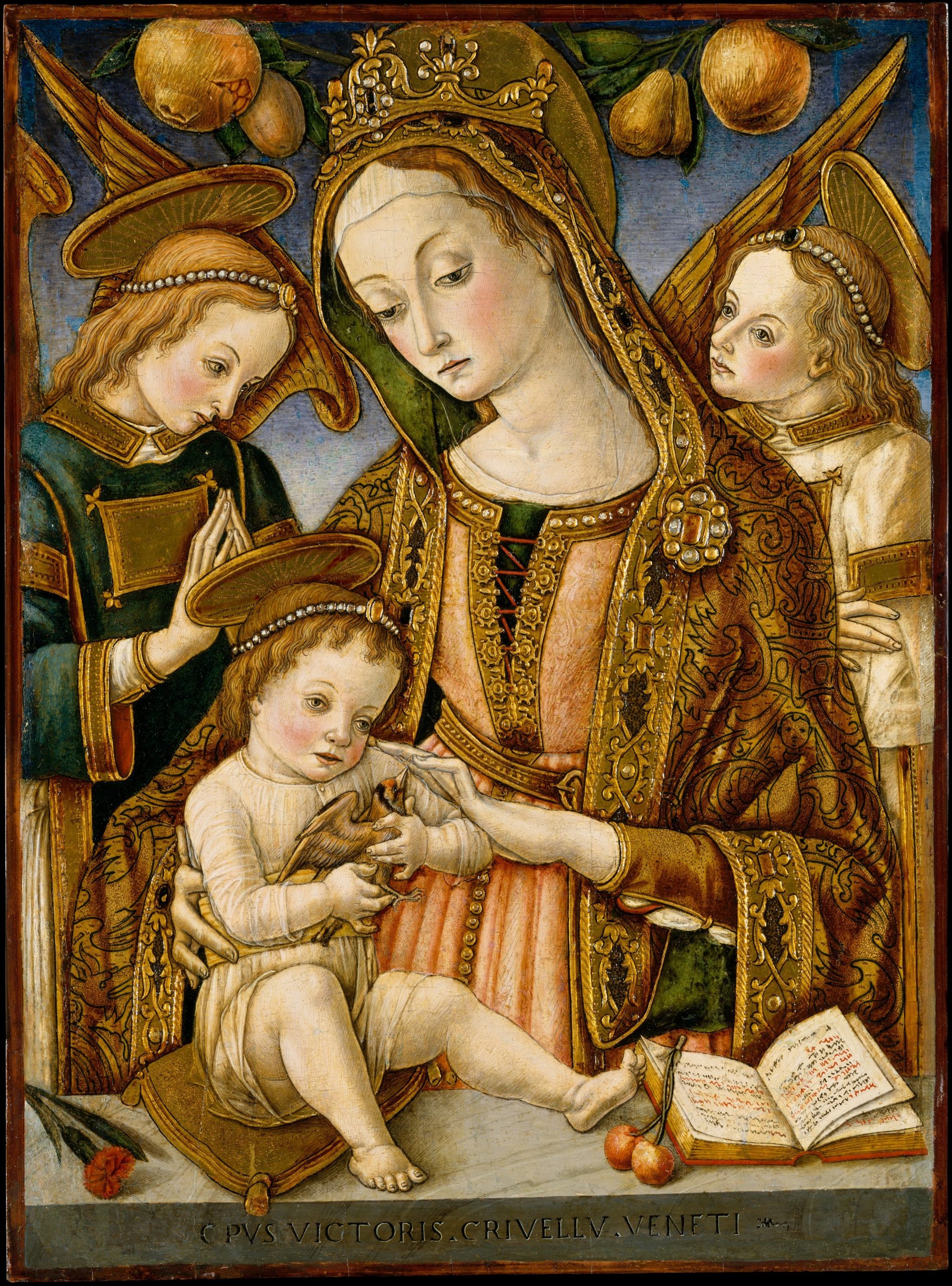
Vittore Crivelli
Tempera and gold on wood, 55.6 x 40.6 cm | 21.9 x 16 in
The Metropolitan Museum of Art
Mary is also often associated with red carnations, which symbolise her divine love and foreshadow the Passion by representing the blood of Christ. The flower’s association with the divine stretches back to antiquity – the scientific name for carnations is Dianthus, which derives from the Greek dios, meaning divine, and anthos, meaning flower. One legend describes how the flower first bloomed where the Virgin’s tears fell as Christ made his way towards his crucifixion.
Over time, carnations came to symbolise motherly and romantic love more broadly, from Renaissance painters using them to signify engagement and marriage to their later role as the traditional flower for Mother’s Day. This symbolism can be seen in Rembrandt’s Woman with a Pink, in which a richly dressed woman is shown holding a single carnation blossom, with an ethereal glow surrounding her hands. In combination with the paired portrait of her spouse, the flower symbolises her status as a loving wife.
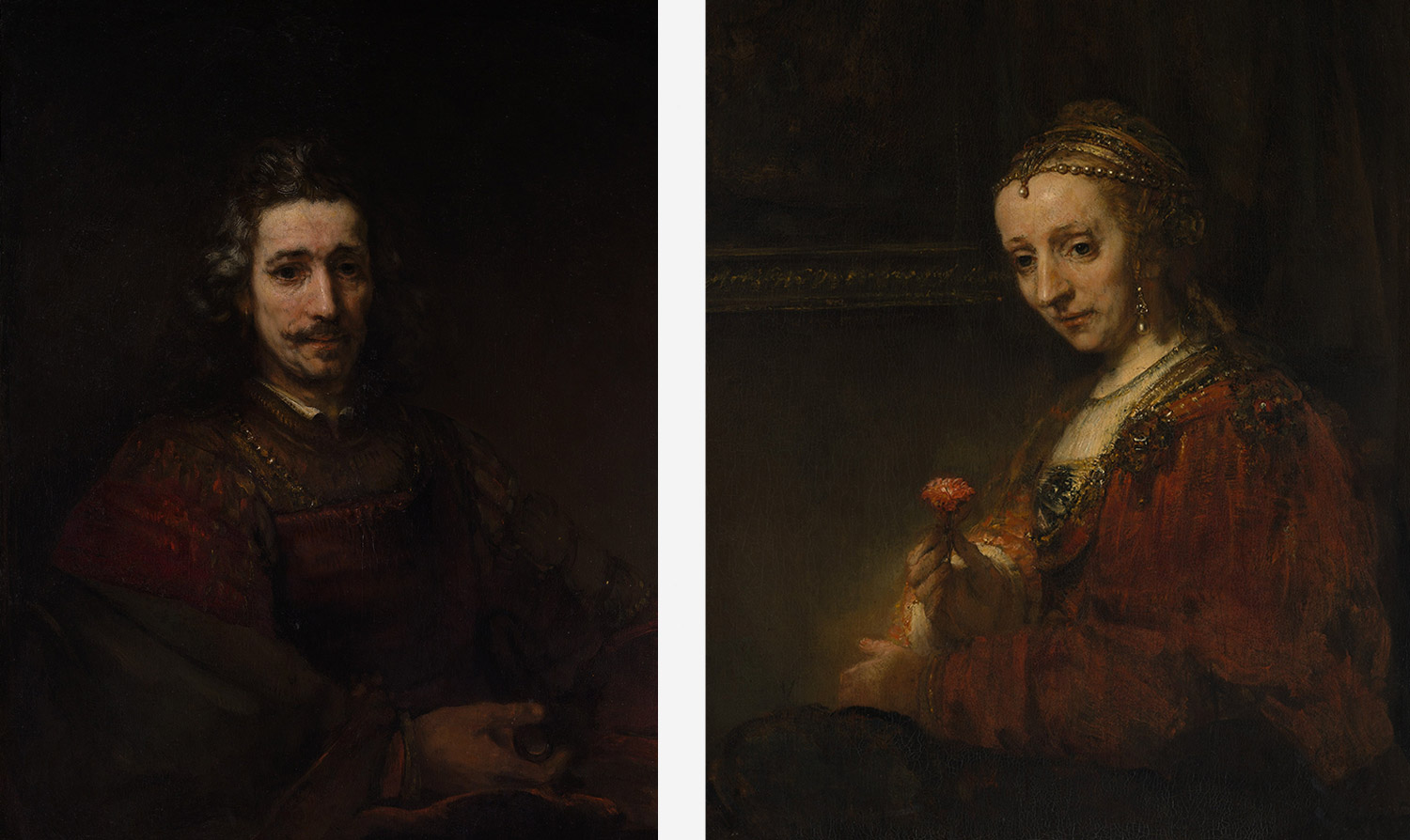
Rembrandt van Rijn
Oil on canvas, 91.4 x 74.3 cm | 36 x 29.2 in
The Metropolitan Museum of Art
Right: Woman with a Pink, early 1660s
Rembrandt van Rijn
Oil on canvas, 92.1 x 74.6 cm | 36.3 x 29.4 in
The Metropolitan Museum of Art
Victorian Flower Messages – Floriography
The Victorians simultaneously followed strict moral codes centred on purity and piety, yet lived through an age marked by crime, prostitution, child labour, class inequality, and poverty. From this repression of emotion, floriography emerged as a means of sending direct messages through flowers. Strict etiquette did not allow lovers to state their feelings outright, but by including certain varieties of blooms in bouquets with intentional meanings, their thoughts would be understood. Books were published cataloguing each popular symbol, with meanings assigned according to colour, appearance, medicinal uses, and established symbolism or superstition.
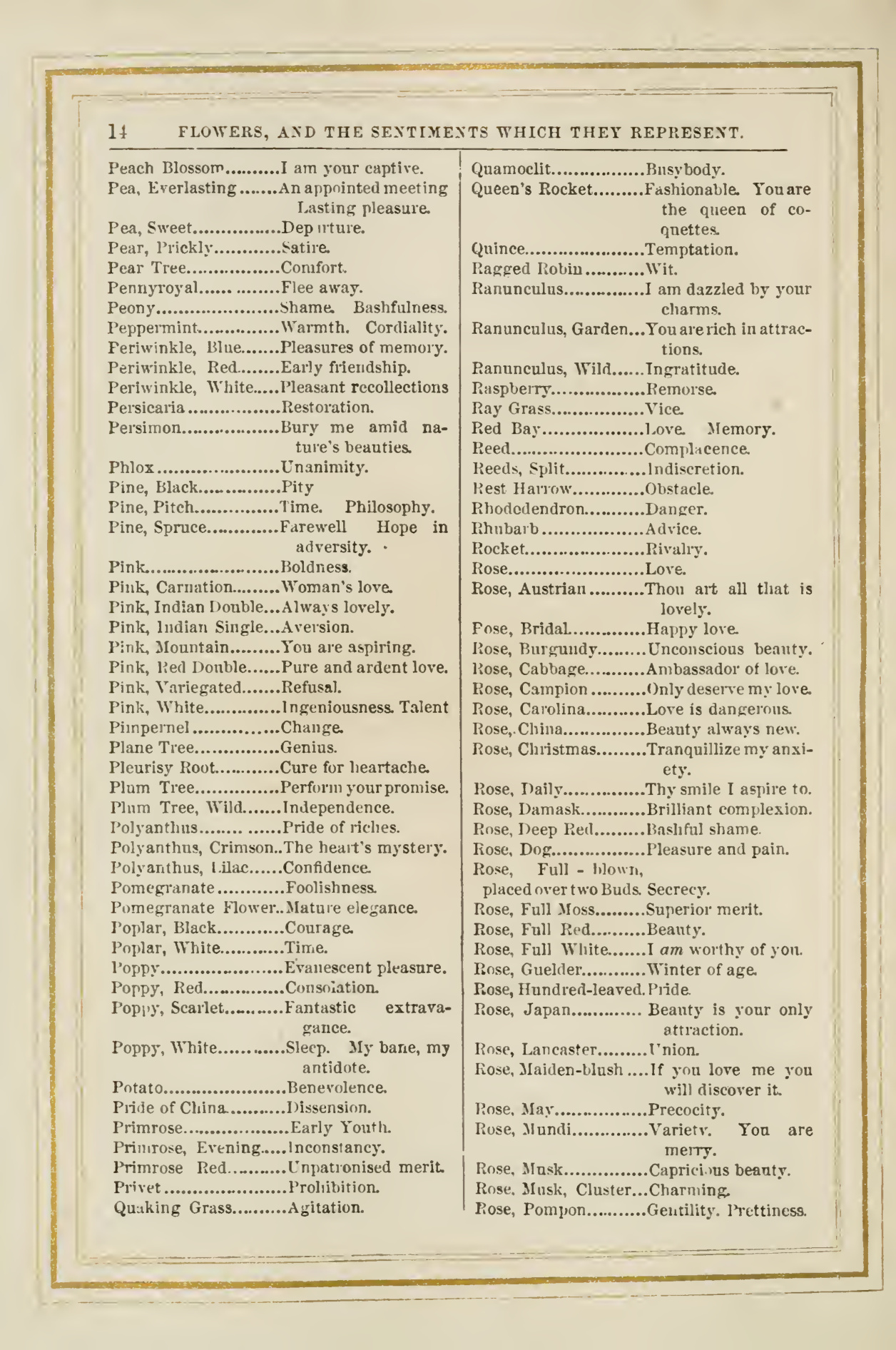
T. Nelson and Sons
Getty Research Institute
The condition of individual flowers also mattered – a flower presented upside down took on the opposite meaning to its established one, and the removal of parts of the bloom added further layers of complexity. For instance, a single rose with all its thorns removed, leaving behind just leaves, meant ‘there is much to hope for’, whereas a bloom without either signified ‘there is everything to fear’.
Artists and writers of the Victorian era embraced this secret (yet not so secret) language and incorporated these symbols into their works. The Pre-Raphaelites, especially, featured flowers in their paintings for this purpose. Dante Gabriel Rossetti portrayed his mistress, Fanny Cornforth, as Lady Lilith – the seductress-turned-demon who refused to submit to Adam. The white roses flourishing behind her declare ‘I am worthy of you’, a foxglove atop her dressing table signifies insincerity or deception, and the poppy beside her represents sleep or forgetfulness.
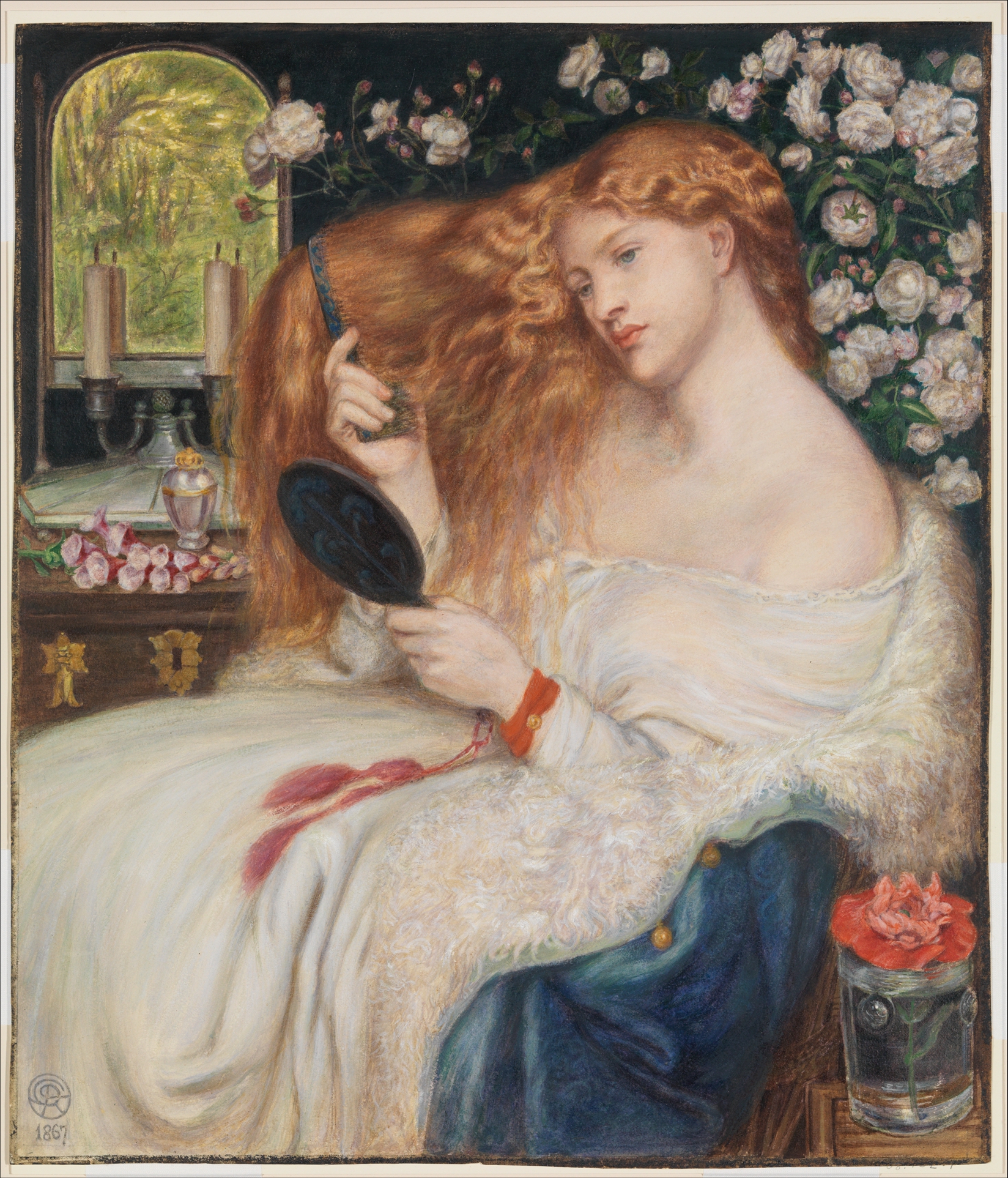
Dante Gabriel Rossetti and Henry Treffry Dunn
Watercolour and gouache, 51.3 x 44 cm | 20.2 x 17.3 in
The Metropolitan Museum of Art
Tulips – Dutch Still Life and Tulip Mania
Fuelled by the influx of mercantile wealth in 17th-century Holland, the Dutch created a coveted luxury market for tulips. The prices of exquisite bulbs that produced unique blooms accelerated rapidly, and growers were in high demand. In 1635, at the peak of the market, a sale was recorded in which 40 bulbs were sold for 100,000 florins – at a time when skilled labourers might earn around 350 florins annually. Naturally, painters immortalised these prized blooms, making use of their popularity to cultivate a similar demand for their own works. In these paintings, tulips symbolise status and wealth.
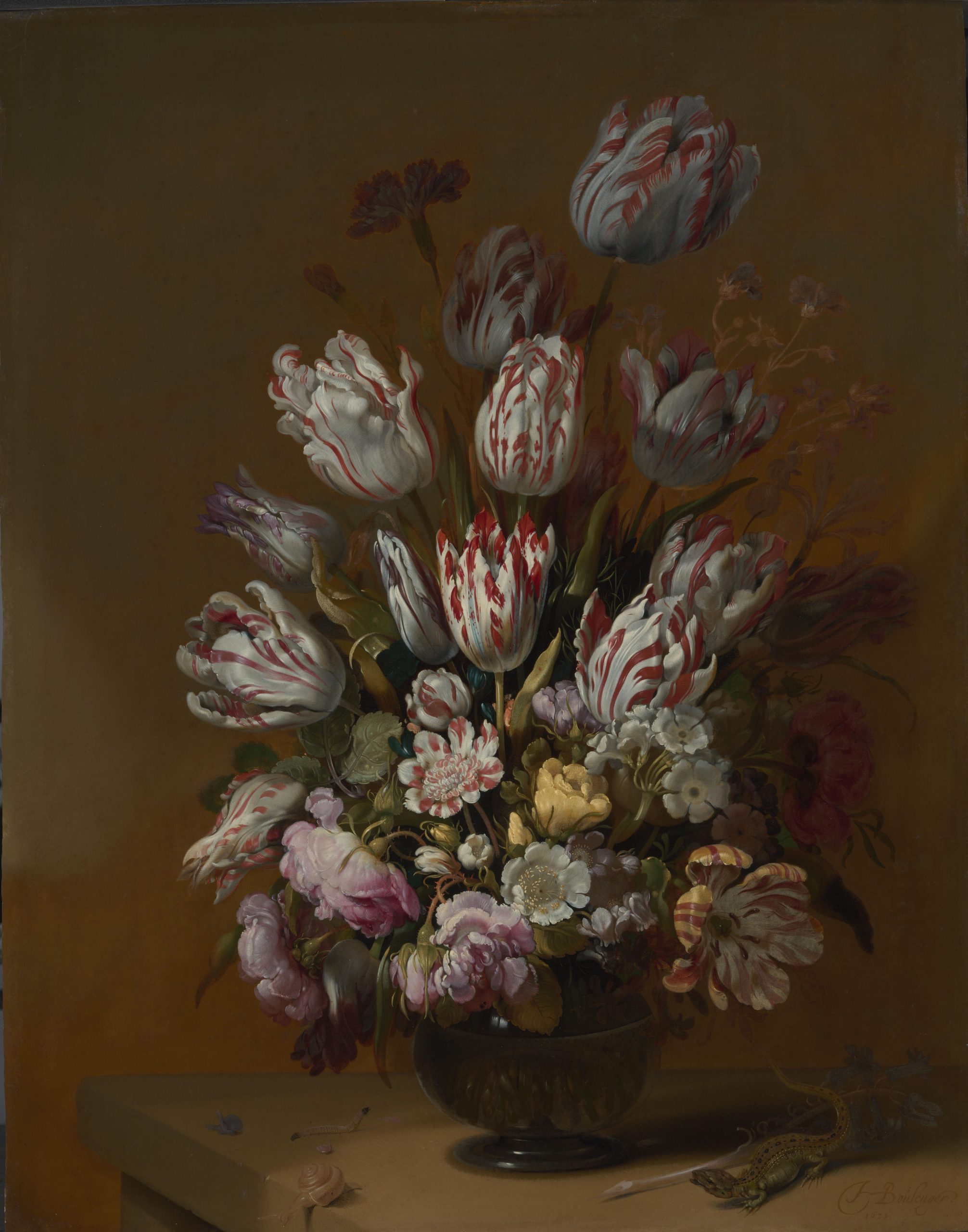
Hans Bollongier
Oil on panel, 67.6 x 53.3 cm | 26.6 x 21 in
Rijksmuseum
‘Tulip Mania’ came to an abrupt end in February 1637, when buyers in Haarlem finally refused to pay the extortionately inflated prices for bulbs, causing the market to collapse. Beyond tulips, Dutch still life painting continued to feature lush arrangements of blooms rendered in extraordinary detail. At first glance, these works may appear to be straightforward botanical studies, but they also have their own layered symbolism.
Many of these works were not created from a single bouquet but were worked on continuously throughout the year as new species came into bloom or were assembled from detailed individual studies into arranged compositions. Much like the Victorians who followed, the Dutch ascribed meanings to specific flowers, carrying symbolic associations forward from the medieval era. Downturned or dying flowers became memento mori, reminding viewers of the brevity of life. No one was more adept at painting flowers than Rachel Ruysch, who rendered her works with incredible detail and personality, becoming the most celebrated flower painter of her day.
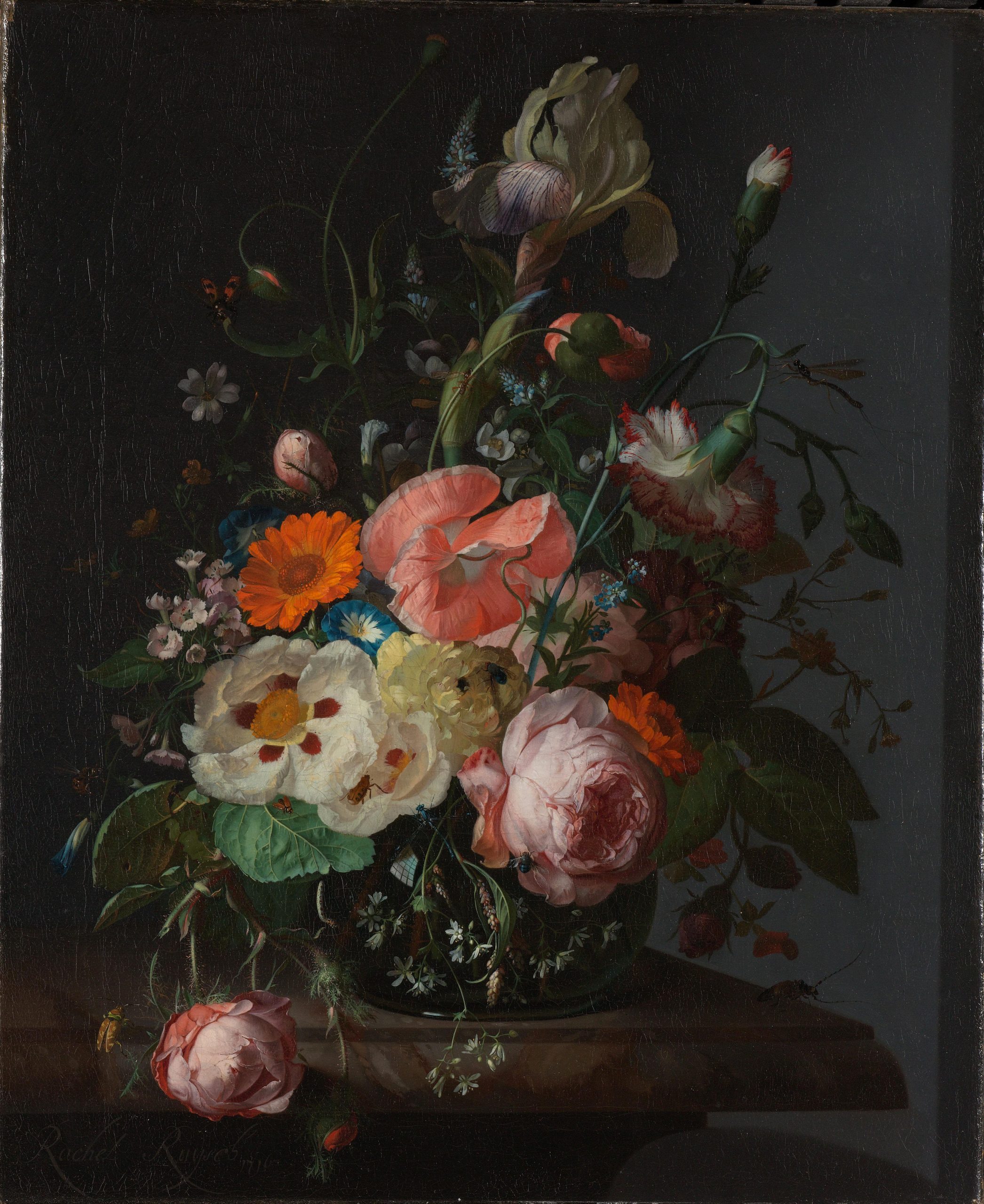
Rachel Ruysch
Oil on canvas, 48.5 x 39.5 cm | 19.1 x 15.6 in
Rijksmuseum
Lotus – Divinity, Rebirth, and Purity
The lotus flower symbolised divine rebirth, creation, and the cycles of the sun in ancient Egypt, as it opens during the day and closes at night. Growing from the mud of the Nile, the lotus features in Egyptian art throughout its extensive history. From the Old Kingdom (c. 2686–2181 BCE), the deity Nefertem was, in some accounts, said to have been born from a lotus, and is depicted with one atop his head. He is a god of healing and the sun, and is connected with the pristine beauty and perfume exuded by the open flowers.
The most prized variety was the blue lotus flower, which appears on artefacts found within pharaohs’ tombs and was used to decorate images of the gods – its petals were even strewn across Tutankhamun’s body. It is thought that the plant was also used for its psychoactive properties, infused into wine for ritual purposes.
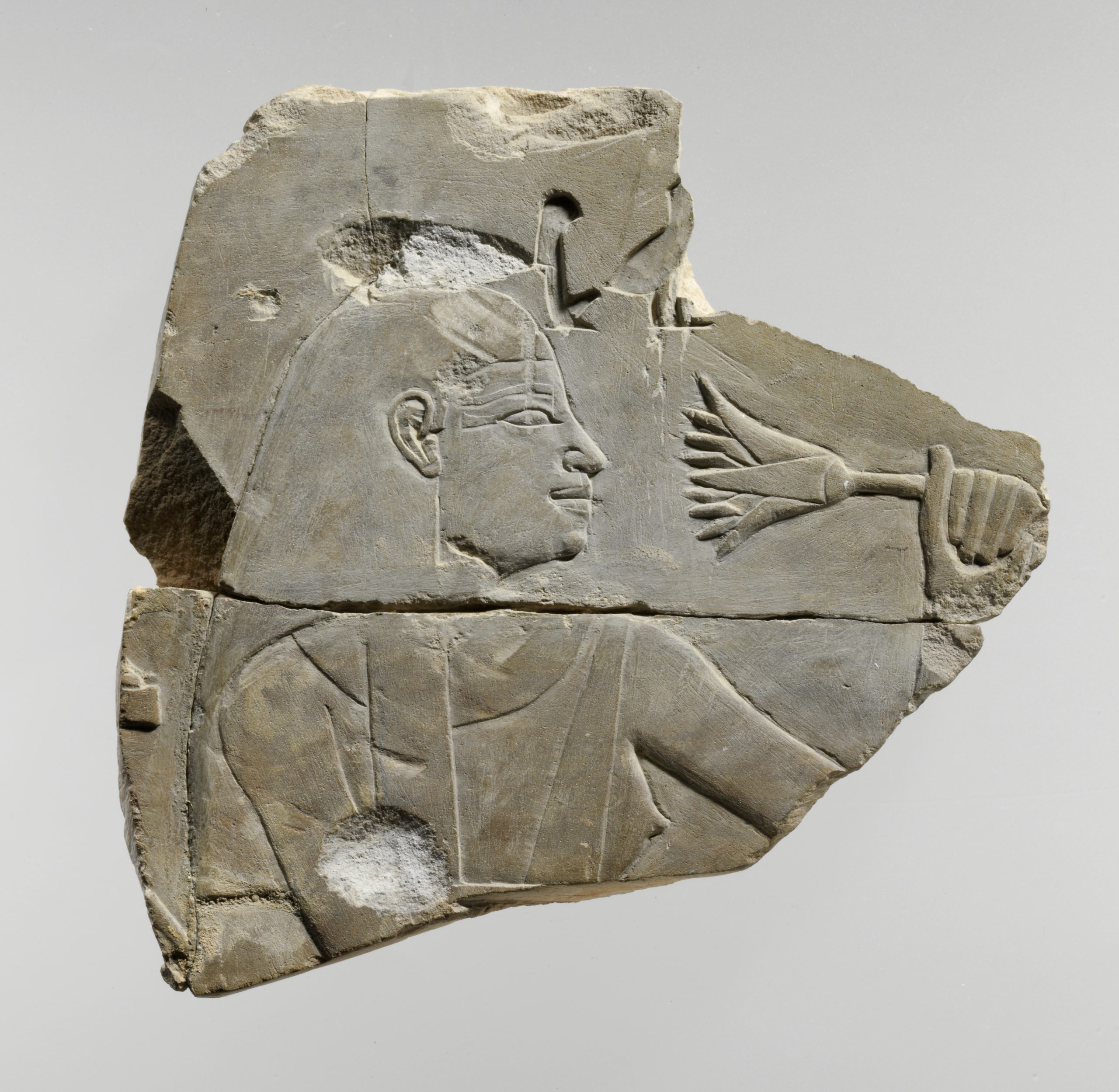
New Kingdom, Egypt
Limestone carving, 17 x 18 cm | 6.7 x 7.1 in
The Metropolitan Museum of Art
The lotus also has longstanding cultural importance across Asia, deriving significance from its role in Hindu, Buddhist, Jain, Muslim, and Sikh art. Broadly across these cultures, the lotus symbolises rising above impurity towards divinity and spiritual consciousness. This symbolism aligns with the nature of the flower itself, which grows from murky water and emerges immaculate above the surface.
The flower recurs throughout Buddhist art as a throne or pedestal for deities, as the Buddha compared himself to a lotus flower grown from the mud. It symbolises the Buddhist ideals of purity in body, speech, and mind. In Hindu art, Vishnu (sometimes called the Lotus-Eyed One) and Lakshmi are often depicted on top of lotuses, while other gods use them as thrones or are decorated with them. An ancient Hindu myth describes Brahma, the god of creation, blooming from a lotus flower that grew from Vishnu’s navel. This gave the lotus additional symbolism connected to birth and transformation.
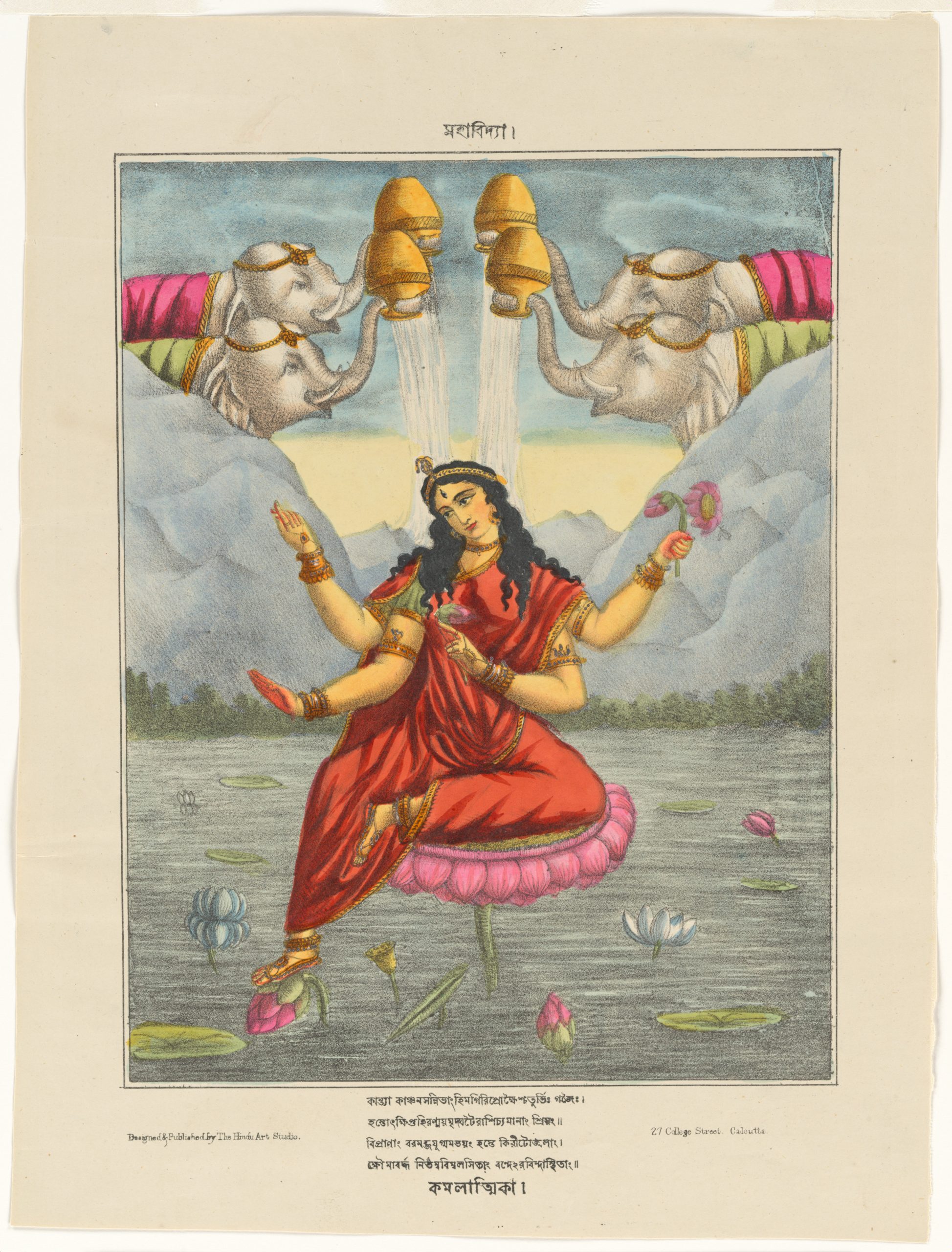
The Hindu Art Studio
Lithograph with hand-colouring in watercolour, 40.7 x 30.5 cm | 16 x 12 in
The Metropolitan Museum of Art
The Four Gentlemen – Chinese Flower Symbolism
The ‘Four Gentlemen’, or si junzi (四君子), in Chinese art refers to four plants that represent the seasons – plum blossom for winter, orchid for spring, bamboo for summer, and chrysanthemum for autumn. The word ‘gentleman’ in this context doesn’t refer to social standing, but instead suggests the traditional Confucian virtues of integrity and stability.
Specifically, the plum blossom symbolises endurance, as it blooms amid adverse winter conditions. In painting, it suggests that the owner or subject possesses steadfast resolve, even in the face of political, social, or personal turmoil. Native Chinese orchids, or lan, have small flowers hidden among their long leaves and exude a delicate fragrance, and therefore came to symbolise modesty through their understated beauty. In art, the orchid reflected a life lived with integrity. Bamboo came to symbolise flexibility, and the ability to return upright after challenges. Finally, the chrysanthemum continues to flower as other plants die back with the onset of autumn, leading it to symbolise independence. It’s often used in Chinese art as a symbol for those who preferred virtuous solitude over competitive ambition in society.
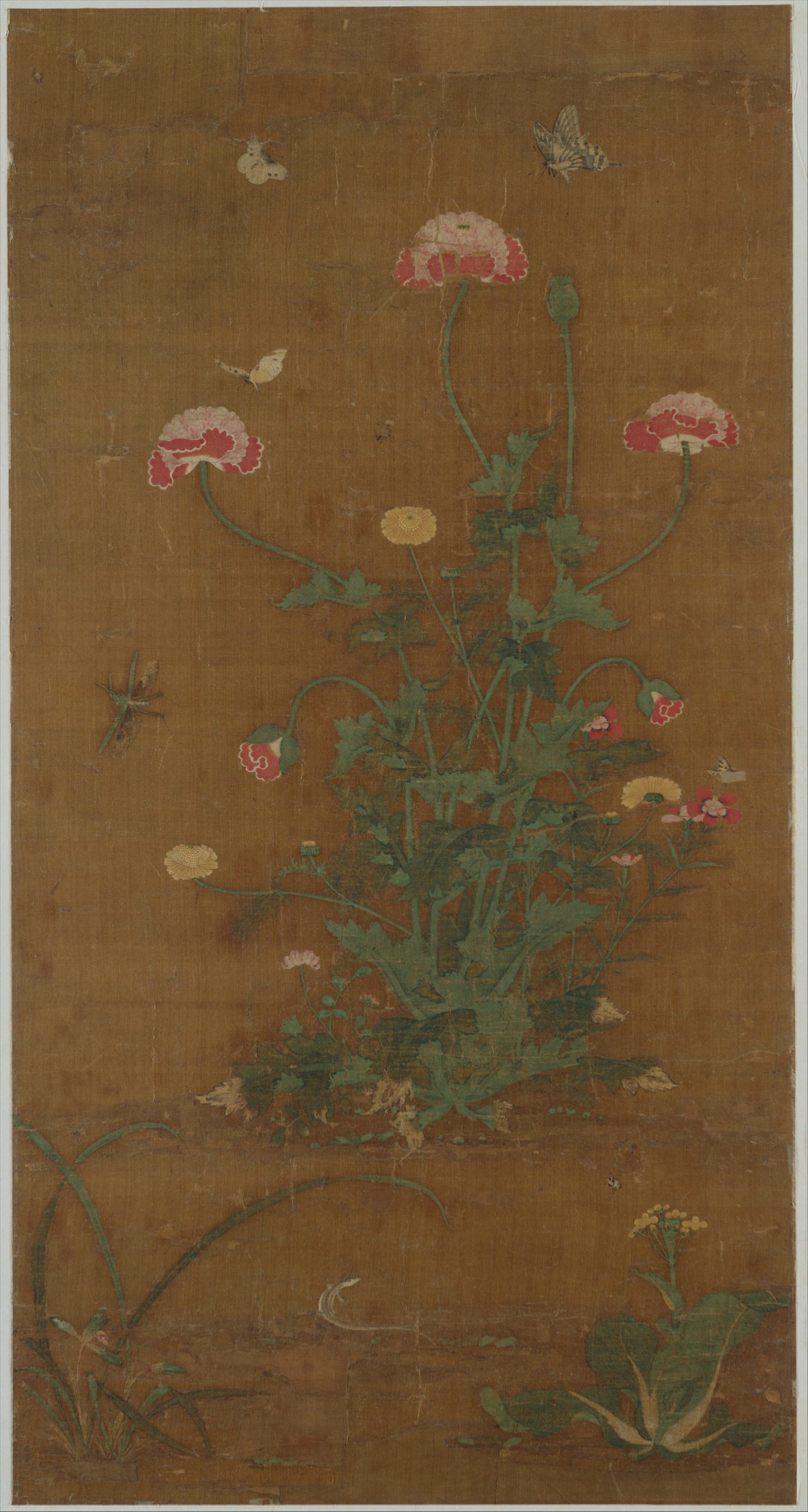
Lü Jingfu
Hanging scroll, ink, and colour on silk, 101.6 x 53 cm | 40 x 20.9 in
The Metropolitan Museum of Art
This painting of flowers by Lü Jingfu combines chrysanthemums and orchids with poppies, china pinks, asters, and cabbage, peppered with butterflies, insects, and a salamander. Broadly, the combination of these plants and creatures, which rely on one another for sustenance, symbolised the cycle of predation in nature. This subject may have become popular in 14th-century Chinese art while the country was under oppressive Mongol rule, as a quiet statement of resilience amid their challenges.
Sunflowers – Loyalty, Friendship, and Conflict
You might not immediately correlate sunflowers with loyalty, but in the 17th century, this was commonly held symbolism. It developed from the heliotropism of young sunflowers, which causes them to turn loyally towards direct sunlight throughout the day. Van Dyck made a mysterious painting titled Self-Portrait with a Sunflower, where he glances out toward the viewer, tugging on a gold chain around his neck and pointing toward a sunflower that stares into his face. It’s thought that the heavy chain was gifted to him by King Charles I, implying that the sunflower is a symbol of his loyalty to the Crown. Another portrait appeared from his studio with the same motif and indication of loyalty to Charles I, this time of Sir Kenelm Digby – a courtier, author, diplomat, and naval commander – with close ties to the King.
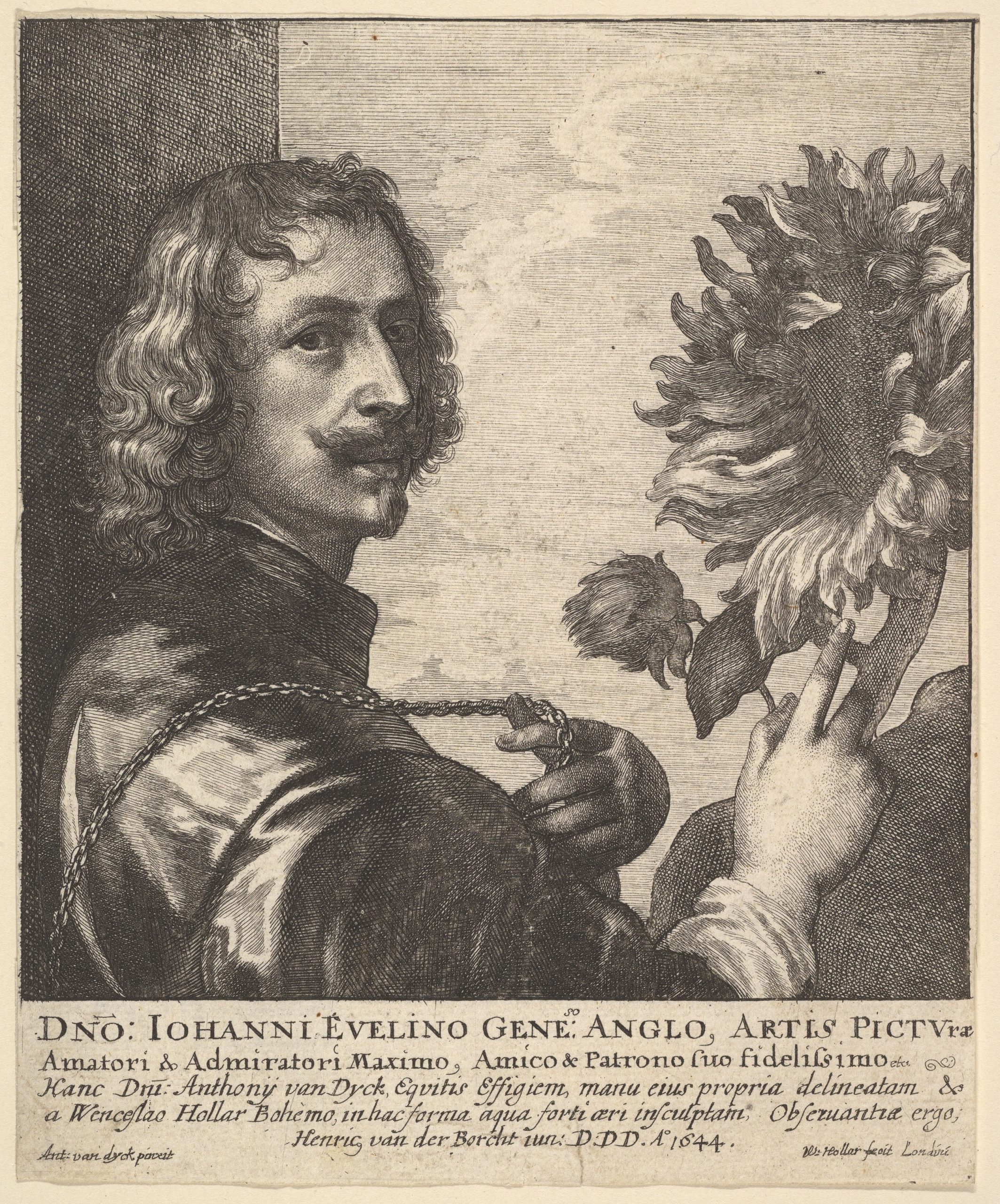
Wenceslaus Hollar after Anthony van Dyck
Etching, 13.5 x 11.3 cm | 5.3 x 4.4 in
The Metropolitan Museum of Art
Some of the world’s most renowned paintings of flowers are undoubtedly Van Gogh’s eleven Sunflowers. The most celebrated of the series were painted in 1888 to decorate his Yellow House in Arles in preparation for Gauguin’s tumultuous visit. Van Gogh was an artist obsessed with the handling of light and rich colour, which sunflowers possess and embody. His subject matter depicted the everyday environments and working people around him, and sunflowers were similarly considered rustic and would have grown in his local vicinity. Like Van Dyck, the sunflowers may have personally represented devotion – this time to the friendship he had seeded with Gauguin. In a letter to his brother Theo, he wrote, “You know that Jeannin has the peony, Quost has the hollyhock, but the Sunflower is mine, in a way”.
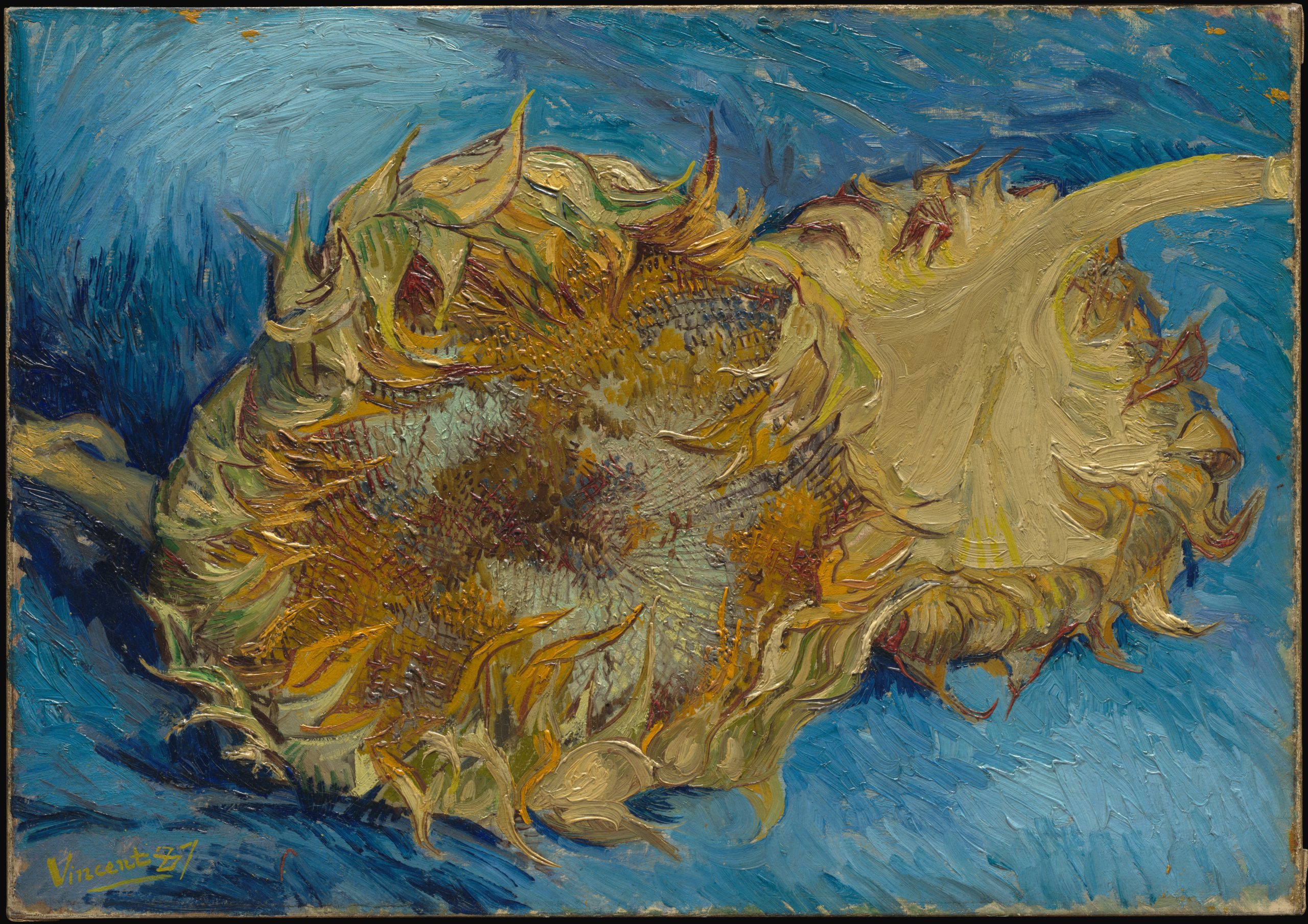
Vincent van Gogh
Oil on canvas, 43.2 x 61 cm | 17 x 24 in
The Metropolitan Museum of Art
The sunflower also recurs in the Surrealist Dorothea Tanning’s paintings, but with much more sinister connotations. She considered them the ‘most aggressive of flowers’ as ‘a symbol of all the things that youth has to face and to deal with’. In her works, the sunflowers facelessly confront young women, themselves, and the elements. The most famous of these is Eine Kleine Nachtmusik, where a haunting corridor hosts a face off between a giant sunflower head with torn off petals and twisted broken stem, as if just taking a pause from fighting, beside two young girls. One leans exhausted against the wall, clutching a shorn petal, whilst the other faces it, fists clenched, with hair flying wild with rage.
The Mirror by Tanning sees a sunflower gazing at its own reflection within another sunflower, which takes on the appearance of a handheld mirror, all framed by an oval of sunflower petals. The layering of the humanoid flowers displaying introspective behaviour within other decorative flowers is brilliantly unsettling.
Flora – Goddess of Flowers
The Roman goddess of flowers, springtime, and youth is Flora, and her Greek counterpart is a nymph named Chloris. Both are depicted as individual figures in Botticelli’s Primavera, where Chloris, pursued by Zephyrus, the god of the west wind, has flowers streaming from her mouth. Her future self, Flora, stands crowned and draped in blossoms, offering the viewer an unusual smile for this era of painting. It’s written that the subsequent marriage of Zephyrus and Chloris transformed her into Flora, elevating her to the status of a goddess.
The couple also appear together on the left of The Birth of Venus by Botticelli, swooping in to combine their powers by blowing flowers through the wind. Flora is responsible for the metamorphosis of characters in mythology into flowers in their dying moments to provide them with new life, such as Narcissus, Hyacinthus, and Adonis. In Ovid’s Fasti V, he recounts how Chloris made Hera pregnant with Ares using a flower. For these reasons, Flora and Chloris also represent transformation, fertility, and rebirth.
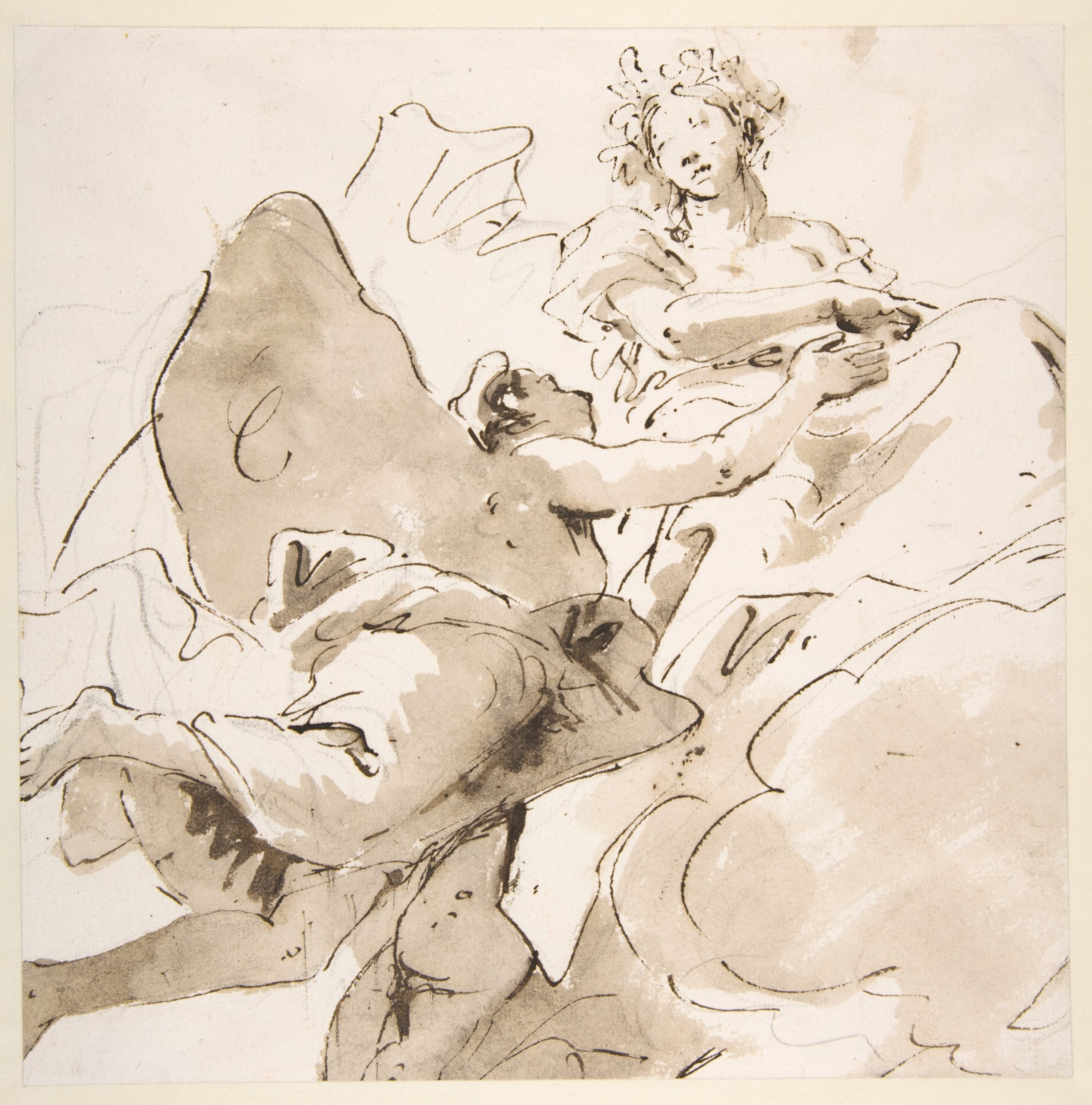
Giovanni Battista Tiepolo
Pen and dark brown ink with wash and chalk, 22.9 x 22.8 cm | 9 x 9 in
The Metropolitan Museum of Art
Charles Cromwell Ingham was an Irish-American portrait artist, recognised for his masterful handling of seamless colour built in successive glazes, inspired by Ingres. His painting The Flower Girl is unusual within his oeuvre, as he rarely painted allegorical figures. He was influenced by European paintings of street vendors, but chose to adapt the subject into a feminine character to evoke the goddess Flora. His flower seller carries a basket of wonderfully colourful blooms under her arm and holds a potted fuchsia, which symbolises love.
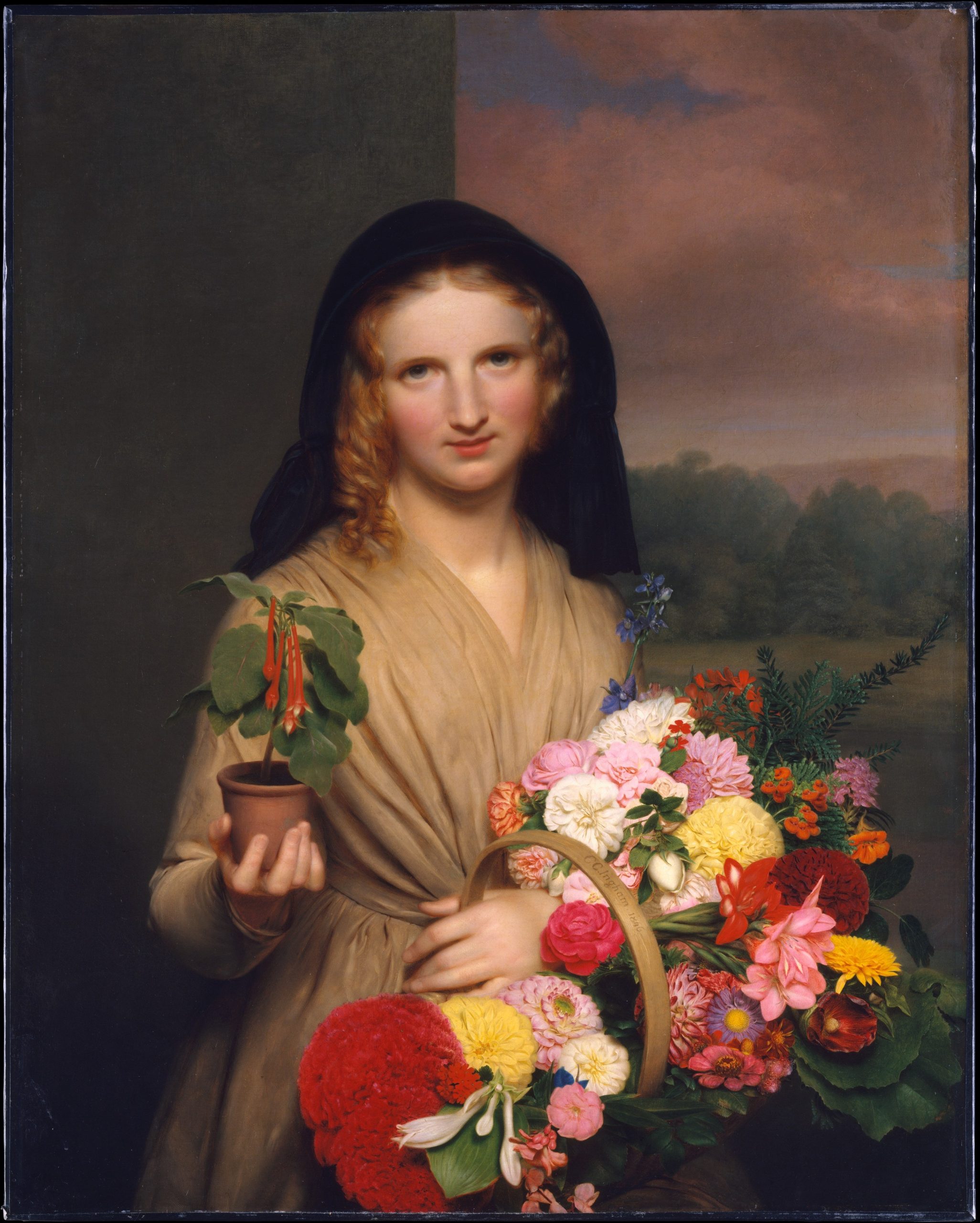
Charles Cromwell Ingham
Oil on canvas, 91.4 x 72.1 cm | 36 x 28.4 in
The Metropolitan Museum of Art
Roses – Romance, Death, and Sleep
It would be amiss to write about flowers and symbolism without mentioning roses. Of course, their main association is with love, and they are still gifted today as romantic gestures. This connection to romance stems from Greek mythology, where the rose was a symbol of the goddess of love, Aphrodite. We see them blooming in seminal artworks, such as those clutched in the goddess’s hand in Titian’s Venus of Urbino. The origin of this association comes from her romance with the mortal Adonis. Ares heard of their relationship and transformed himself into a boar to attack Adonis in a jealous rage. Aphrodite rushed to help him as he died, but she was too late and cut her feet on the white roses growing beneath her. Her blood stained the white roses, and red roses have been associated with the love of the goddess ever since.
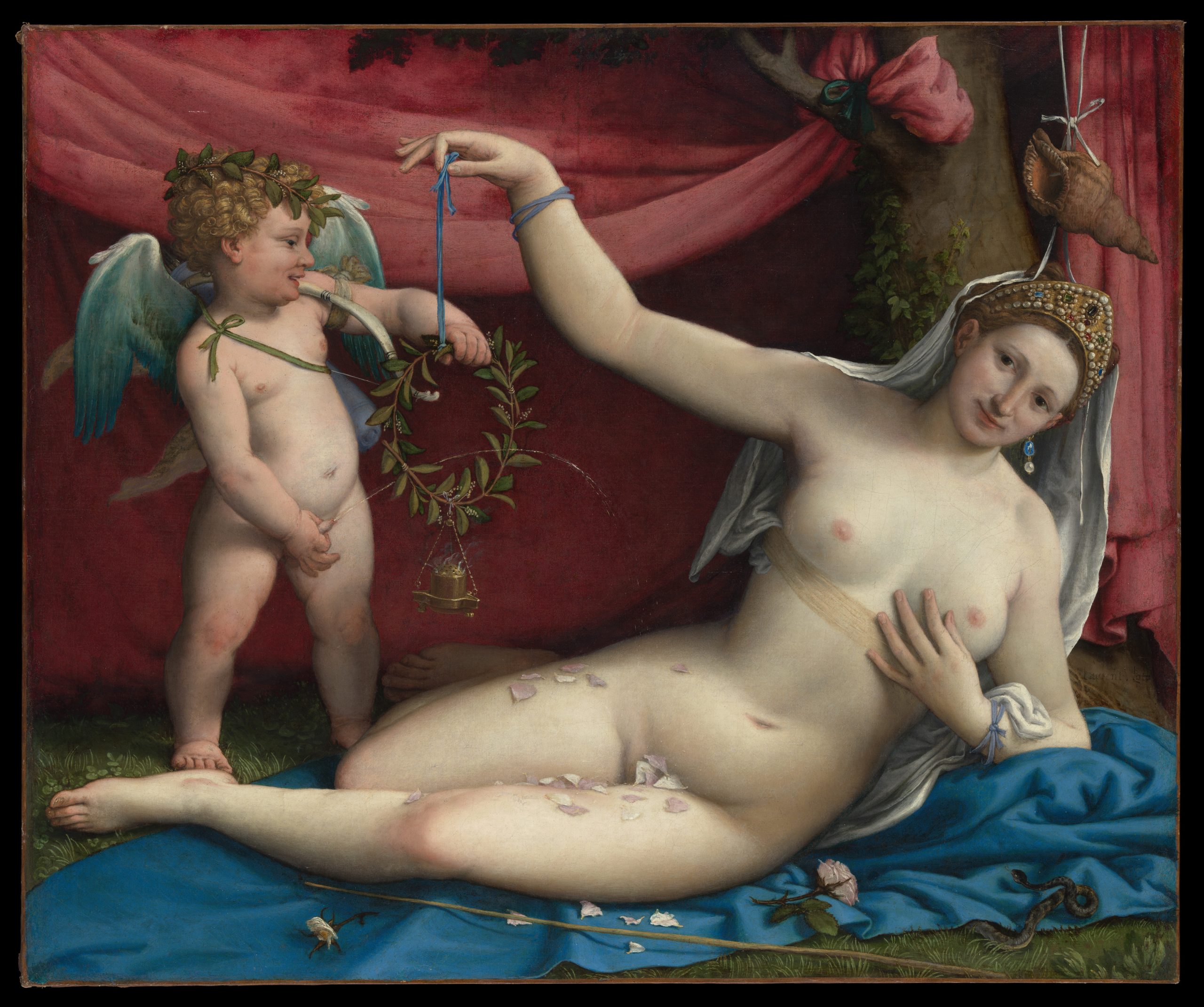
Lorenzo Lotto
Oil on canvas, 92.4 x 111.4 cm | 36.4 x 43.9 in
The Metropolitan Museum of Art
Roses haven’t exclusively been used to symbolise romantic love – in The Roses of Heliogabalus by Lawrence Alma-Tadema, they become lethal. A wave of rose petals surges over a crowd of onlookers, suffocating them in the sweet perfume. The subject derived from the Roman emperor Marcus Aurelius Antoninus, a cruel teenager who reigned for four years. According to an account, he suffocated the guests of a banquet with a huge volume of ‘violets and other flowers’. As a Victorian artist, Alma-Tadema was aware of the symbolism held by certain flowers, and specifically how positive violets were. Because of this, he transformed the lethal mass of flowers into roses, which carried more ambiguous meanings depending on the variety, while also creating the visual impact of the swathe of pink across the painting. His biographer detailed that he had tonnes of roses imported from France to his studio in order to complete the work.
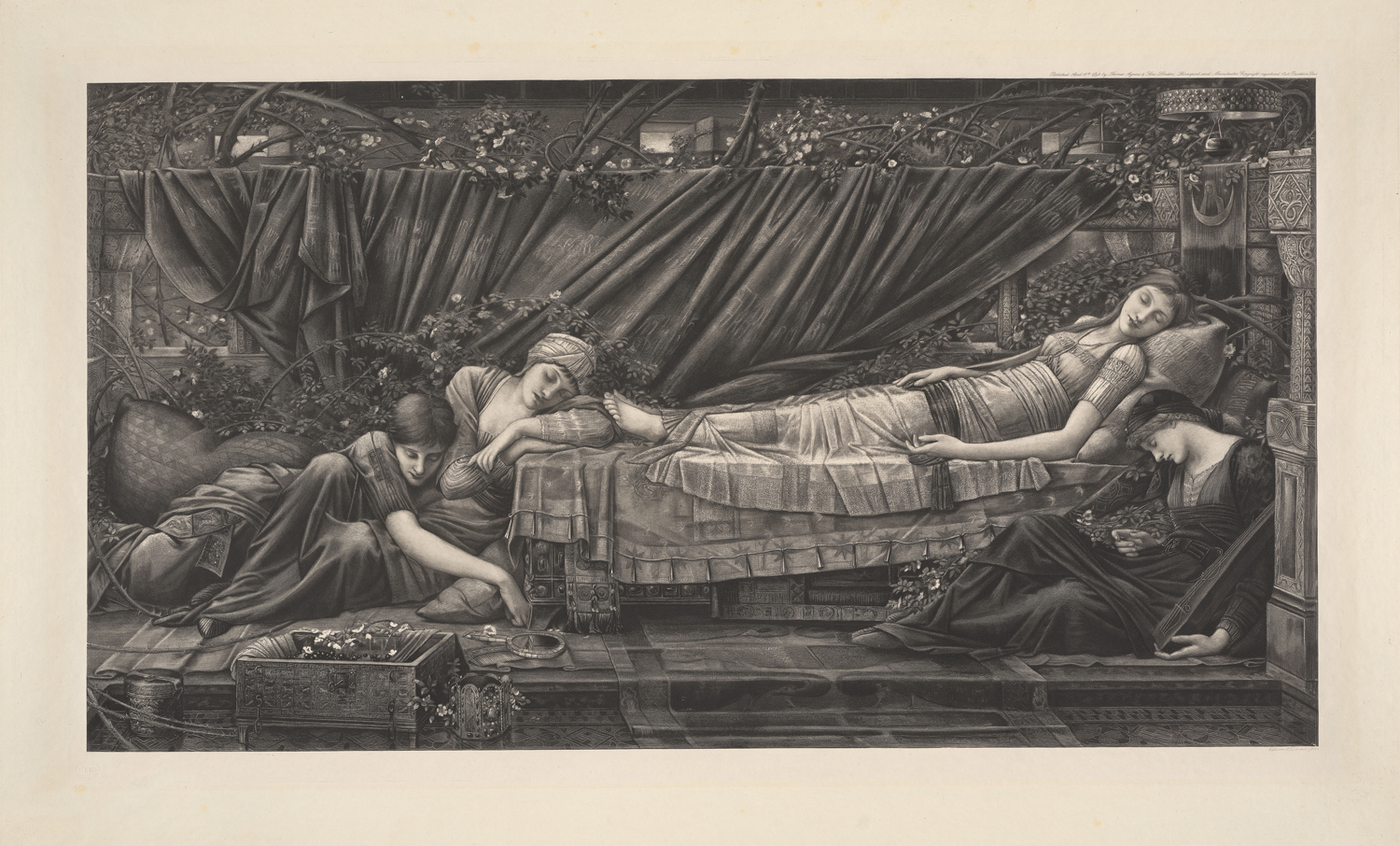
Thomas Agnew & Sons after Edward Burne-Jones
Photogravure on cream wove paper, 41.9 x 78.1 cm | 16.5 x 30.8 in
Yale Center for British Art
Another Victorian artist who delved into the sinister aspect of the rose was the Pre-Raphaelite Edward Burne-Jones, in reference to Sleeping Beauty by the Brothers Grimm. He painted The Legend of the Briar Rose – a series of four paintings depicting the deep slumber beset on a royal court by a curse of somniferous roses. Throughout the paintings, thorny flowers overwhelm and envelop the figures, from knights entangled in their vines to weavers collapsed over their work. Burne-Jones wrote to a friend asking for roses to paint from, specifying that he would like them to be ‘hoary… thick as a wrist and with long horrible spikes on it… Three feet would be enough.’ The figures are trapped within a dream that we are helpless to witness, perhaps reflecting Burne-Jones’s concern over society’s general acceptance of industrialisation, which the Pre-Raphaelites resisted.
The Flower – Art Prompt
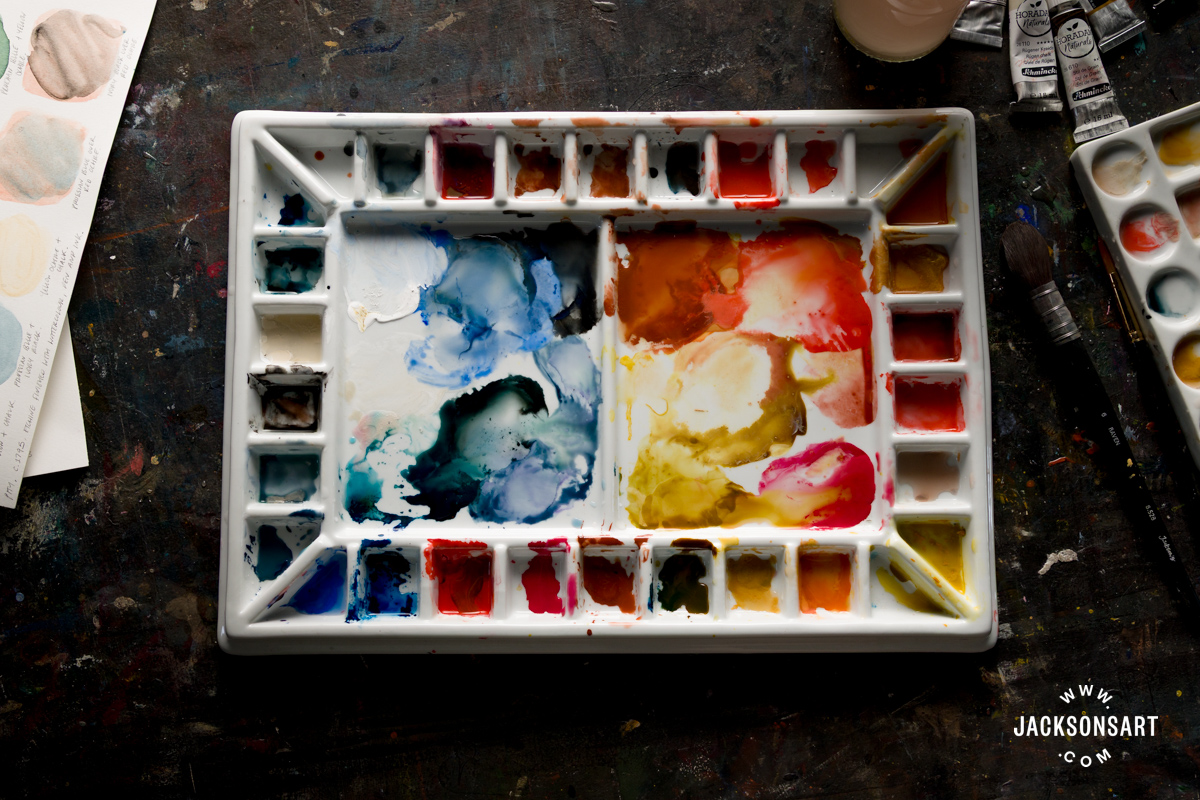
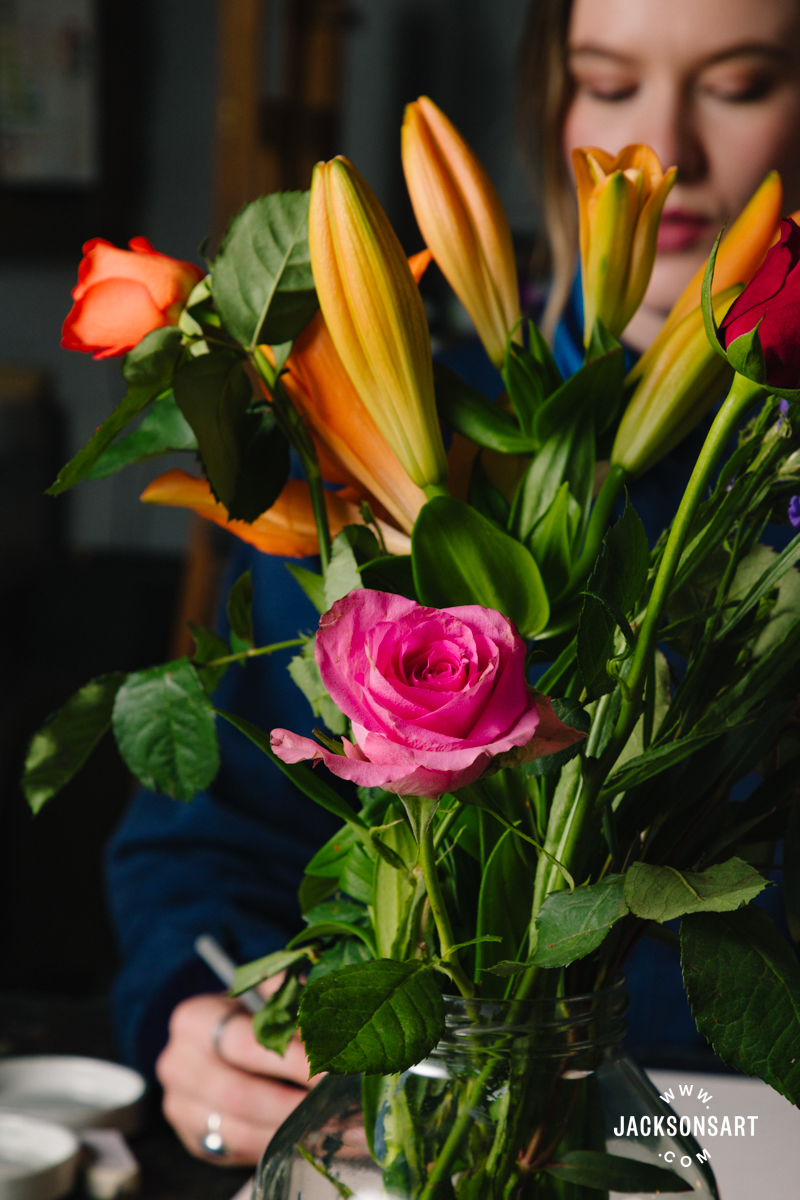
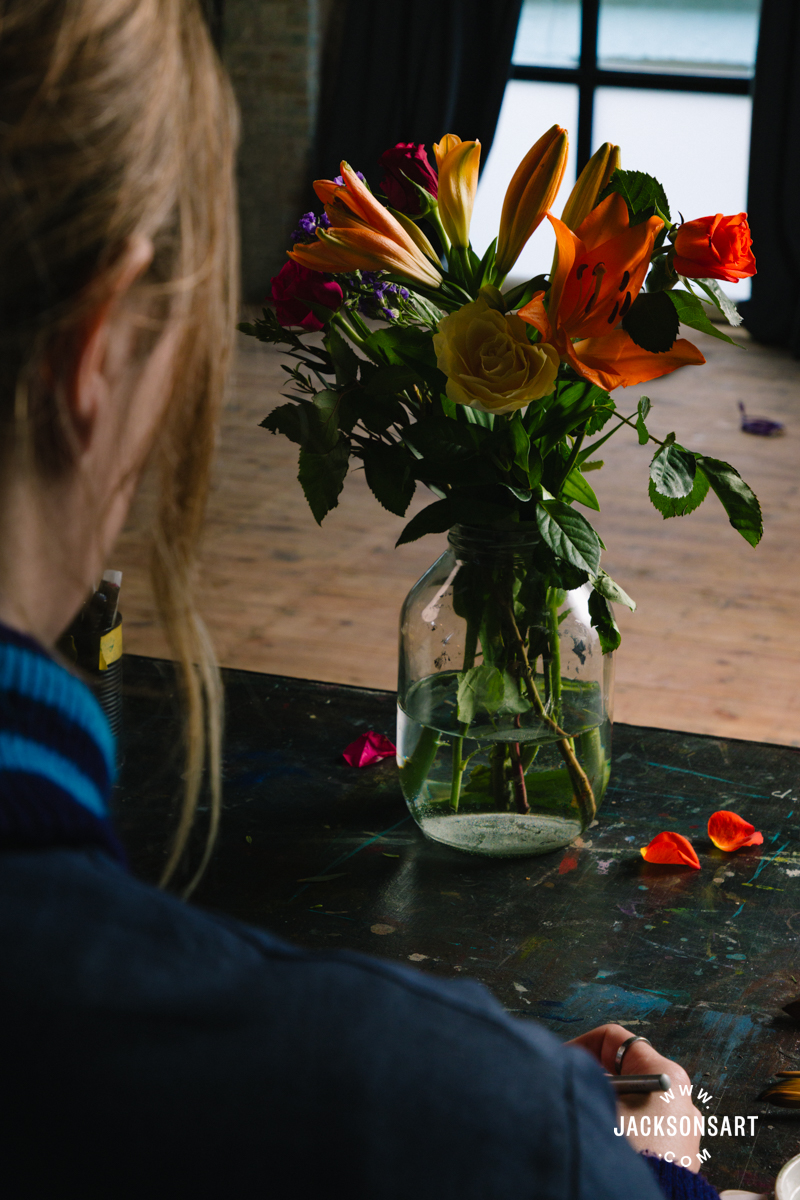
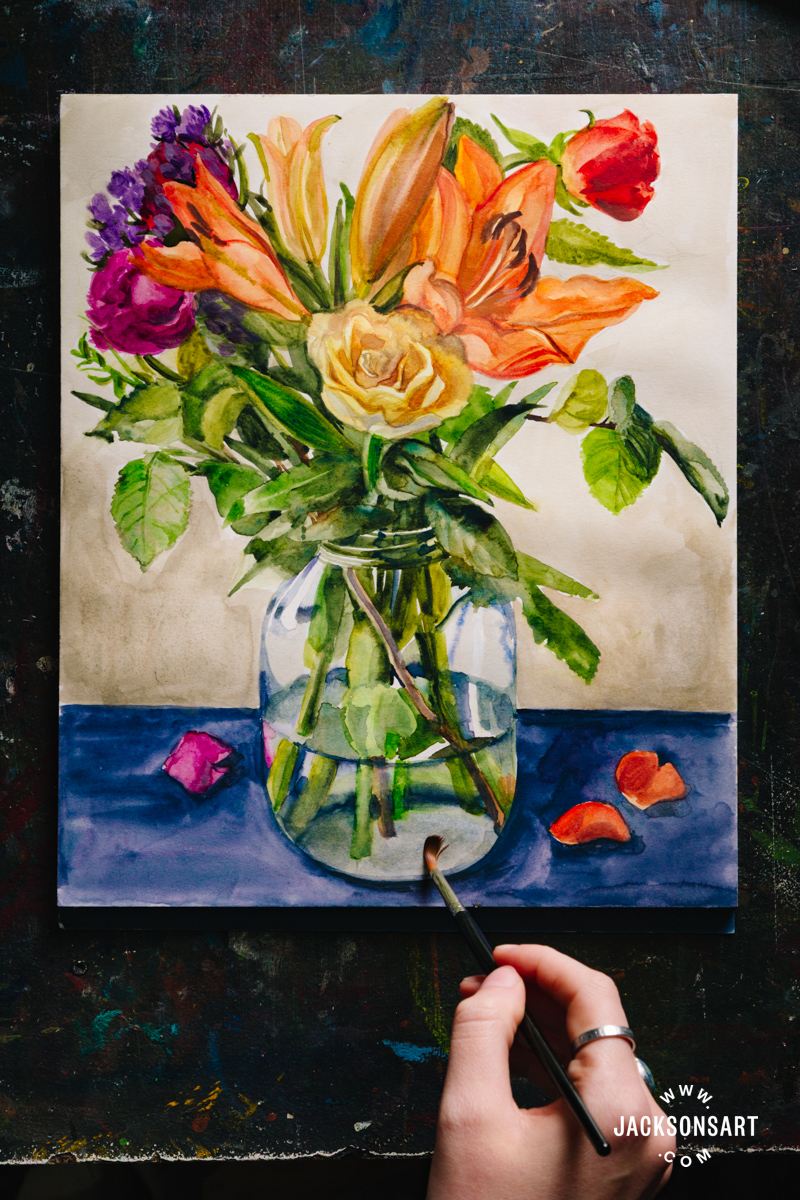
For my artwork example, I was inspired by Rachel Ruysch’s rich still-life paintings of flowers in vases, paired with the soft hues created by the watercolour in Rossetti’s Lady Lilith. I bought a bouquet of flowers, including the aforementioned lilies and roses, and arranged them in a vase to study from life.
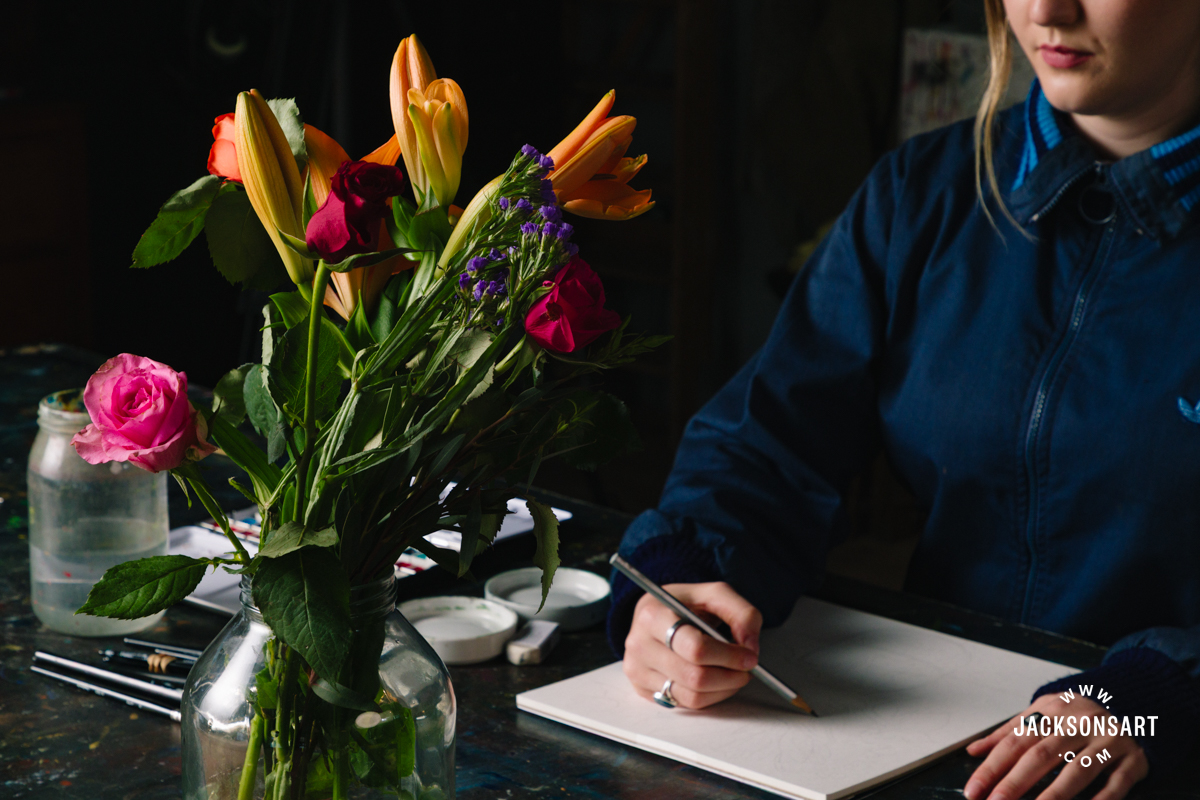
For this art prompt you’ll need:
A selection of Roman Szmal Aquarius Watercolour Paints
A Jackson’s Empty Metal Watercolour Box
A selection of Jackson’s Watercolour Brushes
A sheet from a Jackson’s Watercolour Paper Block
Two jars of water (one for rinsing the brush, and the other for painting with)
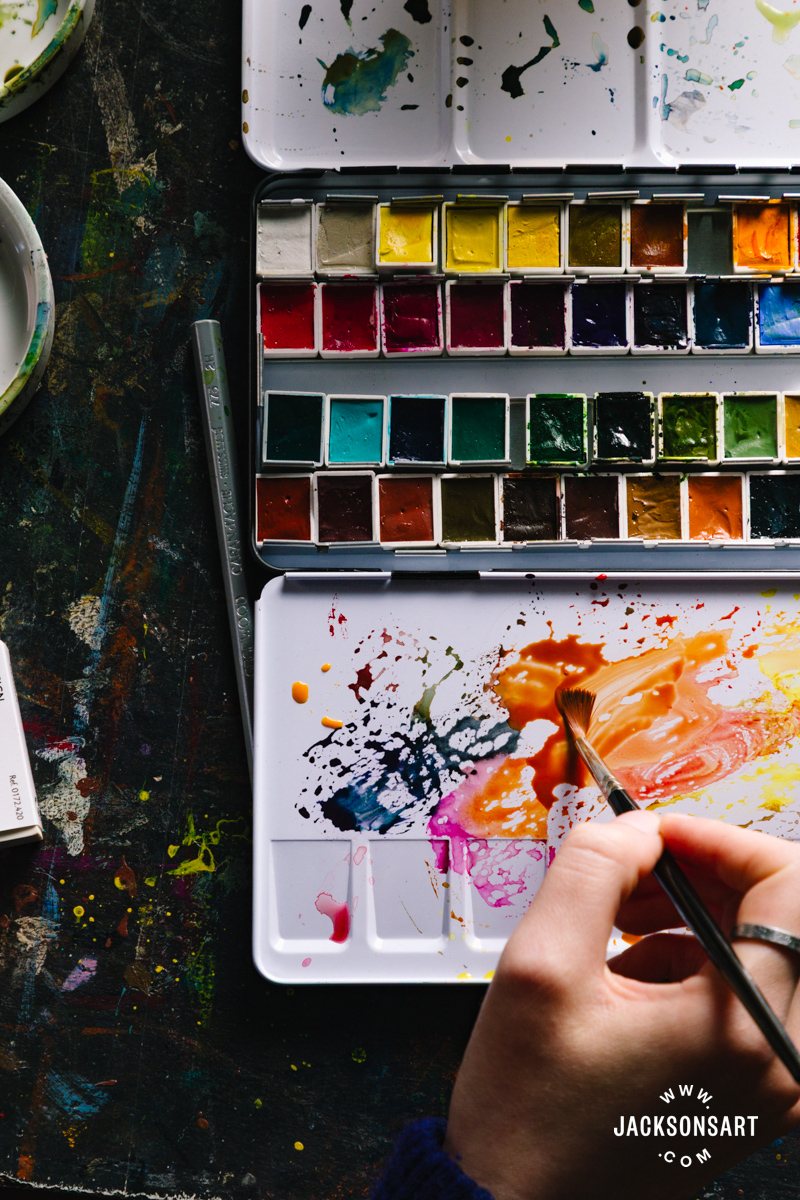
To begin my artwork, I set my bouquet up in front of me in a glass jug, taking care to arrange them with satisfying placement, and trimming any stems to make them the desired height for my composition. Then I placed a couple of fallen petals on the table next to the vase, to suggest the memento mori aspect of vanitas paintings.
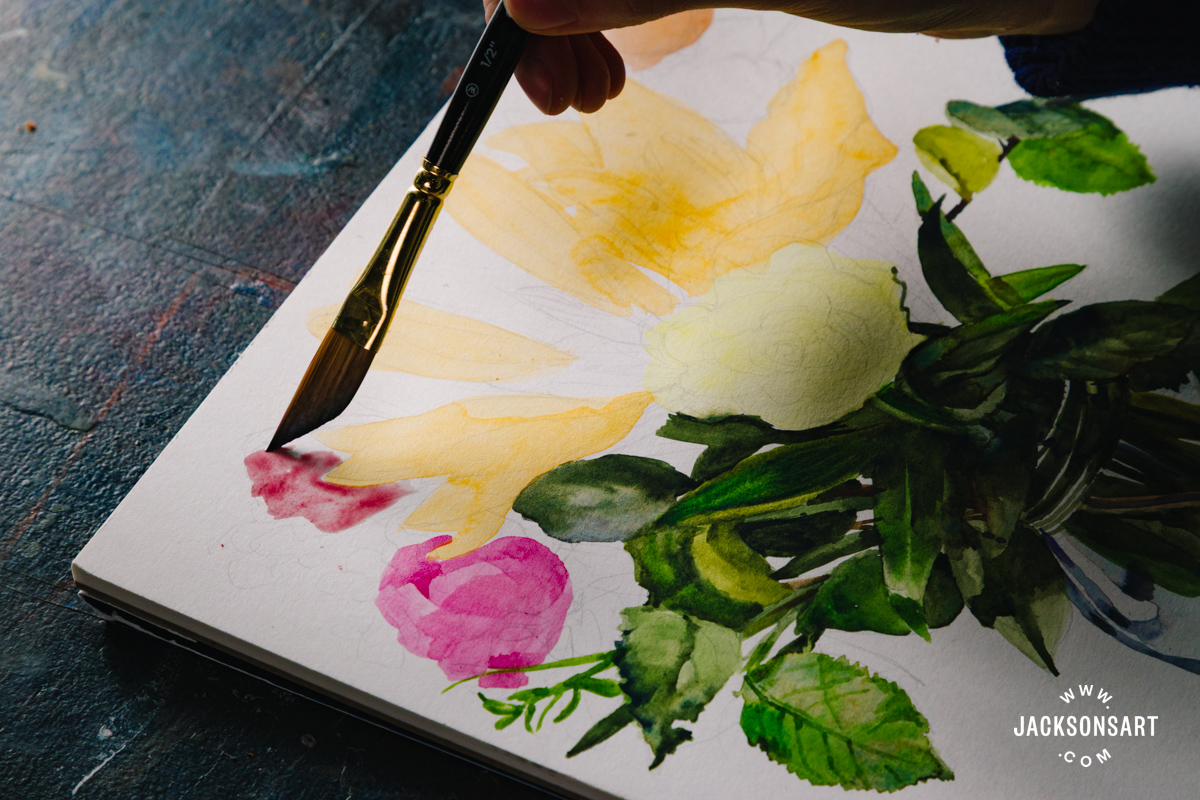
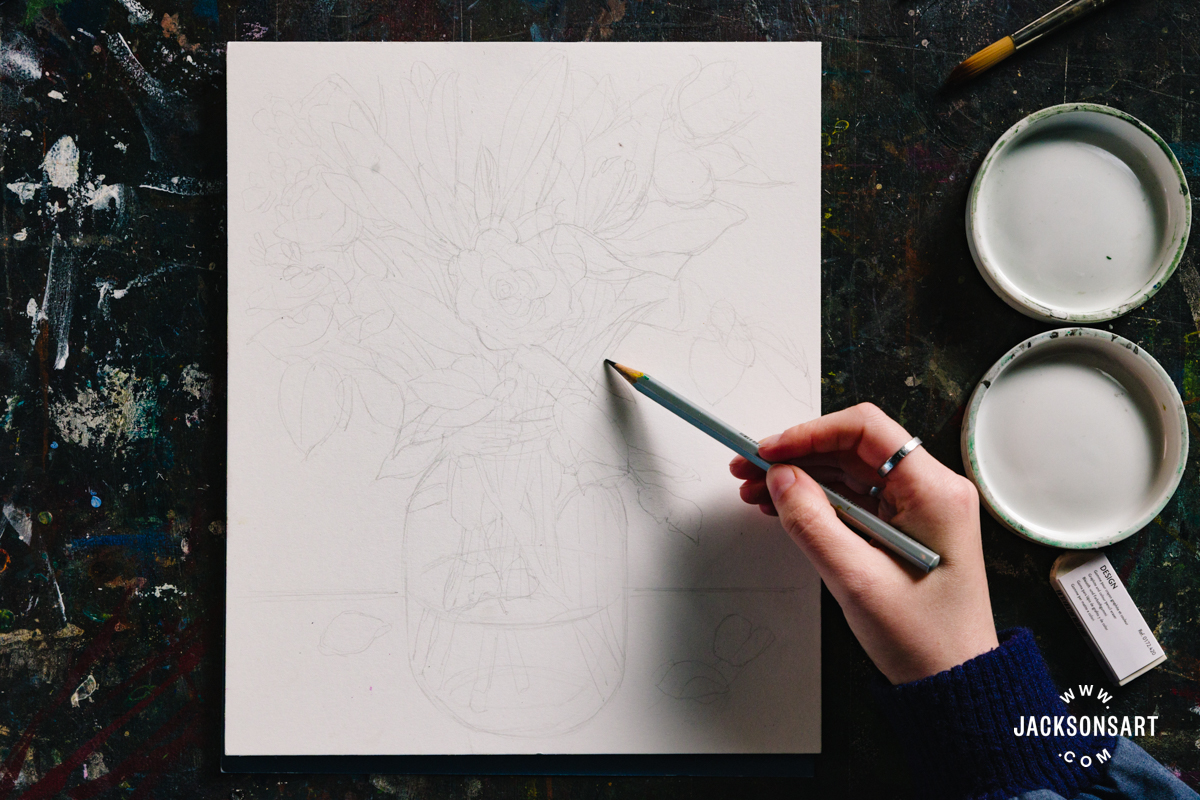
Next, I lightly sketched the placement of the flowers on my paper in 2H pencil to act as a framework for the painting, which I could easily conceal or erase later.
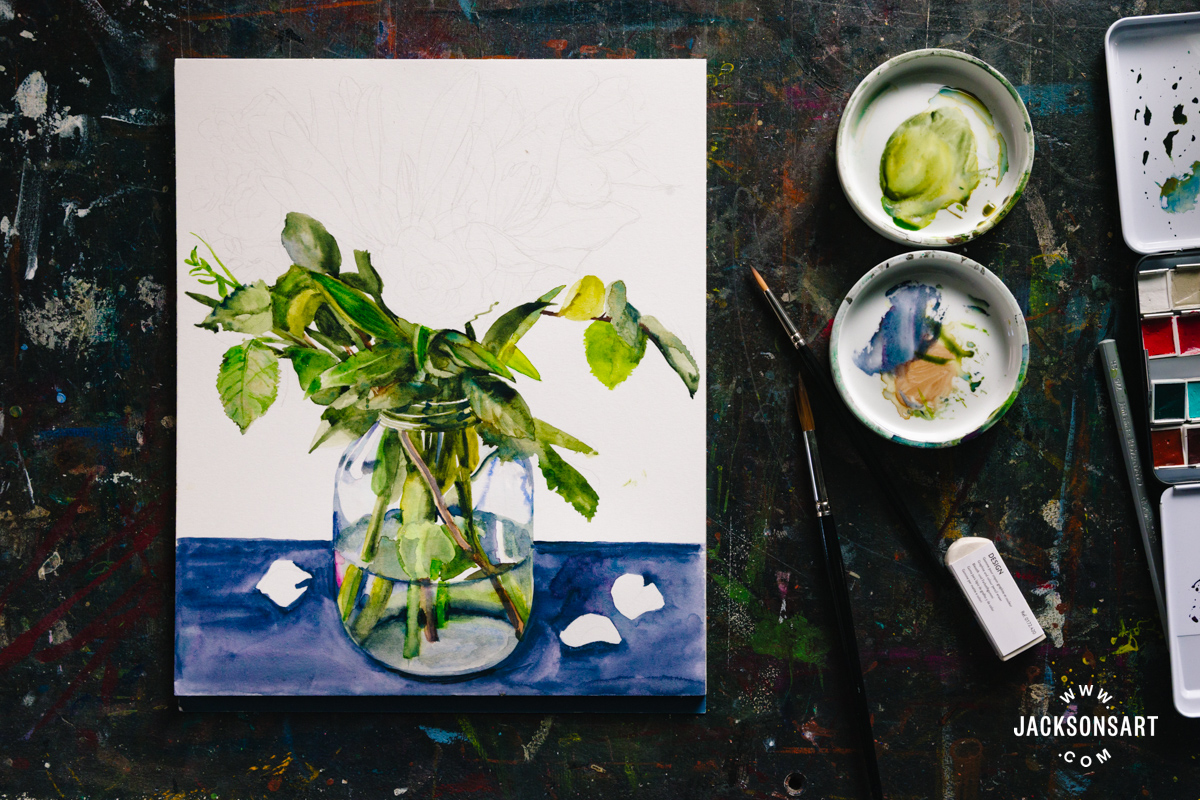
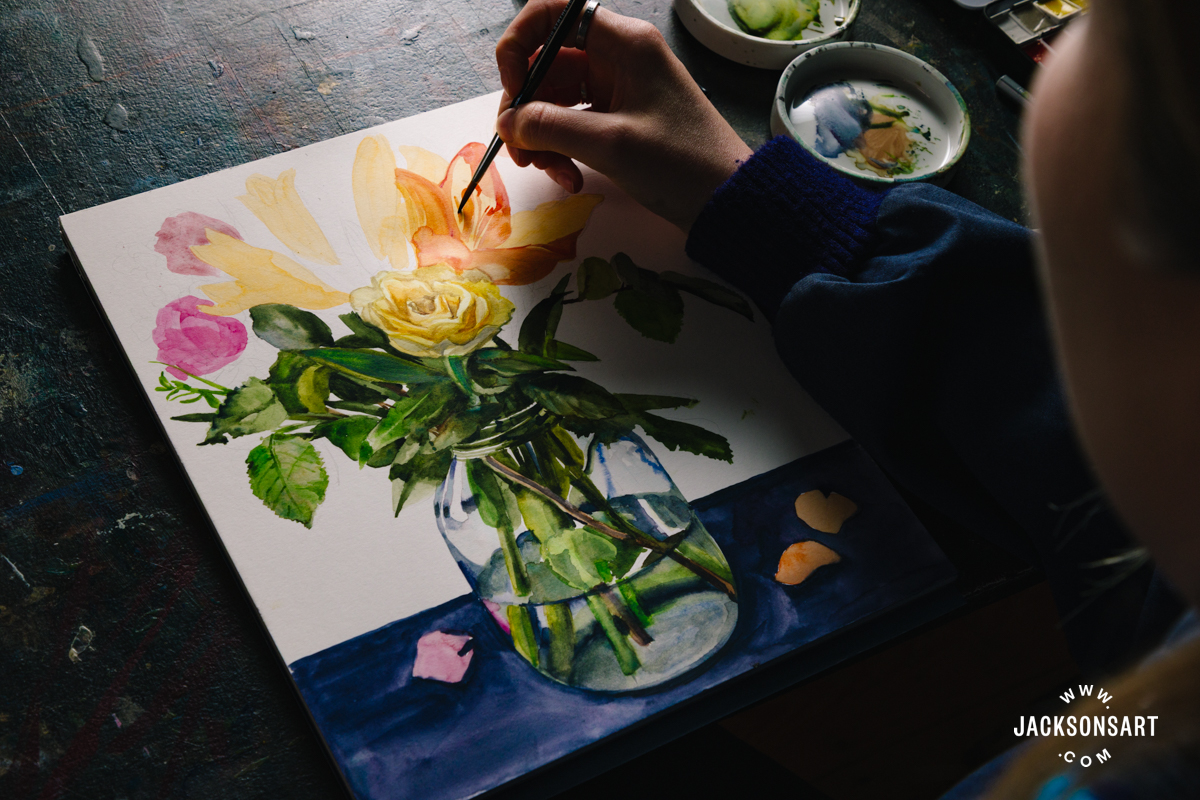
To begin the painting, I started with the leaves along the rim of the glass, wanting to establish some of the rich green beneath the blooms so that I could better assess how vibrant to paint the flowers.
I worked my way around the flowers methodically, blocking in their key colours and forms, before refining the details once the initial layers dried.
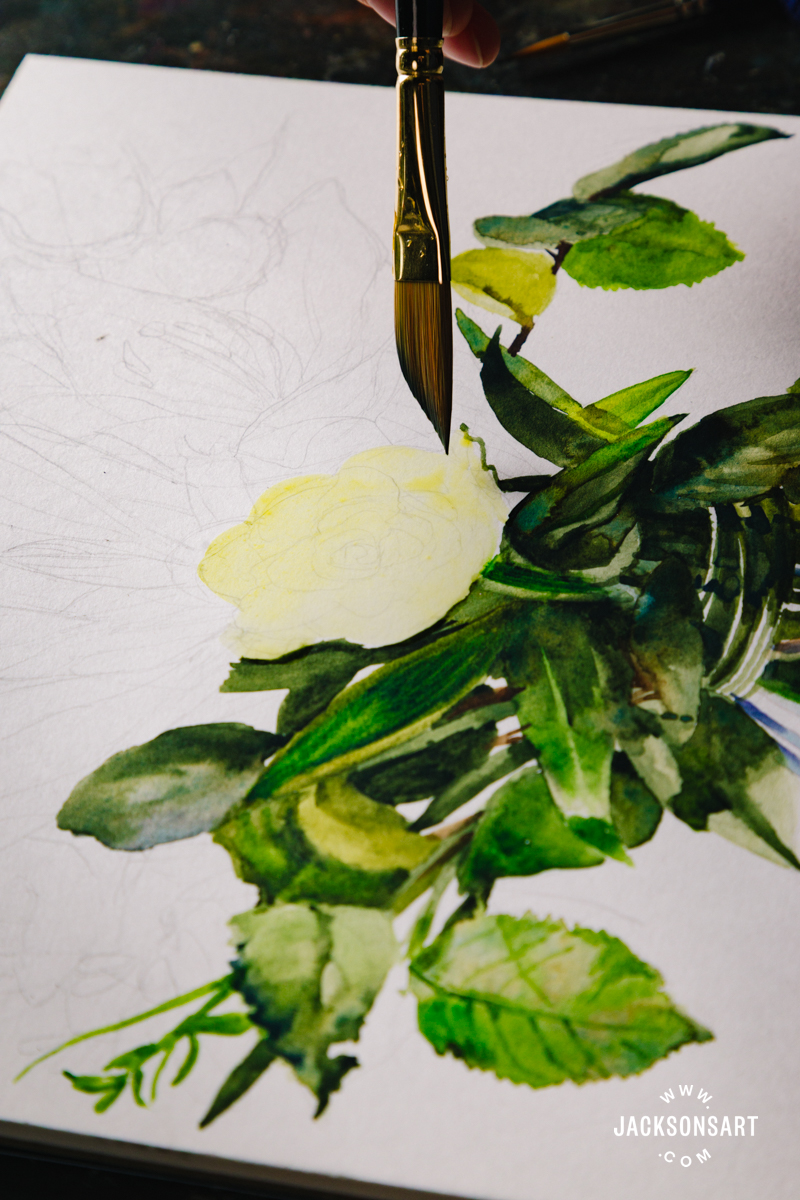
I used light lifting in a couple of areas to bring back the white of the paper and create delicate highlights on the petals.
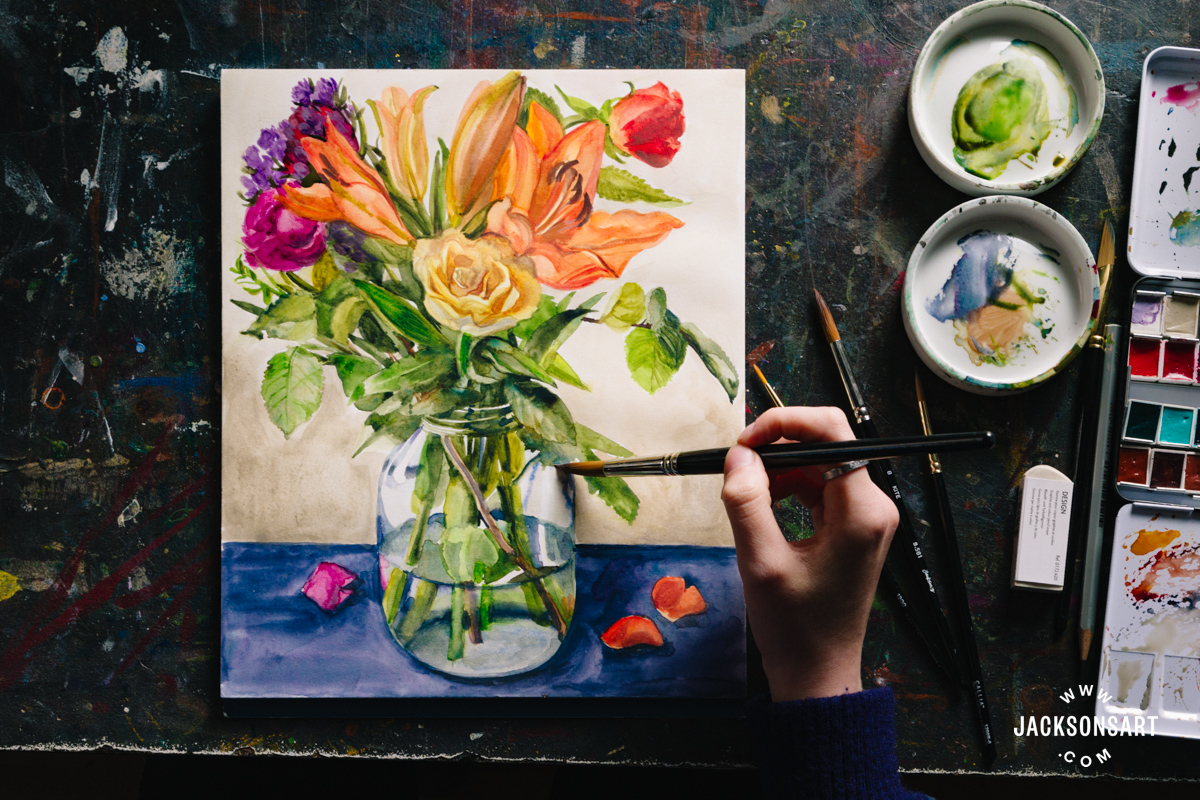
To complete the painting, I painted the surface of the table, and the light behind the vase in broad washes.
Further Reading
Art Through Symbols: Songbirds
Painting With Sunshine: Van Gogh’s Yellows
Recreating the Colour Palette of Georgia O’Keeffe
Artist Insights: Billy Showell
Shop Art Materials on jacksonsart.com