France Bauduin, a member of the UK Coloured Pencil Society (UKCPS), uses coloured pencils for stunning animal drawings. Here she tries the new smooth surface of Colourfix Paper that Art Spectrum released earlier this year.
Experimenting with a new suede paper: Colourfix Smooth
Earlier this year, I was given 3 small samples of this new paper Colourfix Smooth: burnt umber, elephant and aubergine to experiment with.
Burnt umber turned out to be the perfect colour for my subject: the portrait of a young lynx. With such a dark coloured paper, I was surprised to see that it didn’t need an undercoat of white for even the palest colour to come true. As for the white, I never thought it would possible to get it so bright with so few layers.
With elephant, I chose to draw the portrait of a silver tabby kitten. Again, this was the perfect colour for my subject and I managed the most incredible bright sparkly eyes. I used a black Pitt Pastel pencil for the background and found that it covered the paper even better than colour pencils.
Aubergine would not have been my first choice for the portrait of a snow leopard or any other animal but as there were some undertones of purple in my model, I decided to give it a go. The result was bright and colourful but my snow leopard didn’t look very natural.

Aubergine (25.5 hours to complete)

Burnt Umber (12 hours to complete)
Snow Leopards on Black Colourfix Smooth Paper
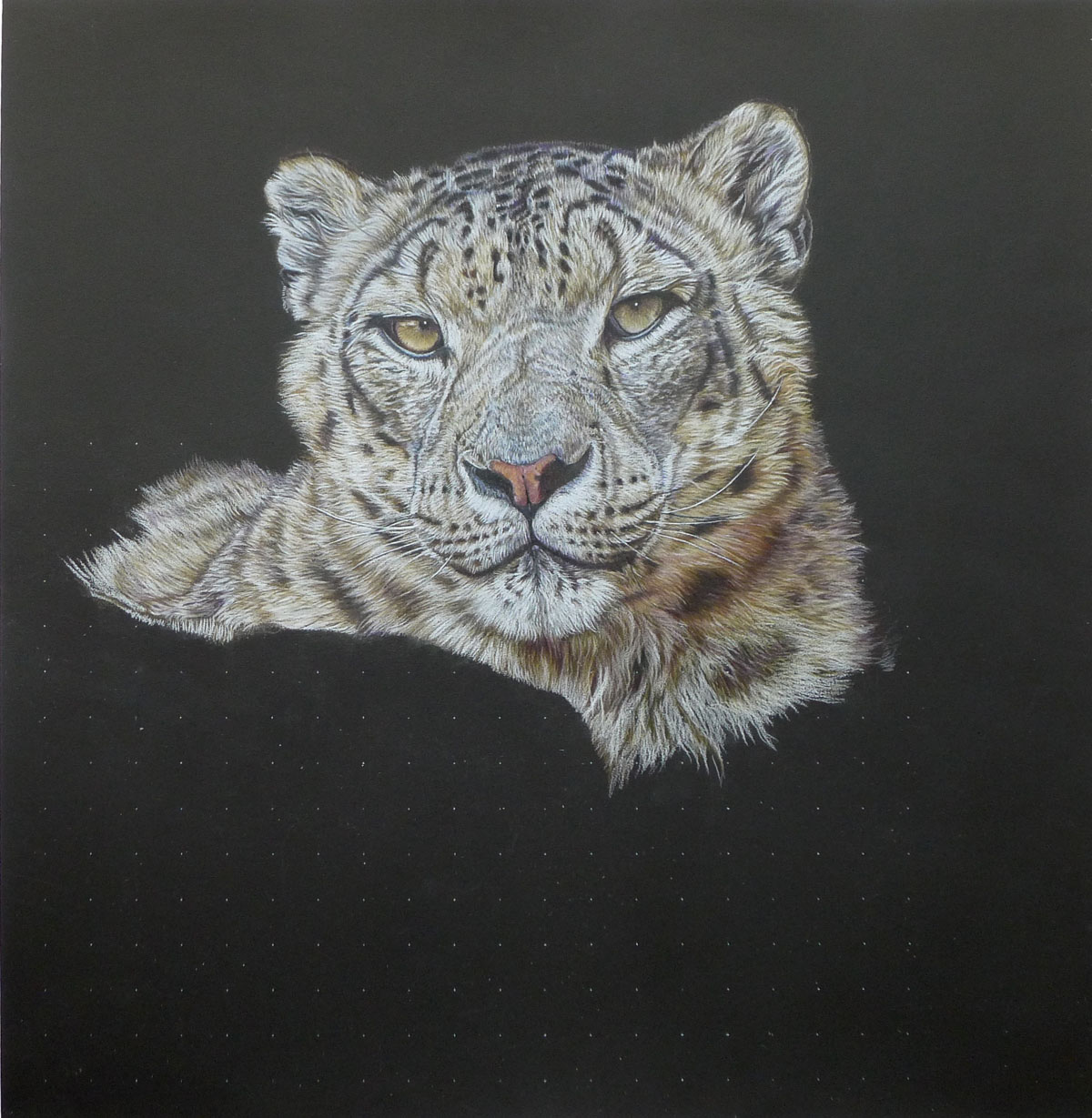
Jackson’s then sent me four new big sheets of Colourfix Smooth including black. Remembering how well my colour pencils were covering Burnt Umber, I couldn’t wait to try to draw my snow leopards on black.

by France Bauduin.
by France Bauduin.
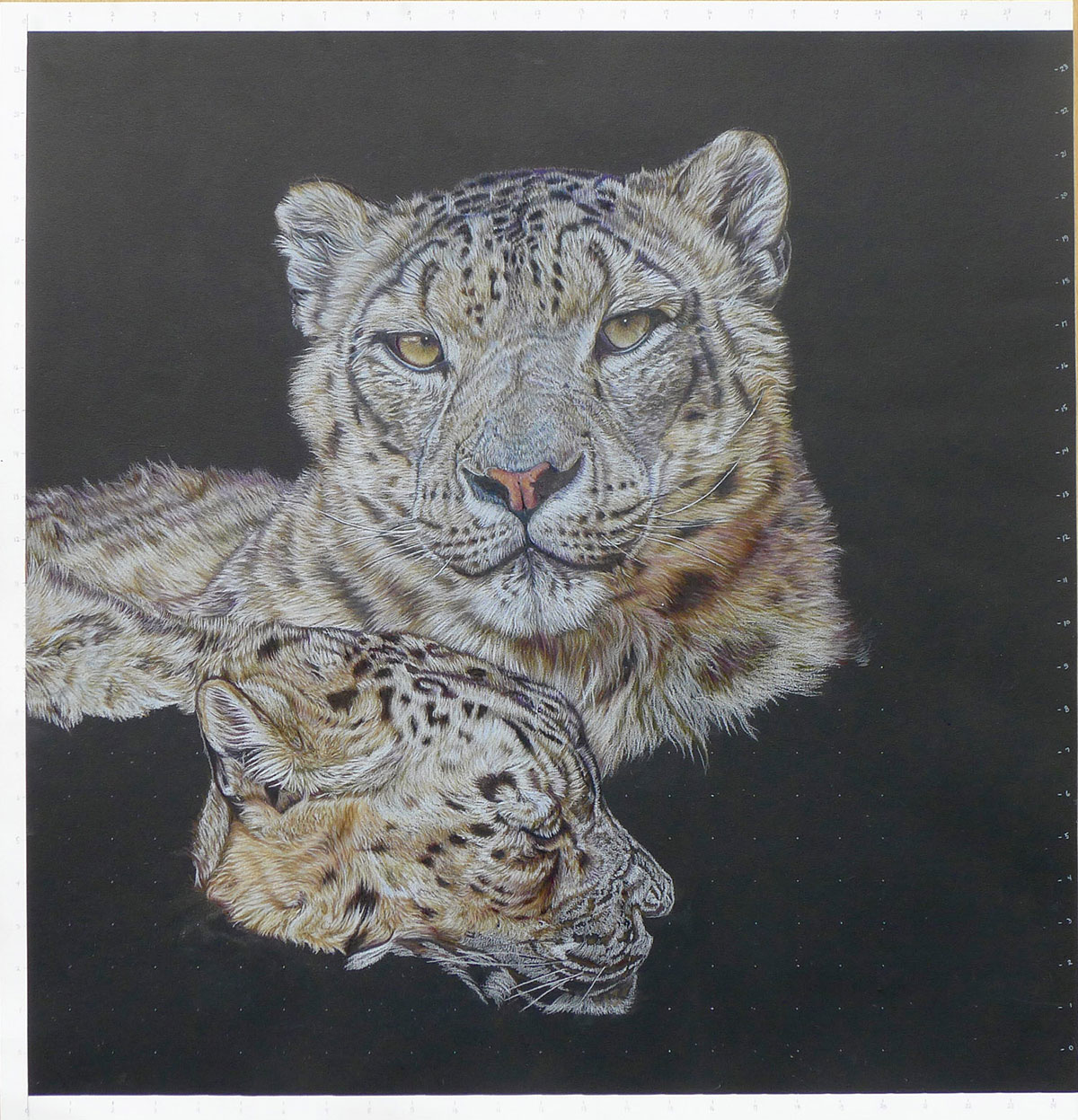
Creating my usual grid with white dots looked promising. Just like with burnt umber, I didn’t have to press hard for these to come out well. Just like before, it took me a bit of experimenting to find which colour pencils I needed to achieve the desired effects as the paper doesn’t allow that many layers. Not that you need many as most colour pencil brands cover it so well. Faber-Castell Polychromos pencils work particularly well on this kind of surface, as well as Caran d’Ache Pablo. I also got good results with Prismacolor & Caran d’Ache Luminance but less so with Derwent Coloursoft unless they were applied first. A warning though: while it was easy to erase mistakes to bring back a pristine black, doing so also seemed to erode some of the fixative that allows the colours to take so well on that kind of paper. While dark colours weren’t much affected, the white areas were never as bright afterwards, looking more greyish blue than white. Fortunately, by adding a fine layer of white pan pastels over these little areas, I was able to solve that problem.
by France Bauduin.
by France Bauduin.
As I wanted to keep my black background black, I didn’t place my subject first like I usually do. Instead, I worked from top to bottom and usually left to right as it was easy to smudge the colours near the outline. If it happened, it was easily lifted with a Faber-Castell putty eraser. So not really a problem but you still need to be careful.
Another advantage of not having to apply so many layers is that once you have found the combination of colour pencils that give you the desired effect, you can work a lot faster with generally less colour pencils as well. It’s possible that as a result, you may not achieve as much finesse and depth as with another type of paper that allows more layers but this should prove an advantage for anyone doing commissions where time is money. A solution to add more layers could be to use a fixative between coats but I have not tried it.
The colours also come out brighter than most papers I know and are similar to what you can achieve with pastels. For this, black paper was the ultimate test and my snow leopards came out bright and lively and this time, with the right colour undertones.
Choosing the right colour for your subject is indeed paramount to a successful drawing. The good news is that Colourfix Smooth comes in 20 different colours so you should be able to pick one that will suit you.
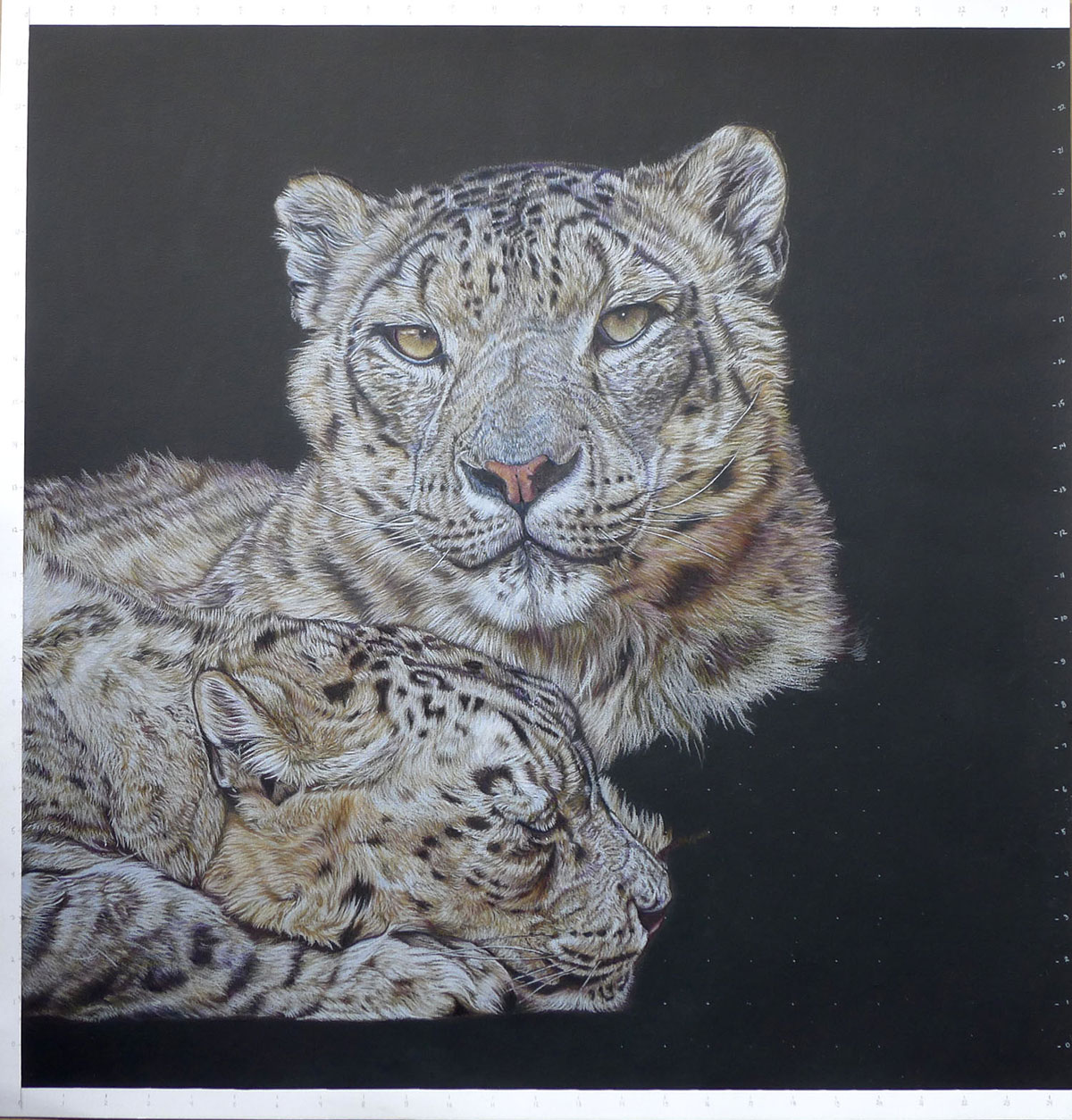
The Finished Drawing

18.7 x 16.5 inches
France Bauduin
(The drawing took 52 hours to complete)
Some of the colours perform better than others
I discovered however that somehow not every colour for Colourfix Smooth reacts the same way to colour pencils. I also did a drawing on snow leopards on soft umber Colourfix smooth and discovered to my dismay that the adherence of colour pencils to that particular colour was much less than the other colours I had tried. It was much harder to achieve good contrast and very difficult to layer it. I still managed to pull it off but it’s not a colour I would recommend for anyone. I thought I might have had a ‘bad sheet’ but my friend Judith Crown had the same problems with her own sheet of soft umber. I hope not many people will have their first try with this colour as it would probably put them off the whole series of Colourfix smooth.
On the other hand the Elephant colour is performing well. Here is a work in progress photo of five kittens that I am currently working on using that colour.
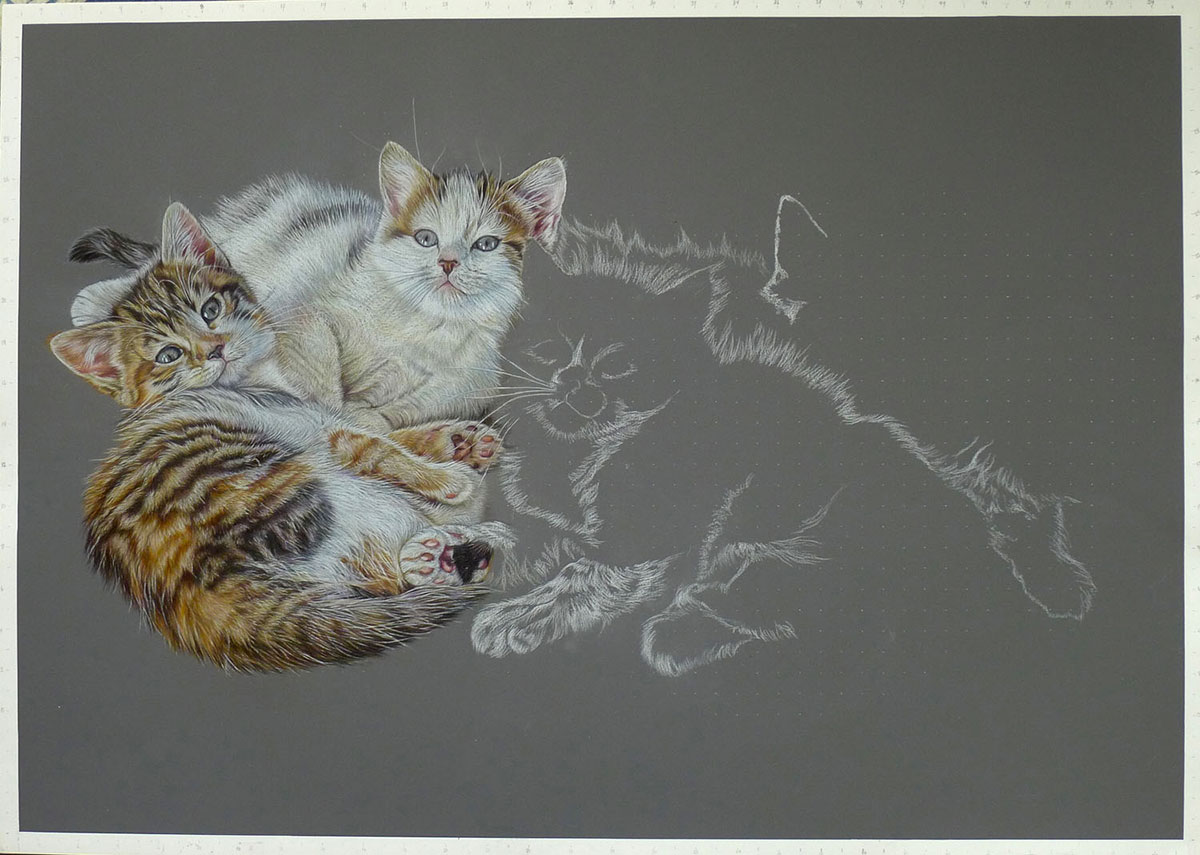
By France Bauduin
Summing all up:
The advantages of the Colourfix Smooth paper are numerous:
- A good range of deep colour backgrounds is available
- Colours of your subject come out a lot brighter and you need fewer layers to achieve what you want
- As a result, you can work so much faster which should make commission work easier and allow you to lower your prices
- It erases easily leaving the background colour intact so correcting mistakes or making adjustments is a lot easier on that kind of paper
- Pastel pencils and pan pastels work like a charm on it
While its drawbacks are mostly minor:
- It doesn’t seem to allow that many coats of cp and your work might lack the finesse and depth you could achieve with other types of paper
- You need to sharpen your colour pencils more often to keep a point
- Erasing the colour seems to erode some of its adhesive coat so with very dark coloured papers, white and pale colours in general may not come out as bright in your corrections
- The colour pencil will smudge more easily than other types of paper so you need to work with care although not to a point that it needs fixative like for pastel
- Would I recommend this paper to cp artists? Definitely. I certainly plan to use it for many of my drawings. My next test will be to draw a different scene of the same snow leopards on light umber and see how they will come out on a much paler paper. I also plan to experiment with pan pastels for the background. Eventually, I want to draw another pair of snow leopards on white paper to see the difference
To be continued…
France Bauduin SOFA, UKCPS
Click on the underlined link to go to the current offers on the Art Spectrum Pastel Papers in the Coloured Pencil Department on the Jackson’s Art Supplies website.
Postage on orders shipped standard to mainland UK addresses is free for orders of £39.