



During these unprecedented times, it’s important to maintain a healthy state of mind, and whether you’re in quarantine or self-isolation during the current Coronavirus crisis, engaging with drawing or painting can help. The therapeutic qualities of creating can help you keep your mind focused and will inevitably make your confined space feel bigger as you create space in your imagination. Many of us will be using our time at home to create art, often in a space we have not previously thought of as an art-making space. In this post I will suggest ways of opening up to the possibility of taking a more flexible approach to the space you have available to you. I will also offer tips on how to keep this space as ergonomic and safe as possible.

Making the most of your space
With the latest advice from government being to stay at home unless absolutely unnecessary, with only one trip out per day in isolation, it’s easy to feel a little claustrophobic. However in these times we need to find ways to use the restrictions to our advantage. If you’re a painter you may find it helpful to liken the restriction in space to a limited palette – by using just 3 colours you are more likely to achieve colour harmony in your painting. Perhaps in these times by reducing the focus to what is immediately around you and what you feel within, you’ll find a coherency and clarity in your creative expression? It’s food for thought in the very least. Here’s my checklist for making a workable art space in your home, no matter how little space you have.
1. Find a suitable spot
Choose a space you can dedicate to your art – not necessary for weeks on end, just long enough for your painting/drawing session (I’d plan for an hour at least).
Outdoors
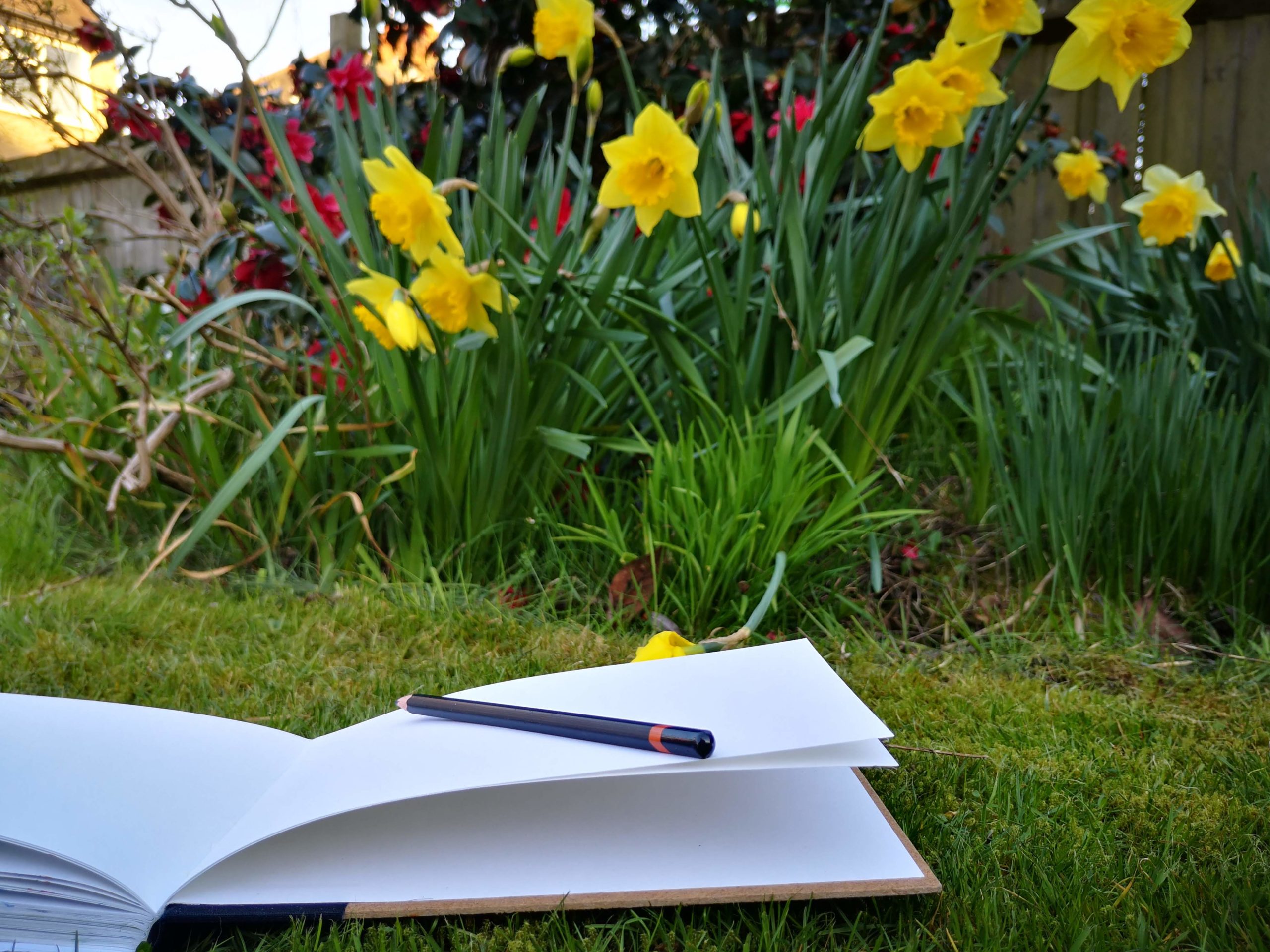
If you have access to a garden- use it. If it’s warm enough, paint in it. Do you have a view you can paint, or plants you can observe? If not ensure you take breaks in your outdoor space for fresh air at regular intervals (every hour or so) – taking a little walk if you can, to stop you staying in one fixed position for prolonged periods of time (if you don’t have an outdoor space make sure you walk around the space you do have once an hour, for circulation and a healthy mind). If you are going to paint with oils inside you might like to set up a brush washing station outside – it doesn’t have to be elaborate, just a bottle of solvent and a bucket with a lid and a rag to blot rinsed brushes on.
Indoors
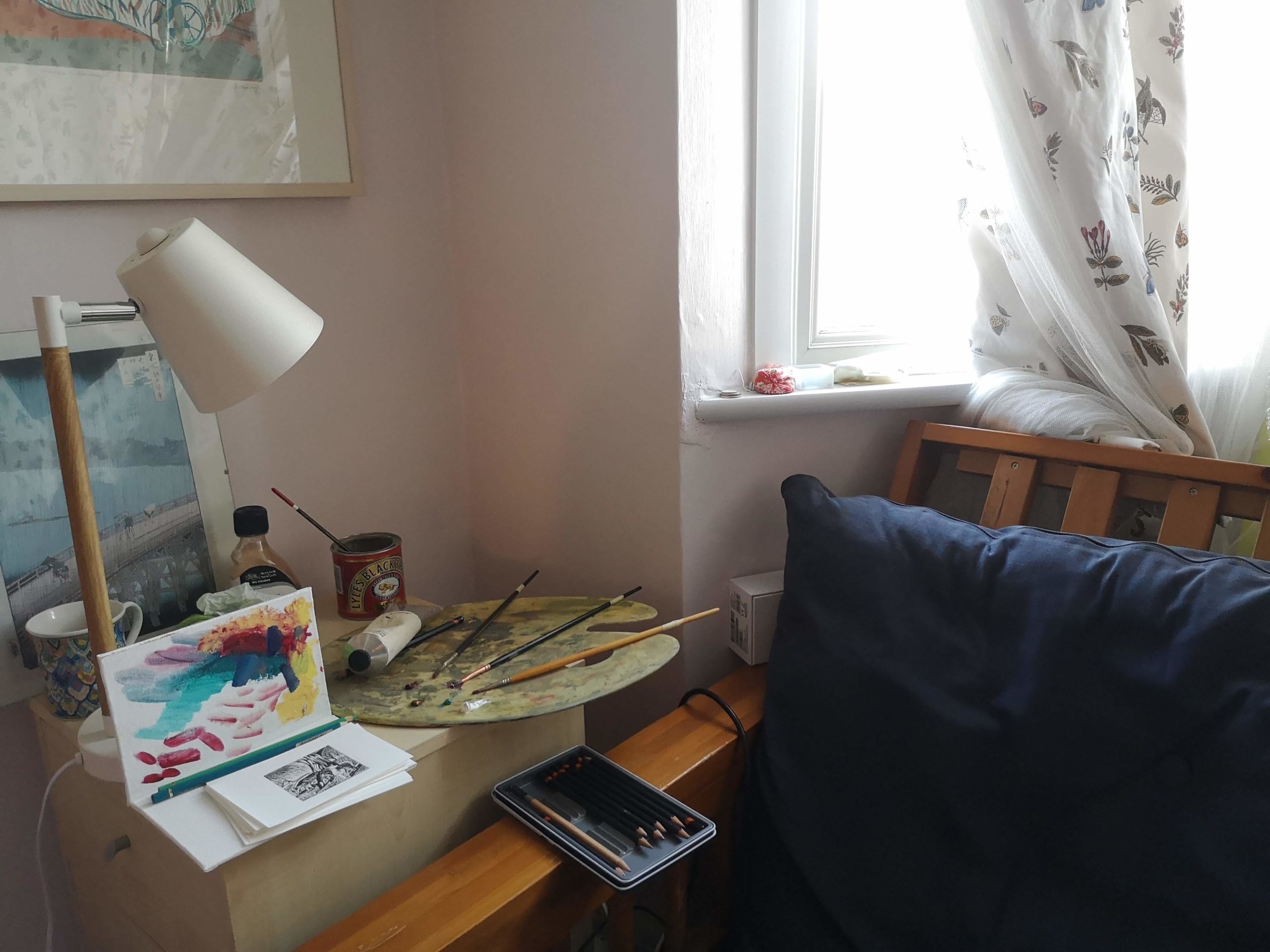
Set your space up by a window if possible, if not at least an electric light source. If you can be near both – even better! That way you can work into the night if you want to.
Clear your intended space entirely. Try to take a flexible approach to your space. You might find it useful to put all the stuff you usually have on your chosen surface in a box or carrier bag, and then another separate box/bag for your art stuff, so you can quickly change from one to the other as and when you need/want to. My art space is going to be my bedside table! It’s tiny but it’s by a wall, and a window, and a light…so in a lot of ways, it’s ideal.
2. Materials
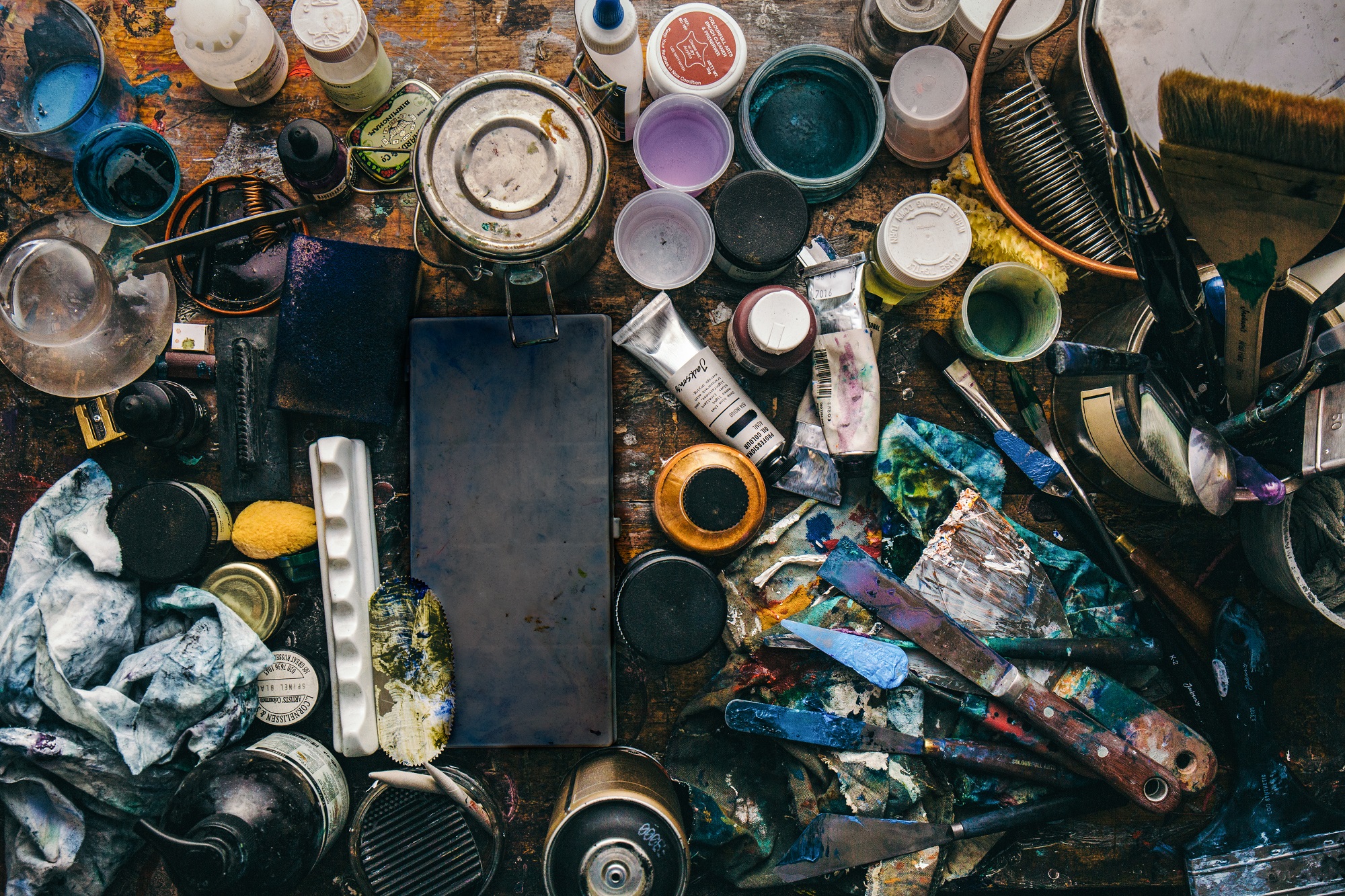
At the time of writing, all but essential shopping is prohibited, but the upside is you probably have everything you need to engage with your creativity, in the home, already. The key to creative success during this time is to think laterally about what you have access to and what you can do with it.
Now is not the time to think about permanency and light-fastness as your highest priority. The work you make during self-isolation is about pure creativity. It might take the form of art-as-catharsis, expressing anger and frustration. It might be about developing observational skills. It might be about engaging with a mindful process. Try not to worry about whether it will last for hundreds of years – your state of mind is more important.
Being Resourceful
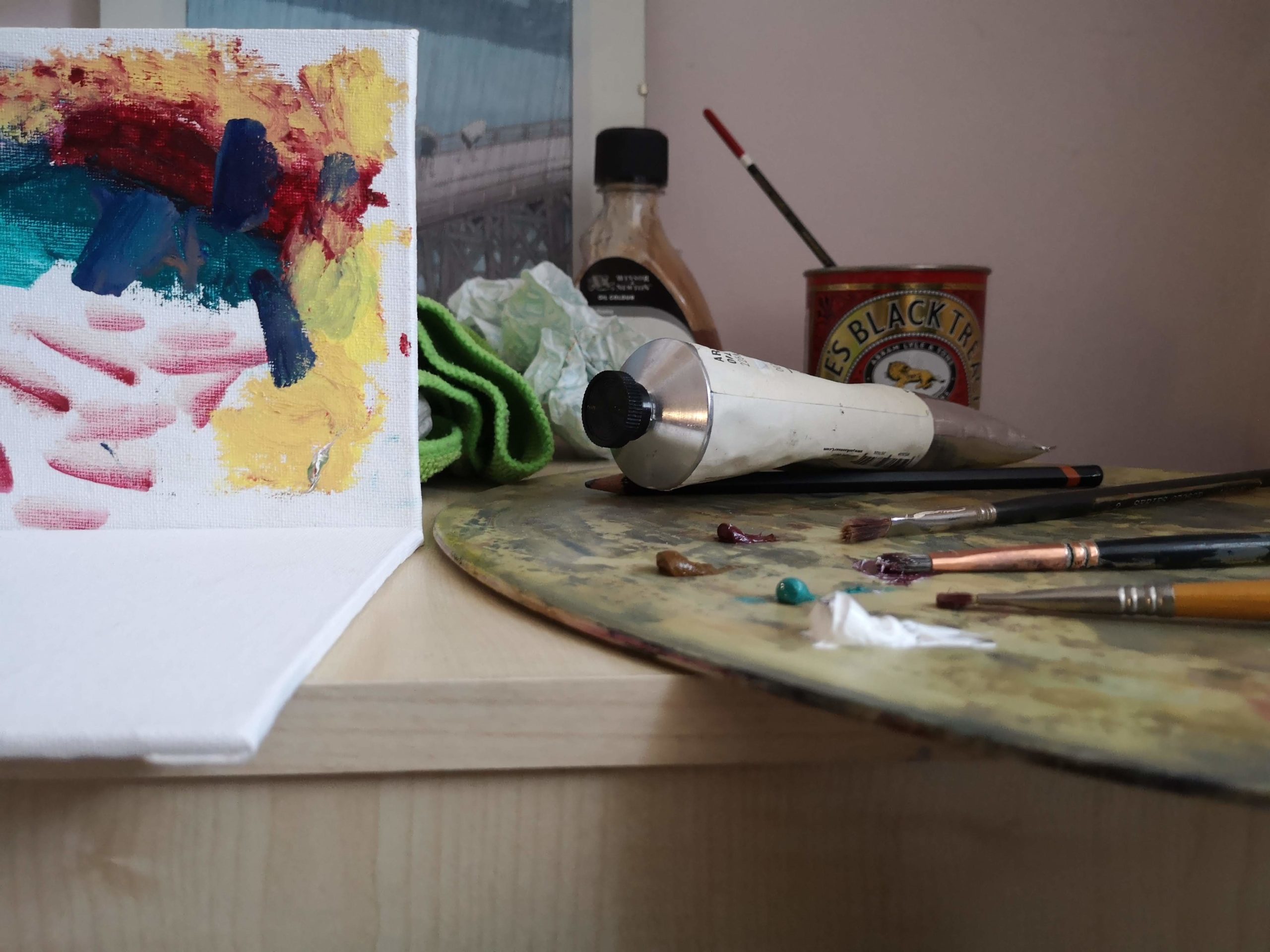
You may need to take your creativity into uncharted territory if you don’t have the materials you usually work with. Maybe now’s the time to try collage with paper you find around the house and in your recycling. There’s value in drawing with a biro on the margin of a newspaper. Picasso used to add his own characters on magazine photos – and now they’re in an exhibition at the Royal Academy (which will reopen eventually!) Maybe you have excess house paints…check whether they’re oil or water based and use them as you would use your artist paints. There are ways around this and if the materials you pick up don’t behave how you expect them to then put it down to experience and try something else. Often the disposability of found materials can help serve to free up creativity. This has potential to be a significantly creatively nourishing time.
Advice for artist materials in the house
If you are lucky enough to have materials in the house, here’s some thoughts about safe and practical use within the home.

Drawing – Gather all your pencils, pens, markers and crayons (whatever you like to use) and have them all in one place. Scour the house for what you might have squirrelled away. Separate out the materials by medium and keep them grouped – perhaps separate them using pencil cases or old ice-cream or take-away boxes. Ask yourself what else you’ll need – a bin for sharpenings, kitchen roll for blotting, a putty eraser, and of course some paper or card to draw on. Once you have everything gathered think strategically about where to place it in your art space – what do you need quick and easy access to, what’s less important, how will you avoid tripping over while working, are all electric wires from lamps and radios out of harm’s way? It could be worth laying everything out on a bit of cardboard or scrap paper so that leaks and smudges don’t happen on surfaces that you want to keep clean. Think practically first, get everything laid out, and then start drawing. It really will help you immerse yourself in your drawing and achieve a bit of flow.

Oil painting – It’s strongly advised to use oil paints in a ventilated space. However, solvent is not absolutely essential to the oil painting process; you can even clean oil painting brushes without solvents if you really need to. If you are oil painting in your living space I suggest working with neat oil paint with a little fast drying medium (although this does contain some solvent, so if you have respiratory issues, steer clear) or linseed oil if you wish to, and no solvent. Blot your brushes on a rag or kitchen paper in the absence of rinsing. When you need to properly clean, loosen paint in the brush hairs with vegetable oil and finish by washing with soap and warm water. You can paint with oils on any acrylic primed or oil primed canvas/card/panel, or if you don’t mind impermanency and an absorbent surface that you may need to throw away eventually, paper or card. Cover surfaces you wish to protect with a plastic sheet, and keep plenty of rags to hand. Finished wet paintings could replace dry paintings on the wall as a good drying place, out of harm’s way. Or alternatively bookshelves lined with paper or the shed are favourite places of mine to carefully place paintings to dry.

Acrylic painting – It’s a good idea to paint in a ventilated space. Again, cover surfaces you wish to protect with a plastic sheet, keep a damp rag close by to help lift off paint if it gets anywhere it shouldn’t. You can paint with acrylic paints on practically any surface – paper, canvas or card. Try to blot brushes rather than rinse to minimise the amount of acrylic going in to the water supply afterwards.

Watercolour painting – arguably the easiest medium to work with at home. Easy to wash off surfaces and relatively safe to handle. Rediscover that old watercolour set that’s sat neglected in the corner of your bedroom! They can also be combined very easily with drawing media, especially watercolour pencils.
Whatever your materials…Try to keep organised. Group related materials together where you can. If you have a piece of wood lying about consider attaching hooks to it (or pins in a corkboard could also work)….then, attach bulldog clips to the ends of your tubes of paint and hang to the board – it will make it easier to find the colours you want and the bulldog clip also doubles up as tube squeezer.

Good working posture is important, whether working on a computer, drawing or painting. Head, shoulders, and hips should be in alignment, whether sitting or standing for prolonged periods of time.
3. Posture
Try and stand when possible as sitting for long periods of time can be bad for circulation, and make you feel a little stale. Use masking tape to fix sheets or paper or card, or unstretched canvas to a wall to draw on if you don’t have an easel. If you’re worried about getting paint on your wall fix a bigger sheet (some lining paper would be perfect) – newspaper or anything that has print on it is not a good idea as it may smudge. If you need to sit, keep a straight back and make sure you are not over-reaching to paint. Remember to have a little walk around the room and stretch every hour at least.
4. Subject Matter
If you’re stuck for what to paint or draw…try not to think of your creative session as a grand gesture. Don’t set any expectations for the outcome of your creative session. Be open to drawing or painting from intuition. If emotions are running high, use your art as a form of mindfulness, or an outlet for your frustration. Remember too that painting from photos is not a crime! See if you have any photos on your phone that inspire you. Or consider setting up a still life arrangement. If life drawing is what you miss most, there’s plenty of resources online that you can draw from.
Shops may be closed, but you can still place orders at jacksonsart.com and deliveries are still being made, albeit with a little delay. Please visit https://www.jacksonsart.com/covid19-update for the latest updates.


50 thoughts on “Bringing Creativity Home: Setting up an Art Studio during Coronavirus Lockdown”
I have my own studio, its the fourth / little
bedroom possibly 10 x 5 feet massive for
one person painting, I paint oils, i have
watercolur, and sketching kit too. I have a
desk, laptop and printer one end and art
the other, two chairs too. I find time in
here relaxing creative. Do you know,
yesterday I did my first watercolour
painting for fouty years, getting ready for
out doors in the summer.
Dear Tim
That’s wonderful to hear! Great to hear some positivity during this challenging time. Please keep painting!
Best wishes
Lisa
Hi Lisa Great Idea for home studios in lockdown 3 ! Be so nice to see pics of all the home studios -if peeps like to send in and/or you can share
Thanks for an excellent idea Tracy! We’ll work on something along these lines, stay tuned!
Best wishes
Lisa
Do you have a picture of it ?
Dear Jacksons
Do you sell or obtain a set of Gouache more
than twelve tubes ?
Dear Richard
Is it traditional, water – based gouache you’re after? If yes we have these that may be of interest:
(14 pans)
https://www.jacksonsart.com/caran-d-ache-studio-gouache-set-of-14-pans-10ml-white
48 set of watercolour/gouache hybrid:
https://www.jacksonsart.com/shin-han-pass-watercolour-and-gouache-hybrid-set-48-20ml-tubes
24 set
https://www.jacksonsart.com/reeves-gouache-10ml-set-of-24
Or if it’s acrylic gouache you’re after, do take a look at the results on this link:
https://www.jacksonsart.com/search/?q=acrylic+gouache+set
Many thanks
Lisa
Excellent suggestion regarding the
setting up of a home studio in these
grim times. Set .one up yesterday and it
is really quite cosy.
That’s great to hear Steve. Hope you enjoy your creative time in the weeks ahead, and beyond!
Best wishes,
Lisa
Great ideas, thank you. Really
appreciate this during our isolation.
Thanks so much for reading, be safe and creative!
I am lucky enough to have a studio space at
home but I read your article and thought it
really encouraging.
Thank you Val!
As for subjects to draw/paint, Margaret Allton, who teaches the painting group I go to, says that you have a ready made subject with you at all times, i.e. your disengaged hand! A pair of old shoes is also usually to hand and if you are self isolating, what abut your feet? That should keep you occupied for a while.
Dear Terry,
Thanks for your suggestions – absolutely brilliant! Hands are notoriously difficult so should keep most of us suitably challenged throughout our time at home!
Feet too! I love the idea of shoes as well…will have to get the box of paints and brushes out later.
Very many thanks
Lisa
I found the suggestions for setting up a home studio ver
comprehensive. I do have an art space set up in a bedroom but
need to be more disciplined in not getting too many things out and
spreading them around too much, which makes it a long winded
job leaving the room as I would like to find it next session. A
useful addition for dim days is a daylight lamp to render colours
more truly
Hi Penny,
Yes, it’s easy to get lots of materials out and then feel a bit low when you have to put them all away again! If you have room to keep everything on a drawing board that you can put on top of the table you’re using, and then move it as and when you need to, it can speed things up. Or gather some good storage boxes, or ‘bags for life’ That are designated places to keep materials, so you can quickly put them away. Also, you may do this already, but getting into the habit of keeping all lids on paints and boxes during the session so you don’t have to spend too long looking for wayward lids after you’ve finished painting can be good practice!
Many thanks
Lisa
Thank you so much for your inspiration
Lisa. I’m about to do a 5-day challenge of
a 20-minute painting each day. Large
brush or palette knife, small surface – and
go! Any subject will do.
Dear Ann
That sounds like a fantastic idea. Please let us know if we can see any of your work online.
Best wishes
Lisa
The virus is human-to-human, there are
absolutely zero reasons to disinfect your
hands when you sit alone in your chair all
day. It won’t fall from the ceiling, some
human or bat should spit on your chair.
And no need to disinfect items you
purchased, let them alone for some hours.
Dear Mimi,
Thank you for your comments. I admit I am not a scientist, however, my understanding is that the virus can survive on surfaces such as metal and plastic. I have seen varying reports with regards how long for. My suggestion is for those who wish to reduce risk as much as possible, who may be co-habiting with others who are still going out for essential shopping etc who may pick up the virus unwittingly. As someone who lives with a relative who falls into the ‘at-risk’ category, I see no harm in taking precaution. The risk I wish to remove is if someone carrying the virus (perhaps without realising) handles a product before you buy it having touched their mouth, therefore passing the virus to the surface; there would then be a possibility that you could handle the same infected surface and unwittingly touch your mouth/nose afterwards, therefore exposing yourself to the possibility of infection. Everyone is entitled to take the level of precaution that they consider sensible, of course!
Many thanks
Lisa
Such good points, well made. And
courteously. Thank you.
Thank you Pru!
I have a little art/craft room with cupboards, shelves and an L-
shaped desk which has a computer and 2 work spaces. My
watercolour materials are easy to keep in order but I have a LOT
of craft items and I find it difficult to organise these easily and
they creep into my watercolour space…..
Hi Helen,
I can relate! I think craft items tend to be more disparate and harder to organise. If there’s a way of sitting down and thinking of ways to categorise the materials you have and group accordingly (if you get really into it you could make a note/map/index of where everything is stored to minimise the amount of rummaging required!) That said, a good rummage, may lead to a little chaos, but also often leads to using unexpected materials, which can often be a good thing!
Keep on creating!
Best wishes
Lisa
Yes better safe than sorry. I do
antibacterialise everything that
comes through the door, why take a
chance when even the package it
comes in that could be cardboard is
capable of carrying the virus for
24hrs as I heard on BBC from a
microbiologist. It doesnt take a
second to do. Then wash your hands
and away you go to create!
Couldn’t agree more, Val. Thank you for your comment.
Best wishes
Lisa
Hello, I would like to know when
all this isolation is over, is there
anyone who will be available for
art lessons? And how to contact
them. I would like to gain more
skill in my artwork. Kind regards.
Dear Rob,
Thanks for your comment. it would be worth searching ‘art lessons near me’ in Google and seeing what comes up – you may find an art society or artist in your locality who would be able to provide lessons.
Many thanks
Lisa
You could also look at YouTube for any art
tips/lessons on a medium you’re interested
in and if you take to one of the lessons quite
often these days they’re teaching in further
depth on ‘Patreon’ and will show a link. I
discovered someone that way and then saw
an excellent blog on here from them also.
Good luck and most of all, enjoy
Hi,
The problem I have with painting at this
time of year is that natural light is
limited. Can anyone recommend a free
standing lamp that can mimic natural
light as much as possible? Nothing more
frustrating than finding myself battling
against the sun going down and finding
your colours changing as a result.
Hi James,
Daylight lighting bulbs are designed to mimic natural light. Jackson’s sells the bulbs on their own – https://www.jacksonsart.com/search/?q=daylight+bulb
And we also offer a free standing light – https://www.jacksonsart.com/daylight-lighting-artist-studio-lamp-stand-18w-brushed-chrome – although this is out of stock for a couple of weeks presently.
Sometimes the glare from electric light can pose a problem (much like the glare from sunlight!!) This can be reduced with a light diffuser, such as a milky acrylic sheet, which are available to buy online for a few £s.
Hope this helps.
Best wishes
Lisa
Lovely article!
Unfortunately I don’t have a lot of space
at all. Last lockdown I was painting
canvases on my lap, hardly practical at
all but I’m planning to move my front
room around a little (now the decs are
gone) so I’ll have space for a little table
and a small easel.
I just bought a little vegetable storage
thingy on wheels which organise all my
different paints by medium and I’ve
saved jam jars for my brushes and
palette knives ☺️
That sounds great! Hoping you will be pleasantly surprised by how much you can create with what you have available to you. The vegetable storage trolley sounds really useful!
All the best
Lisa
My “studio” is a corner by a north-east
facing window in my husband’s study, with
an old card table covered with oil cloth, a
cheap but comfortable Ikea chair and a
rickety set of plastic drawers on wheels to
hold my art supplies. Two empty jam jars
for water, tubes of watercolours in an old
plastic box, a ceramic mixing palette, a mug
for holding brushes and, instead of an
easel, a plastic chopping board propped on
a strip of wood. Add some good holiday
photos for inspiration, result total bliss!
That sounds fab Pamela! Enjoy your creative space – so important right now.
Best wishes
Lisa
Great article and timely too as I’m just
starting to set up a spaces…. Yes im a
covid painter. Any suggestions for goes
too maintain posture as a watercolour
painter?
Hi Seval,
This video is really good. Although it is primarily for working at a computer the positioning of the body advice would be relevant to those painting sitting down and working at an easel or table – https://www.youtube.com/watch?v=vmQtA__sUlk
Ultimately, you want to organise yourself so that you never need to overstretch, and you are maintaining the 3 natural curves of the body as described in the video. The most important points to check are that you are sat deep into your chair, your easel or watercolour is within comfortable reach so that you are not sloucing over your work, and that your knees are lower than your hips when seated.
Hope this helps.
Best wishes
Lisa
That’s so valuable. Thank you! Pru
This is such a lovely comprehensive read
and exactly what I needed after a long
day at work. I rediscovered my love for
acrylics during the last lockdown and
have recently started doing acrylic pours
which is a messy but very freeing way of
making art. Will definitely be taking the
advice of utilising and incorporating
everyday objects that are around me on
during this lockdown. 🙂
That’s so good to hear Sumi, wishing you the best with your creativity. I think there’s a lot to the said for making art where the process feels liberating, and enjoyable, in these times.
Very pleased this has been re-issued. Full of
sensible advice and helps all of us in
practical ways. For of us who are of a certain
age, the advice on posture and getting up
and walking around is an important
reminder. As complement these these
exercises which you can do at home are
useful. https://www.youtube.com/watch?
v=b2DYU7ZQgN0 To engage in warm ups,
seated or standing, and use the exercises for
shoulders, wrists and hand all help all artist.
It is important to keep good circulation
going as standing still or sitting for long
persiods can create problems.
Hi Ian
Thank you so much for this, really useful and important!
All the best
Lisa
Wonderful, it is so good to switch off from
the daily problems and immerse oneself in
colour and shape. I’m trying oils for the first
time and have a room where I can leave it all
out, so fortunate.
That’s really fortunate! Enjoy your space and your creativity, so important right now I think.
Best wishes
Lisa
Daughter moved out….I moved in. Did not need an extra
spare bedroom so the whole space is mine. The only
downside is my tendency to hoard and keep anything that
‘might come in useful’. That includes photos, magazines,
books (150 ish mainly from charity shops), cuttings as well
as ‘ bargains’ picked at art fairs over the years. I reckon I
could set up my own art shop!
I am the same with hoarding! You never know when these things will come in handy.
Enjoy your studio!
Best wishes
Lisa
Trying to send a picture of my vast and
well ordered studio. I have started
painting more since the first lockdown,
I squatted a local bus stop and turned it
into Chichester’s only Abandoned Art
space.
Please do send a picture of that. I
have so much art stuff but it’s not
well-ordered! I could use some
inspiration.
That idea about setting up a brush cleaning
station outside is brilliant. Don’t know why I
never thought of it for my balcony.,
Comments are closed.