We are drawn to flame like moths by our innate survival instincts – but we are mesmerised by fire far beyond its simple ability to light our way, cook our meals, or warm our bodies. The ember embodies the spark of new life, and the inferno the destruction of another, with ideas on communication, foolishness and power found in between. The Art Through Symbols series explores the interpretation of symbols throughout art history – be they cultural, religious, folkloric, or personal. Each article analyses a series of artworks before detailing an art-making tutorial inspired by the symbol for you to try.
Art Through Symbols: Fire
Interpreting Fire

Gerrit van Honthorst
Oil on canvas, 75.5 x 64.5 cm | 29.7 x 25.4 in
Art Institute of Chicago
“A great fire burns within me, but no one stops to warm themselves at it, and passers-by only see a wisp of smoke.” – Vincent Van Gogh
The elemental force of fire can be essential for our survival, but it is also one of the greatest threats to it. From a purely aesthetic perspective, the dramatic lighting conditions brought by flame in a darkened room have inspired countless artists to render in chiaroscuro. The motif of a single candle carries a more romantic, calming, or reflective feeling than the jovial heat of a campfire or the violence of a wildfire.
Control is key to how we visually interpret fire. But fire isn’t always shown in human hands. From the rebirth of the phoenix, rising from the ashes anew, to the fiery maw of the demons in a hellmouth, myth and religion are intrinsically linked to fire due to its natural power, making its interpretations universally understood. There are Gods that personify fire from practically all global cultures, underlining that fire is fundamentally a brilliant force that we cherish and respect with caution, by our very nature.
Fire in Art History
Birth and Enlightenment
The Ancient Greeks believed that fire was a gift stolen from Olympus for humankind by the Titan Prometheus, marking the beginning of civilisation. Prometheus created the first human by sculpting him from mud in the image of the Gods, before life was breathed into him by Athena. Despite their appearance, Zeus didn’t wish for humans to have any godly traits – like flight or immortality – to help them thrive on Earth, hoping to keep them as keen but inferior worshippers. Prometheus was upset that his creation wouldn’t be treated better than this. Zeus tasked him with teaching humans how to offer tributes and sacrifices, and to hand over all the best quality things.
Prometheus tricked Zeus by dividing a sacrificed bull into two piles, one with the valuable meat and useful hide, obscured by its organs, and the other with the bones and gristle, covered by the fat. Zeus rejected the organ pile and took the fatty pile, only to later discover he had been cheated of the valuable parts of the animal.
In revenge, Zeus vowed that humans should never use fire on Earth, for cooking, warmth, or light. Prometheus was enraged by the cruelty of keeping the people cold and vulnerable, so he climbed Mount Olympus to steal fire from the forge of the Gods and brought it to the humans. His gift of flame allowed humanity to develop and civilisation to begin. Zeus punished Prometheus for his indignation by chaining him to a rock for eternity, where an eagle – the symbol of Zeus – would eat his liver every day, before regenerating it through the night, in an endless cycle.
In this engraving from Goltzius’ workshop, we see an amalgamation of this myth in one scene, where the newly created man is handed the heavenly fire. They are surrounded by the creatures of the Earth and overlooked by the Gods from above, amongst churning clouds. In this work, the fire represents birth, enlightenment, and knowledge. Or the spark to begin the ultimate fire – the progress of humanity.
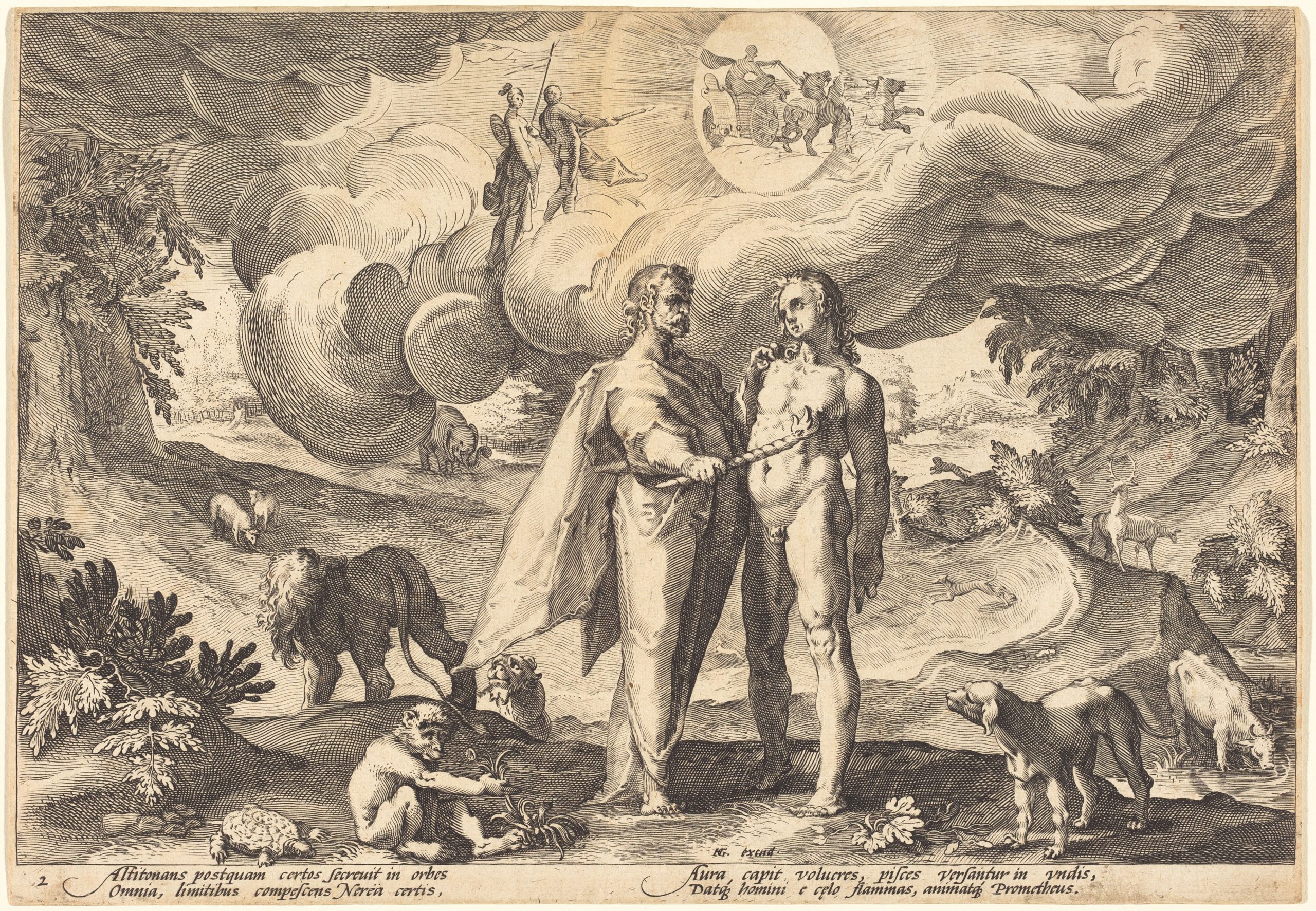
Workshop of Hendrick Goltzius
Engraving on laid paper, 17.5 x 25.1 cm | 6.9 x 9.9 in
National Gallery of Art
Safety and Sustenance
Fire also represents a primal survival drive in us, since we have relied on its warmth, light, and cooking utility for centuries. The safety and comfort of building a fire in the wilderness is a much riffed-upon subject in the arts. The brevity of Van Gogh’s brushstrokes to emulate the fire in his painting Peasant Woman Cooking by a Fireplace makes the painting crackle with the movement of the pan. We can practically feel the warmth of the yellow flame, spreading through the whole room, by the green hue that dominates the palette.

Vincent van Gogh
Oil on canvas, 44.1 x 38.1 cm | 17.4 x 15 inches
The Metropolitan Museum of Art
Camp Fire is an observational painting by Winslow Homer from one of his trips into the land, where he would hunt, fish, and walk to gather artistic inspiration. Here, he enjoys the warmth of the fire with two fishermen, alongside their makeshift shelter. The glowing light in the painting comes from the broad tonal range, concentrated on the glow of the flames, with the shadowy, mostly obscured surroundings. I especially enjoy how the sparks from the flames have been painted in careful, thin lines, floating into the air.

Winslow Homer
Oil on canvas, 60.3 x 96.8 cm | 23.7 x 38.1 in
The Metropolitan Museum of Art
Destruction
Aside from being warmed and safely lit by fire, we also fear it for its destructive power. There are innumerable artworks of fire enveloping buildings and lighting dark skies, partially to record the history or tragedy of each incident. But also because it makes for an arresting image. The Burning of the Mansion House, Queen Square, Bristol, is a brilliant watercolour and gouache study of the consequences of the Bristol Riots in 1831, painted from the artist’s first-hand observation. In this work, we see arson committed on the Mayor’s office, with fire billowing out into the sky, creating thick ash and intensely bright light. The complementary combination of blue and orange draws us into the scene with the gathered crowd.

William James Müller
Watercolour with gouache on paper, 16.8 x 24.4 cm | 6.6 x 9.6 in
The Metropolitan Museum of Art
Punishment and Purification
Painters have rendered the fiery pits of hell for centuries, striking fear in the hearts of the viewer to compel them to walk a holier path. The flames represent incredible suffering and the purification that will happen through it. The image of people trapped in the flaming landscape, or pulled into a burning Hellmouth creature, proliferated throughout European art history. Perhaps the most inventive in their cast of demonic characters are those by Hieronymous Bosch. In the painting Christ’s Descent into Hell by one of Bosch’s followers, we see a disturbing and barren landscape lit by distant fires, plunged into chaos by the demons herding people in. Christ himself rescues some of these souls from their fiery fate, illuminated in a cave amongst the darkness.

Follower of Hieronymous Bosch
Oil on wood, 53.3 x 116.8 cm | 21 x 46 in
The Metropolitan Museum of Art
Fire’s association with punishment also moves beyond Christian art. In Kiyomori’s Visit to Nunobiki Waterfall: The Ghost of Yoshihira Taking Revenge on Nanba, we see the ghost of the warrior Yoshihira coming back from the dead to attack his murderer, Nanba, with lightning and flames. The powerful blast through which he leaps is also ringed with fire, with the heat of the orange contrasting beautifully with the shadowy blue environment. In this work, the fire is used as a device for powerful vengeance. The ghost and his elemental power are an unstoppable force.

Utagawa Yoshifusa
Woodblock prints on paper, 36.8 x 24.8 cm | 14.5 x 9.8 in
The Metropolitan Museum of Art
Communication
Fire may also represent communication, with examples like Moses in the Bible receiving a message from God through a burning bush, the history of smoke signals, and Agni, the Hindu god of fire, delivering messages through it. In Landscape with Moses and the Burning Bush, the Baroque painter Domenichino depicts a tranquil landscape, suddenly interrupted by the ferocity of the burning bush. The positioning of the trees directs our gaze upwards to the Heavens, pointed to by the raging fire.

Domenichino Zampieri
Oil on copper, 45.1 x 34 cm | 17.8 x 13.4 in
The Metropolitan Museum of Art
Domination and Fear
The Panchatantra is a book of ancient Indian animal fables that became popular across the Middle East for its tales and visual fusion of artistic influences. According to the book, the owls are the great enemies of the crows. After an owl was chosen as the king of the birds, the crows protested by saying he was too ugly and harsh, and that they already had a king. The other birds were all convinced and left, leaving behind the owl, who slept through all of the drama because he was nocturnal. He awoke to his coronation being cancelled, and the crows and owls have feuded ever since.
In this jarring escalation of the conflict, The Crows Trap the Owls in Their Cave by Lighting a Fire at the Entrance and Fanning it with Their Wings, we see the owls defeated by the crows through the power of fire. Despite their avian limitations, the fire gives the crows a destructive advantage, making it a symbol to be feared regardless of the user’s capabilities.

Attributed to India, Gujarat
Ink and watercolour on paper, 31.8 x 22.6 cm | 12.5 x 8.9 in
The Metropolitan Museum of Art
Fire as a symbol for fear is captured more subtly in The Smoking Fire by Giovanni Battista Piranesi, which is part of his famous Carceri d’Invenzione (Imaginary Prisons) series of etchings. He conjured up labyrinthine buildings full of archways, staircases, and machinery, that we, as the viewer, are trapped inside of under vaulting ceilings. Piranesi was trained as an architect, and the majority of his works depict real structures like the buildings of Rome. It’s clear that he drew from his font of knowledge to create these surreal structures, designing the spaces like studies of his own mind, which he considered “a source of self-analysis and of creative release”. The Surrealists were later inspired by the series and it directly influenced M.C. Escher’s imagery of endless stairways and impossible buildings.
The Smoking Fire, in particular, induces fear because the fire blusters in front of us in the middle of the composition, although diminutive inside the incredible scale of the building. It is roaring out of a fireplace or grate, but the sense of the uncontrolled elemental power inside a crowded building with people walking below enhances the feeling of being trapped with it, and at the mercy of the prison. Nothing sinister has happened just yet, but there’s an implied sense that it could happen soon.

Giovanni Battista Piranesi
Etching, 53.6 x 39.8 cm | 21.1 x 15.7 in
National Gallery of Art
Foolishness
And His House Catches Fire is one print of Goya’s Caprichos series, criticising the drunkenness of esparto (grass) weavers. He neglects his oil lamp on his woven chair, which catches aflame whilst he can barely take off his trousers. In this work, the fire is a symbol for the consequences of stupidity, left in the wrong hands. The placidity of his expression and stillness of the otherwise bare room give the work a sinister edge.

Francisco Goya
Etching with aquatint, 21.4 x 15.1 cm | 8.4 x 5.9 in
The Metropolitan Museum of Art
Fire – Art Prompt
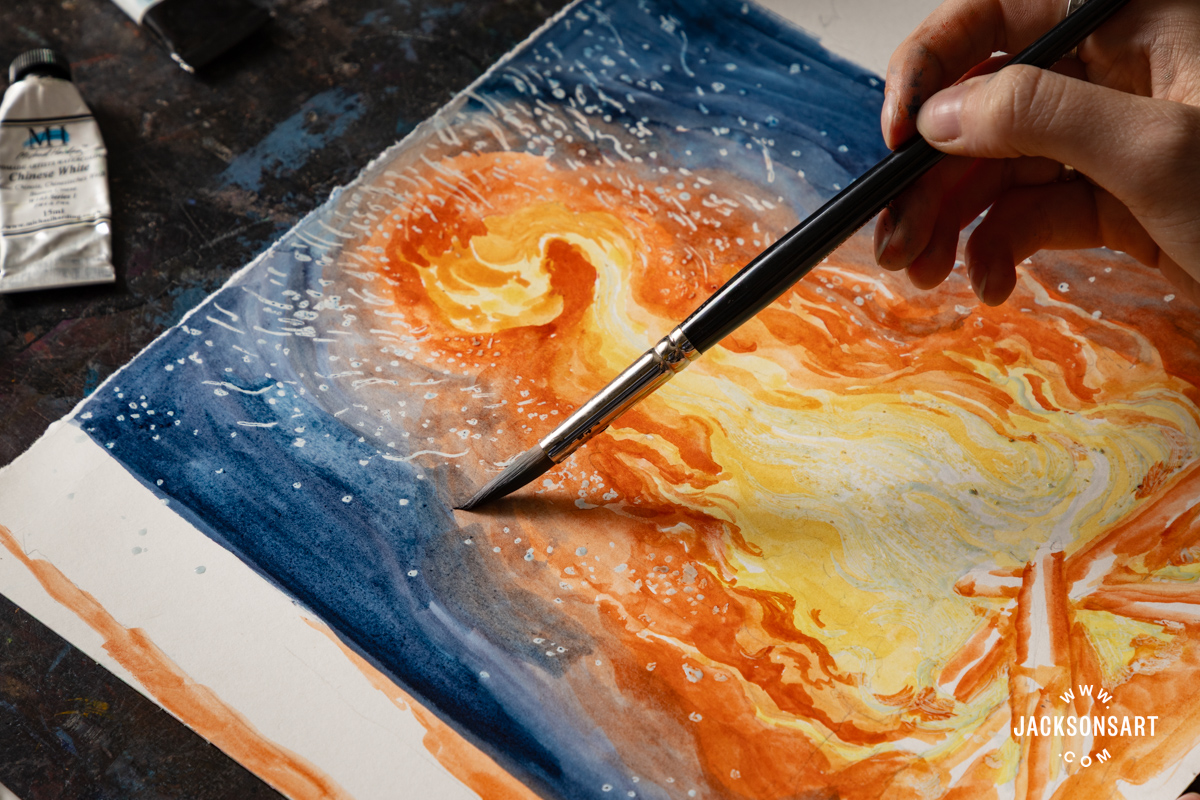
I was inspired by the rendering of fire in watercolour and gouache in The Burning of the Mansion House, as well as the delicate details of the drifting embers in Camp Fire by Winslow Homer. For this art prompt, we’ll create a watercolour and gouache painting of a campfire, using masking fluid to resist the fine details.
For this art prompt, you’ll need:
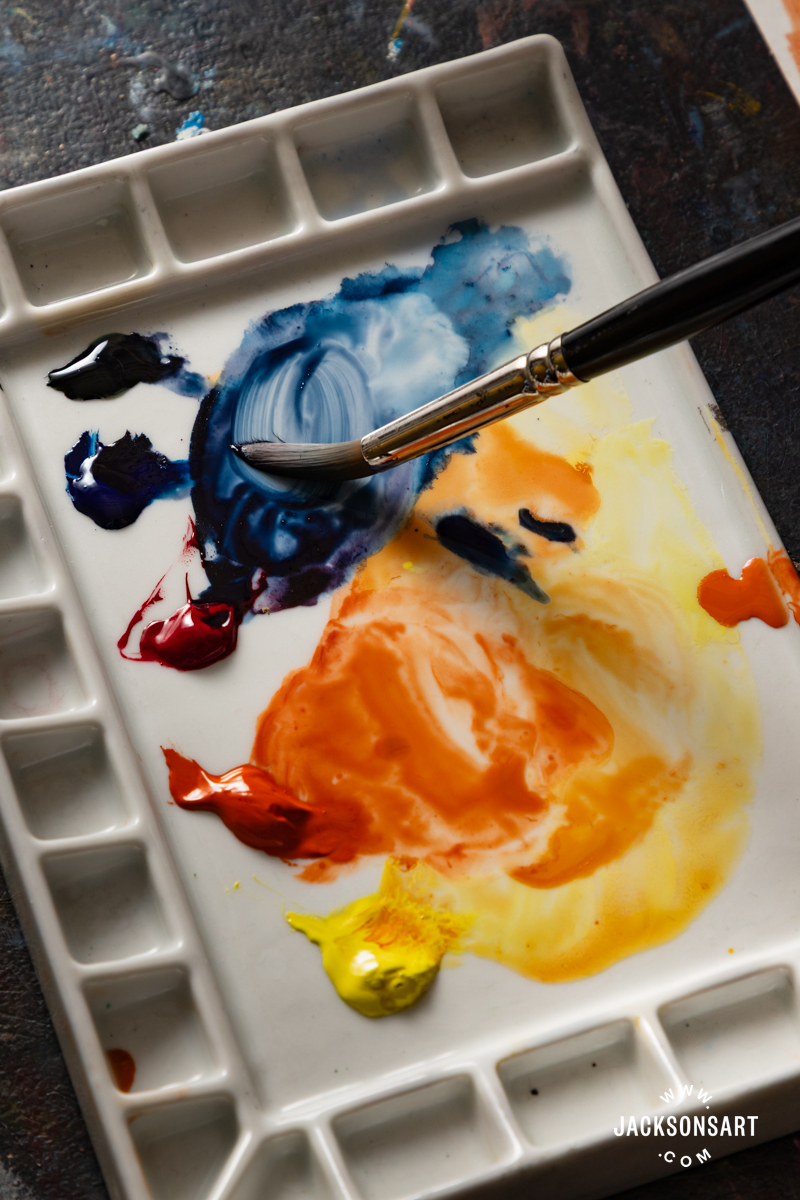
Daniel Smith Extra Fine Watercolours in Nickel Titanate Yellow, Permanent Alizarin Crimson, and Earthy Light Red
Michael Harding Artists Watercolour Paint in Phthalocyanine Blue Lake and Ivory Black
Jackson’s Watercolour Paper Block Hot Pressed
Jackson’s Studio Synthetic Watercolour Brushes

I began my watercolour by lightly sketching the placement of my campfire on the watercolour paper, with a B pencil.

Next, I applied the masking fluid with a couple of synthetic brushes – taking care to apply my shapes in curling ablaze shapes, and to pick out lots of tiny dots and lines for the embers drifting into the sky.

Once the masking fluid was touch dry, I began my watercolour by applying a yellow-orange around it.

Next, I layered on a darker orange, working around the glowing centre in layers, getting darker as I moved away from the flame. I picked out the orange glow on the ground around the fire, and the trunks of a couple of trees.

Then I began adding my night sky with a mixture of Phthalocyanine Blue Lake, Ivory Black, and a touch of Permanent Alizarin Crimson. Again, working in a gradient with the darkest areas the furthest from the centre of the flame.

Next, I layered on a line of trees in the background in Ivory Black, silhouetted against the deep blue night sky.

Once the paint was completely dry, I used an eraser to remove the masking fluid. You can also use your fingers to peel off any fiddly bits.

After exposing the white of the paper below the masking fluid, I used the pure Nickel Titanate Yellow to merge the yellow-orange around the edge with the blank paper, leaving just the centre of the flames pure white at their hottest point.

To finish my painting, I applied yellow and orange to the embers around the fire.

Further Reading
Chiaroscuro Techniques for Painting, Drawing and Printmaking
Art Through Symbols: The Skull
Resist Techniques for Painting, Drawing and Printmaking
Shop Art Materials on jacksonsart.com