



Demons and monsters emerge throughout art history in a wide assortment of guises, from mischievous to horrifying. Looking back through time and across cultures, terrifying, monstrous, and uncanny beings have crouched in the background of human culture from the very beginning, making the demonic and monstrous closely tied to the human experience. These beings can symbolise elemental forces of the environment, but often represent something much more inward – our most primal fears and reflections of our own nature. Demons don’t simply represent evil; when you dig beneath the surface of their depictions in art, we can see meanings ranging from protection and desire to inner emotional states and humour.
The Art Through Symbols series explores the interpretation of symbols throughout art history – whether cultural, religious, folkloric, or personal. Each article analyses a selection of artworks before offering an art-making tutorial inspired by the symbol for you to try.
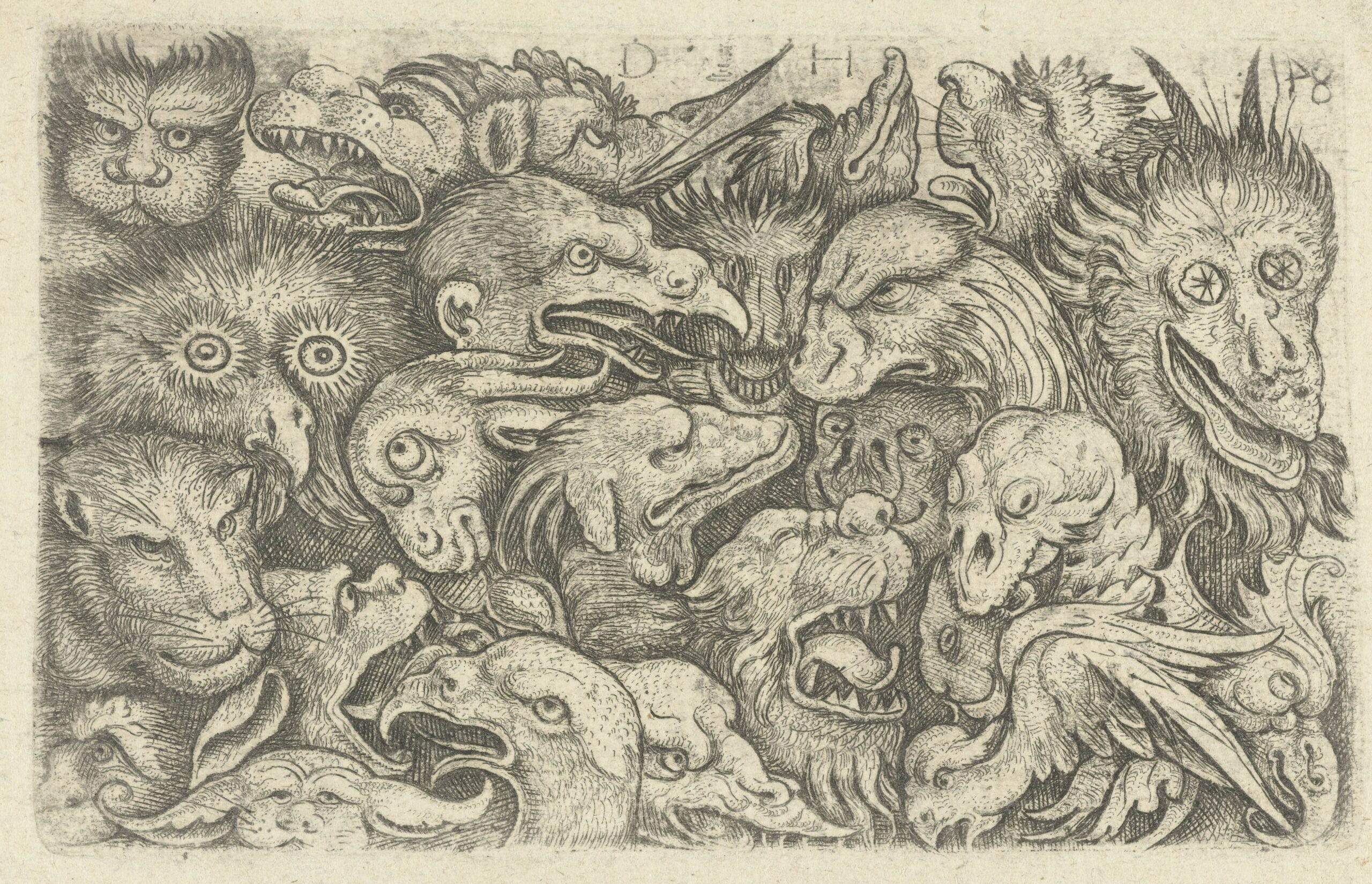
Daniel Hopfer
Etching, 8.5 x 13.5 cm | 3.3 x 5.3 in
Rjksmuseum
Interpreting Demons and Monsters
A demon is often defined as a malevolent or evil supernatural spirit, and a monster is usually defined as a terrifying or fantastical creature. However, both terms cross a multitude of cultural definitions and contexts.
For modern artists living in increasingly secular societies, advancements in technology and science and the resulting social changes have led many away from the idea that malignant spirits exist in reality. However, despite this, demonic and monstrous beings remain major symbols in art. Today, we commonly use phrases like ‘inner demons’ to describe our dark, unattended emotions. Modern artists often use the motif of demons to dig into themes surrounding the human psyche, disintegrating values and social change, and personal struggle. From the bizarre creatures depicted in the works of Surrealists Max Ernst, Dorothea Tanning, and Leonora Carrington to the works of Gurminder Sikand and Cecily Brown, the subject has had a hold on artists of the 20th and 21st centuries.
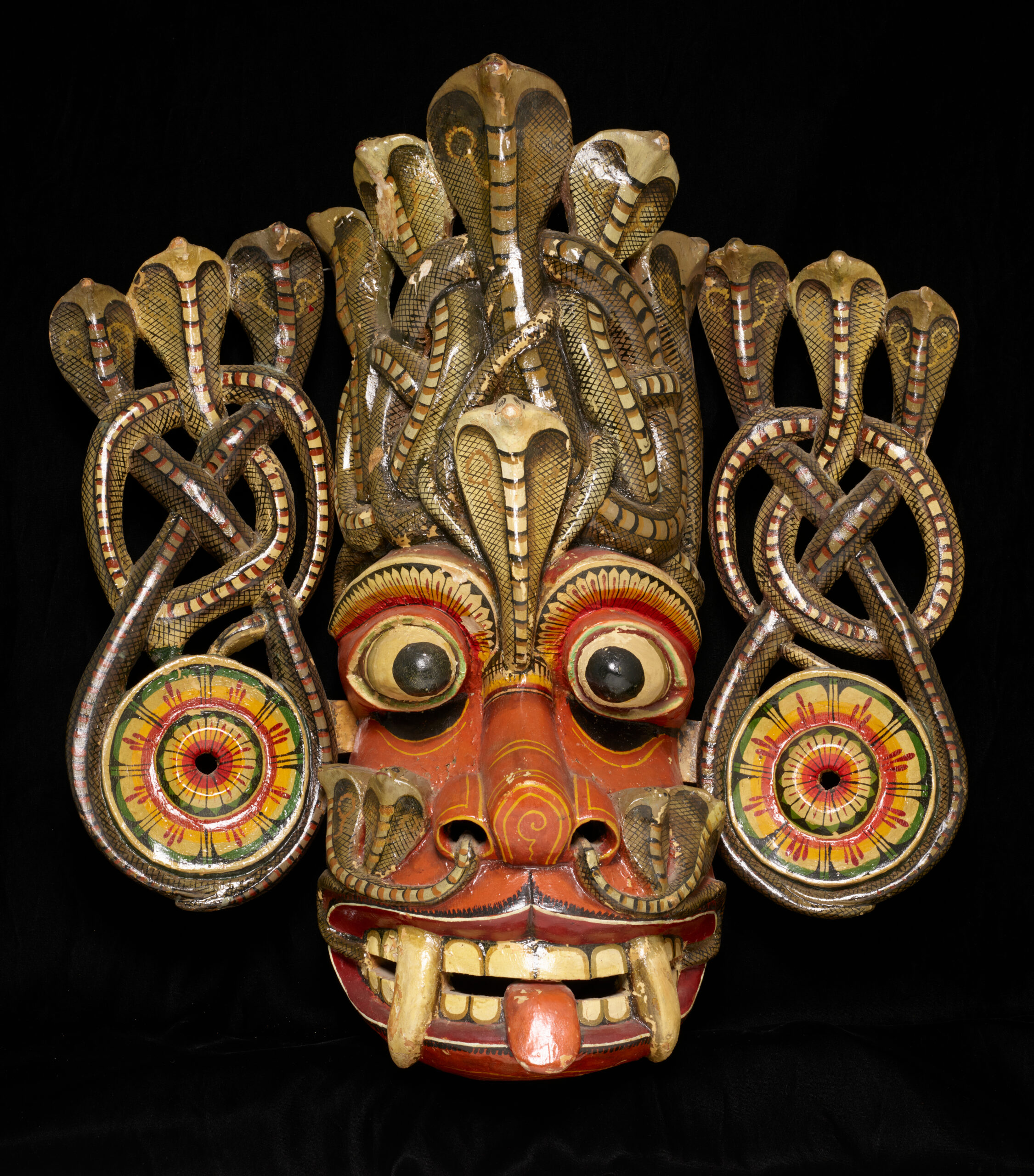
Sri Lanka
Balsa wood, pigments, 66 x 64.8 x 26.7 cm | 26 x 25.5 x 10.5 in
Minneapolis Institute of Art
Throughout history, many cultures have seen demons and monsters as major threats to human life, representations of natural forces, and even sources of protection. In some cases, demons could be invoked as tools to frighten away more sinister powers. This protective ability can be represented in art through ritual objects such as the Raksha masks of Sri Lanka.
In many folkloric traditions, demons are representative of natural elements, enforcing laws outside of the human world. For example, the Sasabonsam of the Akan people of West Africa is a territorial forest demon said to viciously attack those who wander into their arboreal homes. But besides being dangerous, they are also believed to enforce the rules of forest renewal and are a symbol of nature’s cycles.
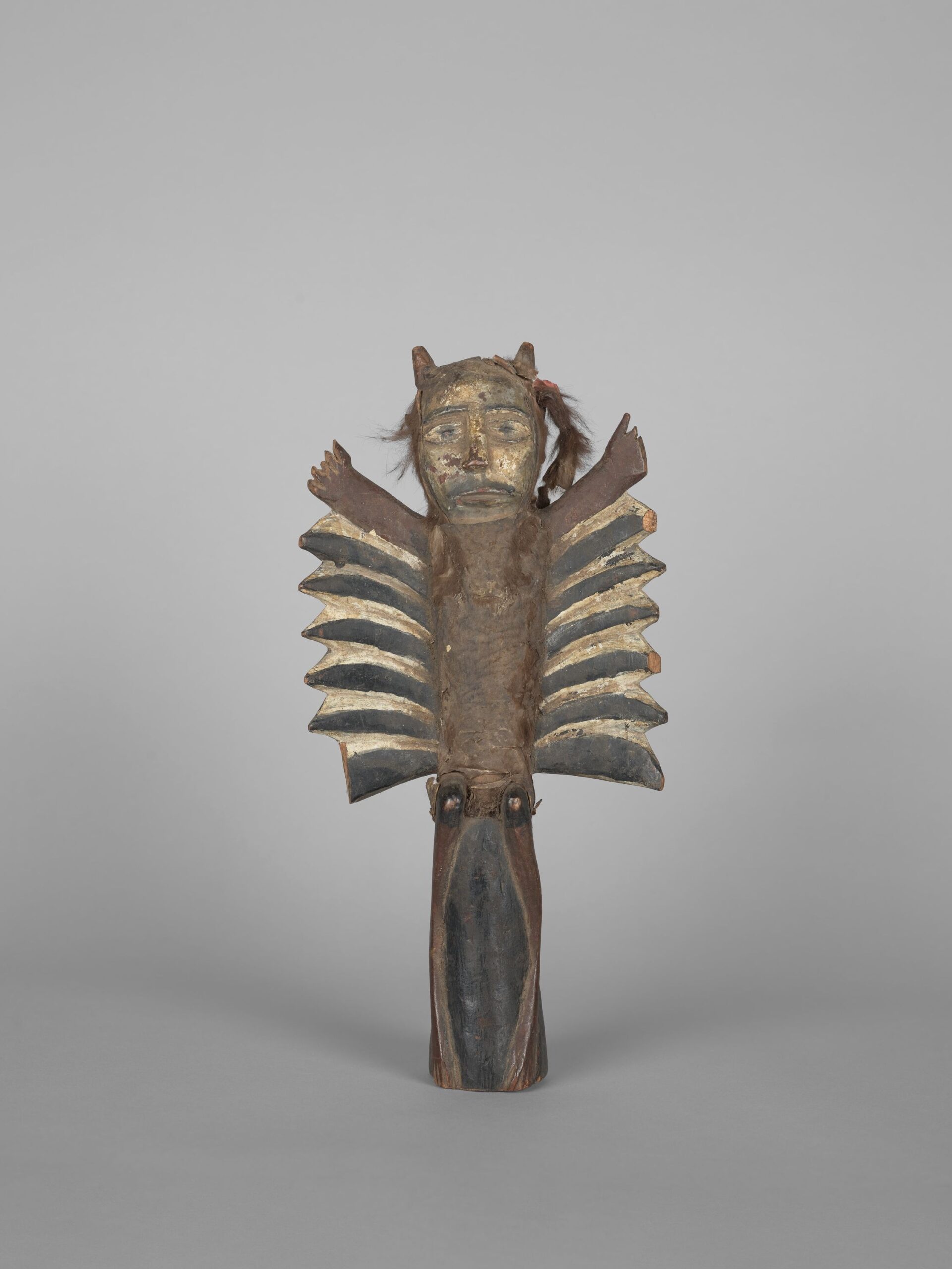
Possibly Asante peoples, Ghana (possibly also Côte d’Ivoire or Mali)
Wood, animal skin and fur, and paint, 41 x 20.3 x 7 cm | 16.1 x 8 x 2.8 in
The Menil Collection
In medieval Europe, demons were seen as part of reality and everyday life. Just as we may see thieves or scammers as genuine threats today, to Christian Europeans of this time, demons were just as problematic to their day-to-day lives – lurking in the shadows, waiting to take advantage of the vulnerable.
With the onset of the European Enlightenment in the 17th and 18th centuries, a major cultural shift happened. As empirical evidence and scientific thinking began to gain more traction, the belief that demonic spirits truly existed and had the ability to cause harm within the physical realm slowly began to evaporate. However, the cultural significance of these beings did not disappear. Instead, they morphed into more abstract meanings.
Throughout the world, demons and monsters have crept into art in many forms – evidence of the importance of these motifs across cultures. Here, I’ll explore just a few examples of the powerful, evil, uncanny, mischievous, and bizarre.
Birth and the Forces of Nature
Tlaltecuhtli is a Mesoamerican deity worshipped by the pre-Columbian Mexica (Aztec) people of central Mexico. She is often referred to as ‘Earth Monster’ or ‘Earth Deity’. Tlaltecuhtli is commonly depicted as a fearsome reptilian or toad-like monster squatting in a pose representative of childbirth. The Mexica believed that Tlaltecuhtli needed to be constantly fed with the blood and hearts of human sacrifices to keep her nourished. And that if she was deprived of these, her hunger would lead to crop failure and devastation, as she was the Earth itself.
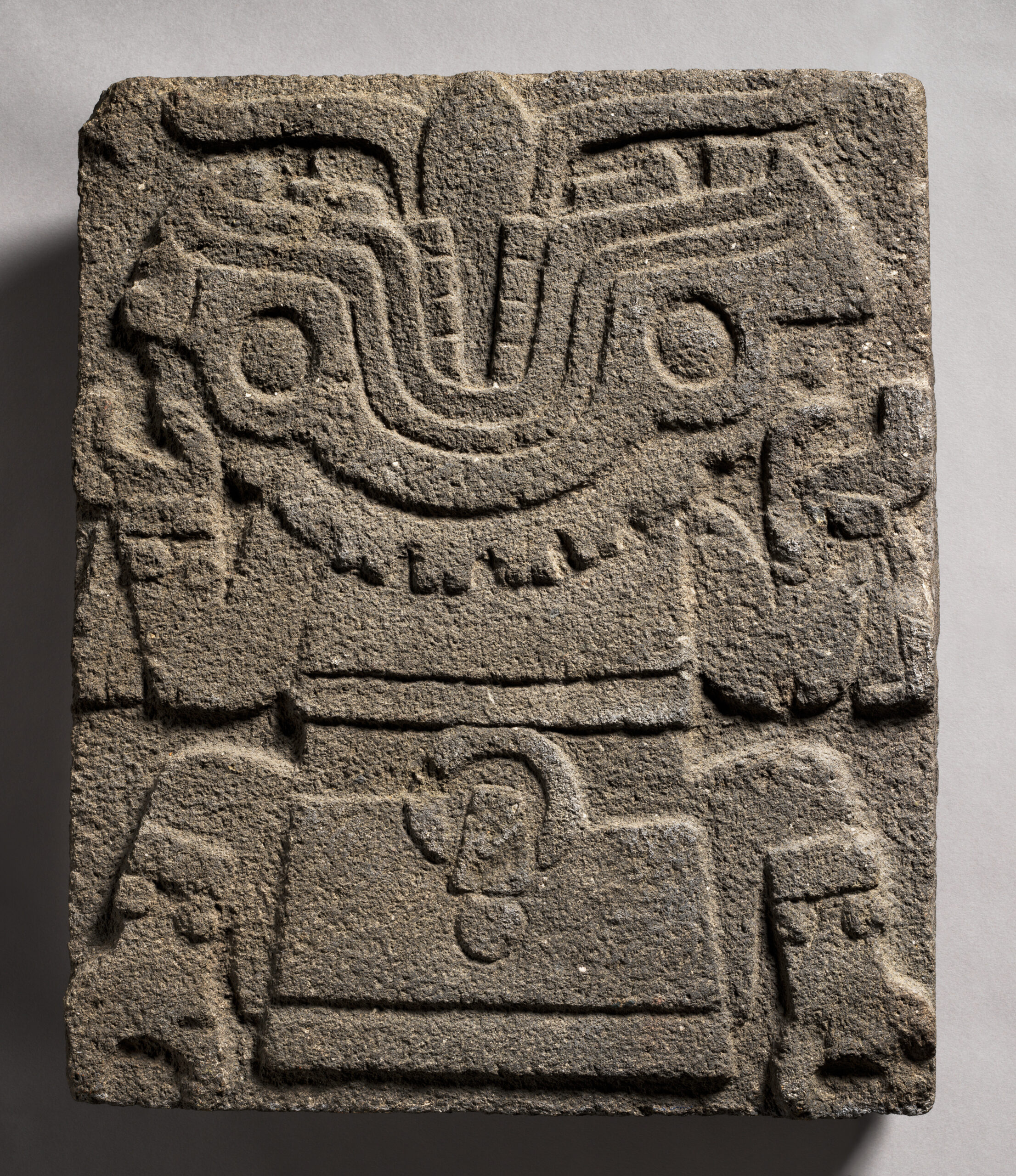
Mexica artist(s), central Mexico
Stone sculpture, 50.8 x 41.9 x 12.7 cm | 20 x 16.5 x 5 in
The Metropolitan Museum of Art
Tlaltecuhtli plays a crucial role in the creation myth of the Mexica people. In one version of the story, the gods Quetzalcoatl and Tezcatlipoca transformed themselves into gargantuan serpents and attacked Tlaltecuhtli, ripping her body into two pieces. The upper half of her body became the sky, and the lower half became the earth, whilst other pieces of her dismembered body became elements of the landscape – mountains, rivers, and plants. In a connected myth, Tlaltecuhtli was believed to swallow the sun god Tonatiuh each night and regurgitate him each morning – creating night and day. In many carvings, her skin is hewn with geometric designs, such as in the example above. The furrows and crevices of her crocodile-like skin are thought to represent the topography of the Earth.
Tlaltecuhtli’s monstrous thirst for human sacrifice is terrifying, but she also symbolises life itself. By connecting this deity to natural cycles, such as birth and death and the cycle of day and night, she becomes a symbol of the eternal power and endurance of Earth’s natural cycles.
Protection
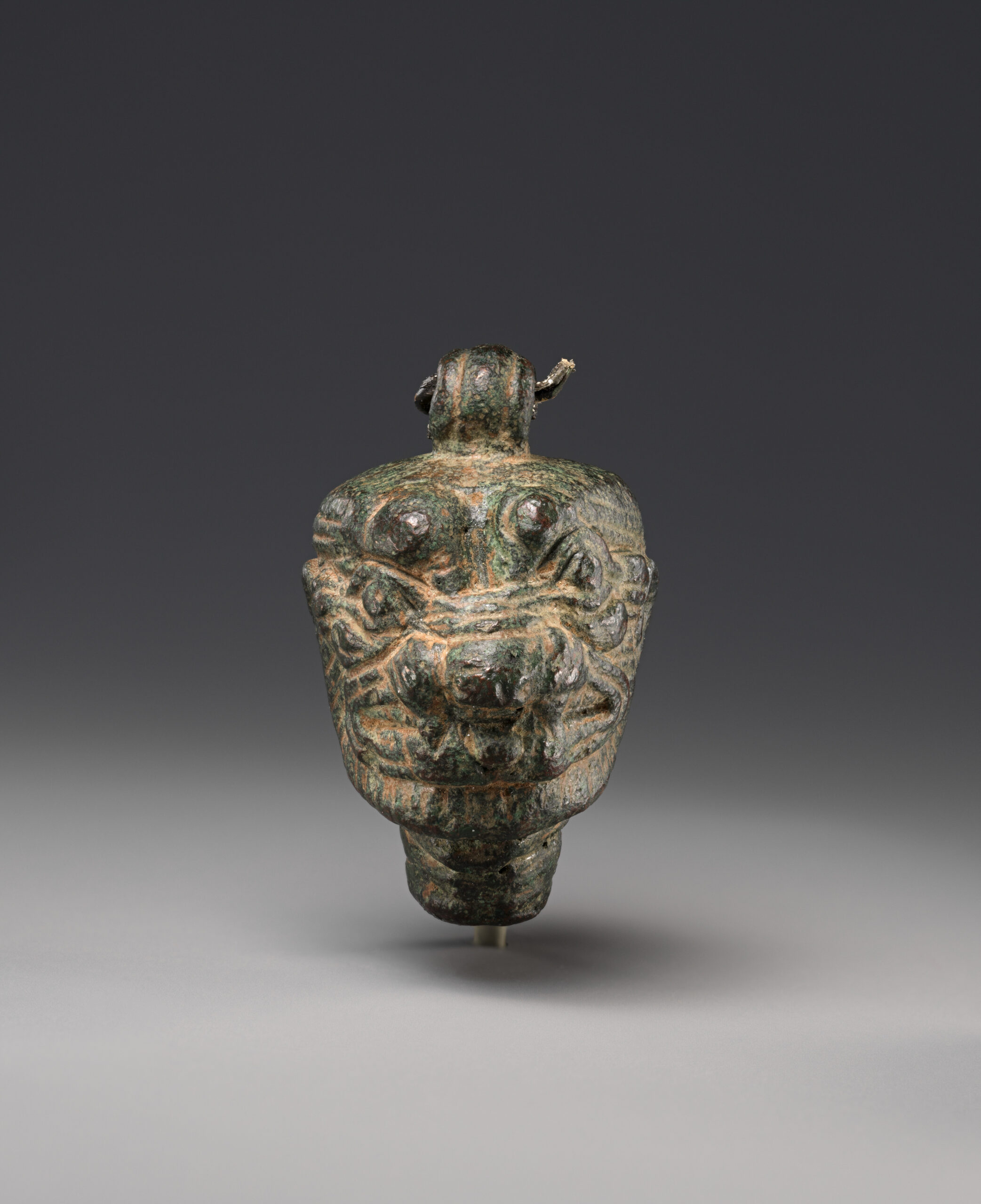
Assyria
Bronze, 4.3 x 2.7 x 2.7 cm | 1.7 x 1 x 1 in
The Metropolitan Museum of Art
Pazuzu is arguably most famous as an ancient spirit of evil that is awakened to possess the 12-year-old Regan MacNeil in the 1973 horror film, The Exorcist. However, the inspiration behind the film’s terrifying demon can be traced back thousands of years to ancient Mesopotamia, where the deity Pazuzu was the king of the evil wind demons. Although Pazuzu was by no means a kind being – he was connected to cold mountain winds thought to bring illness and death – he could also be summoned as a protective spirit. His likeness was often used as a powerful talisman to ward off other, more aggressive, demons like Lamashtu, who was believed to cause miscarriages and child mortality. Therefore, amulets like this menacing bronze pendant from Assyria were often worn by pregnant women and mothers. Depictions of Pazuzu symbolise powerful natural forces and the balance between destruction and protection.
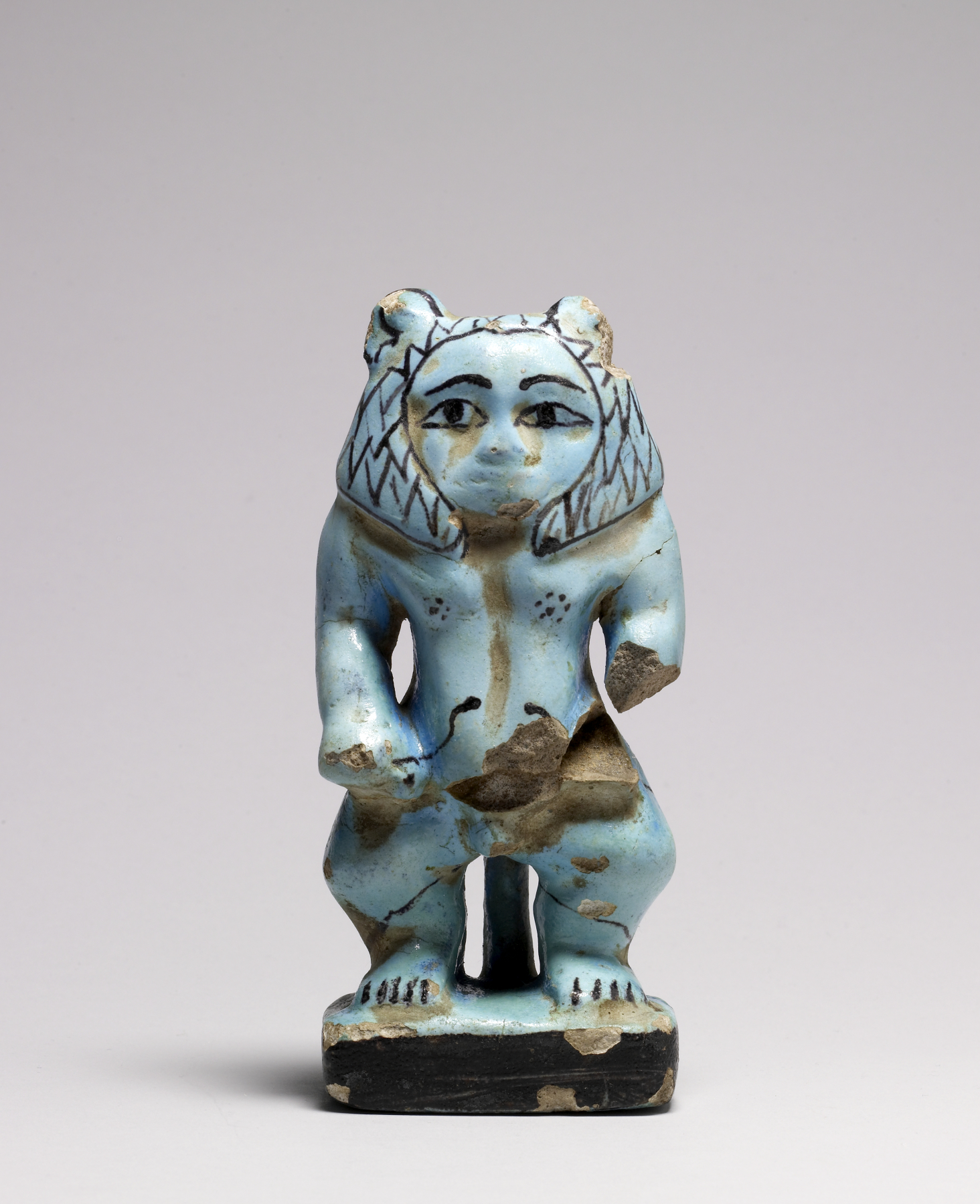
Egyptian
Faience with blue glaze, 17.2 x 7.6 x 4.9 cm | 6.8 x 3 x 2 in
The Walters Art Museum
Another protective demon tied to fertility and domestic guardianship is the Egyptian deity Bes. Bes was venerated as a protector of the home, family, and fertility. In this statuette, a demon resembling Bes is depicted with a placid expression and is holding two snakes – symbolising his ability to ward off the attacks of venomous animals. To the ancient Egyptians, a demon was not necessarily a source of malevolence, but rather a liminal spirit, that whilst existing in a supernatural realm, was seen to have influence in the physical world. The gentle human-like qualities the artist has imbued upon Bes can be interpreted as symbolising the connection between our human experiences and the supernatural world.
The Industriousness of Evil and Conspiracy
Like their ancient Egyptian and Mesopotamian counterparts, demons in medieval Europe were also believed to have a tangible presence in the physical world. The existence of demons was accepted by most of contemporary society, and evil spirits were believed to meddle in day-to-day activities – bringing temptation and torment to the lives of everyday Christians. As a result of this belief, and the tie between the Church and the art world of the time, medieval art boils over with depictions of demons and monsters.
In medieval artwork, Hell is often depicted as a busy workplace, with demonic labourers bustling about doing the bidding of the Devil. This industrious evil is visible in works such as the engraving below, a copy of a 14th-century fresco found in the Camposanto Monumentale in Pisa. Here, Hell is depicted somewhat like an anthill, swarming and productive, where demonic workers busily torture damned souls. The subservience of the demons can be seen to mirror the feudal system of the time. The evil is organised, and demons are serfs to the Devil – symbolising both the belief in a great enterprise of evil and the underlying foundations their society was built upon.
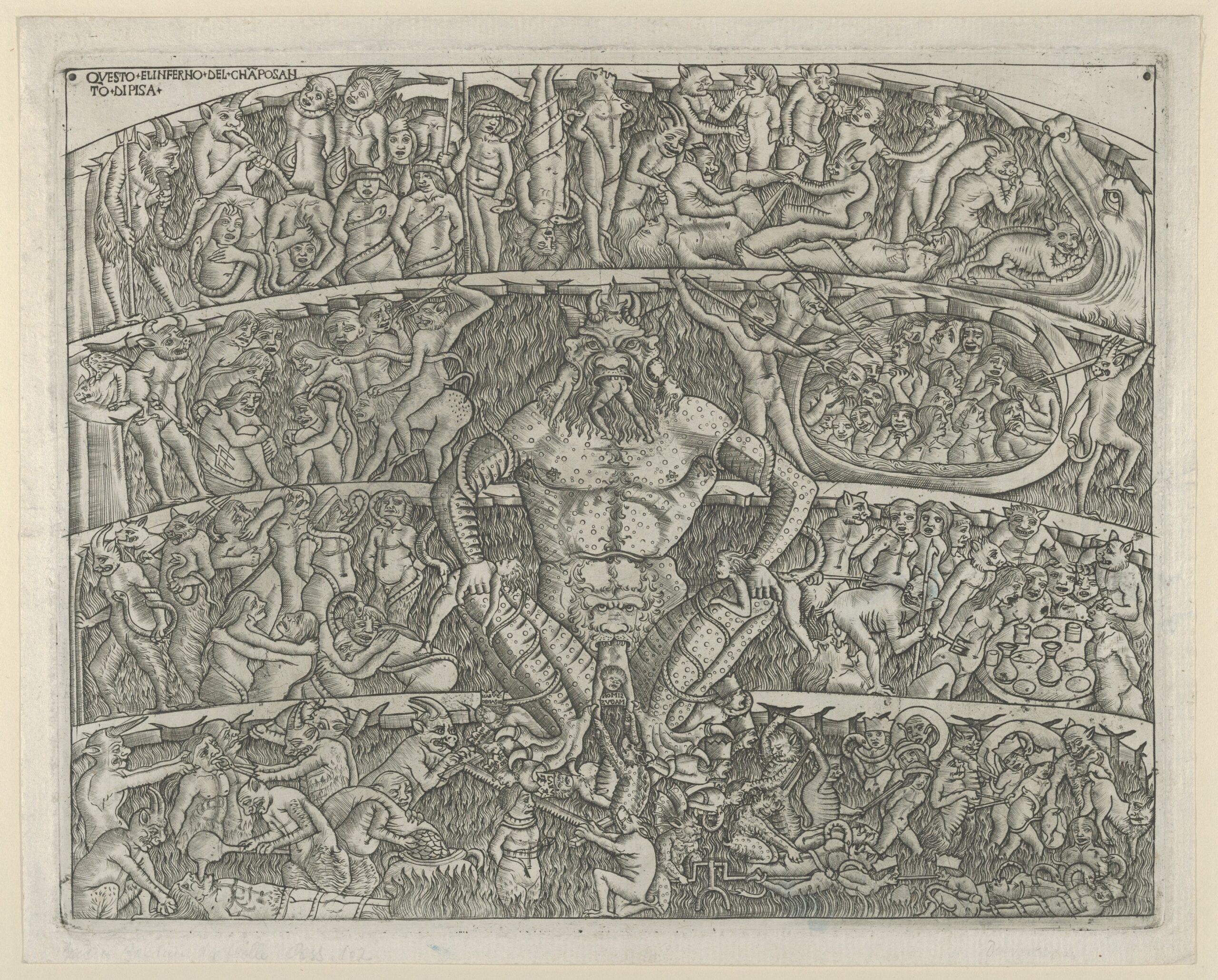
Anonymous artist, Italian, 15th century
Engraving (a later restrike), 24.3 x 30 cm | 9.5 x 11.8 in
The Metropolitan Museum of Art
With the upheaval of the Protestant Reformation and the religious conflict that followed in its wake, a wave of witch hunts washed over Europe, reaching its pinnacle in the 17th century. Across the continent, people, primarily women – many from working-class backgrounds – were accused by neighbours, friends, and relatives of collaborating with the Devil. They were often tortured and executed as a result. During this period, the visual language surrounding witchcraft often involved depictions of women conspiring with their colleagues in the service of Satan. In this nocturnal engraving by Jan van de Velde II, a woman is seen concocting a potion amongst a gang of sinister entities. This piece was created at the apex of witchcraft hysteria, and reflects a societal fear of dark conspiracy. The sense of evil lurking amongst the everyday populace, diligently labouring away in the background, was a prevalent belief throughout much of the early modern period in Europe and is reflected in the art of the time.
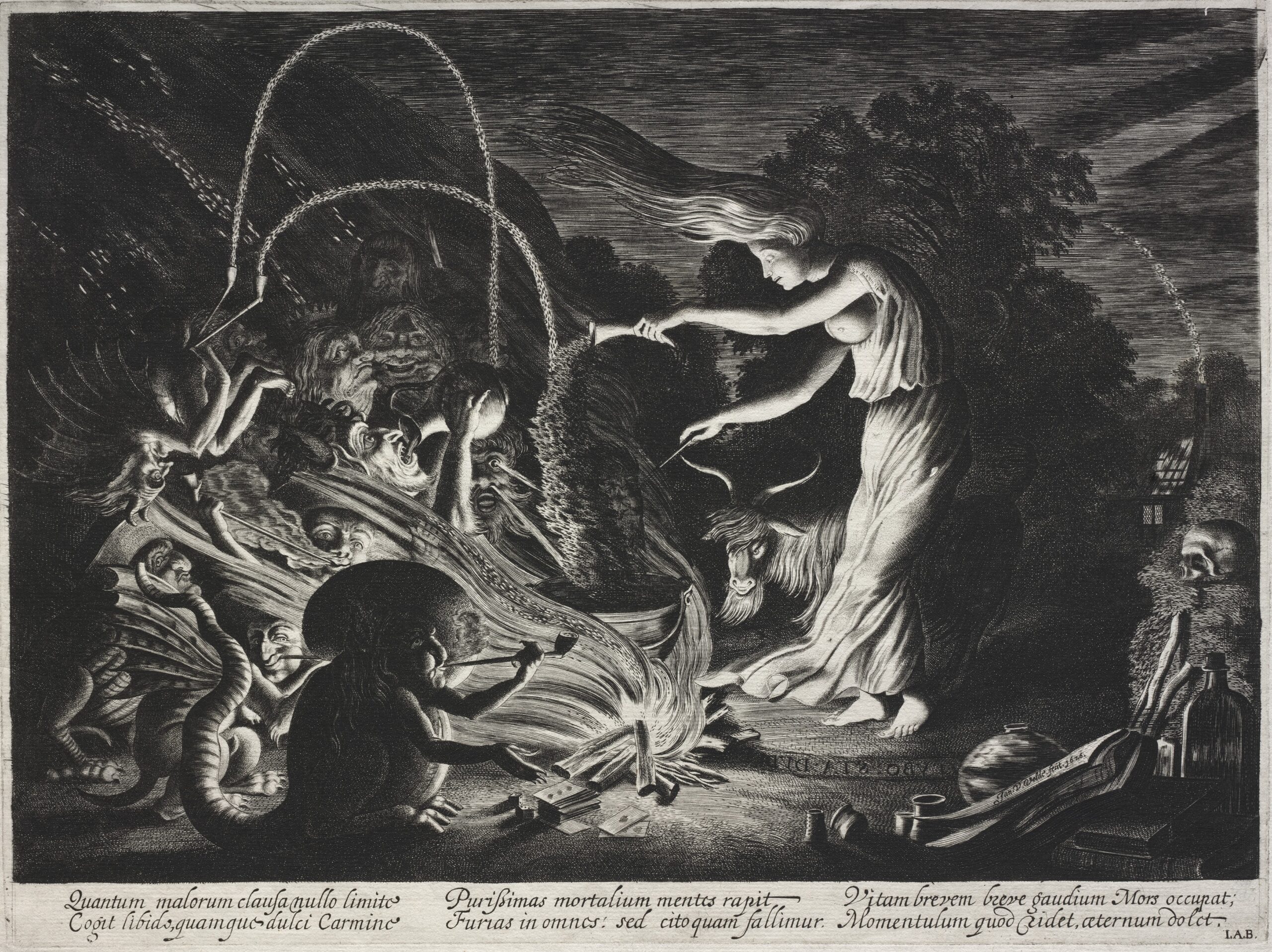
Jan van de Velde II
Engraving, 21.6 x 29 cm | 8.5 x 11.4 in
The Cleveland Museum of Art
Violence, Suffering, and Desire
The Temptation of Saint Anthony is a Christian story that first emerged in the 4th century and later rose to popularity as an artistic subject during the Middle Ages. It tells of Saint Anthony the Great, who abandoned his worldly possessions to take up life as a hermit in the Egyptian desert. During his sojourn into the desert, he is assaulted by hideous demonic creatures and manifestations of his lustful thoughts. The subject has been immensely popular with artists over the centuries, as the tale allows for a great amount of creative liberty and the ability to interpret our basest fears and desires through the use of unbridled imagination. It was particularly popular with artists of the Northern Renaissance, such as Hieronymus Bosch, Pieter Bruegel the Elder, and Martin Schongauer – whose engraving Saint Anthony Tormented by Demons was reproduced by a 12-year-old Michaelangelo in his first known painting.
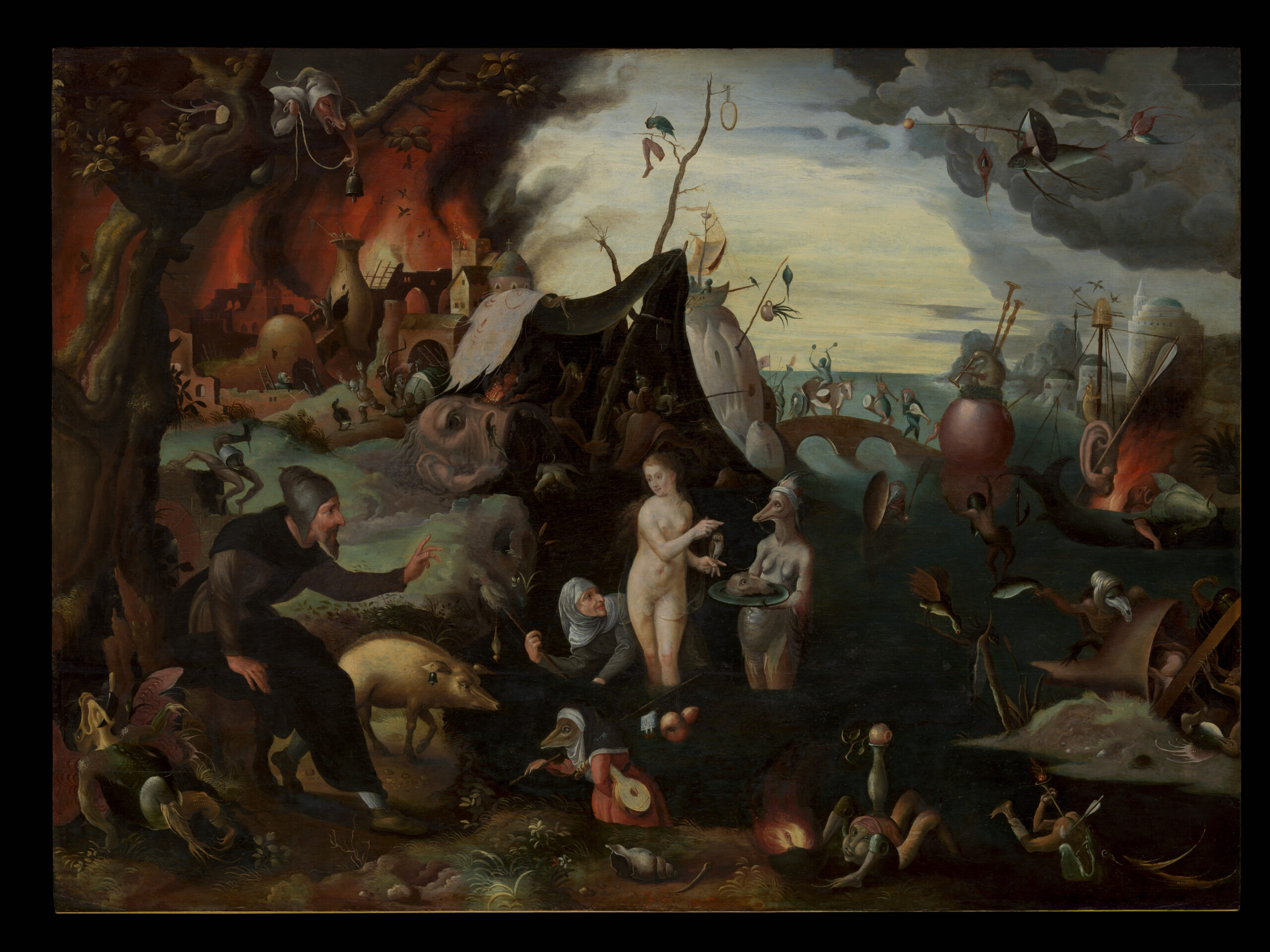
Attributed to Pieter Huys (active 1545–1584)
Oil on oak, 109.2 x 149.9 cm | 43 x 59 in
The Metropolitan Museum of Art
A particularly dynamic interpretation of the subject was painted by German Renaissance artist Matthias Grünewald between 1512 and 1516 as part of his masterpiece, the Isenheim Altarpiece. In it, a violent swarm of hideous demons assaults the elderly saint, who grips his walking stick with one hand, the other defensively raised to protect himself from the onslaught. The monsters snatch at his clothing and hair and attack him with clubs made of sticks and animal bones. A figure in the bottom left is afflicted with a painful skin condition and bloating associated with ergot poisoning, and similar maladies can be seen in many of the figures throughout the altarpiece. The altarpiece was commissioned for a monastery whose Antonite monks cared for those suffering from skin conditions and other illnesses. The demons portrayed here are symbols of worldly suffering and the pain we face in our mortal existence. Grünewald’s work is thought to have been a major influence on Francis Bacon’s triptych Three Studies for Figures at the Base of a Crucifixion, 1944.
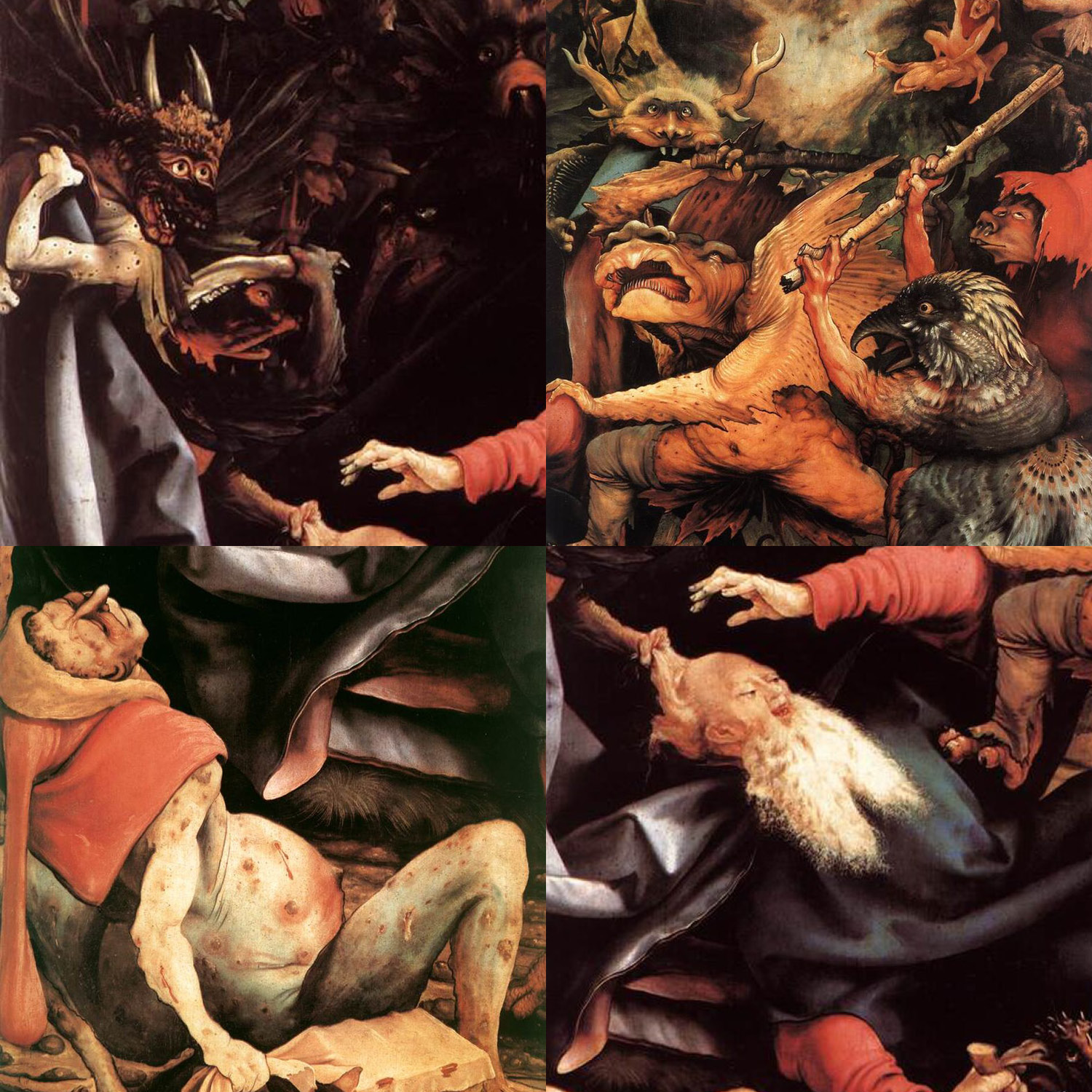
Matthias Grünewald
Oil on limewood panel, 232 x 75 cm each | 91.3 x 29.5 in
Housed at Musée Unterlinden, images: Wikimedia Commons
The Temptation of Saint Anthony provided perfect nightmarish fodder for artists of the 20th century, particularly the Surrealists, who gleaned inspiration from the visionary monsters of Bosch and Grünewald. In 1946, a group of painters, including Surrealists Max Ernst, Leonora Carrington, Salvador Dalí, and Dorothea Tanning, participated in the Bel Ami International Art Competition, where they all depicted their own version of the story. The winner of the competition, Ernst, had his writhing version featured in Albert Lewin’s film The Private Affairs of Bel Ami, loosely based on Guy de Maupassant’s novel Bel-Ami.
Dalí’s version is unmistakably sexualised, as the bodies of nude women are paraded towards a defiant Anthony. Leonora Carrington played on the tale by depicting the tormented saint as the most visually bizarre figure in the composition, in contrast to his tormentors, who could be interpreted as benign, or even peaceful. In earlier artwork depicting the story, sexual and worldly desires, often associated with womanhood, are frequently presented as corruptive and evil. For Carrington and Tanning, the corruptive aspect of desire is subverted. Carrington’s scene is almost peaceful, where it seems the demons of Saint Anthony have organised autonomy rather than the ravenous frenzy many of their depictions take. Tanning’s demons seem collected and confident. Painted in rosy hues, a seductive demon calmly watches on as Saint Anthony’s cloak transforms into a flurry of women’s body parts, seemingly ready to enrobe him in sexuality. Tanning describes her work here:
‘St. Anthony, alone in the desert, struggles against his visions; half-formed, moving in indolent suggestion, colored with the beautiful colors of sex, his desires take shape even in the folds of his own wind-tossed robes.’ – Dorothea Tanning
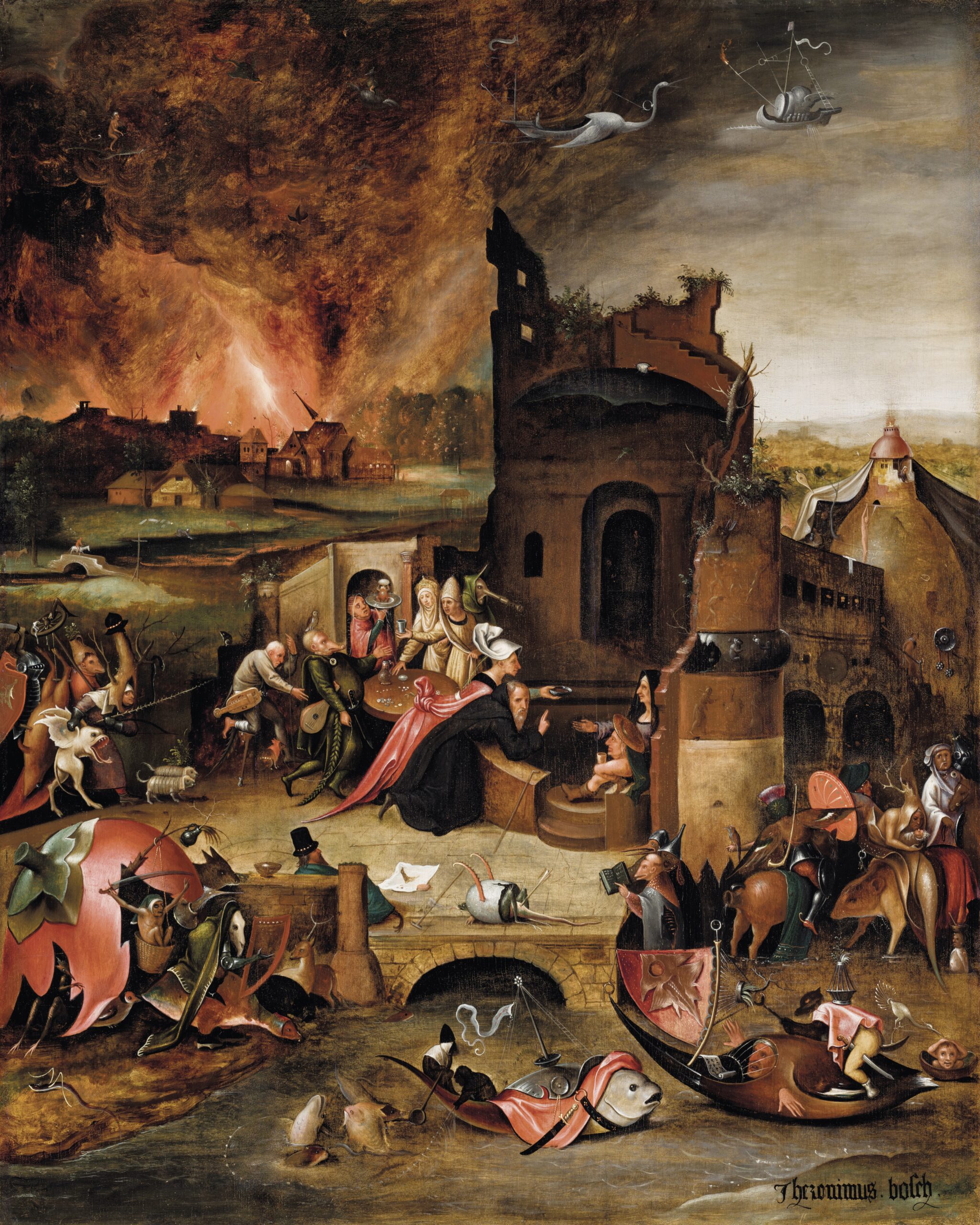
Follower of Hieronymus Bosch, Low Countries
Oil on panel, 88 x 71 cm | 34.6 x 28 in
Royal Museum of Fine Arts Antwerp (KMSKA)
Regardless of the time period, depictions of the Temptation of Saint Anthony can be seen to symbolise the push and pull between our instinctual cravings and how society approaches them, our capacity to deny corruption, and the suffering we face as humans.
Mischief and Humour
Besides commonly reflecting the fears of a particular culture, monsters and demons often play roles in art beyond simply scaring us. They can also be symbols of social and political commentary through humour and playfulness. Many examples also walk a tightrope between horror and comedy – a boundary that often reappears in art and plays on our innate psychology.
Oni are horned demons from Japanese folklore that have appeared in a wide variety of guises over the centuries, ranging from mischievous to terrifying. In this hanging scroll, an oni is depicted masquerading as a Buddhist priest and chanting nembutsu, a mantra recited to the Amida Buddha for the salvation of souls. The impish spirit appears to be enjoying his ruse. This subject was popular in Japan during the Edo period and can be read as simply a comical paradox or as a commentary on religious hypocrisy.
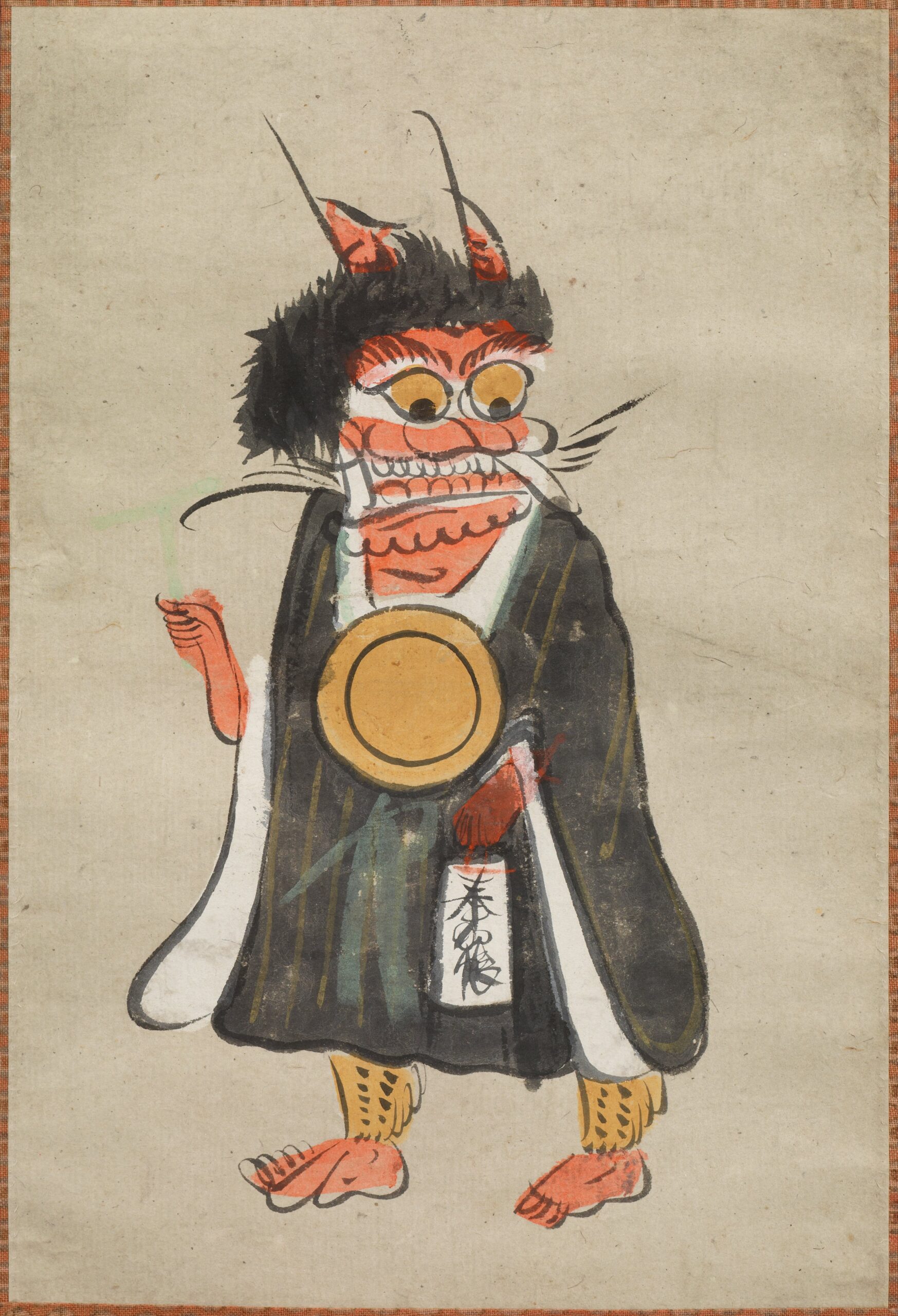
Japan
Hanging scroll, ink, and colour on paper, 33.5 x 22.5 cm | 13.2 x 8.9 in
Minneapolis Museum of Art
Kawanabe Kyōsai was a Japanese painter and caricaturist who lived during the late Edo and early Meiji periods. He is considered to be one of the first creators of a manga magazine. His book of paintings, Kyōsai’s Pictures of One Hundred Demons (Kyōsai hyakki gadan), features outlandish yōkai (supernatural creatures), oni, and ghosts from Japanese folklore during the Night Parade of One Hundred Demons. This is a traditional Japanese folk story in which, as darkness falls over the country, a throng of demons and monsters swarms over the land.
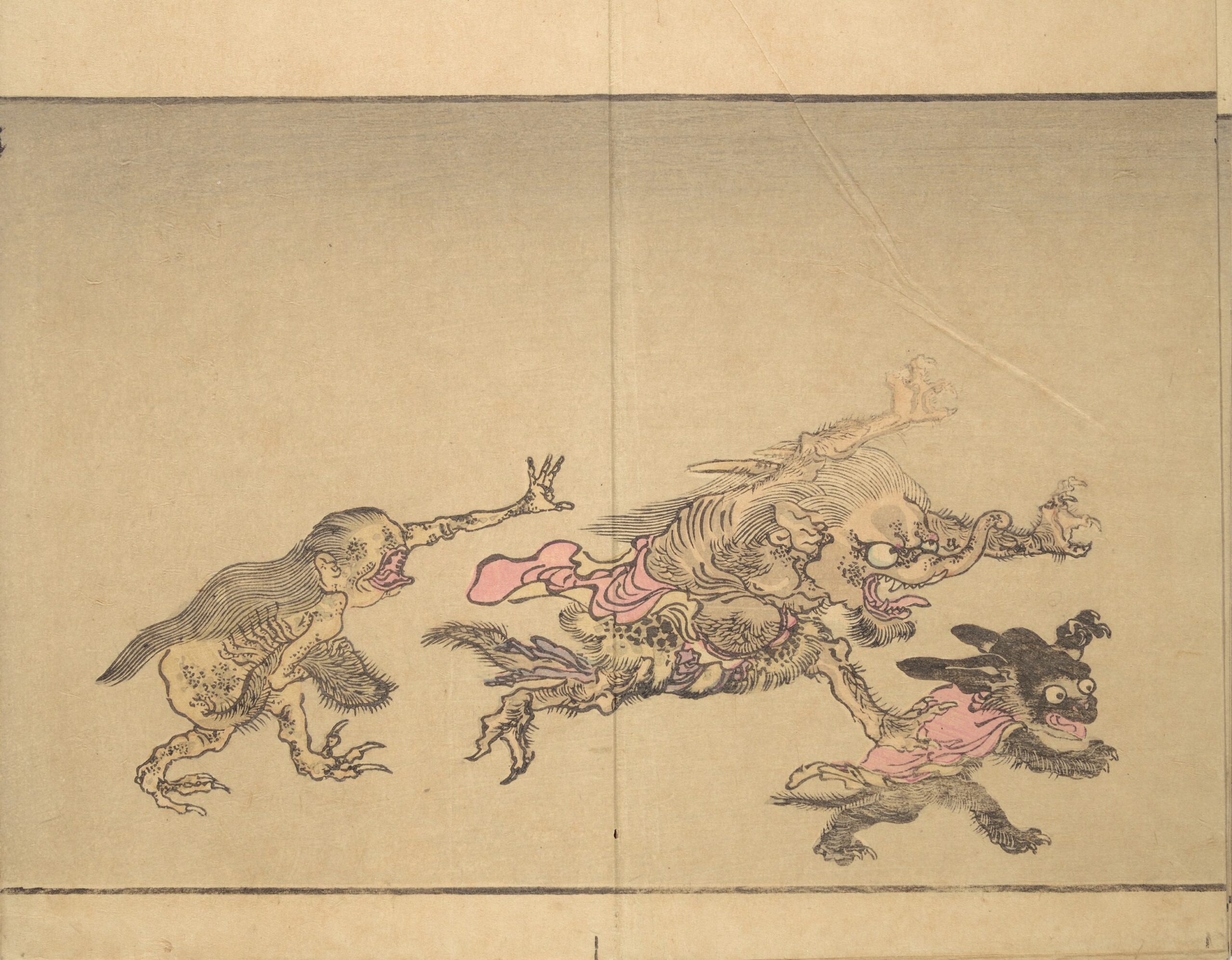
Kawanabe Kyōsai 河鍋暁斎
Woodblock printed book (orihon, accordion-style); ink and colour on paper, 19.8 x 12 cm | 7.9 x 4.7 in
The Metropolitan Museum of Art
Kyōsai was the son of a samurai and experienced the drastic cultural change that occurred in 19th-century Japan as the nation shifted from a feudal agrarian society to a modern industrial one. His depiction of a mob of unruly characters, both comedic and disturbing, has been interpreted as a symbol of the political and cultural upheaval that occurred as Japan shifted away from its traditional past. Kyōsai found himself in trouble with the authorities on multiple occasions for his unwillingness to censor himself.
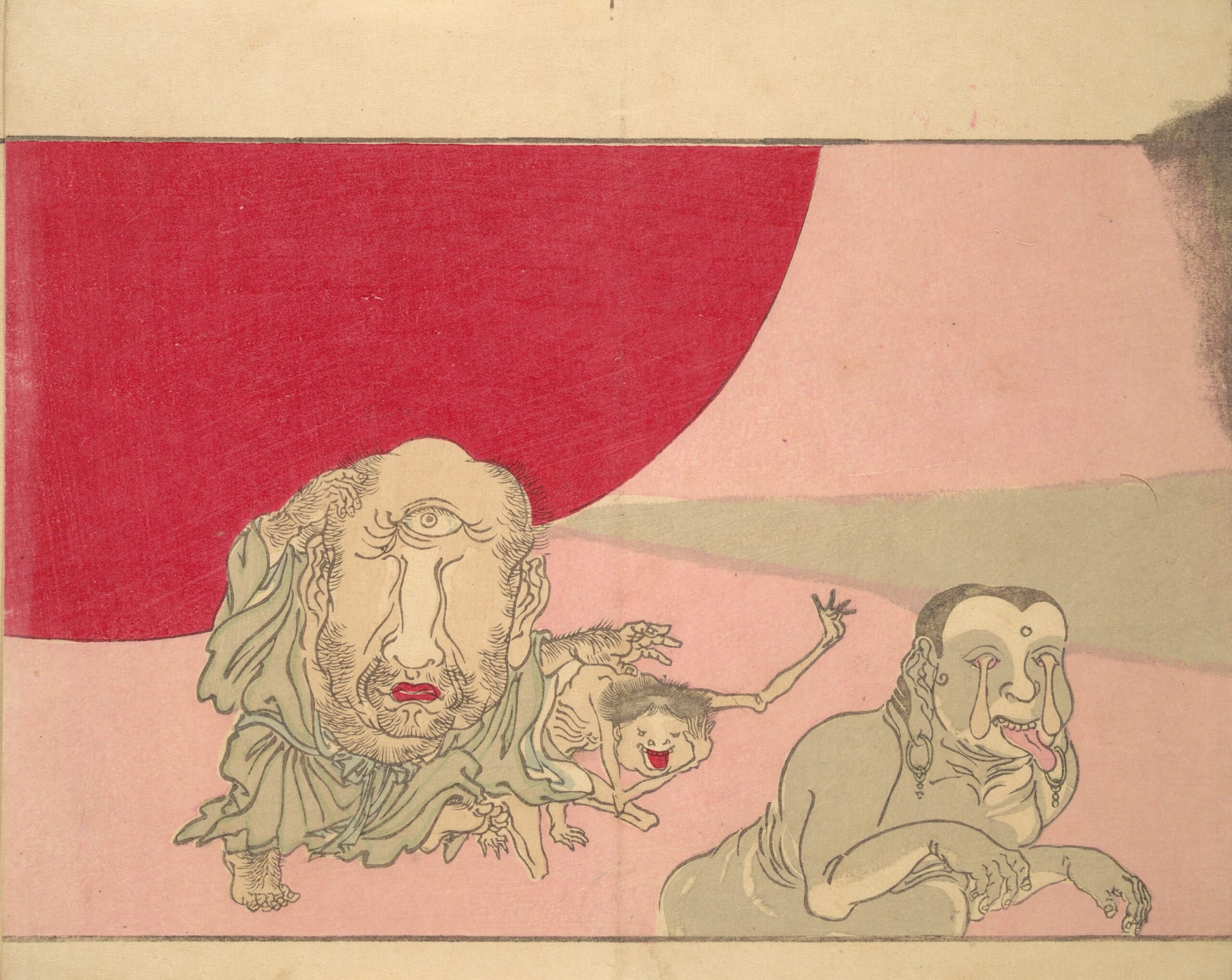
Kawanabe Kyōsai 河鍋暁斎
Woodblock printed book (orihon, accordion-style); ink and colour on paper, 19.8 x 12 cm | 7.9 x 4.7 in
The Metropolitan Museum of Art
Monsters of the Enlightenment
Like Japan, Europe also faced a series of changes during the 19th century. Los Caprichos is a series of aquatint etchings made by Francisco de Goya at the very end of the 18th century. This frightening series is usually interpreted as a biting commentary on the society Goya was living in and a criticism of the authoritarian power of the Spanish government and the Inquisition. Los Caprichos is rich with grotesque images of goblins, witches, and monsters, and features both moments of genuine horror and dark comedy. The best-known work from this series, and one of Goya’s most lauded works overall, is The Sleep of Reason Produces Monsters. It depicts a sleeping man, slumped over his work desk, as if overcome by a sudden exhaustion. He is surrounded by sinister-looking creatures – owls (or owl-like beings), giant bats, and an enormous cat.
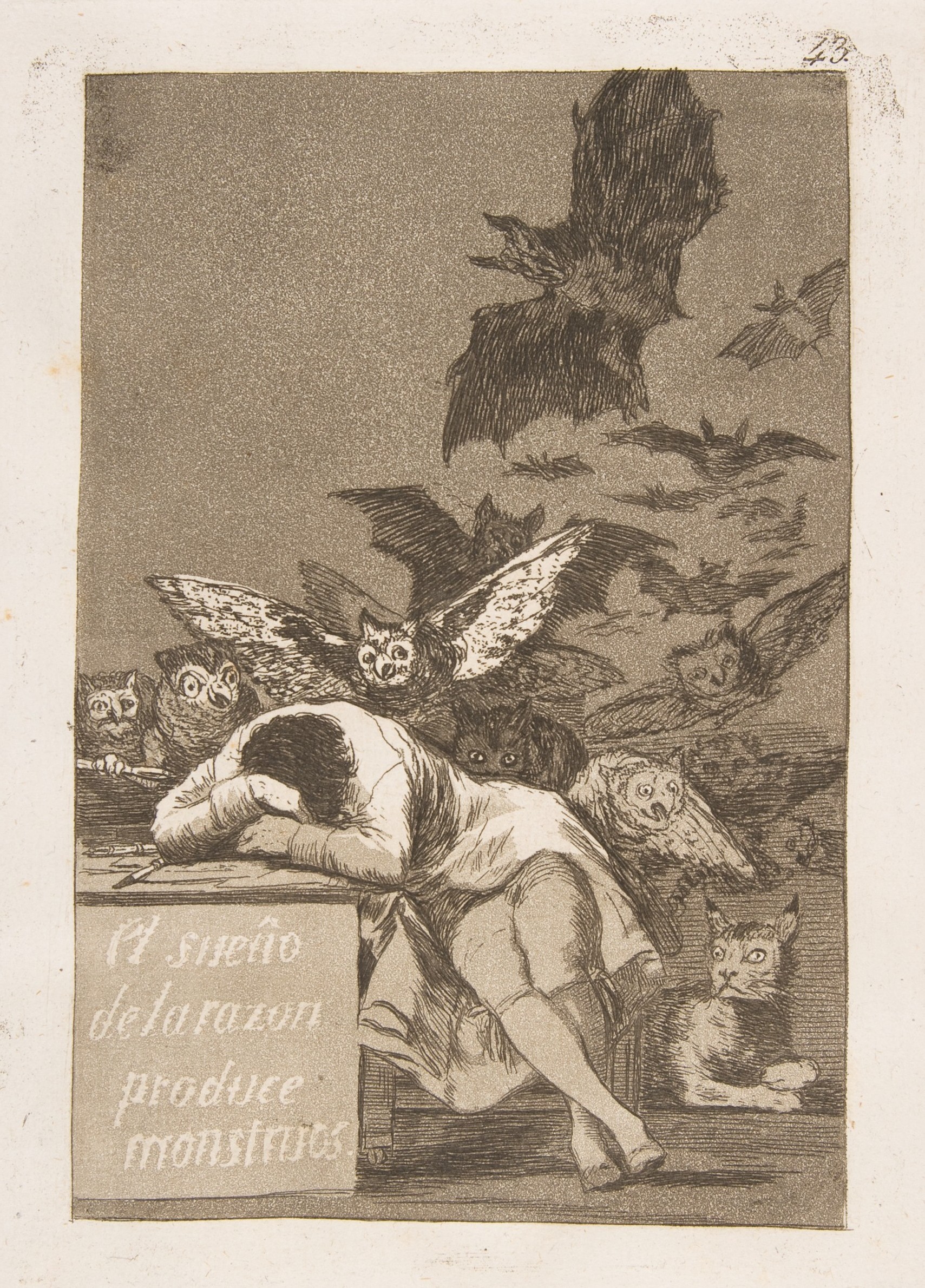
Francisco de Goya
Etching, aquatint, 21.2 x 15.1 cm | 8.3 x 5.9 in
The Metropolitan Museum of Art
Goya was working during a time when the ideas of the Enlightenment were radically changing European society. The religious superstition that had influenced how people navigated the world during the Middle Ages was being challenged by science and belief in empirical evidence – heralding the Modern age. Goya’s interest in depicting subjects from both camps of thought makes his work complex, as the contrasting ideas between the medieval and the modern wickedly merge. The creatures in this work symbolise the fear, danger, and unrest that rise when reason ‘goes to sleep’, but also the power of the human imagination.
The Enlightenment triggered the Romantic movement in art and culture, where a swathe of artists and writers chose demons and monsters as their subjects in reaction to rapid industrialisation, technological advancement, and social change. In literature, Mary Shelley’s depiction of the monstrous in her seminal novel Frankenstein warns of the perils of unchecked scientific ambition, and the archetype of the ‘Byronic demon’ touches on themes of social otherness and rebellion. In the visual arts, artists such as William Blake and Henry Fuseli explored the boundaries of reason in their works. Throughout this period, the monstrous and demonic become powerful symbols of societal failings in the face of change, the folly of human ambition, and those things that lie beyond rational understanding.
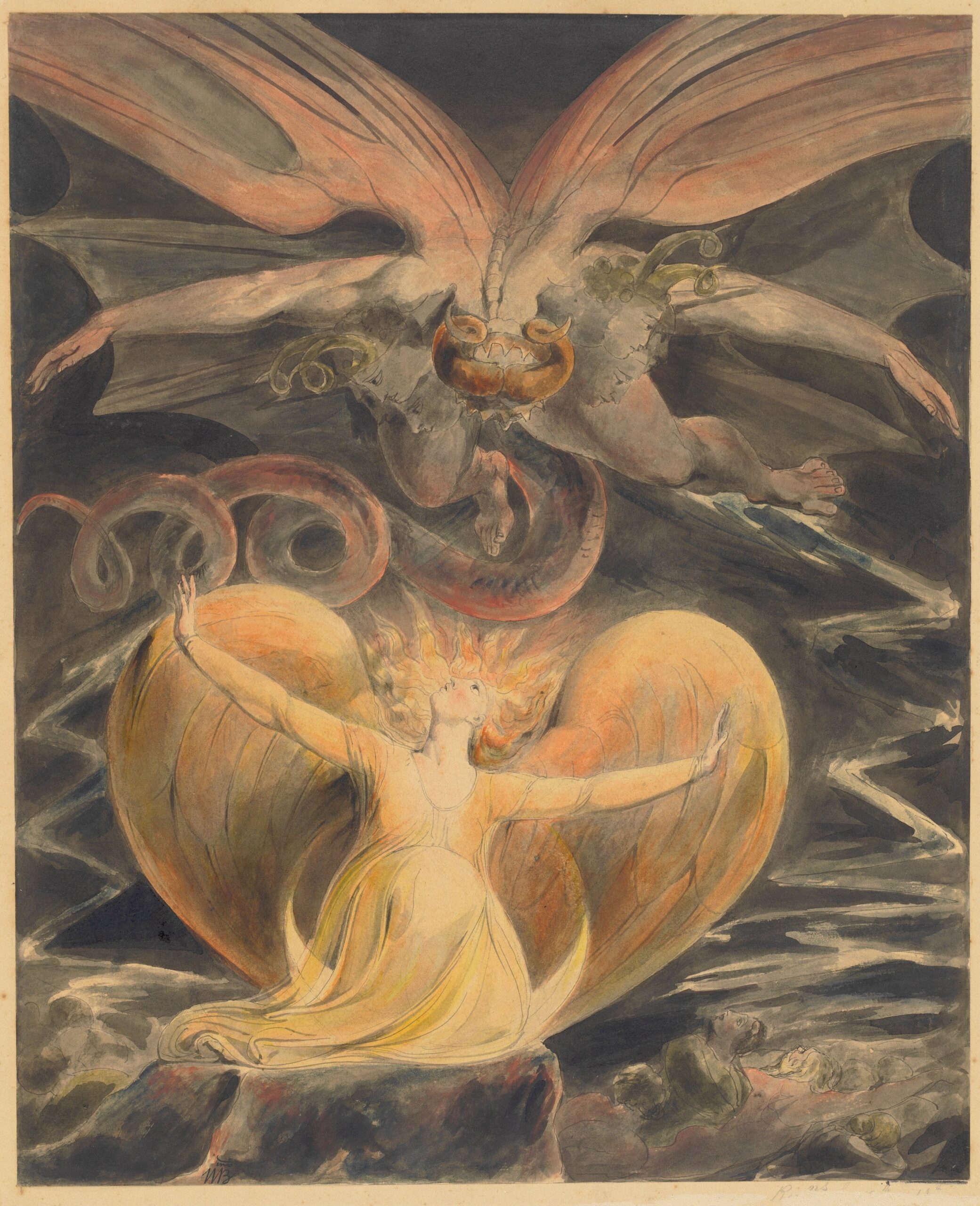
William Blake
Pen and grey ink with watercolour over graphite, 40.8 x 33.7 cm | 16 x 13.25 in
The National Gallery of Art
Psychology and Creativity
The modern science of psychology was born during the second half of the 19th century. During this period, demons became increasingly powerful psychological symbols for artists. Hantise (Obsession) is a lithograph by French Symbolist artist Odilon Redon. In this striking composition, we see a woman posed in a shadowy setting, her dress billowing in the wind. Behind her, strange demons emerge from a shroud of velvety darkness. But their figures are partially obscured, leaving the viewer with a great sense of unease – what else lurks in the gloom? The unease is further accentuated by the contrasting expressions on the demons’ faces: one smiles coyly, whilst the other grimaces – leaving us unsure about their intentions. These figures can be interpreted as symbols of psychological states, their ambiguity reflecting the mysteries of the unconscious mind.
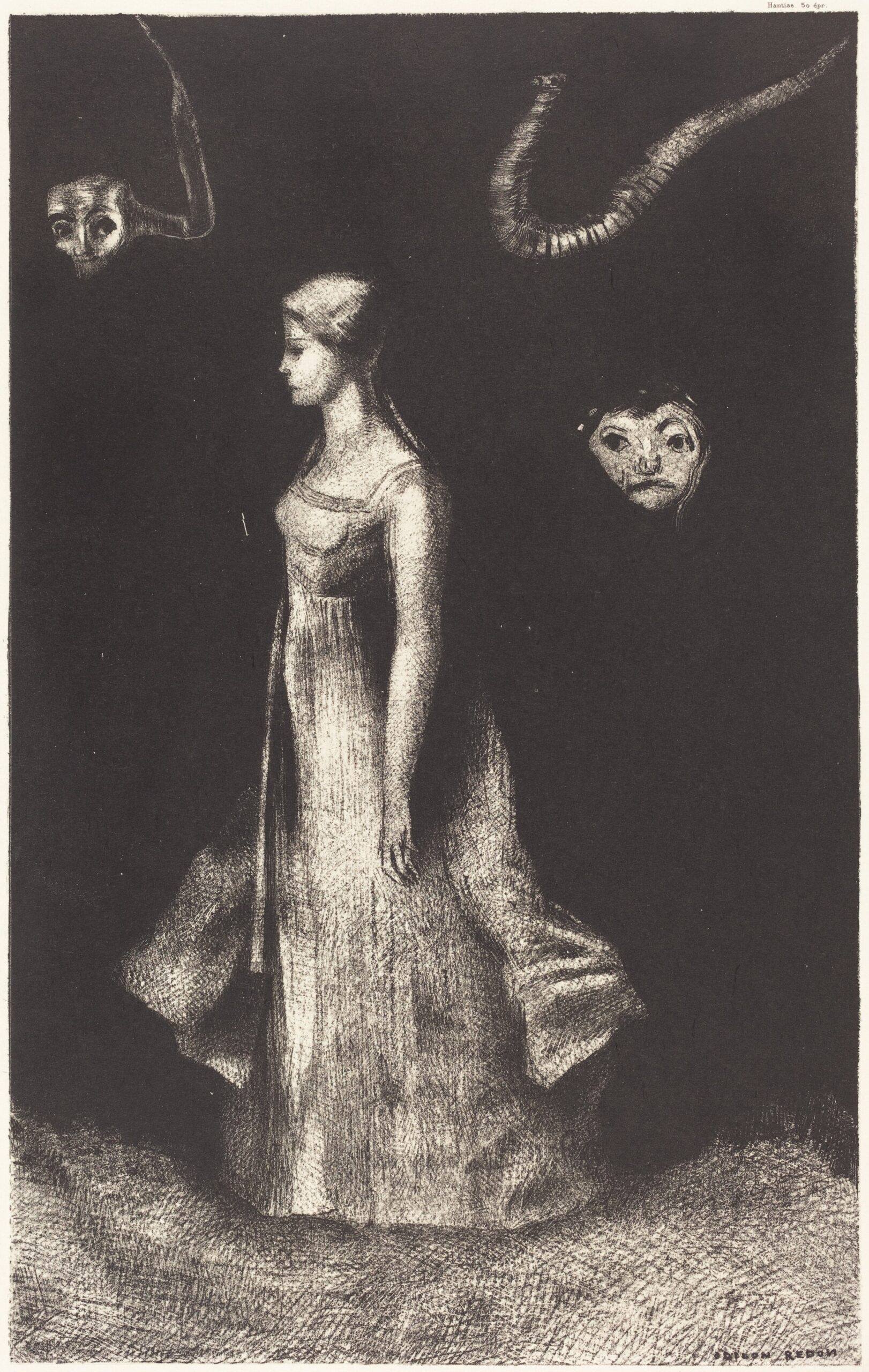
Odilon Redon
Lithograph, 60.8 cm x 40 cm | 24 x 15.75 in
The National Gallery of Art
James Ensor was a Belgian painter famous for his garish depictions of carnivals, masks, and macabre skeletal figures. Ensor repeatedly returned to the motif of demons and monstrosities in his work, including his own version of The Temptation of Saint Anthony.
Ensor’s polarising work was often met with harsh criticism. As Ensor’s work became increasingly gruesome and bizarre, he was rejected by many of his peers, including members of the radical art group he helped found, Les XX. The demons in his work are often tied to mockery and become a reflection of his sense of social alienation. They can also be viewed as symbols of the frenzy of creativity and personal torment, and therefore the ‘artistic disposition’ itself. For Ensor, possession becomes a catalyst for creativity and a private hell.
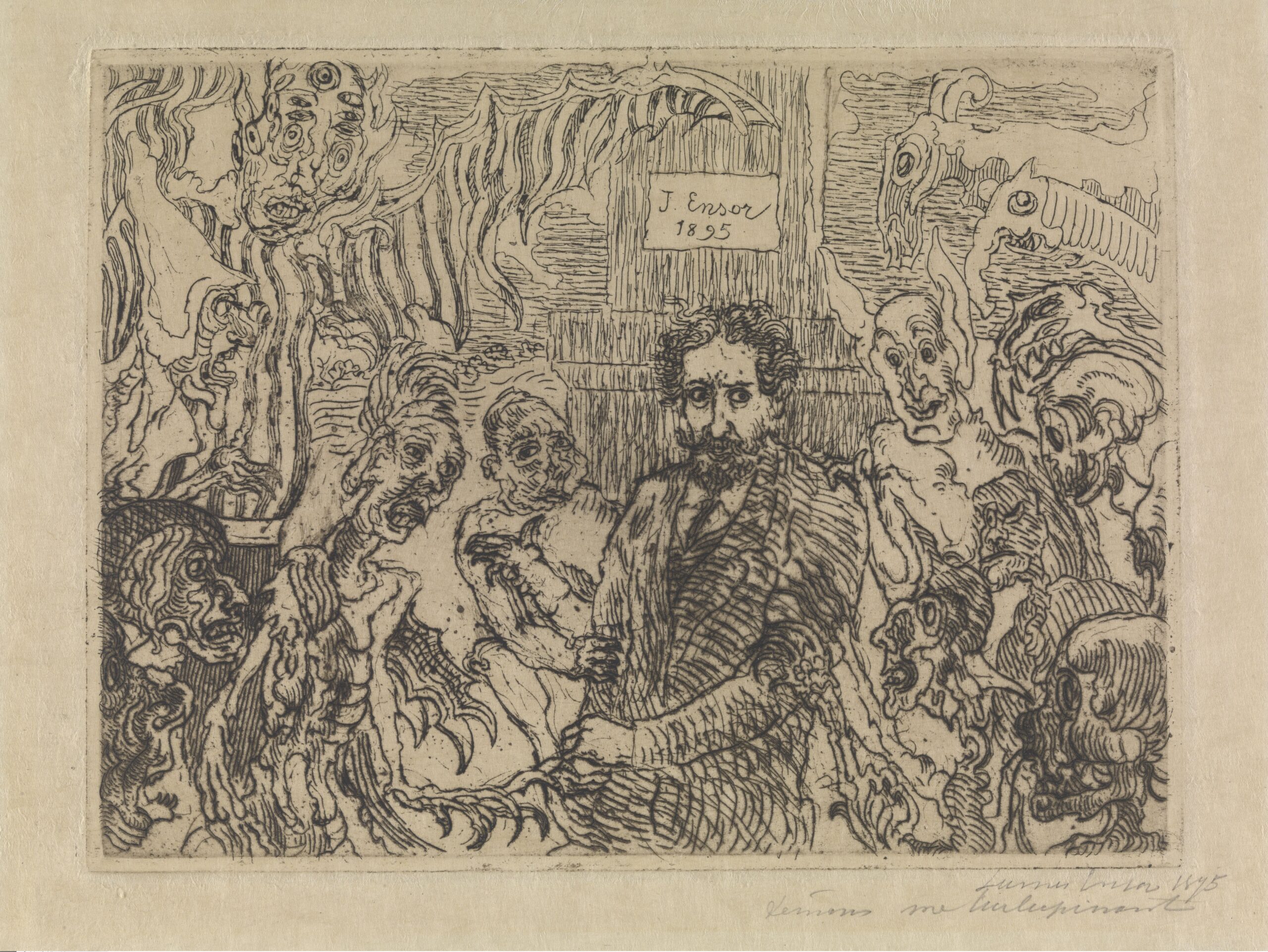
James Ensor
Etching, 11.4 x 15.4 cm | 4.5 x 6 in
Museum of Fine Arts Ghent
Demons and Monsters – Art Prompt
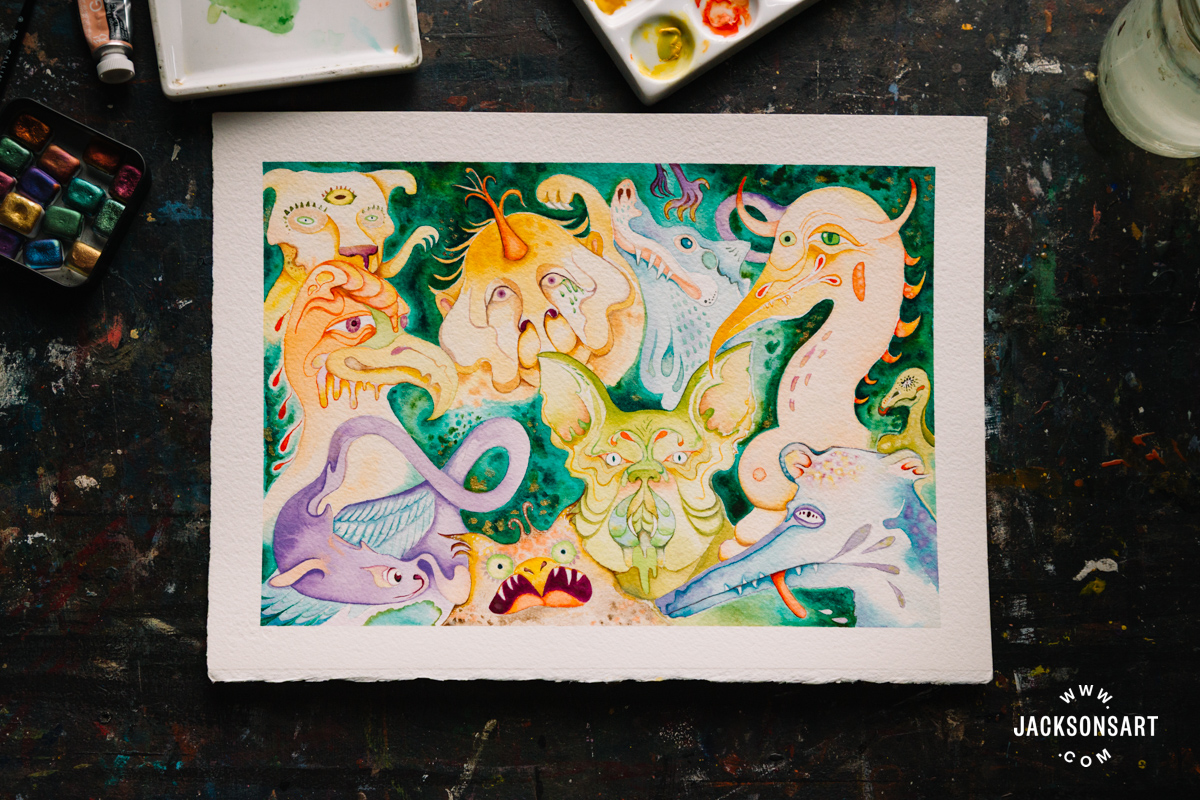
This art prompt is inspired by some of the artworks I’ve mentioned so far in the article. I loved the bustling gang of beasts in Daniel Hopfer’s etching Heads of Grotesque Animals. And was also inspired by the punchy pastel palette and outlandish yōkai in Kyōsai’s version of the Night Parade of One Hundred Demons.
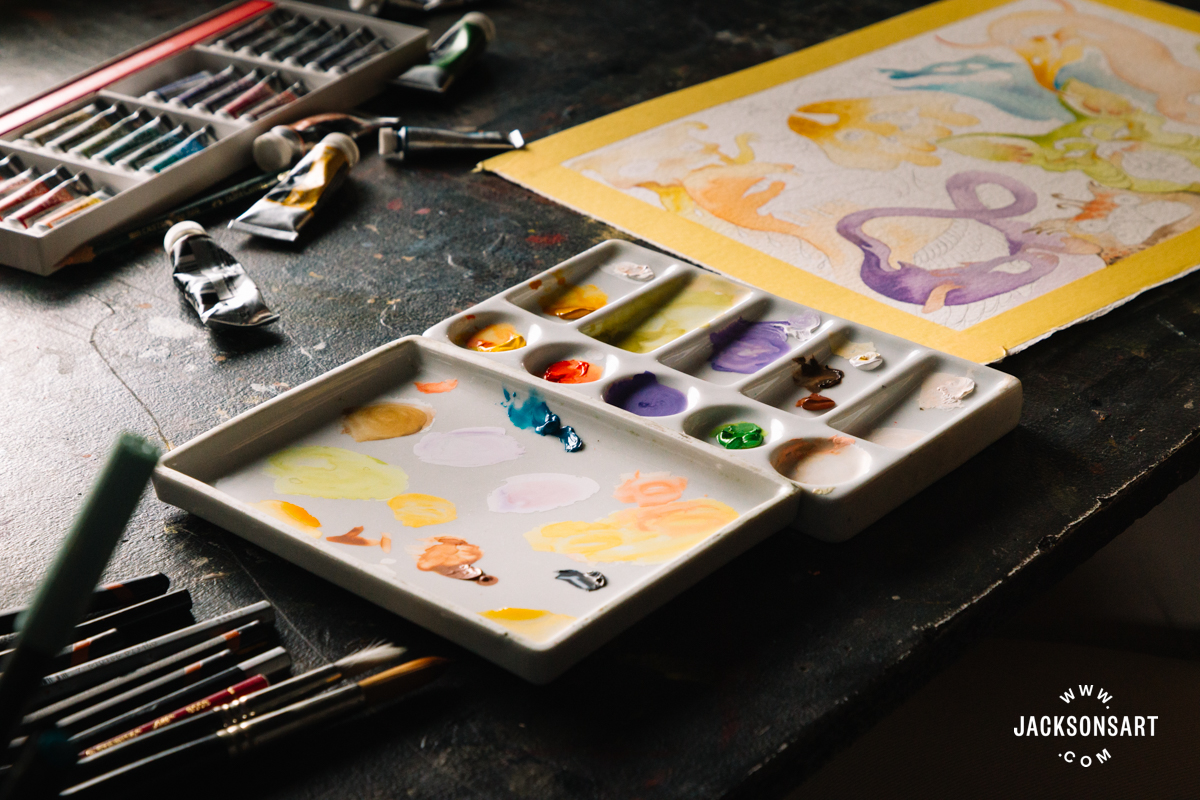
For this Art Prompt I used:
A selection of artist gouache paints. I used Holbein Artists’ Irodori Gouache in the following colours to create my palette of vibrant pastels and jewel tones. Shu/Vermilion, Ususango/Pale Coral, Botan/Peony, Azuki/Russet Brown, Taisha/Taisha Brown, Kohaku/Amber, Mirucha/Russet Green, Rokushou/Patina, Wakaba/Spring Green, Kikyou/Bellflower, and Yamabuki/Kerria Japinca Yellow. I also used a Holbein Artists’ Granulating Watercolour in Jade Vine Blue.
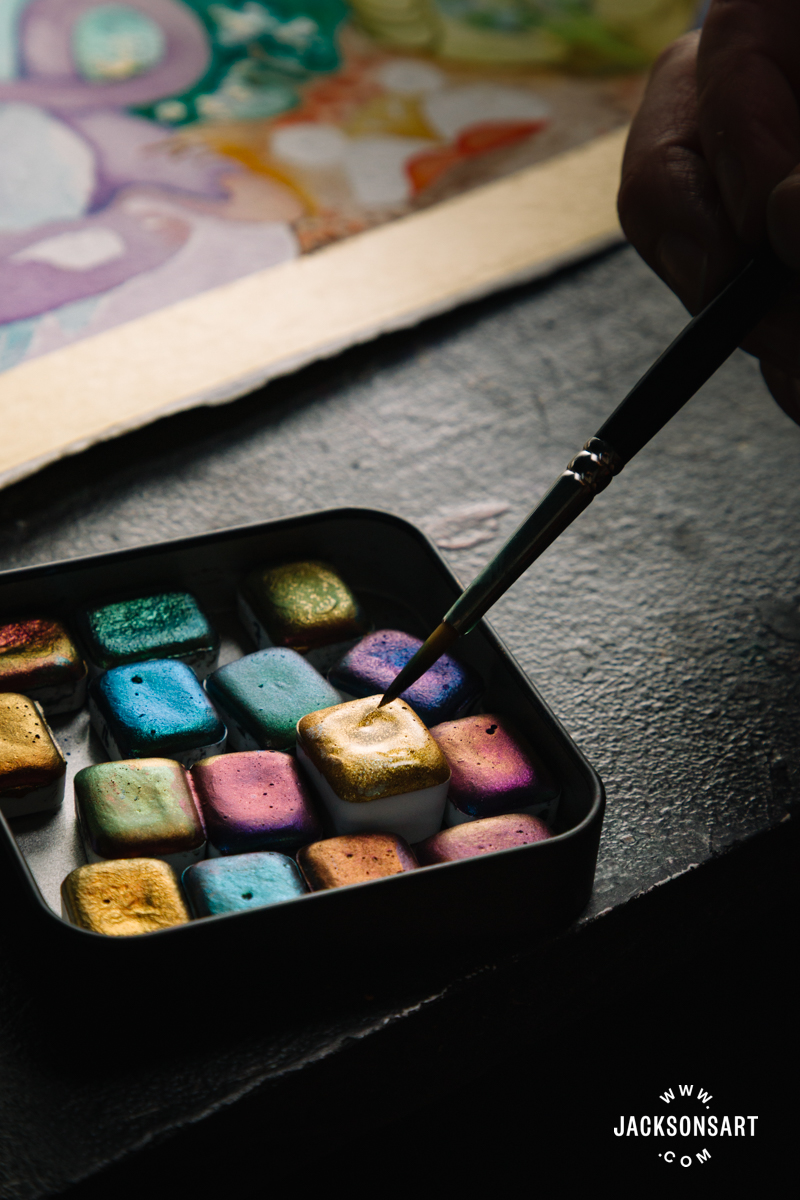
IUILE iridescent watercolour paint palette in Red Brown
A heavyweight cold pressed watercolour paper sheet. I used a 640 gsm Arches Aquarelle sheet, cut into a quarter-sized sheet (roughly 28 x 38 cm or 11 x 15 in).
1 in wide low-tack Masking Tape
A selection of synthetic watercolour brushes
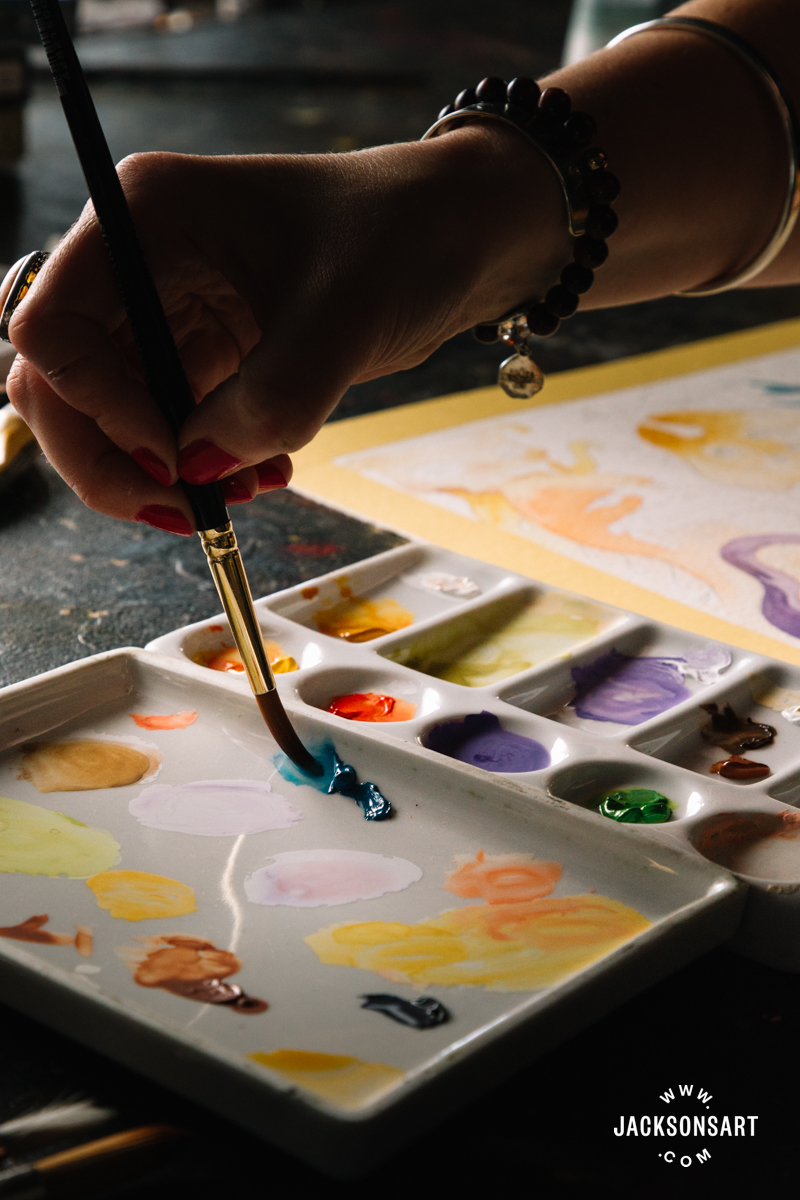
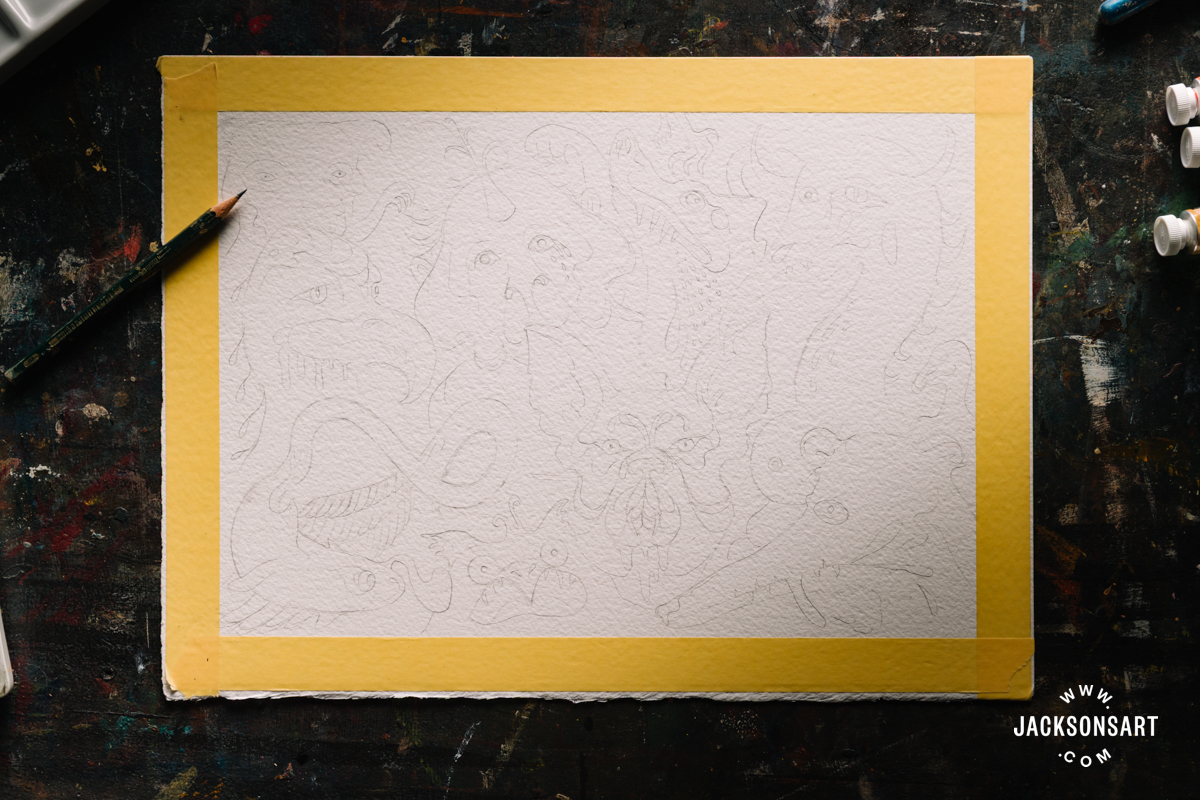
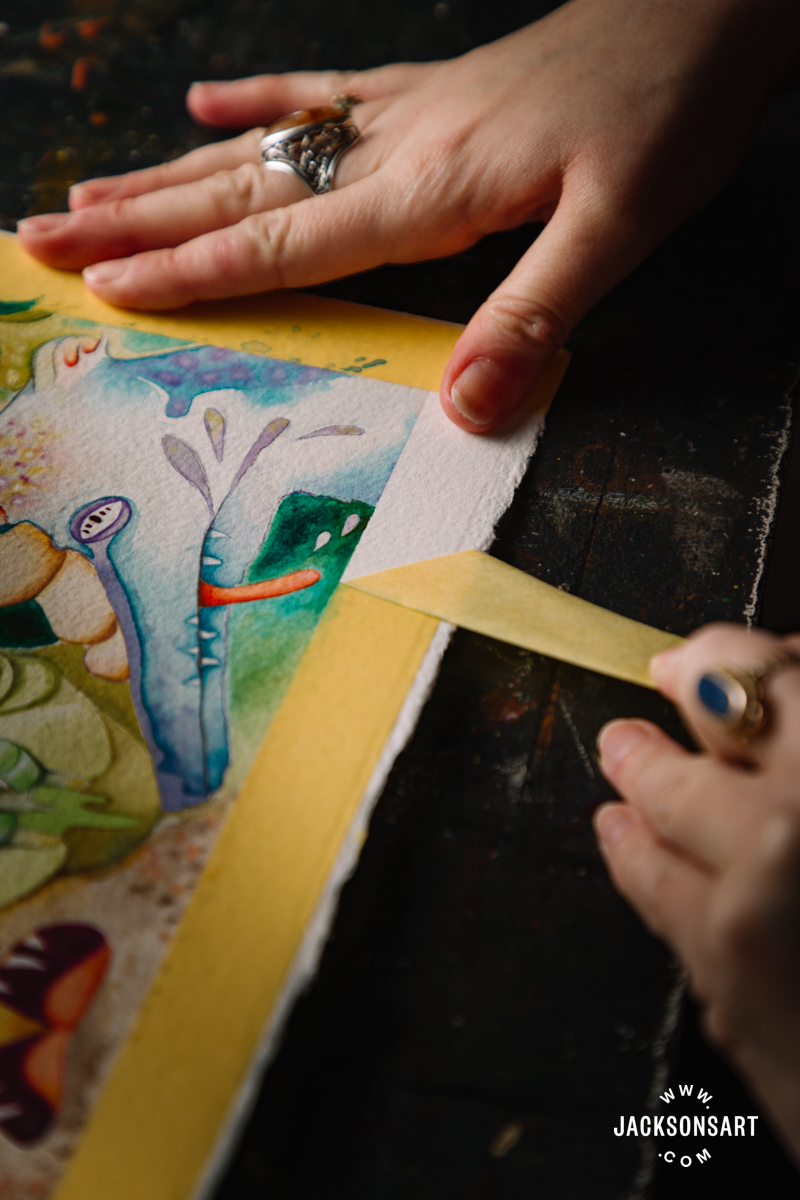
I started my painting by taping around the edges of the painting with masking tape. This will give the painting a crisp white border when I am finished. I sketched a collection of characters in an HB pencil, combining elements of real animals I found in online references and then elaborating on them with my imagination. If you try this art prompt yourself, I encourage you to draw the monsters and their gruesome features from your imagination as much as possible.
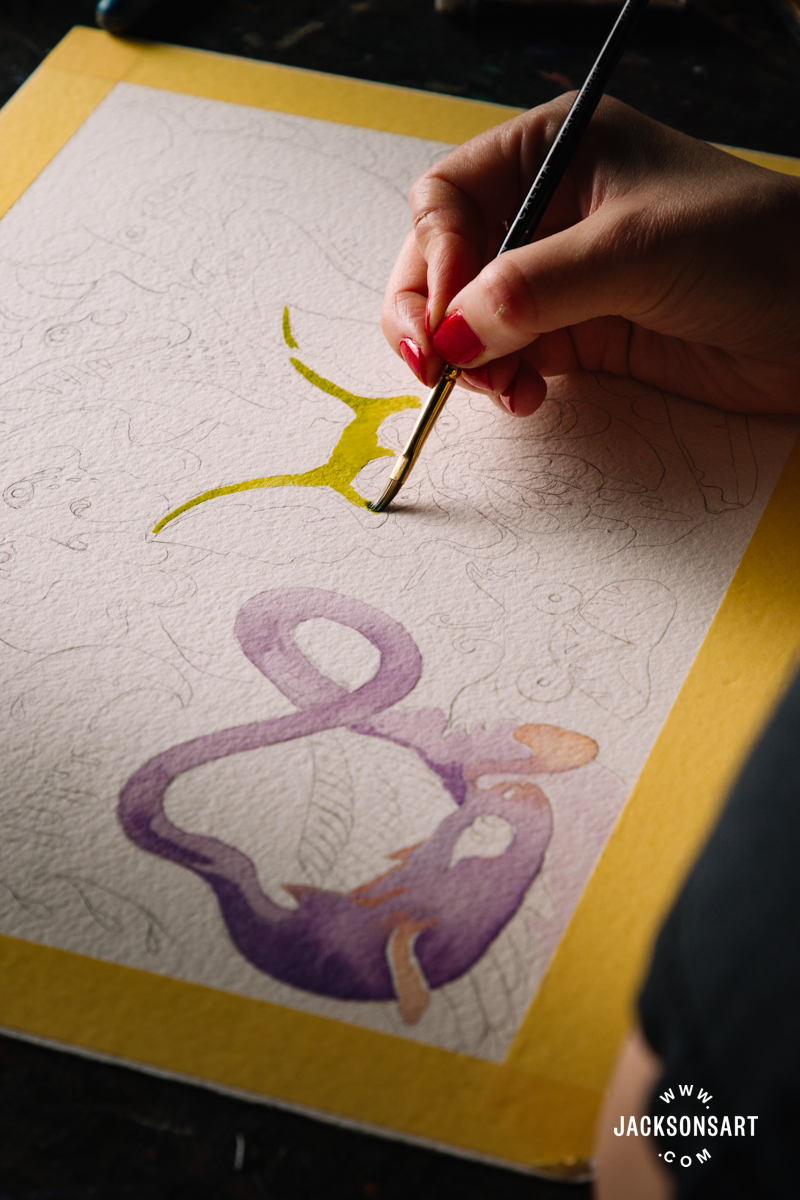
Then I began painting the figures of demons and monsters using washes of gouache, keeping the colours very light to begin with. I used the wet-on-wet technique to create organic textures in the figures.
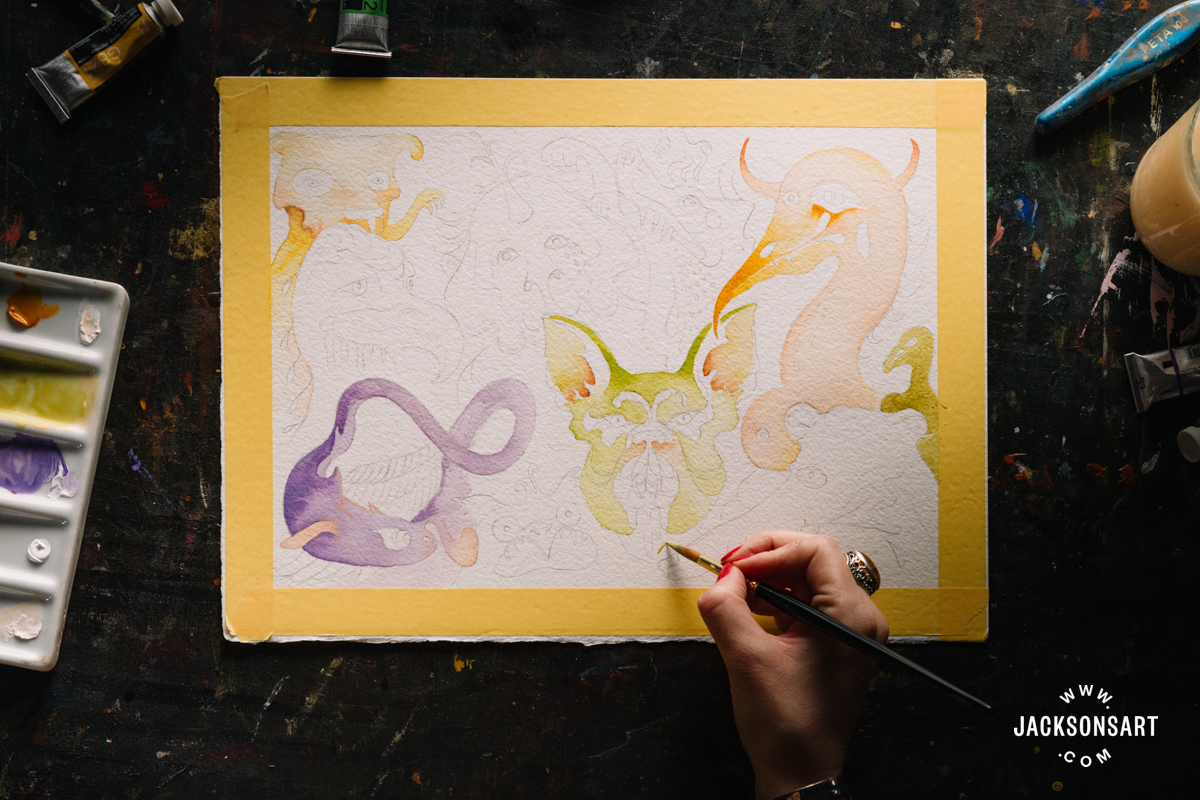
Once I had most of the figures blocked in, I started filling in the background with a rich mixture of Patina and Russet Green.
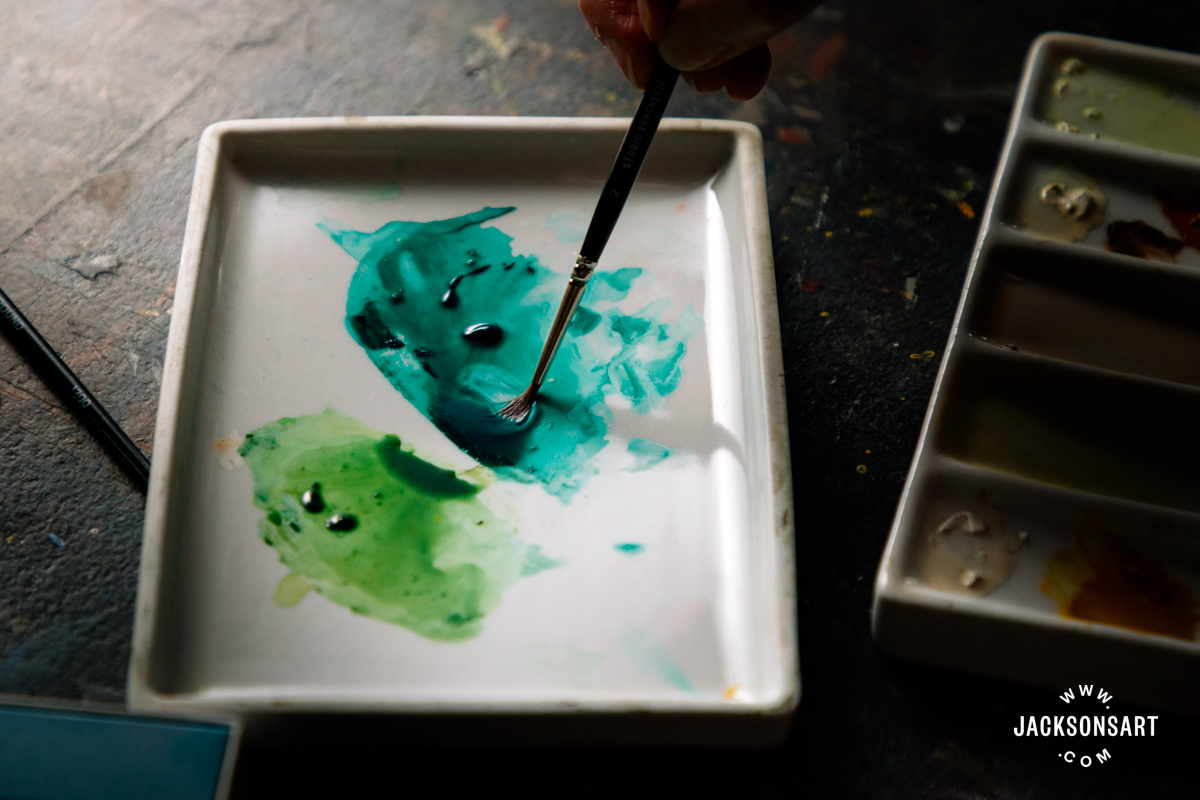
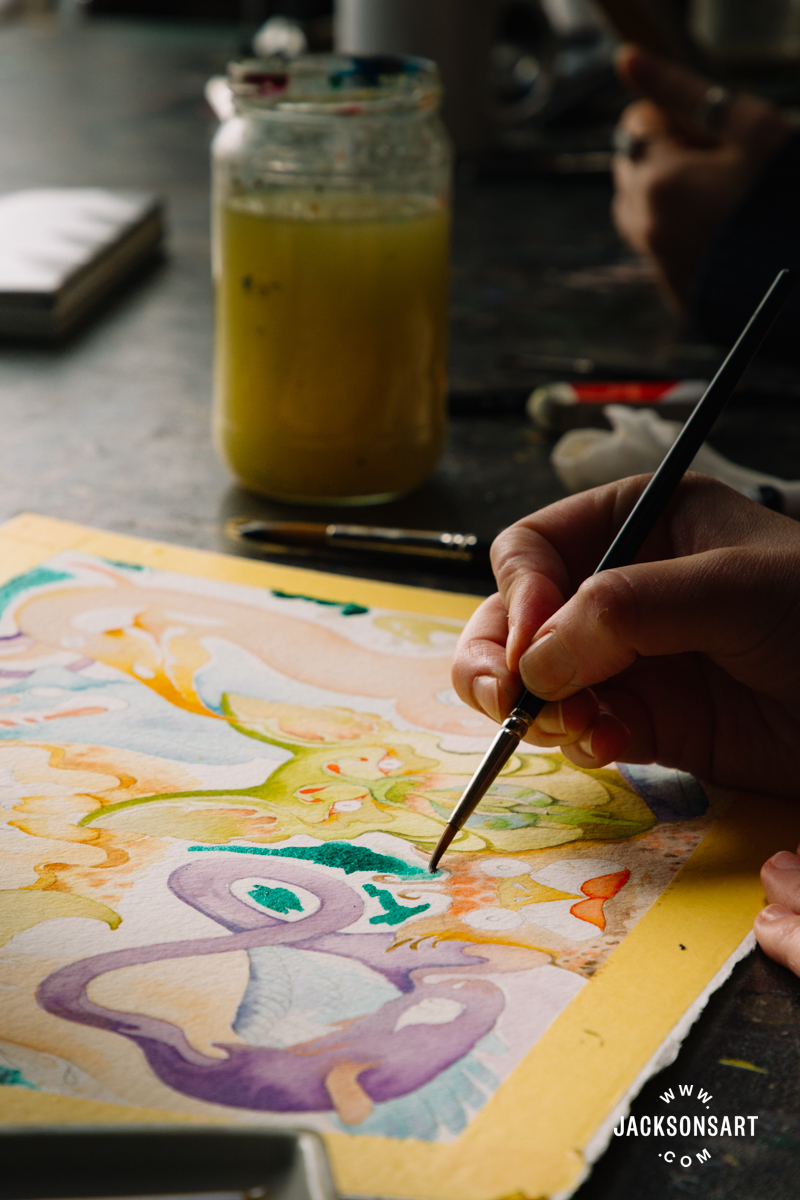
To create a further sense of the fantastical, I dabbed IUILE iridescent watercolour paint into the wet background.
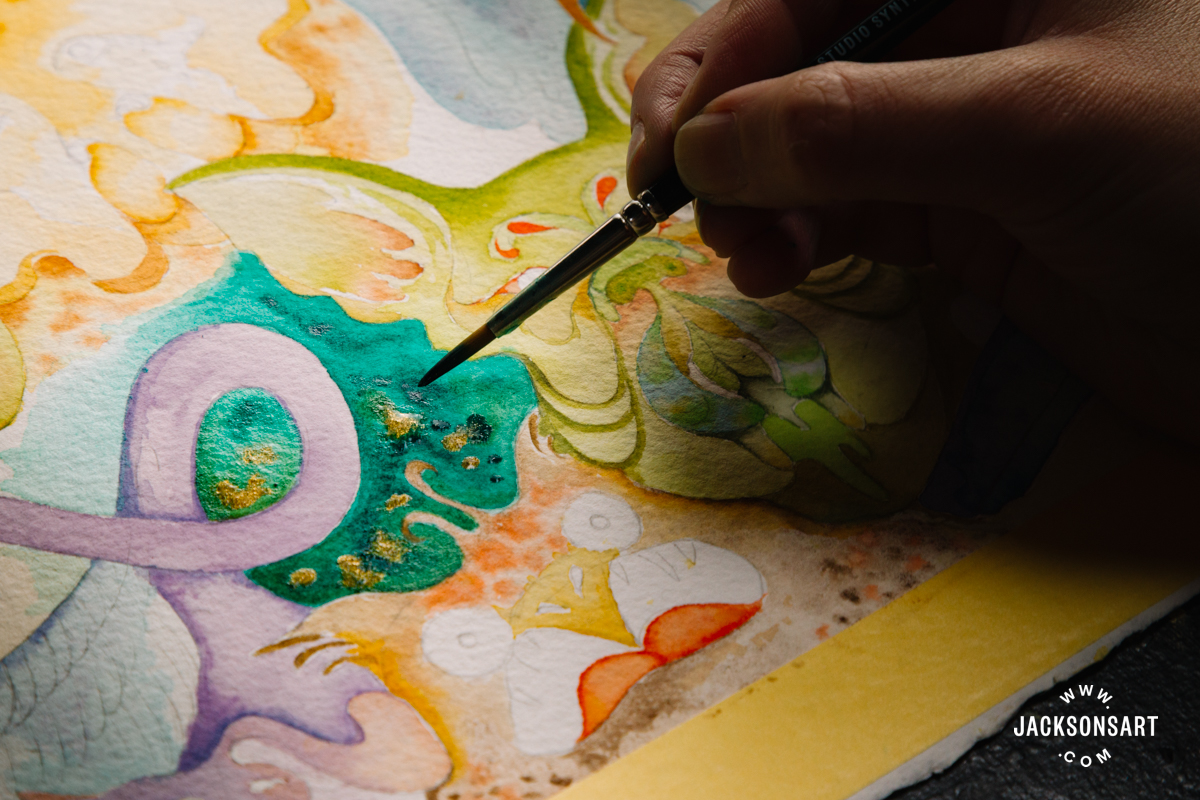
I finished the painting by adding some details and linework to my characters using more saturated colours.
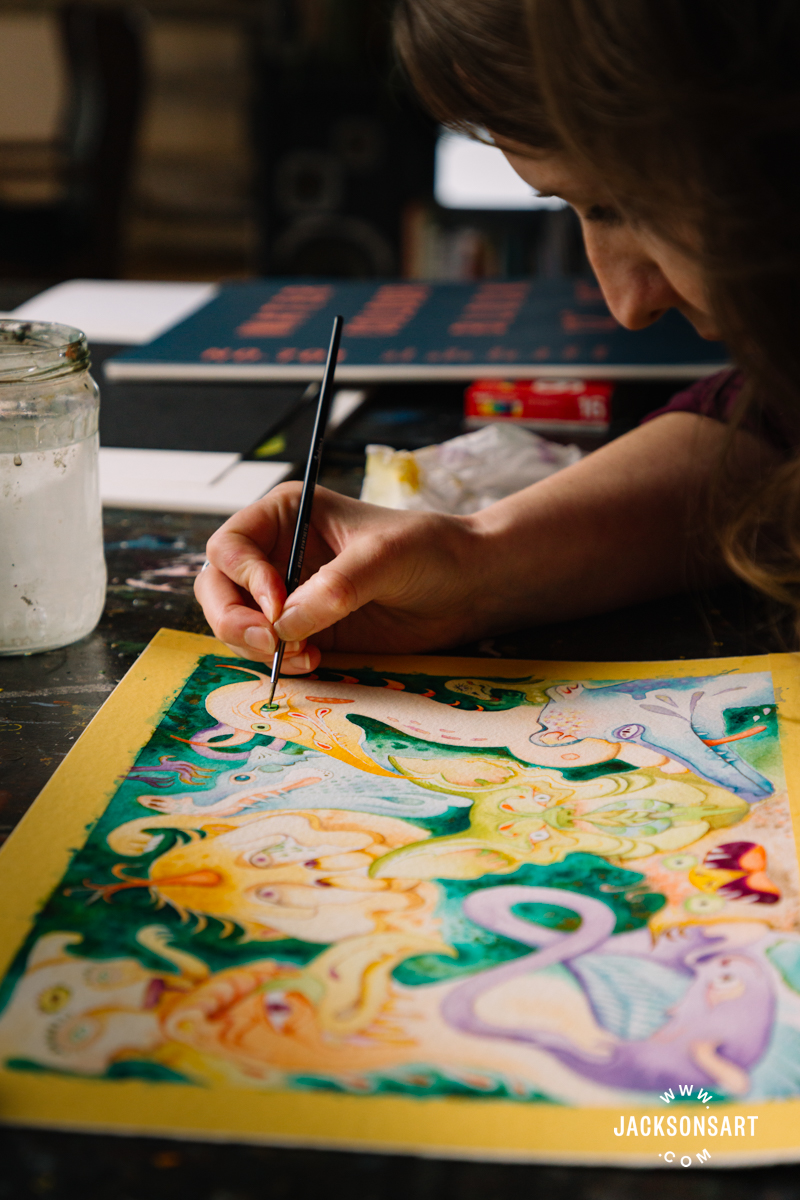
Finally, I peeled back the masking tape to reveal the crisp border surrounding my menagerie of demons and monsters.
Further Reading
Behind the Movement: Symbolism
Recreating the Colour Palette of William Blake
Art Through Symbols: The Skull
IUILE Colourshift Watercolours
Shop Art Materials on jacksonsart.com


1 thought on “Art Through Symbols: Demons and Monsters”
A truly fascinating perspective on how demons and monsters have been represented through art across different cultures! We at Penkraft believe that art is a wonderful way to explore imagination, emotions, and creativity. The ideas shared in this article are inspiring, especially the creative gouache activity that encourages artists to experiment with colours, textures, and unique designs. Thank you for sharing such an engaging and creative read!
– Team Penkraft
Comments are closed.