



When I’m not interviewing artists for the Jackson’s Blog, I’m usually found making linocut prints, so I thought it only right that one of these days I would write about what I do on my non-Jackson’s days. And what better time than now, as the other day I printed using Caligo Safe Wash Relief Inks for the very first time, having used a selection of Michael Harding oils, Old Holland oils, Winsor and Newton and Jackson’s Artist oil colours mixed in mixed in with Daler Rowney Georgian Block printing medium pretty much since I started.

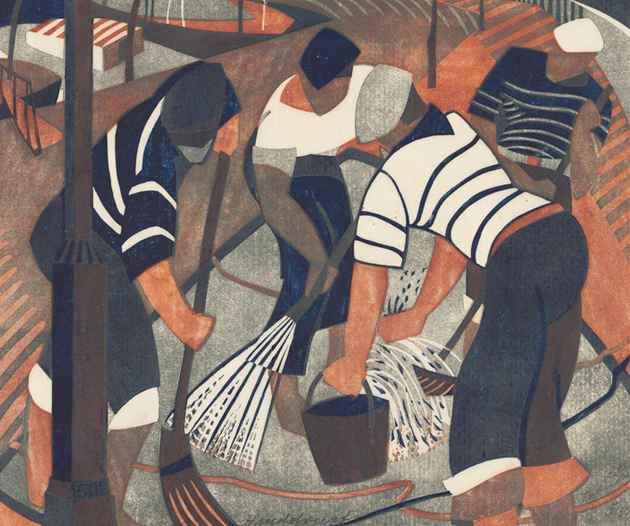
Many printmakers are confused by what was my preferred medium and the answer wasn’t really anything more exciting than the fact that I used to paint and I had a lot of expensive oil colours in my studio that I didn’t want to dry up before I used them. Having been on sabbatical from oil painting for the best part of 2 years now it was a wise financial choice. Georgian Block printing medium has been a godsend, although to my shame I still don’t really know exactly what it is made of (I imagine very likely to be a mix with some alkyd resin, if anyone knows for sure please share your knowledge!)…all I do know is that it increases the tackiness of the oil colour as well as making it a little more fluid, extends the colour, increases the transparency….and it really does work a treat. I have loved being able to use some of my most favourite colours straight out of the tube, mixed in with a little of the medium. I found it reassuring that my excursion into print did not feel wholly unrelated from my painting practice. Plus I felt I was following the techniques of my Grosvenor School heros Lill Tschudi and Cyril Power who I believe also printed using oil paint.
There are a couple of little issues with working with colour in this way – namely with human error. It is easy to accidentally vary the ratios of oil colour: medium and this can have an effect on the appearance of the colour on the print. Also if you print layers of colour over previous layers that haven’t dried fully then it can cause a little slipping and increase the likelihood of smudges. So admittedly I was tempted to try the Caligo Safe Wash Relief Inks. The product reviews on Jacksonsart.com were good and the water-miscibility element was also attractive to me. I was not disappointed.

I’ve had a slight interlude with my artwork having gone through a very time consuming move from London – Bristol, but an idea for a print had been brewing for some time. I wanted to pay tribute to 3 particular artists whose work I have been looking a lot at recently – Henri Matisse (in particular the wonderful cut outs that are in the blockbuster show at Tate Modern this Summer), Gillian Ayres and Patrick Heron. I longed to create an image that appeared effortless yet sophisticated, random yet controlled. I have been making prints of cyclists a lot recently and I was keen to make a print that used the tread of a bicycle tyre as a motif. I’ve also had a bit of a thing for repeated triangles recently, too. And negative spaces – room for the blocks of colour to breathe in.
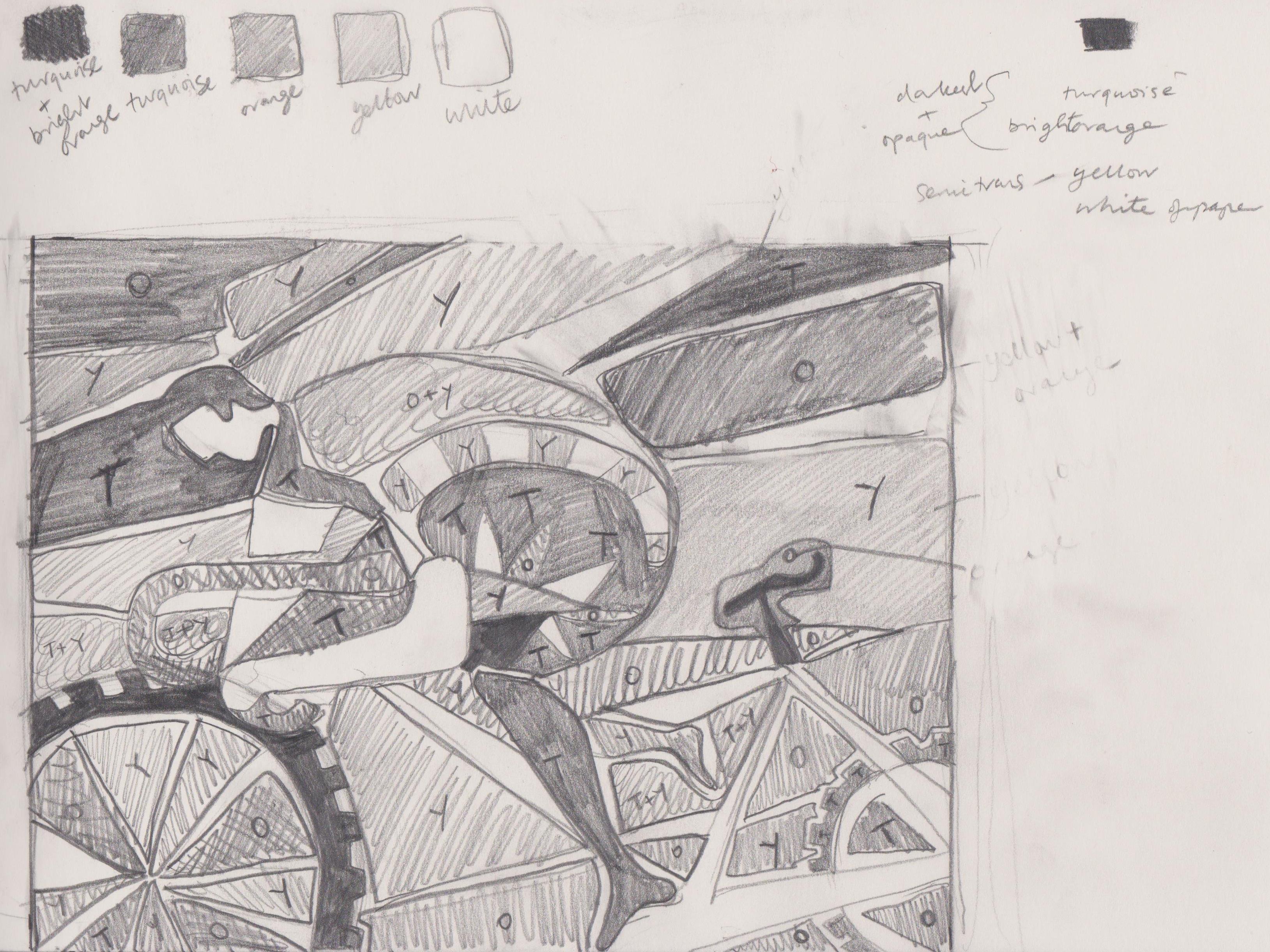
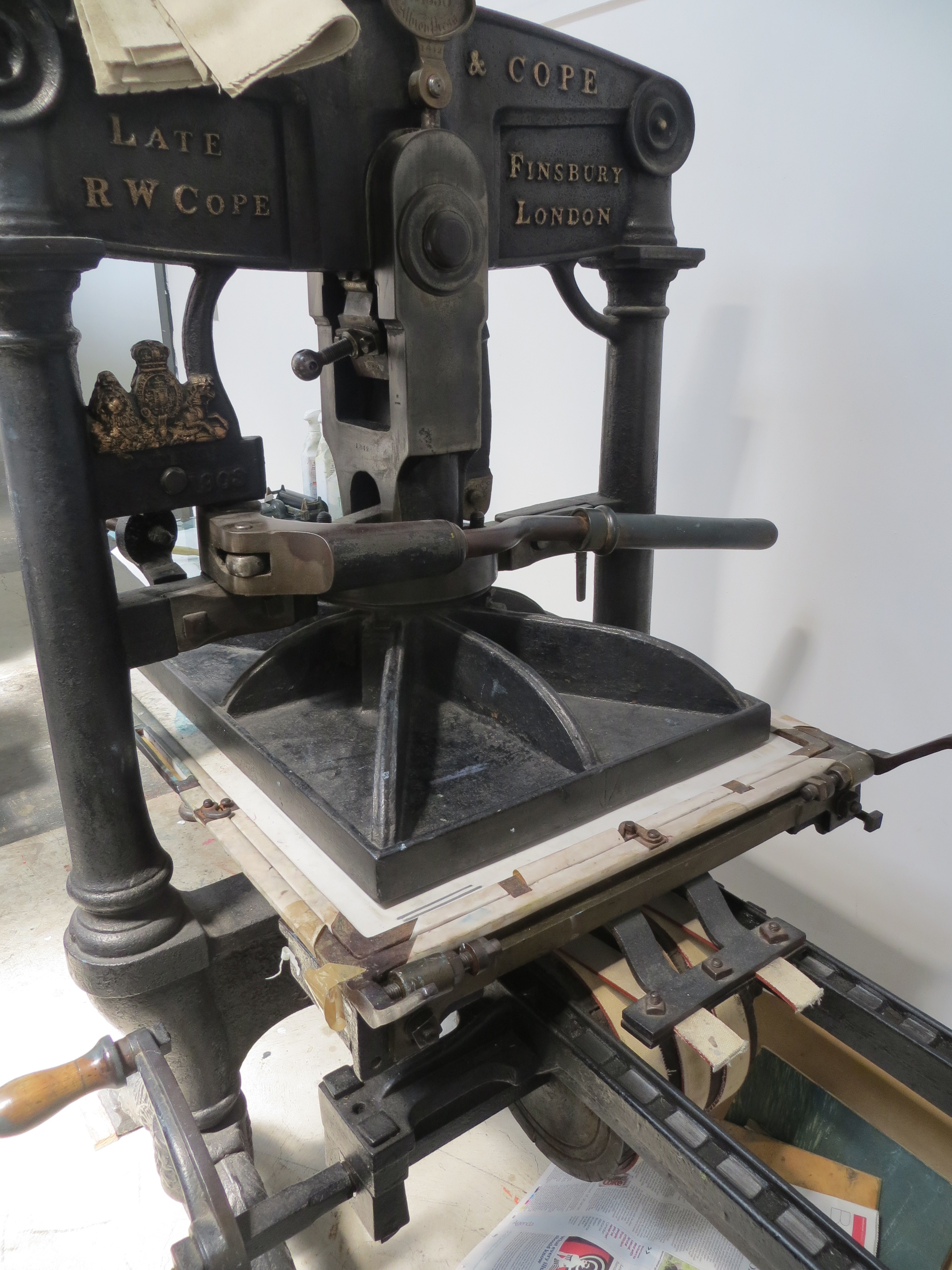
It took a number of attempts to finally get the design how I wanted it in pencil on paper as my work is usually a lot more structured looking (and dare I say easier to design!) Once I had my line drawing just so I experimented with colour by photocopying my drawing and rendering 2 or 3 in some acrylic colours. I then enlarged my drawing to fit the lino tiles I wanted to use and transferred the image using Tracedown paper. Once I had carved my tiles using my beloved Pfeil tools I was down to Spike Print Studio to use the fantastic Albion Press. I took with me my new acquisitions – Phthalo Blue, Phthalo Green, Opaque White, Arylide Yellow and Light Orange Caligo Safe Wash Relief Inks.
When squeezing the colour out on to the glass plate I immediately noticed the difference in appearance to conventional oil colour – the ink looked more like heavy body acrylic – similar in consistency with a high gloss to its surface. The colour was intense, something that became more apparent as I rolled a layer onto my glass. It was really intense! Hard to describe in words but I could tell that the consistency and saturation was going to help me achieve a bold, bright, poster like print, which was luckily what I was after with my design.
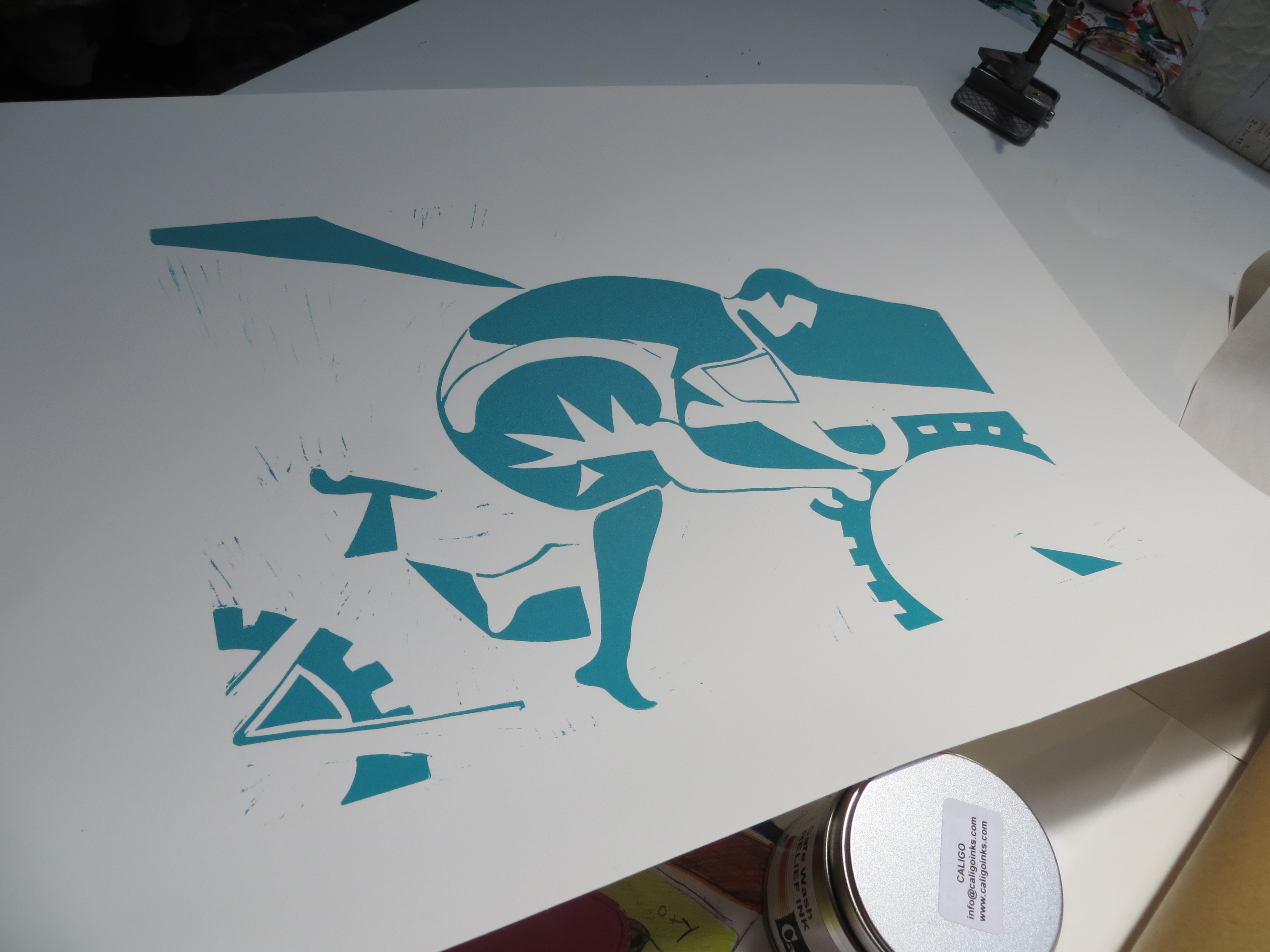
I intentionally avoided opaque colours (with the exception of the white) as I am interested in layering colours and achieving secondary colour mixes. Where colours layered the mixes were really beautiful – it’s only when you do this that you realise the true value of using single pigment colours; your mixes appear bright and not muddy. It’s now inspired me to design a print with more overlays. I used the white mixed in with a little of the Arylide Yellow. I printed this over the top, which was not as successful as I had hoped – it looked a little powdery but I think this was wholly down to the opacity of the colour mix and I think I should have used a transparent white instead.
Using Caligo saves time. In the past when I have attempted to layer colours over one another, the Georgian block printing mix has often not adhered to semi-dry colour very well, leaving a dimpled affect on the top layer of colour. Sometimes this can be interesting but usually I’m not so keen! It was a different story with Caligo – colours layered on to wet layers as if they were 3 days dry, and edges remained clean.
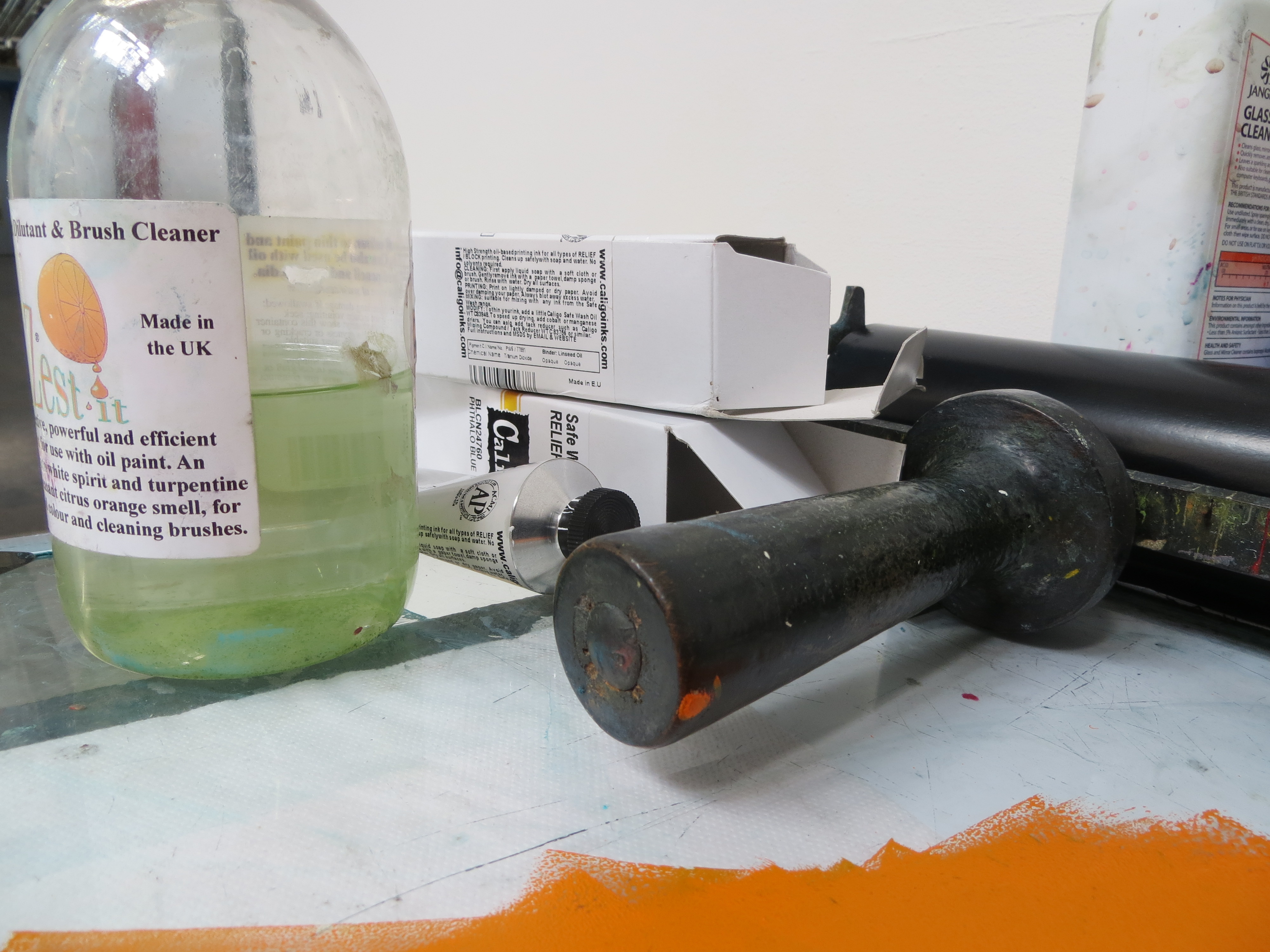
Finally, the clean up operation. I was slightly dreading it having tried another range of self-proclaimed ‘Water-miscible’ oil relief inks recently only to find at the end of the session that they weren’t water-miscible at all, and a clean-up operation ensued that combined water with Zest-It which is far from ideal – messy and laborious. I could have forgiven Caligo for not being water-miscible as they had been such a joy to work with…but I needn’t. They wiped clean from my glass plate with a soft sponge dipped in lukewarm water, and the clean-up operation was incredibly quick and easy. So nice to not have to use any solvents whatsoever, yet enjoy the colour brilliance of oil based inks. In case you’re in any doubt, I couldn’t recommend Caligo Safe-wash relief inks more highly.




5 thoughts on “Linocut Printing with Georgian Medium and Caligo Inks”
I have been using Caligo for ten years now both in my own prints and when teaching relief printmaking workshops. I adore them! They are also great for monoprinting……
Hi Lisa, thanks so much for the info.
I like your work…it’s very inspiring for me. Very very nice.
I just bought some Caligo relief safe walk inks for my first reduction print.
I’ve practiced layering inks in the past but it always shows stipples.
I’m hoping caligo inks will respond better, but it could be my technique. How long should I leave the coats to dry typically?
And do you add any modifiers to help the onk layers adhere to one another?
I am printing at home without a printing press I use the back of a wooden spoon and feel I’ve been quite thorough.
If you can give me any type of instruction to help me get some clean pulls, I’d really appreciate it
Karol
Hi Karol
Thanks for your kind comments.
I’m sure you will find Caligo layers better than other inks. When only using Caligo I have found it’s possible to print over printed colours immeditaely, but if you are printing without a press I guess you may be using a little more ink and therefore it might be wiser to allow drying time between layers. A day or 2 to be on the safe side. I don’t add any modifiers to Caligo inks, but you could add cobalt driers to speed drying time if you need to.
Hope this helps!
Lisa
Hi Lisa I love you work. The way that you can use so many
colors. I use to do lino but now I have returned to my
country and I don’t have the same facilities like before. I
have tried to use water based inks for the first time
because I don’t want to work in my place with chemicals
and thing that are smells intense, but the result is really
bad and way different than the ones that I used before.
The oil one are more smooth and it can blend way better,
and the result on the paper is way better. The water ones
have “rugged surface” they are not planning well and I
can’t work with more than 2 colors. I don’t understand if I
am doing something wrong. I would love to hear your
opinion. Thank you!!!
Hi Antria
Thank you for your comment. In my experience I must say I prefer oil based inks too, but do you know that the Caligo Safe Wash inks are washable with soap and water? You do not need to have any solvents in your work space, and they behave just like regular oil based inks. Try them if you haven’t already!
If you would prefer to continue using water washable, my personal preference is for the Schmincke lino colours. They are not re-wettable after 15 mins so good for layering colours. Good luck!
Lisa
Comments are closed.