



A painting in transparent acrylics or oils on top of a panel covered in gold leaf, or another metal leaf, can glow with a shining light. The procedure for painting on top of gold leaf, silver leaf or copper leaf – genuine or imitation metal leaf – is not as complicated as you might think. After you have applied your gilding and let it cure you then apply one or two types of sealer and you are ready to paint.
Painting in Acrylic or Oil on Top of Gold Leaf
1.
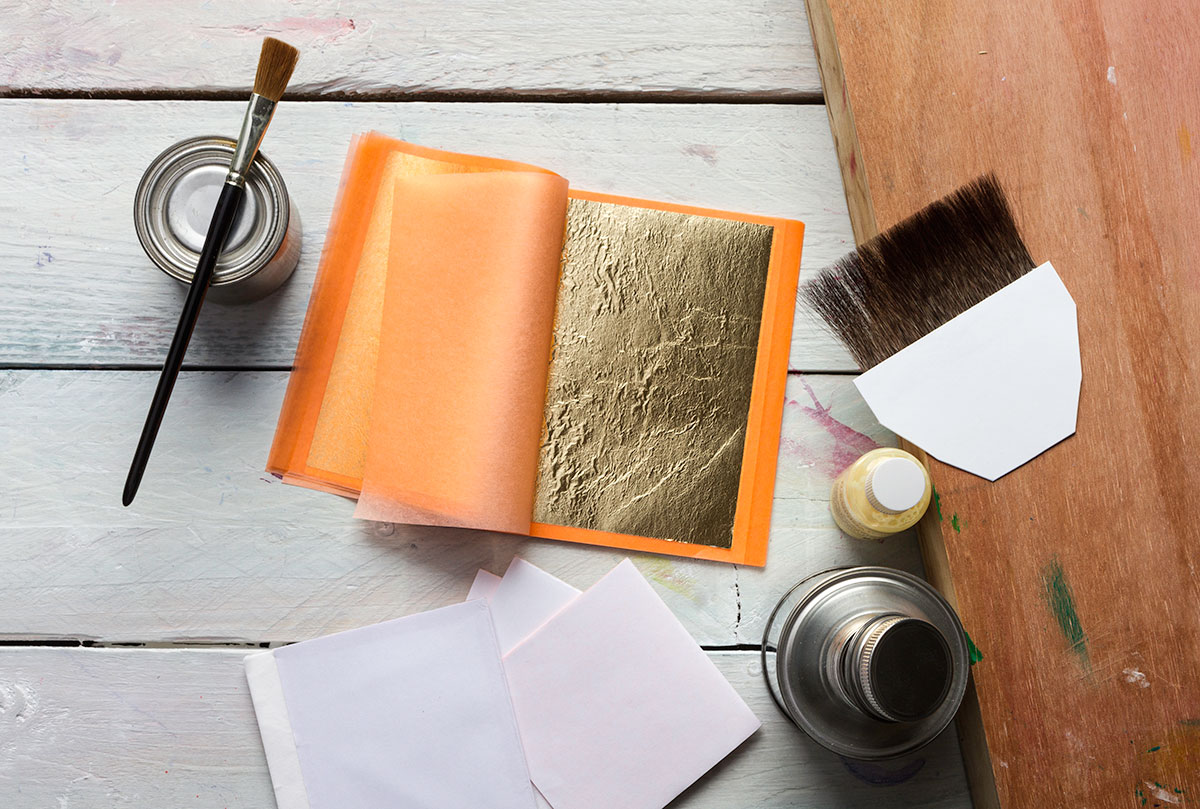
Metal leaf is so thin that any texture underneath will show through, so you may wish to prepare the surface of your support to be as smooth as possible. Apply your metal leaf to your support following the directions on your bottle of acrylic gold size or oil-based gold size (that’s the adhesive).
I use the transfer gold or silver leaf as opposed to the loose metal leaf because it is so much easier to work with and you don’t really need the loose leaf unless you are working on a surface with grooves or carving that you need to push it down into. Brush the excess off gently with a soft brush. Rub the gold down firmly through a piece of paper or cloth. Then let it dry thoroughly, usually about three days or the curing time listed on the bottle of gold size, before sealing it in the next step. It needs to have air reach it to finish the curing process and become hard and stable.
2.
Then spray or brush on Golden MSA (Mineral Spirit Acrylic) Gloss Archival Varnish to seal and prime the metal leaf surface for the oil or acrylic paint layer. You should seal all metal leaf because it is thin, delicate, and can be scratched. Some metal leaf will also tarnish if you don’t seal it. For tarnish-able leaf, choose a product to seal it that will not itself cause tarnishing. After speaking with an expert and testing it ourselves, we determined that Golden MSA varnish is ideal for sealing metal leaf without damaging it. Using a gloss varnish allows you to retain the shine of the metal. Three coats of spray varnish or one thin coat of MSA Varnish brushed on should be enough to protect the surface from tarnishing. Read the label for the dilution instructions of the brush-on varnish.
There are two ways that the metal leaf can tarnish. Sealing with the MSA varnish prevents both kinds.
If left unsealed some metals will tarnish over time from exposure to air and some will not:
- Genuine silver leaf will tarnish
- Imitation silver (aluminium) won’t tarnish (it may slowly tarnish if not pure aluminium)
- Genuine gold of 22ct or more will not tarnish
- Genuine gold of less than 22ct (gold plus copper – or sometimes silver or another metal) will tarnish
- Imitation gold (copper and zinc) will tarnish
- Genuine copper and imitation copper (copper and zinc) will tarnish.
Acrylic paint and mediums contain ammonia which will tarnish any leaf containing copper. Sealing the metal with solvent-based varnish before applying acrylics solves this problem. If you are painting in acrylics and are using one of the metals that does not tarnish (genuine gold 22-24ct, genuine or imitation silver) you can skip the varnish sealer and use the acrylic medium in the next step instead.
3.
If you are painting over the metal leaf with oil paint you should next apply a coat of GAC 200 or another clear gloss fluid acrylic medium. This will seal the MSA varnish from any future solvent applications.
4.
You are now ready to paint. Lots of artists like the look of bits of shiny metal peeking out of the paint. Remember that transparent colours will allow some of the metal leaf to shine through the colour (especially if painted on thinly or in a glaze), while opaque colours will completely cover over it, and metallic paints will be less shiny than the metal leaf.
5.
If you plan on a final varnish, a gloss varnish will keep the metallic shine the best. You can use the same MSA that you primed with, it works on top of oil or acrylic.

Sealing the Metal Leaf
- All metal leaf should be sealed before beginning your painting.
- If painting in acrylic on a leaf with no copper in it (genuine gold 22-24ct, genuine or imitation silver) then you can seal it with a hard clear acrylic polymer medium in gloss.
- If painting in acrylic on a leaf with copper in it (imitation gold, genuine or imitation copper, genuine gold of less than 22ct) you need to seal with MSA varnish before painting.
- But if you’re painting on top with oils you need both steps – the MSA varnish to seal the leaf and the polymer medium to seal the varnish from solvents.
Adding More Gold Leaf on Top of Paint
- Oil paint takes six months or more to completely dry, so applying metal leaf on top of oil paint is not advised because the adhesive (gold size) will prevent the oil from finishing drying and making a stable structure. It should be fine to add it on top of a very well-dried painting – dry enough that you would varnish it (this could be a year or more if it’s thick paint). Be sure to use an oil-based size and test a bit to make sure it adheres. You will need to seal the leaf each time you apply a new layer.
- Adding more metal leaf on top of acrylic paint is fine, but be aware that acrylic needs a few days to cure and let all the volatiles gas-off, so don’t add size on top right away, give it a few days so you don’t seal the surface too soon. Be sure to use an acrylic-based size and test a bit to make sure it adheres. You will need to seal the leaf each time you apply a new layer.
Materials Used
- Metal Leaf
- Gold Size
- The Gilding Department
- Golden Acrylic Archival MSA Spray Varnish Gloss
- Golden Acrylic Archival MSA Brush on Varnish (you will need to dilute it, see article below)
- Gilding books
- Soft brushes
- Golden GAC 200
Further Reading
MSA Varnish Dilution Test Results
Casting A Spell: Image Making with Screenprint, Linocut and Gold Leaf by Colin Blanchard
Inspired by Gold: How Alison Woolley uses traditional water gilding techniques in her work
Metallic Oil Paints with Oil Bronzes
Greg Ramsden: Meticulous Observation of Tone
Shop Gold Leaf on jacksonsart.com




96 thoughts on “Painting in Acrylic or Oil on Top of Gold Leaf”
Thank you; very useful information!
Hello I’m just starting out with this technique, using silver
leaf; there are so many thicknesses to choose from that I’m
wondering which to choose?
Hi Sarah
We stock gold and silver leaf, genuine and imitation, from our specialist gilding partner A.S. Handover. They tell me that gold has different thicknesses but not the silver.
Which thicknesses did you mean?
The thickness of gold leaf is measured by weight as the actual thicknesses are so tiny. The Italian leaf has grams as will all gold leaf.
When choosing thickness I would think about what goes underneath it – for example, glass needs a thicker leaf as it is far easier to see imperfections, pin prick holes, etc., whereas a yellow gesso or paint base wouldn’t necessarily need to account for this. Another factor is durability – if the gold is for use on say a weather vane or a staircase handrail I would choose the thickest/heaviest leaf as it will wear away less quickly.
I have sprayed my imitation gold leaf with three coats of the
MSA varnish but have also read that a layer of Golden Gac
200 is advisable. What do you think? The Gac 200 is said to
provide a tooth for acrylic paint to adhere to. Many thanks
Julie
Hi Julie
I have added more information to the post.
It depends if you are painting in oil or
acrylics.
I have long wanted to paint with oils on gilded panels and
am finally getting started on it. I bought the Golden MSA
varnish you recommend for prepping gilded panels (since
paint doesn’t flow very well on the surface… it kind of
“beads up” a little bit). However, I saw on artist Nancy
Reyner’s blog that this exact varnish you recommend is
great if you’re going to then paint on it with acrylics, but it
isn’t suitable oils, as the solvents in oil paints and related
materials will dissolve the varnish. She says you need a
permanent varnish if you’re going to paint with oils on it.
What are your thoughts on this and do you have any
recommendations for a permanent (non-removable with
solvents) varnish?
Hi Dominica
I have added more information to the article for oil painters The varnish should still be used to seal the leaf as it doesn’t tarnish the leaf when applied. Then to seal the varnish from solvents a clear acrylic polymer medium should be used to seal the whole thing.
Hi, I got advice from an major art supply source that in
order for the acrylic to adhere forever to the silver leaf,
that the Golden varnish you mentioned is not good. What
they recommended is Chroma Fusion I.A. Series Pro-
Grade Binder Medium or Jo Sonya all purpose sealer. I
would like what you say to be true because I have that
Golden product but not the others.Could you please
comment on this?
Hi JoAnne
Following further insight we are lead to believe that GAC200 or GAC500 is a better coating to apply to gold leaf prior to painting, but we need to run some tests to confirm. We do not have the products you mention so cannot confirm their suitability for this purpose, but we will be right back on this! This article has been removed from general viewing in the interim.
Many thanks
Lisa
Hi JoAnne
Any acrylic including the mediums,
contains ammonia which will tarnish metal
leaf with copper in it. So a sealant is
required before you put any acrylic
product on top of the leaf. If you are using
silver leaf you need a sealant from the air
but not from acrylic so you can use any
clear medium to seal it from tarnishing.
Do you colour Prime your surface before applying gold leaf? I understand
from other sources that this is adviseable. If so, who h colour would you
recommend? Many thanks
Hi Sue
Traditionally, gold leaf is applied to bole – a reddish brown clay mixed in with rabbit skin glue. With this as your base the gold leaf appears warmer and richer in colour.
However nowadays bole is available in a range of colours, so the artist is free to experiment with which colour works best for their individual needs.
To shop for bole click here – https://www.jacksonsart.com/search/?q=bole
This is also a very good guide to gilding – https://www.jacksonsart.com/book-practical-gilding
Many thanks
Lisa
Hi Sara, I have been told to wait 3 days before sealing gold
metal leaf ( imitation) and then 3 weeks before painting
over it. Is that the norm.
thank you
lJean
Hi Jean
It depends what kind of size you are using.
If it is linseed oil based it would be worth waiting 3 days as you don’t really want tacky oil under your seal.
But if you are using a waterbased size like polyvine or wundasize 3 days is more than is needed in most situations.
Hope this helps…
Many thanks
Lisa
I have a question. I applied imitation
gold leaf and sealed it to a painting.
Over the next few days I noticed some
parts tarnishing, I am wondering how to
correct this? Could I just apply a new
layer of adhesive, then imitation gold
leaf then sealant over the tarnished
areas?
Hi Maria
Yes this should work. Remember to coat your hands with either cotton gloves or a layer of talcum powder when handling the gold leaf and this will minimise the risk of tarnishing on the new layer..and then always a layer of varnish over the top.
Many thanks
Lisa
Hi Maria
What did you seal it with?
I was just reading on Golden’s website that
their MSA varnish is meant as a top coat and
should not be painted over. Have you
experimented with this? I wonder why they
say do NOT paint over this varnish. Oh well,
I’m giving it a try. As you said, you want to
protect the metal leaf from tarnishing.
Hi Julie
This is stated on the MSA Varnish Data sheet:
‘Painting Over MSA Varnishes: As Golden Varnishes are removable, it is important that they not be painted over. Paint applied over the varnish would also be potentially removable, and would pose a difficult problem in conservation or restoration attempts.’
MSA Varnish, as a top coat varnish, is designed to be applied on top of an isolation coat (this can be made with 2 parts soft gel gloss to 1 part water, but other mixtures could work). It can then protect work underneath from direct exposure to dirt, light, changes in humidity and temperature etc. If the varnish ever gets dirty or coloured then it can be removed and a fresh layer applied without the work underneath being affected.
Because of its removability anything painted over the top will be painted on a removable surface, causing future restoration to the potentially problematic. Also because it is an impermeable layer I suspect paints may not adhere to it very well long term.
Many thanks
Lisa
Hi I am doing a mixed media with
paper, acrylic, over gold leaf to do
a modern take on a tryptich type of
mural. WHICH should go on first? Can
I modpodge over dried sealed gold
leaf? I would like to cover the
canvas with gold prior to doing the
paper and acrylic parts.
Hi Amy
Yes you can – ModgePodge is effectively an acrylic based media. Once the gold leaf is sealed you can work with it over the top.
Many thanks
Lisa
Golden MSA varnish comes in matte,
satin and gloss. Is one preferable over
another when painting over the metal
leaf (yet leaving some areas exposed)?
hi Miranda
This really all depends on how you want the end result to look…all the varnishes perform in the same way.
Many thanks
Lisa
Hi Miranda
If you want to make the most of the shine of the metal it is best to use gloss.
I’ve been reading the article and then the
comments and there seems to be a
conflict of what things to use. I’m starting
out and want to paint in acrylics and use
metal foil under AND over the paint as I go
along. What products do I need to buy to
adhere the metal foil, seal the foil ready to
paint on top of, and lastly to finish off the
painting completely. Is there a video blog
showing this process?
Hi Dee Dee
Apologies that the post isn’t clear.
Here are two good resources, from where we got much of our information. Nancy Reyner has a video in her post as well.
https://www.justpaint.org/acrylics-on-gold-leaf/
https://nancyreyner.com/prepare-gold-leaf-oil-painting/
“next apply a coat of GAC 200 or another clear gloss fluid acrylic medium”
Could you please advise on another clear gloss fliud to use instead of GAC 200 – would Liquitex gloss medium/varnish be suitable?
Thanks
Cathy
Hi Cathy
It should work well, it sounds very similar to GAC 200 – it is clear, fluid and dries hard.
Hi!! Wish I’d found you prior to my
experiment! I painted with oils over
silver leaf.. love the way it looks but the
paint doesn’t seem to be drying. I did not
seal the leaf prior to painting- is that
why? If it eventually does dry, regular
varnish over the entire piece? Thanks!!
Hi Lori
Oil on metal leaf should dry just as fast as on other substrates. It must be something else you’ve done differently to your usual oil painting. Have you switched paints or used a different medium or painted more thickly?
Student grade oil paints usually have driers added to the slow drying colours to make all the colours in the range dry at the same rate. If you are used to using those then using an artist or professional grade paint for the first time might seem surprising. Whites, some blacks and crimsons can take up to 10 days to touch dry, longer if thickly applied.
If you added a fat medium or linseed oil to thin your paint it will take longer to dry.
Some varnishes will tarnish the metal leaf that is prone to tarnishing: genuine silver, genuine copper and imitation gold. But we know that Golden MSA varnish doesn’t affect the metal, so is safe to use. It also comes in an aerosol – Golden Archival Aerosol MSA Varnish.
Just a reminder that you shouldn’t varnish it right away, it will take six months to dry to the centre and then you can seal it. If you seal it before all the paint has dried all the way through, the bottom of your layer will still be soft and if sealed it will not be able to absorb oxygen to dry and form the hard stable film you require.
Hello!
I have created an oil painting and have put
imitation gold over certain spots. What is
the recommended sealer/varnish to
ensure that the imitation gold leaf does
not tarnish? (I am currently hearing mixed
recommendations between GAC 200 and
Golden MSA Varnish Gloss).
thanks!
Hi Kailee
MSA Varnish gloss, either spray or brush-on, is the sealer for metal leaf.
Hi
I have done an acrylic painting on
canvas. I want to use silver/gold leaf
over this. I will not be painting over the
leaf.
Can it tarnish with just air overtime?
Will I need to seal it?
If so, can you recommend what to use ad
a top coat sealer?
Will this one work?:
GOLDEN : ARCHIVAL VARNISH
AEROSOL.
Also, if i wanted to use acrylic paint over
my leaf, can i use the same varnish as
mentioned above?
Thank you
GOLDEN : ARCHIVAL VARNISH AEROSOL
: GLOS
Yes, that is correct.
Great info, in both the article and
commentary. Many thanks to all who have
contributed.
Thank you, Lisa! Glad it was helpful.
Hey Julie, on your guide you say to wait 3
days for the size to dry underneath before
varnishing, but on justpaints guide they
mention to apply a clear protection coating
the same day?
Hi Adam
Thanks for your question. All the gold size brands I’ve seen say to let it dry for a further 1 to 4 days to cure before sealing it. The average is about 3 days.
Perhaps JP say to seal it right away because they are concerned with preventing tarnishing. But the amount of tarnish that would occur in 2 or 3 days is negligible.
Thanks for your reply Julie. I’ve decided
to leave my gold leaf substrates for 3
days before varnishing.
Pingback: Acrylic Paint Guide - Jackson's Art Blog
Pingback: Painting in Acrylic or Oil on Top of Gold Leaf – Craft Erra
Question: I have an old full-length, ornate mirror that I painted with gold leaf paint. I have sanded off all of the paint except for the ornate spots. Do I need to seal the spots that still have the gold leaf paint on them or can I just paint over them with acrylic paint?
Thank you!!
Hi Carla
We advise sealing all metal leaf to protect it from tarnishing (from the air and from what you paint on it) and from being scratched. If you are covering over all the metal with acrylic paint so that you cannot see it anymore then you won’t need to worry about tarnishing and could probably skip this step.
Does apply with W&N Artisan oils?
Hi Susie
Yes, it would be the same.
Hi Julie,
Request your advise please.
I have just started Oil on canvas and
want to do fine detailing ( windows,grills
,fountain etc set in a resort) and wanting
to use some microtip pens/ markers
Which brand would you recommend? Am
I on right track ? Best .Vijay
Hi Vijay
This is a common question from beginners. How to get the fine lines of the subject.
Pens are not usually used on top of oil paint. They don’t stick well because they are not oil paint. They might be scratched off later and the varnish that you apply 6 months later when the painting is fully dry, might dissolve the ink.
The way most skilled artists approach it is to not paint every tiny part, they paint just enough to show the idea. If every little thing is painted it often looks stiff and false. Go look at paintings in a museum by artists you admire and see how they do it.
When they do want a fine line they paint it and then immediately paint around it with the colour from behind the object, going over the line edge to make it a finer line. So the first brushmark describes the curve of the fountain and the second brushmark adds the shading of the edges of the fountain and the third goes back with the first colour and covers some of the shadow until it is the right size. Most fine lines in oil paint are painted this way by sort of sculpting marks until they are the right size.
I hope that helps.
Hello,
I have used speedball metal leaf adhesive on
a large acrylic painting and applied metal
leaf. The metal leaf looks great but in the
areas where the adhesive was applied but
gold leaf was not, it is still pretty tacky and
has not cured over. It has been 8 days and I
have had a fan blowing on it for the past 3-4
days. Can I go ahead and apply the varnish if
it is still sticky? If not, any tips on getting
the adhesive to cure over? I will be using
Krylon UV Archival Semi-Gloss spray
varnish. I am planning on varnishing it and
then painting over it a little and varnishing
again. I am new at this so hopefully i’m
doing it right 🙂
Hi Megan
We don’t stock this product and are not familiar with it. It sounds like an acrylic gold size but I don’t know how long the cure time is or how to troubleshoot the problem. Have you tried contacting Speedball or the place you bought it from?
I’m planning to use imitation metal leaf to
embellish watercolour ACEOs and wondered
what the best way was to seal them so the
metal leaf won’t tarnish whilst also
protecting the watercolours.
I’ve been searching high and low for info on
this, but everything I found so far is referring
to oil and acrylics.
Do you have any thoughts on the
watercolour angle? Would certain sealant
sprays make the colours run?
Also, to what degree does a sealant actually
protect the metal leaf from getting scratched
or rubbed off? Is it feasible to protect gold
leaf embellished bookmarks, for example, or
is the friction & handling too much for that?
I’m pretty new to all this, so any tips would
be greatly appreciated!
Thanks very much!
Hi Mira
I am working on a blog article right now about making watercolours waterproof. What I have discovered so far is that if the product doesn’t contain water then it doesn’t dissolve the gum arabic in the watercolour.
So an alcohol-based fixative or varnish works well or an oil painting varnish. I have seen a few artists rubbing cold wax oil painting medium into the watercolour surface to seal it.
This means that the MSA spray varnish mentioned in the article should work fine for watercolours. If you want to gild something that will take wear and tear then most gilders use shellac.
As with anything new to you, try it first on one sample that is not super important to see if it works as you want it to.
Cold Wax
Wax Varnish
Watercolour Varnish Gloss
Shellac
Hi,
I am working heraldry on an oil painted brass
panel. The paint has been dry about 6 weeks.
I have used oil-based size which is tack dry
in an about 45 minutes (August temperature
over 30 deg.) and applied genuine gold leaf
to areas of the design.
When removing the excess gold, some
remains stuck to the backing and I can’t get
sharp edges. I have been careful to
degrease the surface before starting and
wear gloves.
What am I doing wrong?
I would be pleased for your advice.
Hi Rod
I asked our specialist gilding experts at A.S. Handover and this is their reply:
Sounds like the heat is reactivating the top of the dry paint maybe? He can put whiting powder on the paint first, then size, then gold!
Hope that helps.
I’ve just seen your reply. Sorry for the
repeat question sent before seeing your
reply.
Thank you very much for the advice.
I have tried dusting lightly with french
chalk which does seem to help.
Perhaps I should wait longer – at least
until it cools down to a more
comfortable temperature.
Hi there! I am just wondering if this method would work:
(All with artificial leaf)
Apply size+gold Leaf to Canvas
Paint (with oil paint) directly onto the Leaf
Seal with MSA Gloss Archival Varnish
(+ appropriate drying times inbetween)
This would be with the aim of skipping the GAC 200 stage. But is
this in advisable?
Is this idea of mine technically possible but not in real life because,
with oils inherantly taking so long to dry, by the time they have
suitably dried, the exposed bits of leaf will have tarnished?
Im just trying to work out why the GAC stage is needed inbetween
(as posts above show) and can only think this must be the reason?
I never paint terribly thickly with oil paints so perhaps I could try
this?
Thanks so much!
Vicki
Hi Vicki
Yes, the purpose of both the varnish (spray MSA) and the acrylic medium (GAC) is to prevent exposure of the metal leaf to air. If you are using imitation gold that is particularly important.
The only reason to add the acrylic medium when oil painting is to seal the varnish from any solvent you may use when painting as the solvent may remove the varnish. If you do not use solvents when painting in oils you do not need the acrylic medium step that seals the varnish from solvent.
Thank you so much, Julie! Thats really clear & I
understand now 🙂
Thanks Vicki
That’s great to hear! My goal is to make things as clear as possible.
Hi Julie,
I have another question if that’s ok.
I have just been browsing the Connoisseur Liquid Leaf range (I am
trying to assess all the options before committing to actual gold
leaf; It’s quite foreboding a concept and seems very involved!)
My question is, if I were to use Liquid Leaf + the Treasure Sealant,
would I then be able to paint onto this with my oil paint (+ any little
bit of solvent) successfully? Or would a layer of MSA? GAC? be
necessary inbetween?
Thank you again,
I really appreciate your help and knowledge on this as I get to grips
with the world of gold!
Vicki
Hi Vicki
Since the sealant is dissolved with alcohol I thought it should be fine with oil paint solvents (turpentine and white spirits), but I double checked with the supplier. I also asked if the liquid leaf tarnishes and needs a sealer.
They responded:
“Yes it’s fine to apply oil paint over sealed liquid leaf, turpentine will not reactivate the liquid leaf when sealed.
Unsealed liquid leaf will reactivate if turps is worked into it.
I haven’t as yet seen any examples of the liquid leaf tarnishing, the sealer is an extra protective layer.”
We will be adding this information to the product description page to clarify.
I hope that is helpful.
Hi Julie,
I have a 2 part question which is a little out
of the box:
1. I would like to use 23K gold leaf on parts
of a pigment-based ink jet print. Do I need
to seal the print first? If so, what would you
recommend?
2. I would then like to use acrylic or
gouache paint over the 23K gold leaf and
perhaps parts of the ink jet print. Again,
does this require any coatings first?
Thanks for all your invaluable help!!
Hi Bill
There are two reasons you might want to seal the print first.
If the ink smears or rubs off when you touch it.
A spray with UV protection will help keep the paper from changing colour and make even the pigment inks last longer.
But it is not required before applying the gold size adhesive.
23k gold will not tarnish so if the artwork is being framed behind glass you don’t need to seal it.
If you are painting on top of the gold it is a good idea to seal it so that you don’t damage it. But in the case of painting on paper I would worry that the a gloss varnish would make the paper shiny and a matt varnish would lose the lustre of the gold. Since you are using non-tarnishing metal, if you paint gently with your acrylic and acrylic gouache you could probably get away with not sealing the metal. If you do want to seal it the MSA varnish recommended in the article would do the job.
Thanks so much. I appreciate your
expertise!
Thank you so much for this invaluable
information.
Hello. I am working on a mixed media
painting using some leftover house
supplies. I created texture using joint
compound, and painted over it with
leftover wall paint. I would love to add
imitation gold leaf (86% copper) as my
next step to reveal the unique texture.
After the gold leaf, I plan to apply a final
coat paint over it again with remaining
wall paint. Is using wall paint advisable
and okay to use over the gold lead? I
also purchased satin sealer (by Old
World Art). Could I use this after I apply
gold leaf?
It should all work fine if you seal the imitation gold or it will tarnish because it is copper.
Use a spray or brush-on sealer that does not cause tarnish itself. I do not know the brand you mention. The brand we recommend is Golden MSA varnish.
Hello,
I am seeking some advice on gilding. I
have read many forums and websites
about the process! But my question is
whether it would be ok/sensible to apply
silver/gold leaf to a canvas, not a hard-
backed one but a typical stretched
canvas on a wooden frame.
I know its traditional to gild onto a rigid
surface but would there be any issue
with my idea?
I suppose the usual concern is the
canvas would be too flexible and could
‘flap around’ but I cant imagine it would
get moved much once its on a wall so
i’m thinking it would be ok.
Would the silver leaf be happy with this?
I wondered if you had an experience with
doing this?
Thank you ever so much!
Hi Vicki
Lots of contemporary artists gild on stretched canvas without a problem.
Hi. I want to paint a watercolour portrait with
a real gold leaf background that has some
raised gold leaf areas that I can burnish. I
have no idea how to achieve both. I normally
use 300lb SW w/c NOT paper but believe
that the areas for the gold need to have
gesso and be ultra smooth so I’m wondering
if I can use my paper or do I need some other
surface?
You can apply gesso to paper and build up layers for gilding. Genuine gesso is best on a rigid surface so it might be best to mount your paper to a wooden panel before you paint and apply your gesso.
Pingback: What Makes Schmincke Mussini Oil Paints Special? - Jackson's Art Blog
Pingback: What Makes Schmincke Mussini Oil Paints Special? - Blog
Hello,
Thank you for all this info on subjects which I have been pondering for some time. I only just found this blog post.
Currently I paint in watercolour and gouache on paper and use 24ct gold leaf on top of and around the painting which I then frame under glass. I use an acrylic size for the gold.
I want to try painting in acrylic on a true gesso panel and seal with some kind of varnish so that I can make larger paintings that don’t need to be placed under glass.
My preferred technique would be sometimes painting on top of the gold leaf and sometimes the gold leaf on top of the paint.
For paintings in acrylics with gold it was suggested by a reputable supplier to use Lascaux : Fixative Spray 2070 as a final sealant over a finished piece in acrylic and gold leaf to protect the gold leaf and paint from scratches. What do you think?
Would you recommend still sealing the gold leaf with the MSA varnish before applying any paint on top?
I’d also like to try painting with oils on top of a water gilded gesso panel – but I think you have already covered the technique for that.
Thank you very much
Hi Linda
I am not familiar with that fixative, but fixatives are sort-of weak varnishes. So a few coats should be fine if it covers it well. You could check to see if you can scratch the gold with your nail perhaps.
Hi there, not sure if I’ve made a mistake
in using Liquin to stick gold leaf onto a
tray frame. I saw liquin used on a
YouTube video by a guy who was making
some pretty impressive frames. I had
some so thought I’d use it. I’m now
concerned that the liquin might not dry
sealed in by the gold leaf. Would
appreciate your thoughts. I intend to age
the finish and was thinking of going
down the oil glaze route. Thankyou.
Hi Sarah
I have not heard of this before. I asked Winsor and Newton what they thought and they replied “It is not an appropriate product to use for gold leaf and since I have never tested Liquin in this way, it is not possible to know if it works or not. It is not an adhesive and normally a glue size would be used like Japan gold size. We cannot really comment on very experimental applications like this. We will have to see if this customer comes back with any resulting problems!”
I have sent an email to a gilding specialist and will get back to you and add the reply here when I receive it.
Hello again.
It might be ok.
I asked a gilding expert at AS Handover if the gold leaf was thin enough to be porous and so oxygen can get in to dry the oil. I thought it might be because the gold is so thin that gilders often use red coloured gesso underneath because it can be seen through it and makes the gold look warmer.
She said yes!
“ Gold leaf is porous enough to let the oil based gold sizes dry, and often people use 1shot paints instead of gold size and this dries fine as well. So I can’t say for sure how well it would work but I should think it would be ok – perhaps they could run a test first by checking the next day, etc – if the gold moves still then whatever is underneath is not dry.“
I have a large 5 X 7 mirror wood with gold
type finish. How do I know or tell if it IS
gold leaf or imitation gold leaf or NOT
gold leaf at all? I wish to paint the frame
black ( matte finish then satin finish
laquer) best recommendation?
Hi Roger
It’s not always possible to tell. If you had them side by side you could see a difference in the quality of the shine and patina.
But some clues can help you. If it is metal leaf there will be lines at the edges of each sheet or where each sheet overlaps there will be stripes. The distance between stripes indicates the size of the sheet. The size of the sheets can tell you if it is real gold (8x8cm) or imitation gold (14x14cm).
Either way, if it is metal or gold paint, if you are going to cover it all over then an oil-based paint like enamel will do the job, no other preparation necessary.
Hello,
I applied genuine gold leaf on top of an
acrylic painting that I plan on finishing in
oils. Do I need to seal the 24k gold leaf with
both MSA varnish and GAC 200 or can I just
use GAC 200? The MSA varnish is only
needed if I’m using gold leaf with copper
right? Thank you!
If painting on top with oils you need both steps – the MSA varnish to seal the leaf and the polymer medium to seal the varnish from solvents.
The MSA will also be varnishing any exposed acrylic paint and that is fine.
Pingback: Portray in Acrylic or Oil on Prime of Gold Leaf – My Lifestyle
Hi,
I started an oil painting and planning to
use immitation gold leaf flakes on some
parts of it. I am very new to gilding and
what I am reading on the net is that I
need to use an oil size for sticking the
flakes on it but I am unable to find any in
Canada and the ones imported are too
expensive. What can I use instead, can I
use water soluble size and then seal it
with a good varnish to keep it intact?
Please help guide. I am in the middle of
it and don’t know what to use. I am
guessing from your article that using it
with acrylic would have been an easier
option so will follow that in future.
It’s true that the acrylic glue size won’t stick to your dried oil paint. So you will need to use an oil based glue size to glue on top of oil paint.
Hi Julie,
Thank you so much for taking the time to
write this comprehensive guide! I’m planning
on using 24ct gold leaf in a painting and was
wondering if the Manetti “16g extra thick” is
suitable for that purpose? I can’t seem to
find much info on that anywhere.
Hi Eirik
Yes, it will work fine, it will just be a thicker layer of gold that you apply, and because it is more gold it will be more expensive. If your painting is flat then you can use the transfer leaf which is easier to apply.
I have a gessoed canvas with a thin layer
of acrylic wash with an underpainting
design. I want to apply genuine gold leaf
(23K) to small areas within the design (not
the entire canvas). I’m confused about how
the sealing process before I apply the size
for gold leaf. Do I need to seal the entire
canvas, just the areas I plan to apply the
leaf or not at all since it is genuine gold
leaf. Once the painting is completed, then
I can seal the entire piece with a varnish.
Do I need to apply an isolation coat before
the varnish? If so, can the isolation coat
be applied over the gold leaf? Im
concerned that it may dull the shine.
Thank you so much for your help!
You do not need to seal before you apply the gold size.
If you are using genuine gold of 22ct or more you do not need to seal the gold from tarnishing from the air or from the ammonia in acrylic paint. You can paint directly on it with acrylic paint without an isolation coat.
When the painting is finished you may want to seal any gold left completely exposed with a spray of MSA varnish to prevent it being damaged by being scratched.
Can I use damar varnish instead of the
MSA spray varnish?
Hi Jennie.
I’ve double checked and we don’t think so. The turpentine will probably tarnish the metal.
Thank you for the article. I am hoping to
include gold leaf in my next painting but
after reading the comments I have
gotten rather confused about the best
course of action!
I normally work on a panel primed with
gesso, then I add a layer of acrylic
ground, then I start painting with water
mixable oils on top when all’s dry. Where
would adding gold leaf fit into this? I’m
particularly confused about the
varnishing the gold leaf before applying
oil paint as I’m concerned it will affect
the oils on top and I read somewhere it’s
not recommended to paint over the
varnish. So I would be very grateful if
you could tell me the process and
materials and drying times for applying
gold leaf within a water mixable oil
painting. Thank you so much
If painting on top with oils you need both steps – the MSA varnish to seal the leaf and the polymer medium to seal the varnish from any use of solvents while oil painting. If your oil paint process doesn’t use any solvents, including in your final varnish, then you could skip that step and paint on the MSA varnish sealed leaf as you would if you were using acrylics.
Can you paint watercolor over gold leaf?
Hi Kathleen
Watercolour on top of metal will bead up so painting on gold leaf doesn’t work very well. Because it is not a porous surface like paper is, the paint would also not stick very well.
But it is easy to add gold leaf to a watercolour painting either after you have finished or anytime in the painting and paint up to the edge.
I am working on a portrait with pencil over paper. I have added a very classic halo to the paper with real gold leaf 23.75K, and even worked with punches and incisions. Looks great. But how to protect this gilded part? I tried to apply Dewaxed Shellac (used in icons) to an unseen spot and… it completely tarnishes it! Not only the colour changes, but the shine disappears as well. Can the gilded paper be left unprotected? And if not, what product can I use to preserve the shine and protect the work? Thank you!
Hi John
That’s unusual, because 24ct gold has nothing in it to tarnish. Is it possible that the shellac has colour itself? Shellac (unless it is clear shellac) usually has a colour to it, some of them are quite dark. The darkness might also be obscuring the shine. Could you take a photo and send it to us? If you can, please send it to [email protected] and ask them to forward it to Julie please.
Comments are closed.