



Alkyd Artists Paints
Alkyd resin is synthesised from plant and vegetable oils, like linseed or soya oil, that is modified (oil-modified alkyd resin) for use in artist’s oil paints, mediums and grounds. When it is dry alkyd is tough, flexible and resistant to solvents. The main advantage of alkyd is in the speed at which alkyd resin dries. Alkyd oil paints or oil paints with added alkyd mediums will usually be touch-dry in 24 hours, if painted in a normal thin film. They become tacky within a few hours so brushstrokes can be added without disturbing the earlier paint.
This drying rate allows painters to work throughout a painting session without the oil paints drying on the palette, but the painting surface will be dry when they return the following day for the next painting session. This is particularly useful for painters who apply many oil glazes as the painting will be dry the next day to apply your next glaze. As artist Robert Dance says on his website: “The alkyd medium is about as ideal as I have found to capture this effect without waiting days for these glazes to dry before applying the next glaze.”

The Winsor and Newton Griffin Fast-Drying Oil Colours range of artists paints uses this alkyd resin as its binder. Alkyd oil colours are compatible with traditional oils, mediums, mineral spirits, and turpentine, as well as with other alkyds. Alkyd oil colours also can be used to speed the drying time of regular oil paints.
By modifying the alkyd paints with thinners (Liquin or Liquin Fine Detail or solvents) the paint can be applied like egg tempera, smoothly and precisely. By modifying the alkyd paints with thickeners (like Oleopasto or Impasto mediums) the paint can be applied in a thick paste that shows brushtrokes.
Just as for regular oil painting remember the fat over lean rule – this means that the initial layers of oil colour should have less oil content than the layers applied over the top in order to allow the painting to dry solidly throughout the layers – this will give your painting stability and minimise the paint’s ability to absorb water from the air. Related to this rule is the rule that each layer needs to be slower-drying than the one before. This means that unless you paint all in one session – alla prima – each successive layer needs to have more oil and dry slower. This means that unless you are painting wet-into-wet (alla prima) then straight alkyd is best used for the earlier stages of painting (underpainting) and then either finish the painting with regular oil colour and a bit of oil for later layers or continue with alkyd to which you add some alkyd medium or oil medium.
To show how sturdy these paints are Winsor & Newton says about Griffin Fast Drying Oils: “Alkyd resin dries to a hard paint film that has good resistance to physical wear and weathering. This makes Griffin Alkyd Fast Drying Oil Colour the ideal choice for using on surfaces such as wood, glass, metal or porcelain to decorate both functional (non-food use) and decorative items. Griffin Alkyd Colour is ideal for the decorative painting which is popular in Northern Europe and also with folk artists. The speed of drying and hard paint film make Griffin Alkyd Colour ideal for outdoor signs and oil colour murals.”
A conservationist at an Italian museum that I have spoken with thinks alkyd is the most stable binder available because it is flexible like acrylic but much tougher and can be manipulated by the artist in the same way as oil. So it is the best of both worlds. He thinks alkyd oil colours are the wave of the future.

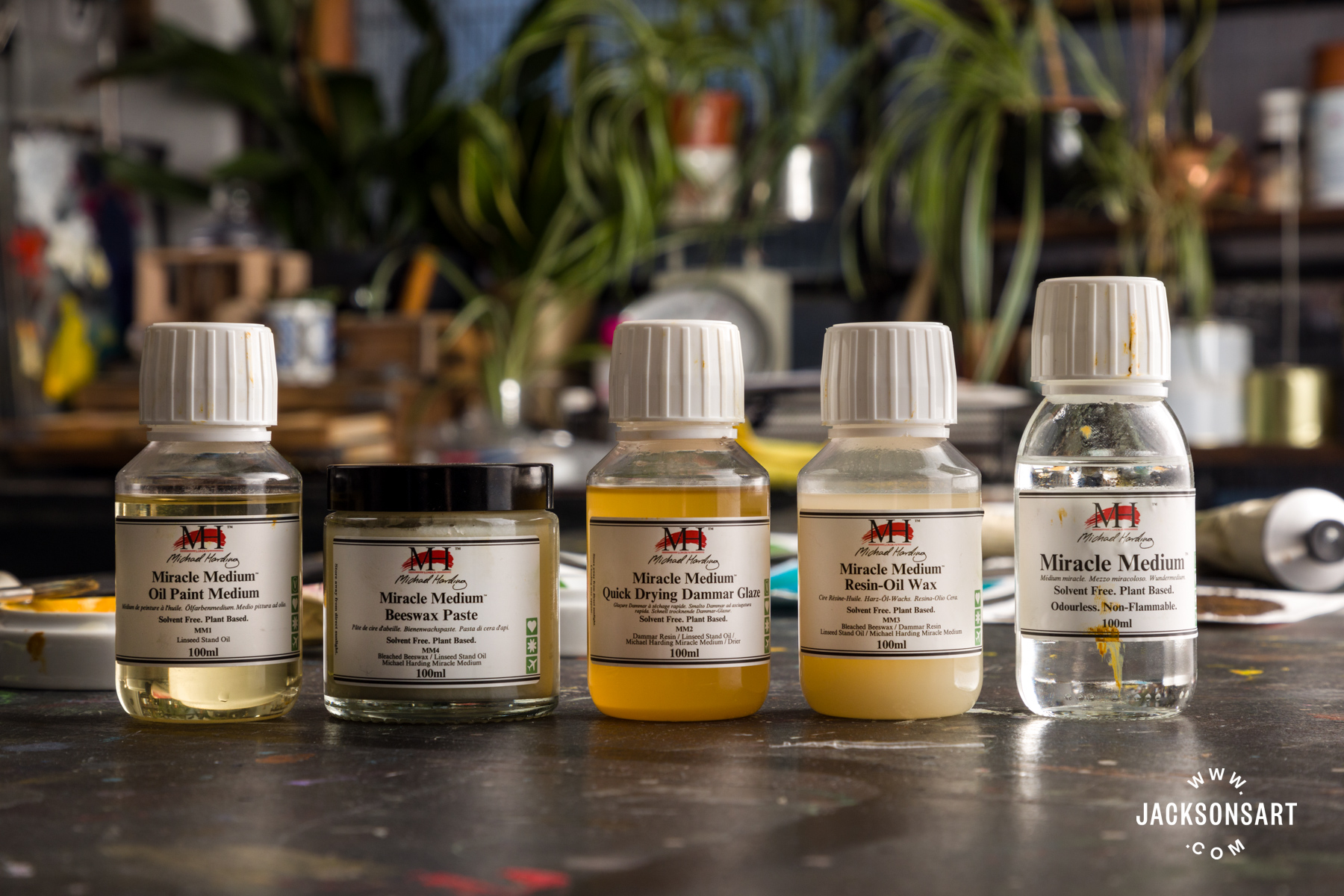
Alkyd Oil Painting Mediums
Adding an alkyd medium to oil colour speeds up the drying time while thinning or thickening the body of the paint and changing the gloss, depending on which one you choose.
Brands Available:
Jackson’s Fast Drying Oil Painting Medium, Jackson’s Alkyd Oil Medium and Jackson’s Gloss Gel Medium.
Winsor and Newton Liquin (Read about the varieties of Liquin in this earlier blog post)
Daler Rowney Alkyd Flow Medium
Pip Seymour Alkyd Resin Glaze Medium

Alkyd Primers
Alkyd resin is also used to make primers (grounds). It allows these primers to dry a lot faster, because you want your ground to be ready to paint on quickly. An alkyd oil ground is similar in appearance to a standard oil ground but is faster drying (touch dry in 24 hours), yellows less than a standard oil-based ground, offers good durability and hardness. Both alkyd- and oil-based grounds require the canvas to be sized (sealed) first.
At Jackson’s we stock only alkyd-based oil primers: Roberson Oil Primer, Winsor & Newton Oil Primer and Jackson’s Alkyd Oil Primer. (We have a few of the discontinued lead-based primers left.)

10 thoughts on “Alkyd: Artists Oil Colours, Painting Mediums and Primers”
I am interested in the Winsor newton oil primer to paint
regular oils on. I want a white background that does not
yellow. It says in their write up about adding a color to
the oil primer to make a prebase color background if you
like, then about how ‘then’ it is ready to hold onto oil
colors. This confuses me. Should this be done or will the
regular oil paint flake, etc. off in time.
Hello
I have read their wording and you’re right it is confusing. It implies that if you don’t add colour then it won’t be ready.
But I think this is not the case. It doesn’t need colour added to work.
Unfortunately I can’t tell you much more as the product is no longer available.
I have emailed Winsor to find out if they are going to do a replacement.
Other white oil grounds vary, but most need some curing time for the surface to be ready to paint on, a week is usual. You need to size the canvas or paper (seal it) first with either acrylic size, rabbit skin glue or acrylic primer before you add the oil ground to protect the canvas from the oil. Wood doesn’t need sizing first. So the oil ground isn’t really a primer, it is a ground on top of the primer. Jackson’s stock 3 other brands of oil ground: Jackson’s, Roberson and Gamblin. https://www.jacksonsart.com/studio/sundries/grounds/oil-primer?utm_source=jasblog&utm_medium=oilgroundscomment190717&utm_campaign=blogarticle
Hi … I know this is an old post, but just came across it and have a
query please …
You say that using the “fat over lean” if working with alkyd paints,
one should start with straight out of the tube and then end on top
with a mix of the alkyd tube paint Plus alkyd (or oil) medium …
Quote “… or continue with alkyd to which you add some alkyd
medium or oil medium.”
But if one is using alkyd paints that is pigment with already added
Alkyd resin, adding extra Alkyd medium to it as a top layer … (
and with alkyd resin making drying faster) … the addition alkyd
resin to the already resin containing alkyd paint, wouldn’t that
make the top layer dry faster than the bottom layer because of
the extra alkyd resin??
It might have come out sounding confusing .. but again if the top
layer has more alkyd resin than the bottom layer, wouldn’t the top
layer dry quicker and then it would be, lean over fat as relating to
drying time leaving the under layer still wet and potentially
making it possible to crack once dried?
Hi Rob,
Thanks for your query – it’s a good question! The alkyd resins used in Alkyd paint and alkyd mediums contain a percentage of oil in them. During the formation of Alkyd resin it is combined with a drying oil, such as linseed oil. So it is a misconception to think of Alkyd resin as being something completely different to linseed oil.
While alkyd mediums do dry faster than linseed oil, the rate of drying doesn’t keep on speeding up the more Alkyd medium you add…. in fact a thicker layer of alkyd resin will dry more slowly than a thinner layer of alkyd resin. A layer of alkyd resin will dry at an equal rate than the one underneath so long as it is the same thickness and has not been thinned out with solvent, and there will be no risk of cracking.
Hope this makes things clearer!
Lisa
I’ve recently put the alkyd primer over an old
oil painting on canvas. It certainly isn’t
drying as I would have hoped. It’s now 48
hours and it’s still tacky. I’ve previously
used a traditional oil primer which, I
consider, worked a lot better. So
disappointed.
Hi Vic
The Thixotropic Alkyd Oil Primer is a one-coat primer that should be touch dry in one or two days and fully cured in 4 – 5 days.
Did the traditional oil primer you usually use dry faster than the alkyd? In my experience, they take a week or more to cure. Or do you mean it worked better in another way than just the drying?
Hi Julie,
I’m considering substituting W&N Liquin
original with M.Graham & Co. Walnut Alkyd
Medium, mainly because I find it is less toxic
and produces less fumes.
I paint with 100% W&N Griffin Alkyd Oils and
after contacting W&N they cannot guarantee
longevity results with the Walnut as they do
not test their products with other brands but
also commented they can’t see any issues
changing to the Walnut Alkyd Medium. I
would appreciate any knowledge you have
for my issue of swapping to Walnut? I’ve
heard negative things online about nut
mediums such as they can darken and
yellow paint over time. I dilute Liquin original
with Gamsol for lean initial layers so looking
for clarification if that would be suitable to
do so with Walnut Alkyd Medium also?
Hi Joel
I do not see any issues with using the M. Graham Alkyd Medium with the Griffin Alkyd paints. You can mix oil paints with alkyd paints so you can mix oil with them, too.
The only issue with nut oil over the other drying oils which are all seed oils – poppy, linseed and safflower – is that it can oxidise faster, that is go rancid sooner. So storing large amounts for a long time is inadvisable. The seed oils also go rancid, that is the linseed oil smell that a few people object to, but just not as quickly.
Walnut oil on its own is less yellowing than linseed oil and faster drying than the other two oils. I don’t know all the ingredients in the M Graham Walnut Alkyd Medium because art materials are not required to list all the ingredients like food. Walnut oil doesn’t yellow and alkyd resin doesn’t yellow. I read on a forum that the medium seems to yellow more than you would expect. But this is only in a test in an unusual situation, not real-world use. In the test it was painted thickly by itself. The medium is meant to be used just a drop per inch of paint so the test wasn’t really representative of what could happen. The medium goes very far and has such a thin consistency that it is great for increasing paint flow with a tiny addition. The test I read about assumed that since there was yellowing with this painted square of neat medium, then it must also include cobalt driers, which do yellow. My understanding of cobalt driers is that a tiny bit goes a long way and if you use just a drop it won’t yellow either, unless you use too much. Summary: the medium shouldn’t yellow if used sparingly as intended and it probably doesn’t contain cobalt driers as this forum surmised.
I have not needed to dilute the Walnut Alkyd medium with solvent myself, but Gamsol should be fine as mineral spirits is what Alkyd is usually prepared with. But because their medium is solvent-free, it might be best for you to drop a quick email to M Graham as they can advise you best on that. Or you could use Gamsol with the first few layers, in lessening amounts and then switch to the Walnut Alkyd. Just remember that you can’t keep adding more, it needs to be used sparingly. If you paint in loads of layers then you may want to add plain walnut oil to your top layers if you need more fat. That would mean you last layers dry more slowly.
You might find these two articles about yellowing helpful:
https://www.jacksonsart.com/blog/2019/10/04/what-is-dark-yellowing/
https://justpaint.org/on-the-yellowing-of-oils/
I hope that helps. Come back and let me know how you got on, if you have time.
Hi Julie,
Thank you for all of the information on
all of the different medium/ solvent
options. I want to start using the walnut
alkyd medium myself and be completely
solvent free but I can’t find any
information about the oil content of the
alkyd especially the M Graham. So would
you recommend using the walnut alkyd
medium in your under painting and then
using just oil paint and adding walnut oil
for your last layers or using alkyd
medium throughout the whole painting
with walnut oil at the end? I’m just
confused how the alkyd would affect the
fat over lean rule if it has oil already in
it.
Hi Sofia
M Graham say that it is a fat medium and also that it is a fast-drying medium. They recommend it for the lower layers of a painting, like alkyd paints.
You use very little, it is very good at adding flow with very little medium, so only two drops are needed per inch of tube paint. I use a pipette.
This won’t add so much as to create havoc with the fat-over-lean method, the real concern of which is to be sure that each layer dries more slowly than the previous. Apply thick-over-thin layers, or think of it as slow-over-fast.
Comments are closed.