



Artists who wish to paint in oils but are sensitive to solvents often choose to use water-soluble oils (also called water-mixable oil and water-miscable oil). The paint is similar to conventional oils but you can paint without a solvent and best of all you can clean up with just soap and water. There are special painting mediums you can use to mix with the paint instead of water and then only use the water to clean up. The benefit of using the mediums is that the mixture of paint on your palette remains the same for hours as you paint, whereas if you use water to thin the paint it will evaporate on your palette and the paint thickens up during your painting session. I also found that thinning with water looked more like watercolour, didn’t blend because it dries very fast and it dried matte. The different brands of painting mediums work fine with other brands of paint.

Water-Mixable Oil Paint Compared
Aqua oils dry in two stages: the water evaporates and then what is left is similar to conventional oils and dries by oxidation at a similar rate to conventional oils. Just like conventional oils you still need to remember the fat over lean rule, you still need to let the painting dry completely (often 6 months) before you varnish with regular picture varnish for protection, you cannot mix with acrylic but can paint over acrylic. You can mix aqua oils with regular oils but as you add more you will lose the ability to clean up without solvent.
I recently read a customer review that said they have been painting better since switching to aqua oils.
Comparing the Makes
These are the three water-mixable oil paints I have compared in these tests:
Update: since this article was written we have added to our range:
Artists sometimes ask how they compare to each other, so I have done some testing. I made two paintings on 24 x 30 cm Belle Arti oil primed linen canvases: one of a row of apples where I did each group of fruit in one of the brands of paint and in the second painting I used the paints all together.

The Results
I had never painted with aqua oils before. I found that using paint straight from the tube is easier with the Jackson’s as it is creamier, the other two needed a bit of water or medium to flow. But more than a drop of water made it look like watercolour and there wasn’t enough pigment to paint with and it stopped acting like an oil colour- it dries so fast it wouldn’t blend. Holbein was a bit pasty in texture, showing white canvas through the brush strokes. The Artisan seemed a bit weaker in pigment strength. I enjoyed the Jackson’s the most (I was surprised), maybe because it was already creamy without adding water or medium and the colours were sumptuous.


Brush Cleaning with Water-Mixable Oils
The brushes I used were Jackson’s Procryl brushes. Cleaning up was very easy. I used warm water and Master’s Brush Cleaner and it was very quick.
Characteristics of the Water-Mixable Oil Paint
Test Chart 1:
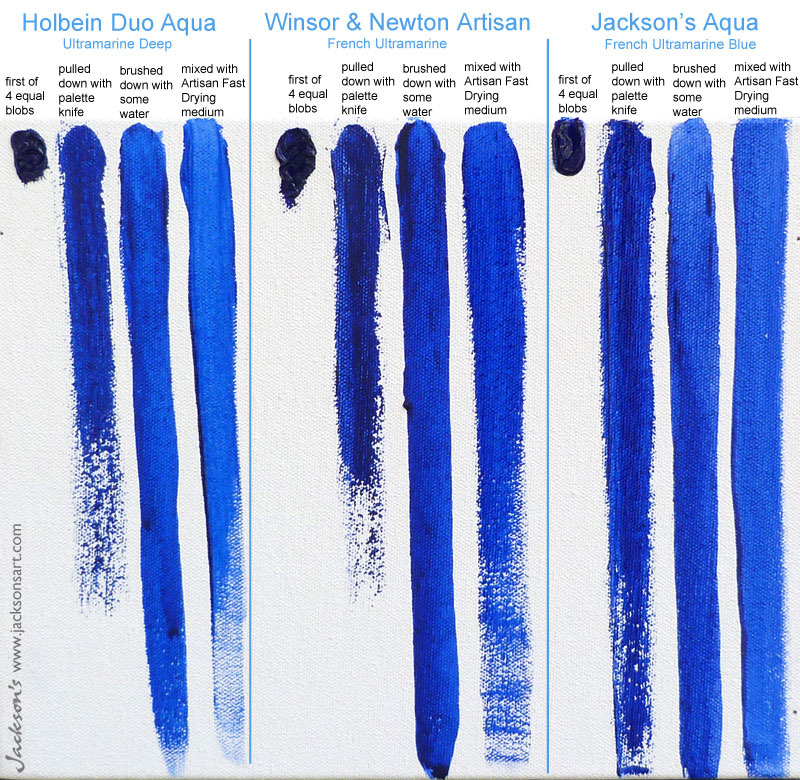
After the two paintings I made a chart of the three makes to find out their properties: texture as a thick impasto, strength of colour, how far the paint spreads, how it makes a wash, and how fast it dries. To do this I started with equal size spots of paint- I left the first spot, I pulled the second spot down the canvas with a palette knife to see how far it would spread, I used a small amount of water to brush the third spot of paint out in a wash as far as it would go, and I mixed the fourth spot with 10-20% Winsor & Newton Artisan Fast-Drying Medium and brushed it out as far as it would go.
The Results
The texture out of the tube: Holbein and Artisan were about the same, thick & smooth, Jackson’s was a bit separated on the palette and has to be stirred together, then it was creamy and smooth, much softer than the other two. (The Jackson’s Aqua was separated in two of the colours but not in the other colours, the oil mixed back in easily.)
How far the paint spreads: again Holbein and Artisan were about the same, Jackson’s went much further in both a palette knife spread and when mixed with medium. They were all about the same in the water wash.
Colour intensity: They all have a similar good colour intensity in all the different uses.
Drying time: All three were touch-dry in 12 hours in the water wash and with the fast-drying medium. The plain oil took about 3 days to dry. The thick blob took about 5 days with the Jackson’s slightly slower at 6 days. Even when dry the thicker areas felt a little bit tacky or sticky, but no paint came off or moved.

Comparing the Makes of Water-Mixable Oil to Convention Oil
Test Chart 2:
I did another chart comparing a conventional oil paint straight from the tube and in a turpentine wash – with the three aqua oils straight from the tube and in a water wash.
The Results
The conventional oil colour (Blockx) had a more intense colour in the turpentine wash than the aqua oils did in their water washes, but they still compared quite well.

I like the water-mixable oils better than I expected. They took some getting used to as any new medium will. I think as I spend more time understanding them they might do things that regular oils won’t, they are a medium unto themselves. Their characteristics change dramatically with small amounts of mediums, including water, and that may be the most important part to practice with. I loved the quick, easy clean-up. I also felt that the creaminess and colour strength made Jackson’s Aqua the winner of the three (even with some of the colours separating and needing to be stirred back together) and this surprised me because it has the lowest price of the three. The Holbein has many more colours in their range so I will probably choose a few of their colours to add to palette as well and the Artisan was a close second performing well in the water wash, so I will also be using some of those colours.
I am glad the brands can all mix together. I will keep painting with the water-mixable colours, there is more to learn.
93 colours in 40 ml tubes, with three different whites in 50 ml and 110 ml tubes and 10 mediums.
40 colours in 37 ml tubes, 31 colours in 200 ml tubes, and 20 mediums.
54 colours in 56 ml tubes, 1 white in a 225 ml tube.
Water-Mixable Painting Mediums are available in three makes: Holbein, Cobra and Artisan. The Holbein smells like linseed oil whereas the Artisan smells very strong of something like solvent and makes me dizzy, the Cobra is somewhere between the two. The Holbein dries as expected, the Cobra dries a little faster whereas the Artisan was still sticky a few days later. Of those three I would recommend the Holbein wholeheartedly and the Cobra is fine. I hope this helps. I will do some tests and write a post about the mediums, they are actually very useful, even if it seems like you would only need water for these.
Further Reading
How to Varnish a Painting in Oil, Water-Mixable Oil or Acrylic
A Guide to Mediums for Water-Mixable Oil Paint
Plein Air Painting at Glastonbury Festival
Inside the Sketchbook of Sarah Dyer
Shop Water-Mixable Oil Paint on jacksonsart.com




46 thoughts on “Water-Mixable Oil Paint Compared”
Thanks for doing this comparison.
I just started using the Winsor water based oils.
I absolutely love the low odor and easily controllable dry time.
What i had to get used to was that they didn’t flow straight from the tube to the canvas as well as my old oils. I’m often finding myself having to work the paint with oil to get it to flow properly, which takes a bit more time.
Glad you found the article helpful David!
Some artists like their oils stiff so they can add different mediums to them when they need to thin them out – gloss mediums, matt medium, glazing, fast-drying, etc. – for whatever they need at the time.
But some artists like buttery paint, ready to go so they can get right to the painting.
So it’s good there are many types of paint out there 🙂
Great article, the test you made are very
helpful. I was wondering what the medium
you used looked like after drying. I use
walnut oil with conventional oils which
leaves a semi glossy look film which is not
always what i want.
Hi Charlene
I have done more recent testing and written an article that you might find helpful
Water-Mixable Oils: Vibrant Colours, Easy-Cleanup and They Needn’t be Sticky
I am also currently working on an article just about WMO mediums. Please keep an eye on the blog for that.
The M. Graham Walnut Alkyd is great with WMO paints, you need so little to make the paint flow. I found that with some paints it is quite glossy and with others, it is almost matt. Because you use so little it doesn’t change the paint that much, so if you don’t like the gloss you might want to try a different brand of WMO paint as some dry nearly matt.
It is important to remember that the sheen can be adjusted with varnish after the painting is fully dry in six months to a year. All oil paintings should be varnished to protect the surface and to seal it so it stops absorbing oxygen when it is stable enough.
Pingback: Georgian Water Mixable Oil Colours - Jackson's Art BlogJackson's Art Blog
Julie
Very interesting article. I have been debating using water mixable oils for some time, as I find using turps and other solvents can be very overpowering in my studio. I am going to order the Jacksons Aqua and see how I get on.
Thanks Maureen. Glad you found it useful. Please let us know what you think of the Aqua Oils.
Hi Julie,
I see Jackson’s now stock Cobra and I wondered if you have tried it yet and how it compares to the other brands?
Hi Helena
Yes, we’ve added two water mixable oils since this comparison – Georgian Water Mixable Oil Colours and Cobra Water Mixable Oil Colours.
I haven’t yet tried the Georgian. I have tried the Cobra and they are really nice.
I didn’t do a side by side comparison but would rate them in the top 2 from my memory. I found the Aqua Oils and the Cobra are both good.
This blog post about the Cobra might help. I paint with it and also do a short video to show the texture of the oil colour out of the tube, some colour mixing and the melting in water http://www.jacksonsart.com/blog/?p=17495
About the mediums – the Holbein are very different to the Artisan. The Holbein smell like mild nutty linseed oil and dry smoothly while the Artisan smell strongly of a solvent-like odour and dry sticky.
Since I wrote the Cobra post we have started stocking the Cobra mediums but I haven’t tried them yet.
Our YouTube channel also has ‘Cobra Water Mixable Oils – Lessons 1 to 8’, which are great videos from the manufacturer. These cover the Cobra mediums very clearly and are very helpful.
https://youtu.be/ur5YPjlxUEk
Hope that helps.
Really helpful article. As a new comer to painting I started with this type of oils, so haven’t compared them to ‘ordinary’ oils. I have some from all the different brands, as I wanted special colours, and sometimes the wait for Jacksons Aqua oils has been too long. My question is ” How does one cope with the separation between pigment and oil in the aqua oils? It’s not just a bit, but so much oil comes out that when mixed in, the paint is very runny, and can often swamp my palette before I’ve a chance to mix it?”
Hi Penny
In my tests there was some separation and I just mixed it back in.
But we have had a few faulty batches where there was major separation inside the tube.
If you can get a thin skewer inside the tube and mix it inside there that could help. Otherwise we will take them back and send you new ones.
Apologies for the waiting time and the separation. We are looking for another supplier to make the Aqua Oils because of this.
I have started with Artisan paints,
but the Jackson’s Auqu Oils look
tmepting. Is there a resource showing
which pigments are used in which
paint from the Jackson’s Aqua Oil
range? I can’t seem to find any
information on it.
Also which mediums would you
recommend to use with them, as
Jackson’s doesn’t have their own line
of water mixable mediums? Would the
Artisans or the Cobras be a better fit?
Watermixable painting mediums are available at Jackson’s in three makes: Holbein, Cobra and Artisan. The Holbein smells like linseed oil whereas the Artisan smells very strong of something like solvent and makes me dizzy, the Cobra is somewhere between the two. The Holbein and Cobra dry as expected whereas the Artisan was still very sticky a few days later. So, of those three I would recommend the Holbein wholeheartedly and the Cobra is fine.
I hope this helps.
I am new to oil painting. I am using Artisan. I’ve
tried thinning with thinner, fast drying agent and
linseed. All water mixable Artisan products. I’ve
experienced the matt finish, tackiness and also my
fast drying agent seems to clot up when mixed
with the linseed or thinner. 2 weeks later, still
tacky. Could use some suggestions and I will
check out those lessons. Thanks
Hi Lori
So sorry for the delay in responding. How are the paints now? Oil paint can take weeks to dry if it is applied thickly. Drying times can also depend on the atmospheric conditions, such as humidity and temperature. I wonder if the fast drying agent may have been sat on a shelf for a while and needs stirring? It could be that the ingredients have separated which is impairing its flow. Matt finishes are usually caused by a higher proportion of thinner (i.e. solvent) being added to the paint – to bring the gloss back you may need to add some linseed oil or any other Artisan painting medium to your paint.
Hope some of my suggestions help!
Many thanks
Lisa
Hi Julia
The pigments are listed on each colour tube and on the page for each colour on the website.
Watermixable painting mediums are available at Jackson’s in three makes: Holbein, Cobra and Artisan. The Holbein smells like linseed oil whereas the Artisan smells very strong of something like solvent and makes me dizzy, the Cobra is somewhere between the two. The Holbein dries as expected, the Cobra dries a little faster whereas the Artisan was still sticky a few days later. Of those three I would recommend the Holbein wholeheartedly and the Cobra is fine.
I hope this helps.
Thank you for this article. I was wondering whether the
different water mixable oil brands can be mixed with each
other, as well as the mediums / oil, or would I need to stick to
one brand for everything.
Hi Alice
I have been told and have found in usage that the various brand of watermixable oil paint and mediums mix together very well. They also mix with regular oils, but you lose more watermixability as you add more regular oils.
Can you mix Jackson and Duo together?
Hi Debbie
Yes, they work well together. The Jackson’s Aqua is softer and the Holbein is quite stiff, so together they make a good consistency,
I have mixed cobra and jacksons water mix able oils
with no problems. The cobra website has an excellent
u tube clip about this type of oils.
Thanks Penny! Good to know.
Here is a link to the Cobra videos I think you are talking about:
https://www.youtube.com/user/JacksonsArtSupplies/search?query=Cobra+Water+Mixable+Oils+-+Lesson
They are really helpful.
I have used the expensive Holbein paints but after trying
Jacksons I wouldn’t use anything else , apart from being
Larger and cheaper they feel like the old oil based paint ,
I am very pleased.
Hi Brenda
Thant’s great to hear! Thanks for letting us know 🙂
I am a rank amateur but enjoy these paints. I often transport
a piece and it’s a problem when it is still tacky. Is there a
way of speeding up the drying process? Thanks
Hi Elsie
The water mixable oils are great, aren’t they!
Winsor & Newton make a fast-drying medium for the water mixable oils. You might want to give it a try.
Winsor Newton water mixable oils are
cheaper than their competition for a
reason, they use less pigment in
their paint to keep costs down. This
makes it harder to mix a hue or value
since they change quickly with the
weak pigment load.
Winsor Newton is a student grade,
whereas Daniel Smith or Holbein is a
professional grade water mixable oil
paint. You get what you pay for.
Hi Julie; interesting article!
My question is, what is known about the durability/longivity of these water soluble oil
paints. I am keen to start using them but would like to tell my customers that these
‘modified’ paints are as durable as traditional oil paints……..
Curious to receive your reply!
Cheers, Johannes Sijbrant, NZ
Hi, I find the Cobra paint very pleasant to work with.
However, I do use it with Artisan thinner because it keeps the
paint a little creamier than water. Remarkably, the Dutch
Cobra paint at Jackson’s is cheaper than in the Netherlands.
However, it is a pity that Jackson’s does not sell 200 ml
tubes. Can’t you add them to your assortment?
Hi Kees
Cobra do a thinner and other helpful mediums that you can use with their paint and I find it works very well.
Cobra Mediums
I will request we do the larger sizes of paint, thanks for your suggestion.
Hi Julie,
I have three questions. Would you know if water mixable
oils can be used/blended with water colors, and can it be
used on water color paper?
Also, after the oil paint drys, can it be lifted from the
paper with water as one can lift dried watercolor paint
from paper?
Looking forward to your answer(s).
Thanks
Joe
Hi Joe
Watermixable oils are oil paint with one change to the oil molecule that allows water to bond with it. When the water has evaporated after a few minutes the paint is simply oil paint.
Except for being able to clean your brushes easily with just soap and water you should think of water-mixable oil paints as oil paints.
Question 1: You can mix oil paint with watercolour paint – the binder of watercolour is gum arabic which is used in a famous oil painting medium – Maroger Medium. I have also tried it with water-mixable oil and it wets out fine.
Question 2: For two reasons most artists will not use oil paint (remember water-mixable is still oil paint) on watercolour paper. 1. The oil will seep out of the paint and leave a brown oil ring halo around the colour and this can leave the paint with not enough binder, so the colour becomes powdery and falls off the paper. 2. If the paper is not sealed from the oil with gesso or similar, then the oil will slowly eat at the paper fibres and eventually will rot a hole in the paper.
Question 3: No, dried oil paint will not lift from the paper as watercolour would – it cannot be re-wetted like watercolour. Even if you add some watercolour paint to the oil it will still have the oil that dries hard and permanent.
I hope that helps!
I am trying to order Holbein Duo Aqua Oils in Australia, do
you know where they can be located?
Hi Fiona
We are in the UK but we have lots of customer in Australia.
If you log in so the site knows your shipping address you can see the cost of shipping. Because you are not in the EU the prices for the materials will be 20% lower because you do not have to pay VAT tax and that helps offset the cost of shipping for most customers. Though you may sometimes have to pay an import duty fee at your end.
I hope that helps!
Hi Julie,
I use Cobra to my satisfaction, however, it is much more
expensive than Artisan and certainly more expensive than
Jackson’s Aqua. I wondered if the different WMO brands
could be used interchangeably. I would like to try
Jackson’s, but of course I don’t want to throw away all my
Cobra paint.
Hi Kees
Yes, you can mix the different brands together.
Many thanks
Lisa
Hello Joe I have painted with watermixable oil paint for 20 years. I find the colours remain faithful also if you are a traveller place cut open plastic shopping bags between each painting then place them in your suitcase with
clothes on top. Days later the paintings can be separated with no ill effects or smudging. Water mixable paints changed my life. No nasty smells no toxic fumes and no skin irritations like eczema or breathing complications. Did
you know you should not eat in the same room as you paint when using traditional oil paints. OR DRIVE after several hours painting. Water mixable paints are safe to use especially in a group painting situation. Enjoy.
Thank you so much for this comparison..it’s been very
informative. I’ve just purchased some Holbein and already
love the ease of clean up. Previously I’ve worked with acrylic
, so the longer drying time and creaminess & lustre with
these new water soluble paints is wonderful !
So good to hear you’re getting on well with water mixable oils Lorraine.
Will Jacksons be developing the water based
oil paint series in larger sizes – currently just
the white in 200ml?
Hi Catharine,
I’m afraid there are no current plans to make the other colours available in a larger size.
Many thanks
Lisa
Pingback: 5 Steps to Safer Oil Painting - Jackson's Art Blog
Hi how is the odour on the Jackson’s
water mixable oil paints. I want odour
free ideally.
Hi Anne
I have done more recent testing and written an article that you might find helpful
Water-Mixable Oils: Vibrant Colours, Easy-Cleanup and They Needn’t be Sticky
I found that all 7 brands had minimal odour. None were odour-free as they smelled slightly of linseed oil. But none were unpleasant or strong.
Super helpful article. I am trying different
water-mixable oil brands and am looking for
a consistency that is a bit “stiffer” than
most, similar to the consistency of W&N
regular oils. Which water-mixable oils would
be close to that?
Hi Nina
I would have said Jackson’s Aqua Oils, but we had to stop making them until we find a new manufacturing partner.
Holbein Duo Aqua is probably the stiffest we have now.
You can also add to your paint Cobra Painting Paste which is a stiff impasto painting medium in a tube.
These two more recent article might be helpful.
MEDIUMS ARE THE KEY TO WATER-MIXABLE OIL PAINTS
WATER-MIXABLE OILS: VIBRANT COLOURS, EASY-CLEANUP AND THEY NEEDN’T BE STICKY
Comments are closed.