



We occasionally invite guest artists to talk about their work, techniques and materials on the blog. I hope that one artist explaining how they solved a problem or their approach to art will help other artists. I would love to see a community evolve where artists will assist each other with their artistic dilemmas, share ideas and technical information as well as make connections and give each other friendly support.
To join the conversation please add your comment below. It will be great to have some interaction!
Here today to share her art with us is Denise Laurent, who paints in London. Thanks Denise!
Jacksons: Please tell us a little about yourself
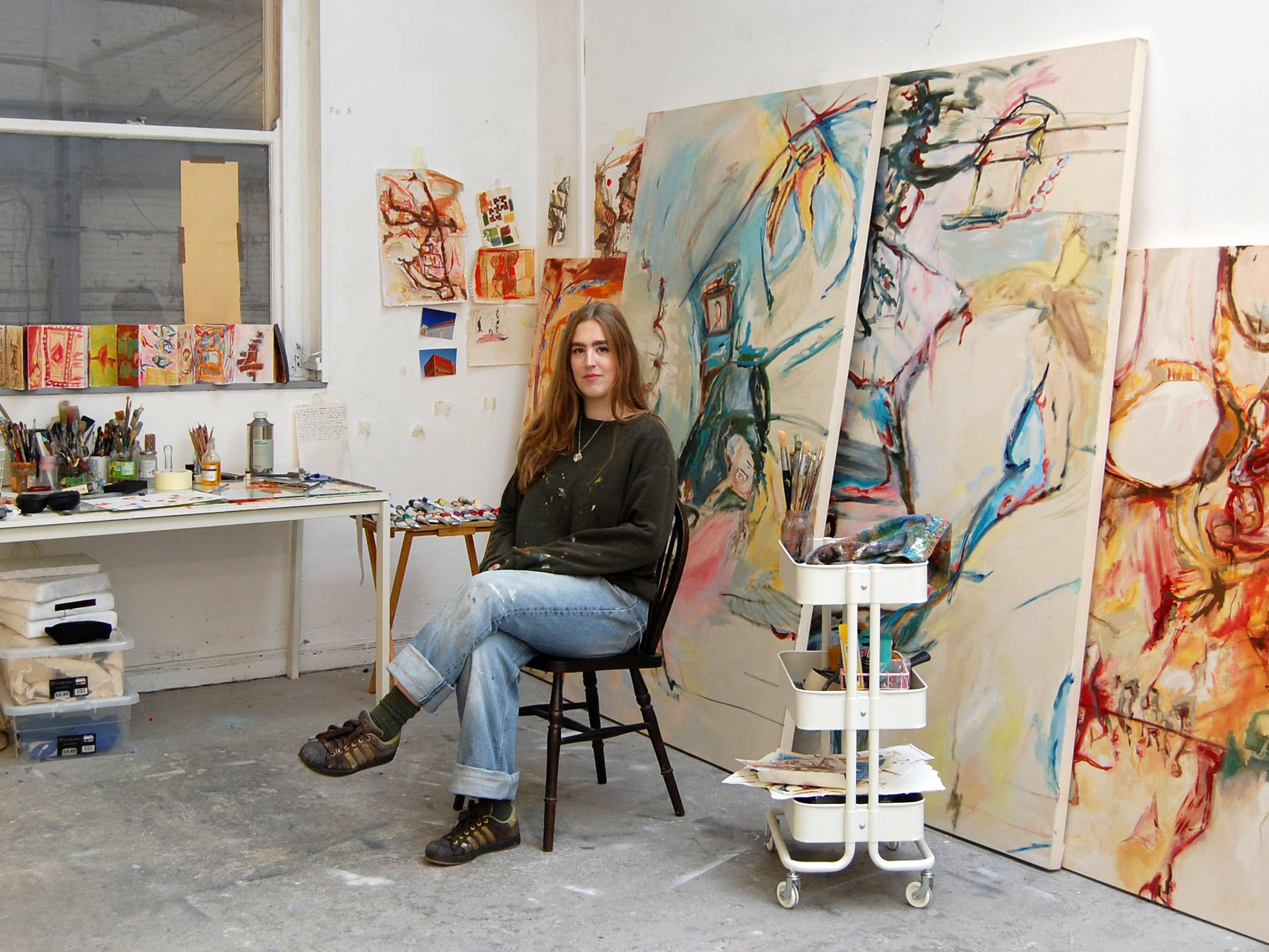
Denise Laurent: I live in London and work from my studio, well ‘studio’ sounds a bit grand, it’s more of a painting area with an easel and a makeshift table made from a drawing board balanced on a second easel for my paints and palette. I’d love a studio of my own but we just don’t have the space. But I do have an endless supply of fresh coffee for fuel!
Jacksons: What materials and techniques did you use in making the art work you are showing here?
Denise Laurent: I work mainly in oils on board (I love the fine texture of the Belle Arti boards). I like to build a painting up in layers, starting with large shapes and large brushes and gradually refining the shapes as the layers progress. I also love blending paint! I keep all my soft blending for the last layers of the painting and I often find myself blending with my fingers as much as a brush.
In The Delicious Miss Honey I toned my board with a warm underpainting of Quinacridone Gold. I knew I wanted the red background to really glow against the black form of the cat. She has quite spectacular whiskers and a warm dark red would help to show them off. I blended three different reds together to create the background and reflected those reds in her black fur. I used Alizarin Crimson, Cadmium Red Light and Quinacridone Scarlet, a fabulous colour from Holbein that can be both cool and warm depending on what you mix it with. (I love it!) Keeping with the warm theme I used Holbein’s Cobalt Violet in her coat on the far side of her body. Cooler than the reds but still a warm colour. Working in oils gave me plenty of time to blend colours together and to cut back through the paint to add her whiskers.

The Delicious Miss Honey – oil painting – Denise Laurent
In Mystique I used the same principle, glowing warm reds, but in this case the reds were the underpainting for the panther. The cool darks over the top let the red break through to make her glow against the green background. I met this beautiful cat and it was a very intense experience, to be eye to eye with such a powerful creature was amazing, so I wanted that to be reflected in the painting.

Mystique – oil painting – Denise Laurent
Jacksons: What challenges (if any) did you face in making this work and can you give other artists any tips for solving similar problems?
Denise Laurent: I work in a small space and I have cats who like to ‘help’ in the painting process, so I need to be able to clean up easily. I also have an allergy to solvents. With no outside space to work in there’s nowhere for fumes to go so I need materials that are safe to use. I know many artists I meet face similar problems; they work from home, they have kids or pets and they don’t have a lot of space for themselves. If you want to work in oils that does present some problems.
When I discovered water soluble oils a few years ago I knew my problems were solved. There’s no need for solvents, even the low odour ones. Your brushes are easy to clean up using soap and water, there are no toxic fumes and paints like Holbein Duo Aquas and Jackson’s Aqua Oils are such a joy to use. They’re just like normal oils, except for the additive that makes them water soluble (which simply evaporates as the oils dry). They look, feel and handle the same way.
You can thin water mixable oils with water and I do that sometimes but I prefer to use Holbein’s Aqua Duo linseed oil. It’s light and lovely and keeps the consistency of the oil paint.
If you thin with water it changes the feeling of the oil a little, making it a little more like acrylics because it’s thinner. That may not be what you want when painting in a more traditional oil painting method. But doing a whole painting this way on a paper made specially for oils is a wonderful thing. You have the best of both worlds, starting with the fluidity of working wet in wet and once it’s dry, complete the work with thick, juicy oil paint. Wonderful!
All this and you can just wash up with soap and water!
Jacksons: What drives you to make work? (what is your inspiration, what interests you, how do you get started?)
Denise Laurent: I’m motivated by a love of the natural world and by colour, so my paintings usually reflect both these things. I’m often inspired by the animals I meet, a dog in the park, a hare in the field or the birds outside my window. I was lucky one day to see a hare sitting in a field minding his own business, but every now and then he’d pop up and take a look at us through the grass. I loved the expression on his face and his enormous whiskers. I wanted to try and capture that. I did several sketches until I found the look that I wanted.

Peak A Boo Hare Sketch – Denise Laurent
I painted him on board in acrylics, but for this painting I used painting knives to try and keep the texture of his coat loose and free. I wanted to keep the freshness of the sketch in the painting and avoid over-working him. I’m not sure if I succeeded, but I loved painting him. Working with the painting knives was quite a challenge, the temptation to dive in with a brush and fiddle was enormous! But I stuck to my guns and really enjoyed the feeling of working the paint around with the knife.

Peak A Boo Hare – oil painting – Denise Laurent
Jacksons: What is your favourite art material?
Denise Laurent: I use both oils and acrylics, but I like my paint to stay open for a fair amount of time so that colours can be blended together without panic. I like to work slowly and to change my mind! My favourite acrylics are Golden Acrylics, especially their Golden Open Acrylics that stay open and workable as long as oils do. It’s amazing to be able to work with acrylics all day without them drying to hard lumps on the palette! And I love the colour range of Golden, so many beautiful colours. I also have some Old Holland and Liquitex acrylics too.
My favourite oils are both water mixable, the fabulous Holbein Duo Aquas and Jackson’s Aquas. The Holbein Aqua Duo range has more than 80 colours including some traditional pigments like cobalt violet (one of my favourites). They are rich in colour and wonderfully buttery and luscious to use. I use their water mixable linseed oil when I need thinner, creamier paint for working in layers or drawing fine lines. The Jacksons Aquas are a little softer and creamier than the Holbein and they work beautifully together.
These are my staples, although I can’t resist new materials and have many other goodies in my art bin.
Jacksons: What is coming up next/your plans?
Denise Laurent: I’m working on painting some of the dogs I’ve met recently. The inspiration for Catch is a beautiful lurcher I met in the park. She was having a wonderful time chasing balls. I love the way dogs throw themselves into the game with such joyous abandon.
Instead of working in oils on board I’m painting these new paintings on Fabriano Pittura paper using painting knives and acrylics. It’s a completely new thing for me, painting on paper. I’m enjoying the challenge of doing something new.
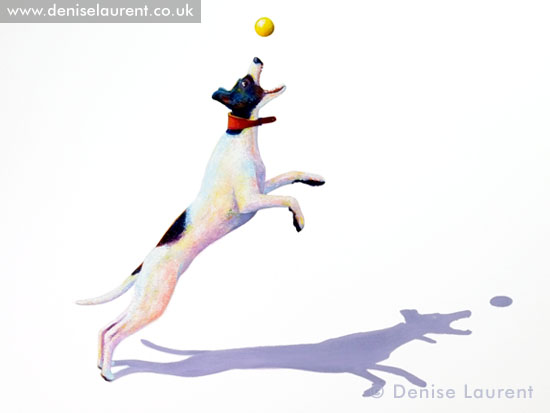
Catch – acrylic painting – Denise Laurent

Catch – detail – acrylic painting – Denise Laurent
Denise Laurent’s Website
Denise Laurent’s Blog
Denise Laurent on Twitter @DeniseLaurent
Denise Laurent on Facebook
All images are copyright of the artist.
1 thought on “Guest Artist : Denise Laurent”
Pingback: 8 of Kitty Curator’s Favorite Cat Artists - Katzenworld
Comments are closed.