



Magda Delgado won the Visitors’ Choice Award in the exhibition of Jackson’s Art Prize 2025 finalists at Bankside Gallery with her work Untitled (“Beauty as Consolation” series). In this interview, she discusses how she ripens her ideas before committing to paint, detaching from the ‘big soup of information’, and giving an older project another chance.
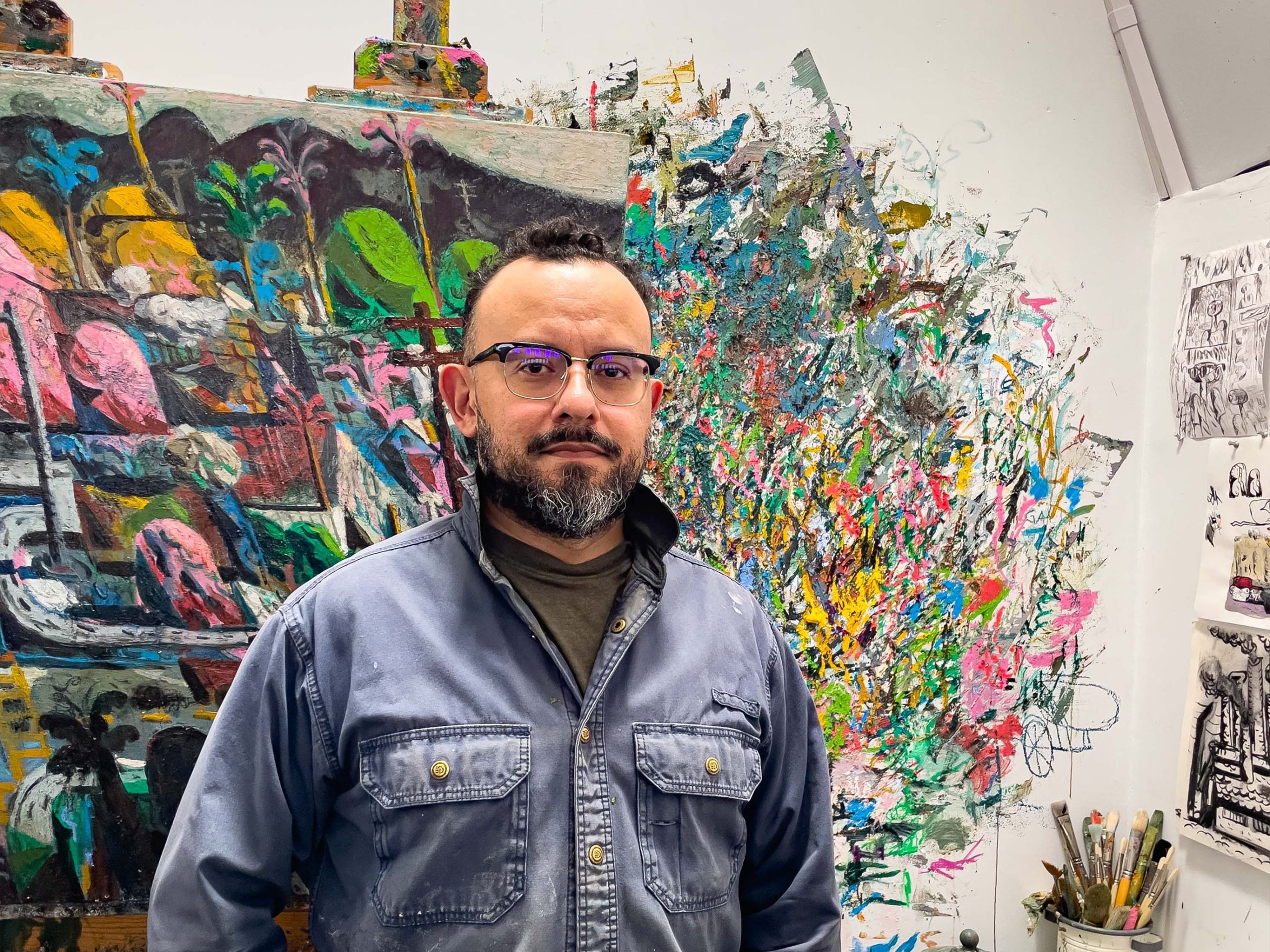
Above image: Magda with her cat Serge Gainsbourg at her studio in UK

Magda Delgado
Pastel, pastel pencil on paper, 21.8 x 44 cm | 8.5 x 17.3 in
Josephine: Could you tell us about your artistic background?
Magda: Mark-making is something that children enjoy; exploring with the help of brushes, crayons on the wall, sticks on sand, bare hands and paint on paper. Or focusing on textures, such as making sculptures/constructions on the beach, moulding clay, and combining objects, etc. Some of them enjoy it more than others, and some never lose that interest. That was my case. All the time spent with two and three-dimensional approaches was a pleasure, and I was always rewarded with such good reactions.
In primary school, I would share an interest with a girl who would become a close friend. We would collaborate on some endeavors for almost a decade. At home, I had someone who was able to transform flat fabric into colourful and volumetric shapes by sewing. Despite this, my family would always be concerned about a future embracing these manual jobs, due to the time spent and hard work without a guaranteed good profit. So when I started using piles of books to make doll houses and spent so much time drawing, something came up. The idea of architecture seemed very exciting to me, as I could study to have a nice job where I would draw houses all day and conceive spaces. So I just pursued that dream since I was eight. I was the youngest of the fellows around me, knowing what I would be one day.
In secondary school, I had a very good teacher (Lourdes Batista) to whom I would write up until some years ago. In Year 10 and onwards, I also had two wonderful teachers. Fernanda Pissarro would teach me the importance of the expression of each line in life model drawing, as well as the basics of engraving. Margarida Ransy (the first person who ever bought one of my pieces – Ceramics), with her curricular lessons and school clubs (until 7 pm), would give the necessary ‘click’; the explosion of experimenting without restrictions, to think outside the box, and she also introduced me to ceramics.
I worked a lot and succeeded in getting into the university course in Portugal that had the second-highest score (medicine being the top). Architecture was a surprise to all my previous art teachers because they knew me better than myself. So, some years later, I was quite unsatisfied looking at AutoCAD all day, and I went to the Faculty of Fine Arts in Lisbon, where I would feel like a fish in water. I did my Master’s there, and since that moment, it has been my life and soul.

Josephine: What does a typical working day in the studio look like for you? Do you have any important routines or rituals?
Magda: Starting the day in the ‘artist mindset’ is quite important for me. I get ready, taming my long hair by doing a quick but colourful, ribbon braid hairstyle or tying a scarf. Then I get dressed in my predominantly blue smock that I have used since I was 12. This way, there is no mistake, my mood is ready for the studio practice.
After not having a proper breakfast, because I am in a rush for the school run with my son, I finally get back to myself again for work. But I am starving at this point, and I can be quite indulgent. So I will cook a miso broth with pak-choi and noodles or something else, ignoring that it’s far too early for lunch. The important thing is that I have to adapt myself to serve my work. I can even use those kitchen preparations to get anxious with time, and wanting to work even more intensely.
My studio is at home, and I have the company of my cats and the wild birds in my garden that I love and check up on occasionally. I can also work in the garden. Aside from all this, I dislike distractions. I can work in complete silence for months because I don’t want to spend the time to find the right tune for my work/soul.
I have to suspend my work to pick up my son, eat a late lunch and return to my studio, which I might abandon completely only at 10 pm.
On weekends, I visit the studio but in a more relaxed and family-friendly way, and I like to take care of the garden, which inspires me a lot. Still, the core is work-related: books, exploring materials, learning techniques, doing something on a screen, sketching outside, watching wildlife in walks, etc. Even when I am away from the studio, I am always tuned into the topic. At dinner time, I bring art to the table, so my family takes part in it, discussing ideas. For me, life itself is thought of with this language, made of visual, tactile, and other elements. It is able to express my perspective of the world, our existence. My artistic path is a pile of passions and results, an attempt to approach a way to do it, only to know that tomorrow I will not totally agree with my choices in an ever-growing overcoming of myself.

Josephine: Which materials or tools could you not live without?
Magda: Young discoveries concerning art supplies can shape us, the course of our path, so they are quite important to me. I love to work on paper and have been very loyal to my Fabriano Artistico Satinado 300gsm for the last 15 years. I was lucky to set my hands on it for the first time when I was 15, while starting etching. Since then, it has been my first choice for most of my work.
When I was 12, I received a tin of twelve Caran d’Ache Neopastel pastels and a tin of 15 Neocolour watercolour crayons. They were exciting and challenging to use because I wouldn’t learn how to use them in school at that age, so it was my own discovery and first approach related to a painterly mind developing. Those attempts in postcards and letters I would send to my friends, or in my first sketchbook, were crucial to me. It would give me at my own pace the confidence to achieve the first results. I still use the same box nowadays, adding more colours to the initial palette.
When I was 15, I was lucky enough to win the first prize in an art competition with an illustration that would be published. As if the honour wouldn’t be enough in that age, I also received a tin with 30 Supracolor Soft by Caran d’Ache and two sets of Talens Van Gogh Watercolour, the wooden box version! There are no words to describe how glad I was every time I grabbed that beauty. I still use them. The remaining watercolour 10 ml tubes are not dry (except the Chinese White and the Lemon Yellow), and they are great in the studio, and the box with the half pans is always lovely to use outside.
A year later, I started with a box of 45 Rembrandt’s Soft Pastels. And then, 10 years later, I started to have a much wider collection, adding new brands: Winsor & Newton, Sennelier. That group of colourful sticks were my lovely companions during my Master’s. When using the media intensively, my favourites became Schmincke for its texture, pigment quality and also because I had the handmade colour chart! It was given by a member of staff when, sadly, my favourite art shop in Lisbon (Varela) was closing for good.
I must confess, I love and thrive when there is trouble at work. I have the pleasure of a proper challenge, which is when there is an accident, because it pushes my boundaries forward. I love the ability to master my surface even when something unexpected or even disgraceful happens. Every event has a perfect twist. Nowadays, in my work, drawing borders is the only thing that has to be controlled when dealing with abstraction, so I can achieve a greater impact. And because of that I cannot live without a Faber-Castell sharpening knife.

Josephine: Do you work from a reference? What is your process?
Magda: I don’t have a fixed process for my creations. My work is precisely about stipulating a process for each work; I love to adapt myself to all this.
In this particular landscape that I chose to submit, I worked with a photograph of a specific landscape. But with previous similar works, I would just draw or paint landscapes that were inside my head or even completely make up some of them. Sometimes they could come from a description in a book, a visual ‘ekphrasis’, some notes about something I saw and could not remember in detail, or as an extension of my mood.
For example, I had a group of work where I used, as reference, masterpieces concerning the crucifixion (Rubens, Tiepolo, El Greco, Murillo, etc) and then completed the space in those compositions occupied by the characters, in order to interpret the remaining landscape. The idea was to eradicate all human presence and deal with only what that landscape was to transmit, all the ‘pathos’. It came from the sadness of such evil events described in those paintings; it was my way of dealing with sorrow about human behaviour. Erasing all human presence would leave a conturbed but peaceful landscape: the dramatic forms of God’s wrath, but a possible redemption in the form of a fiction of non-existence, a denial.

Magda Delgado
Gouache on paper, 31 x 24 cm | 12.2 x 9.4 in
Josephine: Do you regularly draw or keep a sketchbook? If so, how does this inform your work?
Magda: Oh, sketchbooks?! I have a pile of them! Each one, a different theme/technique. It’s a passion I keep. They combine two things I love: fine art and books. What I love about them is the potential to hide something. They are like boxes with secrets that we have to open. Inside a book, we can find a whole universe. Sketchbooks are like beautiful books with made-up letters. Andy Warhol liked to see a book without reading it, and I can understand that fascination, to ‘read’ without reading a single word. I like to write in them, draw in them, and some of them are quite private because they are the core of my ideas, my mind developing through the decades.
This probably started when I was a child, and I would be drawing in secret, instead of focusing on my homework. My mum caught me sometimes, and it was a desperation for her. I grew up in a family where no one was able to draw two straight lines, so for her, it was incredible how I could do it like that. She was right, it was a sign, she saw the artist’s ‘life of damnation’ in my destiny.
I have a very strong connection with sketchbooks; they work for me as a pressure pot because I could go straight to a canvas and paint, but I hold it the best I can, so it ferments and gets ripe inside me. I use a sketchbook for small visual and written notes. My mind is always creating something and I would not have enough arms to follow up, but I plan one day to free myself. For now, I have a lot of joy playing with these forces. While it ferments, it changes a little or a lot. Why do I fight the first impulse, you might ask? I like my anxious heart beating inside the cage/dam I form for my creation, but I am not sure if I won’t change this drastically. I realised that people would more easily feel my ideas if they were able to follow the flow. But like everything in life, I have to feel it’s the right moment for that.

Josephine: Have you ever had a period of stagnation in creativity? If so, what helped you overcome it?
Magda: The closest to a period of stagnation was when my mum was seriously ill a few years ago. At that point in time, my focus was so intensely on her that I truly felt I had nothing to say at that stage. Luckily, it was a relatively short period and all turned out for the best.
Outside of that event, I tend to have ideas like popcorn. It is as if my brain does not know how to stop. Or at least, that has been the case so far. If I stop without moving my hands, the ideas get faster and faster, bigger and bigger, and I am only able to make sketches in a notebook/sketchbook (the most secret one) that helps me to get a track of such a mind’s history. If I don’t write it down, I will not be able to sleep with that passion. That’s the name. I feel heat inside, the heart beating.
During the time I was with my son at home, I realised I didn’t have all the freedom I was used to. I had to reduce the flow of production, and due to this new reality, my ideas would mature more. I would sneak into the studio with an eye on him, listening to him, and I knew all the noises he could make playing with his toys. He would sing all the time, so I was able to know when he had a new idea that could mean trouble. The silence means trouble! I couldn’t ‘survive’ mentally without this activity I love, so I transformed it, I adapted to my new life with this lovely fellow. We would spend a lot of time in the garden doing stuff: a toddler-size shelter with garden trims, we would paint together, piling wood or Lego blocks, make drawings on the plate with mashed potatoes and other colours and ingredients and… photography.
The gaze is fast enough to be impossible to break with other duties and cries. So I was always with my digital camera, exploring. Soon, I had a partner using a pot to do the same! He would use the hole to peep and see through the cone-shaped lens, he would ‘click’ in different directions, the same way I was doing. He became my parallel subject, but I couldn’t draw him very often because he was on my lap or I just wouldn’t risk disturbing him by any means. When he was asleep, I could do the stuff that was more sensitive or demanding. In that time, I changed what is natural to me. Nowadays, I don’t stop when I am hungry; the hunger comes when I stop working. In that time, the artistic work would come when he was fed and asleep. My thoughts would be intermittent.

Josephine: Are there any specific artists or mentors who have inspired you?
Magda: In general, I try to detach myself from that tsunami of images that the art world produces continuously. It is a vertigo of tendencies that can create some impact in our work, distracting us from what can be our own language, giving at the same time an idea of what can be expected. I like to avoid what is expected. Obviously, we all share some references from art education. Visual culture is important to us, but it can also be something we cut off at some point. We can detach ourselves from that big soup of information. I felt some disappointment with the world, and even art sometimes in my life had that role. Mainly, I get influenced by ancient imagery or words, ideas/concepts, observations, and posterior reflections. This way, I don’t have many visual influences, but the ones I have are decisive in my path.
Tarkovsky’s polaroids are so nostalgic and beautiful that they strongly shaped my landscapes. The courage to embrace drawing, sometimes considered a minor importance, came from Paula Rego and her soft pastel work, which levitates between the notions of drawing and painting.
The way David Hockney reflects on the colour presence in nature or even human figures, his constant effort to find a new way of rethinking established notions, is something I can relate to, and even more with his immense curiosity.
But only two authors embraced all my spirit. One of them is the Brazilian Bispo do Rosário. I came to know his work for the very first time in Lisbon, at Museu da Cidade in 2013. The name of the exhibition was Azul dos Ventos (which was presented the year before at The Victoria and Albert Museum). I was about to leave my home country, and I spent some time going to exhibitions.
The spirituality of Bispo do Rosário’s work, his artistic journey in the mental institution and the pieces he created using only scraps, touched my heart and mind in a way difficult to explain; it was like having a revelation! It moved me forever. The message and form of his work tailored the smock I wear when I create. The films O Senhor do Labirinto by Geraldo Motta and Gisella de Mello (inspired by his life) and the documentary O Prisioneiro da Passagem, by Hugo Denizart, left a profound feeling that doesn’t dissipate. That effort and duty, the urgency about the message in art, our message, real and factual, or not.
The other profound inspiration for me is Amália Cardoso (Rodrigues). She was a friend and colleague at the university, and only after she passed away did I understand her importance. I anticipated big achievements for her due to her genius. I even tried to arrange with her to publish her two poetry books when she was already seriously ill, but she did not believe it was to be her end. Two weeks after, she was no longer with us. I thought she was such a miracle happening, and that after so many difficulties in her path, she was meant to bring to the world a bigger message. Now I feel like I am the only witness to her incredible gifts and that maybe I should give continuity to her visual investigation and her spiritually/philosophically shaped art creations. She is my personal unknown Kafka, trapped inside a drawer.

Magda Delgado
Egg tempera on wood, 32.7 x 28.4 cm | 12.8 x 11.2 in
Josephine: What were you thinking about or exploring at the time you made Untitled (“Beauty as Consolation” series)? What inspired it, and how did it come to be?
Magda: At the time of making it, I was in one of the first three phases of exploring my relationship with nature that still accompanies me. I was somewhere between seeing nature as a cathartic balsam for the heaviness of human condition, a refuge where we could lose ourselves, maybe through a transcendental experience, and seeing the human presence as a pernicious contact with a bigger and sacred matter. In this context, while living in Germany, I was planning a collaboration with another artist in which we would repeatedly interpret the same Scottish landscape by interpreting it over and over again, in a visual correspondence about that same image. The project was abandoned, and my first image was separated from its initial context. I looked at it as something I should carry on in a new way, without knowing how, until after moving to the UK.
Once here, living in the North East, I was not so far away from the Scottish natural beauty, so I thought that the theme could be revisited when I had the time to give it a context. I visited the Highlands and found its sibling landscape to fulfill this curious necessity of creating the pair. I then saw the Jackson’s Art competition, where a lonely piece can have its own life, so I felt it was time to give this image a chance to say something by itself to the public.

Josephine: Why did this piece feel like the right one to submit?
Magda: Being a multidisciplinary artist gives you too many options in this part. Which piece to use in an open call when we have work to submit for almost every category? I thought that an art competition would permit me to use this work out of its context and maybe to expose it to an audience. After 10 years, I still liked that pigmented paper, and I felt there was something to complete due to its history. Soft pastels are important to me because they are a symbol of my freedom as a draftsman. I used them when I detached myself from my Master’s opinion at the University. I just felt it was time, so I grabbed what I had on the wall for so long!
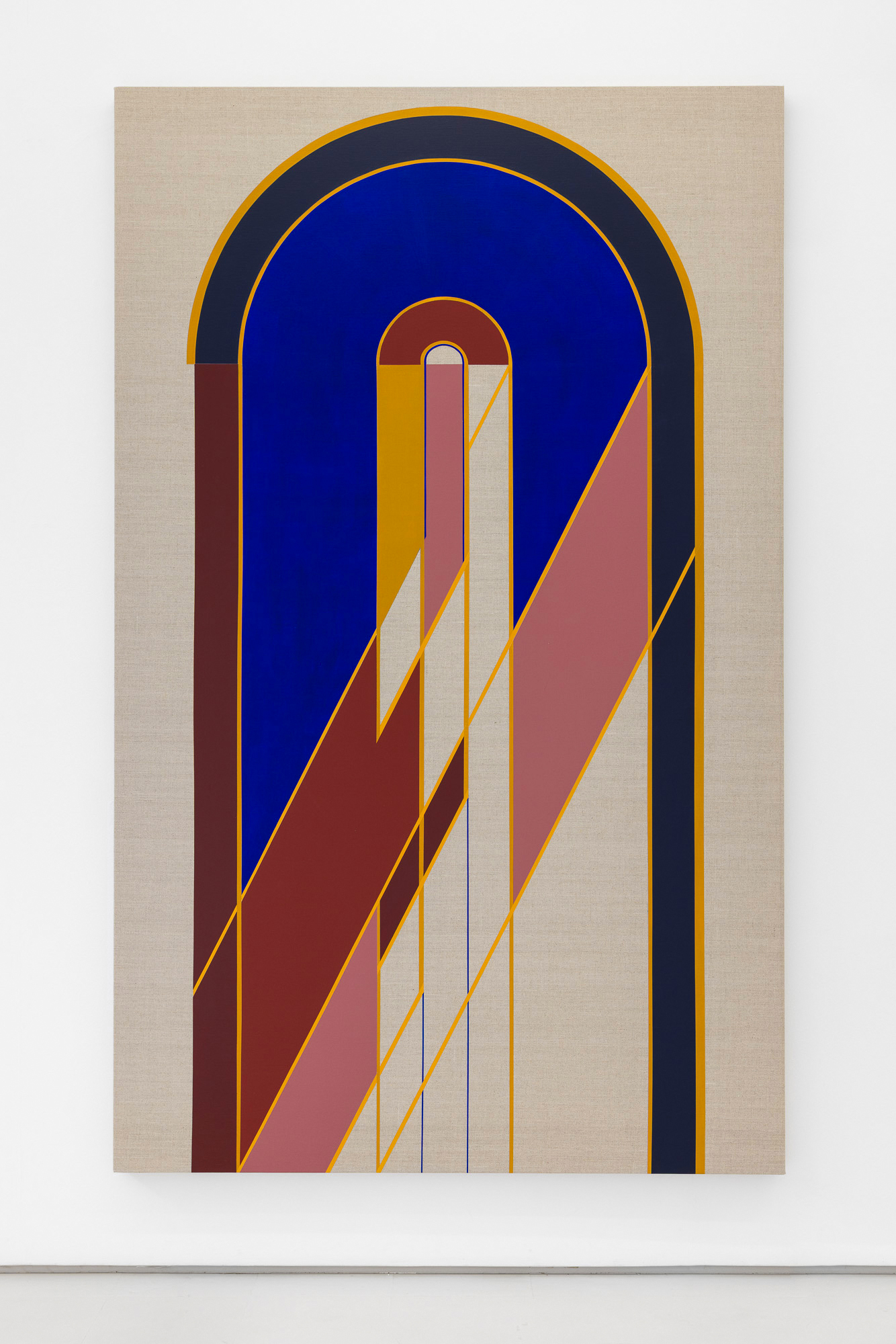
Magda Delgado
Tempera on linen, 198 x 122 cm | 77.9 x 48 in
Josephine: How did it feel to move through the stages of the competition and be shortlisted, and then win the first ever Visitors Choice Award at the Jackson’s Art Prize Bankside exhibition?
Magda: I go through life as an artist managing my own expectations quite closely. I keep my work and soul apart from these events to ensure I keep a clear head and focus on what I am developing while something like this is going through its stages. Because of this, I only actually noticed I had been shortlisted and given the chance to participate in the show (which was a happy surprise, because it is my first exhibition in the UK). Even more so, winning the Visitors’ Choice came as a true surprise, seeing as being from outside, you wouldn’t expect it, as you don’t have the customary close circle of friends and family that could support in a vote like that. Seeing the award being given to me is an indication that perhaps the piece did communicate with the audience, and that is the most important thing.

Josephine: How do you know when a work is finished?
Magda: Sometimes, with butterflies in the stomach when there is a dialogue with an ‘entity’, a conversation with harmony itself. Being guided to touch the right place and make one more minimal stroke or hatch until it is balanced without being too much. I test with people outside the arts and think about how people tend to have the same opinion without realising. I need that opinion, but very often I do the opposite of what I am told, because there is an apparent disharmony in beautiful images that only artists see. Recently, this view gained traction with the proliferation of the Japanese Wabi-sabi concept. My son is the greatest advisor, and I love to hear his thoughts, but my mum is the most terrible judge, and I love to embrace the impact of her words; she is the challenge itself I am always looking for.
I am very difficult to please concerning balance. There is a freshness I must observe. If a drawing/composition is very ‘saturated’, I must saturate it more, until the fullness becomes ‘pattern’. It is valid concerning form, but also texture. Every element has to dialogue fluently with others or emanate tension. I see if every stroke respects this. The older I get, the more demanding, so very often, I dislike earlier works because my sensitivity is increasing. The good part is I am getting faster at disagreeing with myself, so I am able to change what I dislike before I send it somewhere.

Josephine: What’s coming up next for you?
Magda: Currently, my Portuguese gallery is participating in Lisbon’s Drawing Room Art Fair, and I have just finished a solo show there as well. After these shows, I usually review what my message is both in context and in form and start preparing the next wave.
I have an Artistic Residency in Convento da Terra in Torrão (PT) after being nominated as one of the Portuguese Emerging Artists in 2024, as well as another one in Torres Vedras, both in 2026. I am also looking at a show in the North East that has been in the pipeline for a couple of years, and potentially some more, a bit further away, that hopefully will come through, although it is too soon to share.

Further Reading
Meet Eleanor Johnson, Winner of Jackson’s Art Prize 2025
Jackson’s Art Prize 2025 Exhibition at Affordable Art Fair
How We Collaborate With Artists
Expert Advice on Making Your Way as an Artist
Shop Pastels on jacksonsart.com

1 thought on “Magda Delgado: A Pile of Passions”
I am always inspired by artists when they talk about how they keep
working no matter what. Despite all the daily life stuff that goes on,
she keeps her art alive in everything that she does. I admire that so
much.
Comments are closed.