Glenn Hernandez won a Jackson’s Choice Award in Jackson’s Art Prize this year with his work Aberration. In this interview, he discusses feeling divided between two versions of his life, the importance of spontaneity in his work, and how the political climate in the US impacts his creativity.
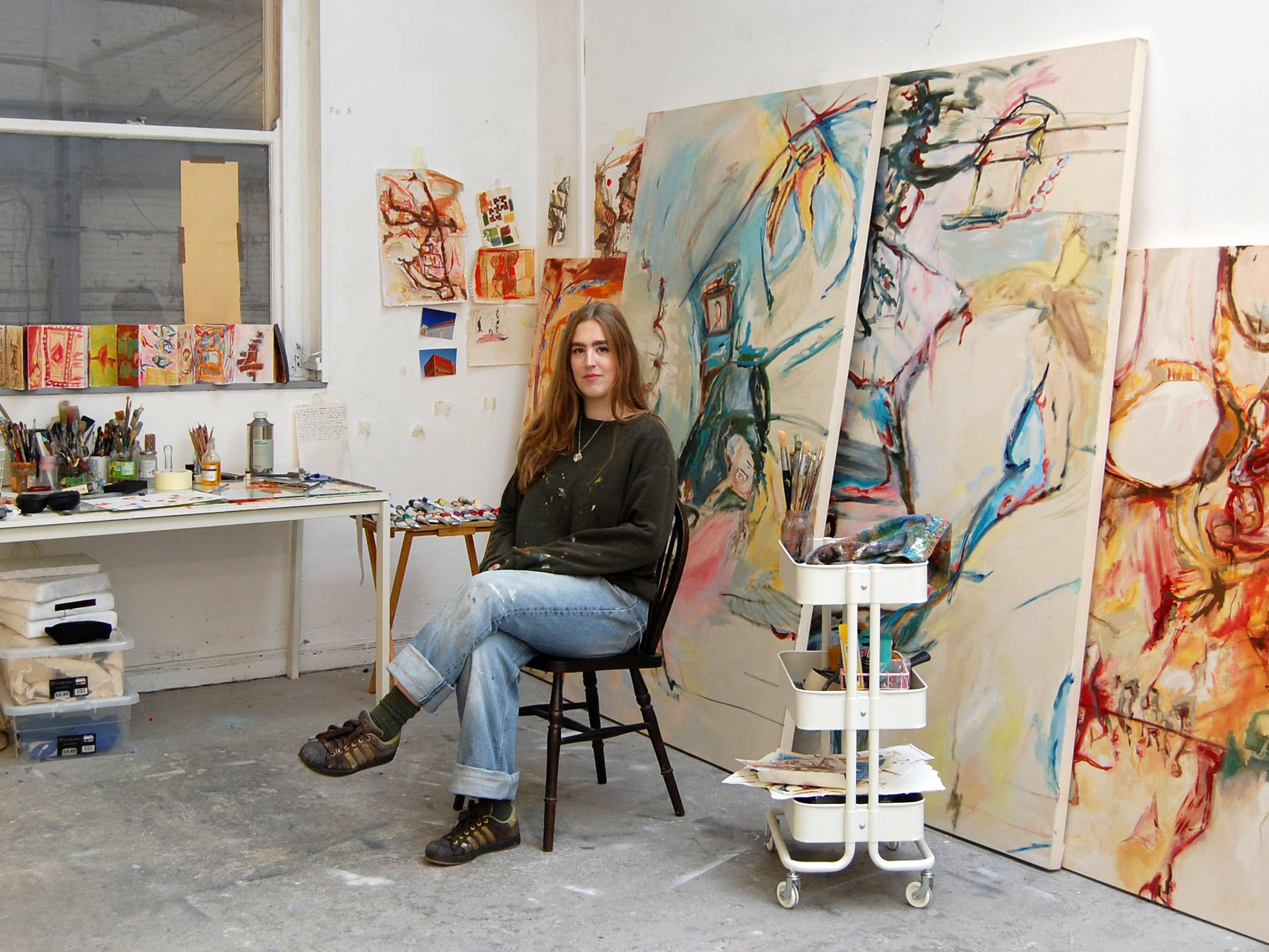
Above image: The artist in his studio

Glenn Hernandez
Oil paint, oil sticks, oil pastels on paper, 50.8 x 50.8 cm | 20 x 20 in
Josephine: Could you tell us about your artistic background?
Glenn: I’ve been drawing and painting since I was five years old. My parents always encouraged it. I also love music and singing, in particular, I love choral music and opera. I started out as a vocal performance major in college, but I couldn’t get beyond my music theory courses, so I fell back on studio art as my major.
My earliest interests in art were more centered on illustration, especially the work of Golden Age illustrator Arthur Rackham. It wasn’t until I took my first art course in high school that I was exposed to fine art and the work of painters like Lucian Freud and Frank Auerbach. Nonetheless, my career as an artist has often been commercial. I’ve been an art director at game and animation studios, and I’ve worked as an illustrator. These are all perfectly practical careers, but after the pandemic and with the onset of AI, those jobs are harder to come by. However, even before my last commercial gig ended, I was returning to paint and canvas, paper, pen and ink, etc. It’s been a welcome but difficult transition, especially financially.

Josephine: What does a typical working day in the studio look like for you? Do you have any important routines or rituals?
Glenn: I am also a father of two, so I have to get up early if I want to get any work done. Usually, I go to bed around 8:30 or 9:00 pm (hopefully), and I get up at 3:30 am to start my day in the studio (which sits in my backyard). At around 6:30 am, I have to get my kids ready for school and daycare. After I drop them off around 9:00 am, I am free for about four hours to work. Sometimes I finish paintings pretty quickly, other times they take weeks. I try to follow that schedule as much as possible. I often fail, but even an hour in the studio feels like an achievement.

Josephine: Which materials or tools could you not live without?
Glenn: No material is precious to me. I use it all, I use it up, it’s there to be used. If there were one thing I could absolutely not do without, it would have to be my studio. It is a Tuff Shed barn that I had built in my backyard back when I could afford it. It’s the best investment I have made towards my practice. I finished it out and insulated it with the help of a contractor friend, and it fits my needs perfectly. It also does double duty as my office when I’m working on design or illustration jobs.

Josephine: Do you work from a reference? What is your process?
Glenn: At times I will go out and sketch from life. Sometimes I like to do plein air painting. For the most part, those sketches are for the purposes of finding new motifs and getting them into a sort of ‘muscle memory’. Rarely do I make a painting that I’ve explored in a sketch first. Usually, it’s bits of sketches that I find interesting. If there is a composition that I’ve seen out in my neighborhood I will jot it down, perhaps it’s the way a fence covers the base of a palm tree, or a collection of disparate vegetation in an overly manicured front yard or the distant hills that surround my neighborhood. Mundane things like these catch my eye at times, and while they don’t always show up explicitly in my compositions, they do influence some of the shapes and motifs present in my work.

Josephine: Do you regularly draw or keep a sketchbook? If so, how does this inform your work?
Glenn: I do, I think I partly answered that question above. Again, it’s not always about finding compositions to paint, but motifs, shapes, feelings. Immediacy is very important to me; sketching offers that, but I am not bound to the compositions I capture in sketch form when I paint.

Glenn Hernandez
Oil on paper, 50.8 x 50.8 cm | 20 x 20 in
Josephine: Have you ever had a period of stagnation in creativity? If so, what helped you overcome it?
Glenn: Absolutely, I am actually going through one right now. Currently, I’m focusing my attention on other projects unrelated to painting. I know that eventually I will come back. In my present situation, it’s not so much that I feel stagnant but that I feel a bit burnt out. After five straight years of producing painting after painting and shipping work here and there, I felt I needed a bit of a break. I’ll be back soon enough. When I do feel stagnation setting in, first I try to make a mark on a surface and see where that mark gets me. If I can’t get into a flow with it, then it means a walk or a bike ride is in order.

Josephine: Are there any specific artists or mentors who have inspired you?
Glenn: Frank Auerbach is one artist who continuously inspires me, not only because of his work, but also his work ethic and discipline. Other artists include Paul Klee, David Park, David Bomberg, Leon Kossoff, Helen Frankenthaler, Lee Krasner, Umetaro Azechi, Joan Mitchell, Philip Guston (of course), Richard Diebenkorn, Eyvind Earle, Robert Crumb, George Harriman, Walt Peregoy, Mary Blair, and Wayne Thiebaud. The list goes on…
As for mentors, a shout out to my former high school art teacher, Terrence Baxter, with whom I continue a friendship and correspondence. Also, one of my favorite illustrators, Joe Sutphin, who recently won an Eisner Award for his Graphic Novel adaptation of Watership Down. We’ve followed each other’s work and careers for some time now, and he’s always been a supporter and a friend.

Josephine: What were you thinking about or exploring at the time you painted Aberration? What inspired it, and how did it come to be?
Glenn: I painted Aberration while recovering from a particularly awful and toxic experience working in feature animation. I was not only struggling with the composition itself but a lingering crisis of confidence. There was a part of me here that was finally open and willing to live with the uncertainty of my marks and to allow my life and career to fall where it may, and then another part that was still hanging on to old ambitions and old goals that I felt I had failed to achieve. They seemed to have revealed themselves as a pseudo portrait, with two halves of myself not able to or unwilling to meet or come to terms, like a print that is off register and creating a chromatic aberration.

Josephine: Why did this piece feel like the right one to submit?
Glenn: This was the first piece where I felt like I finally found my footing as a painter. It was the first time in my practice that I both struggled with a composition yet felt a catharsis in simply living with the marks that I make and not prejudging them. Often, the most difficult pieces to get through are the most rewarding, and I definitely have felt that with this piece, so it seemed like an appropriate addition to my submissions for 2025.

Glenn Hernandez
Oil on linen, 28 x 35.5 cm | 11 x 14 in
Josephine: How did it feel to move through the stages of the competition and win a Jackson’s Choice Award?
Glenn: It was a pleasant surprise every step of the way. In the previous year, I had made the longlist, but that’s where it stopped for me. I felt it might be much the same in 2025, so it was encouraging to see that multiple pieces from my submissions were making it past the subsequent rounds. Then, when I saw that Aberration had won a Jackson’s Choice Award, I was elated, especially considering the significance of the piece.

Glenn Hernandez
Oil on linen, 91.4 x 91.4 cm | 36 x 36 in
Josephine: How does drawing from observation inform or influence your final painting?
Glenn: It influences my work insofar as practiced motifs, shapes, and perhaps (partially) subject matter. Compositionally, it has little effect. I never have my sketchbook at the ready as a reference for a composition. Like I said previously, immediacy and spontaneity matter more to me because I like to be surprised as the painting reveals itself.

Josephine: If you could experiment with any new technique or concept without limitations, what would you love to try?
Glenn: I would love to do more block printing. I love the feeling of carving the wood and the Ukiyo-e technique. I’m particularly fond of the Mid-century block print work of Umetaro Azechi. His treatment of landscape is a huge influence on my work, though I often find it difficult to simplify some of the motifs and shapes I explore in oil paint for the woodblock. Therein lies the challenge, I guess.

Josephine: Are there any new materials or ideas you’re excited to explore using your prize?
Glenn: I keep things simple… All I need is more canvas and paint. Techniques will develop as needed.

Josephine: What’s coming up next for you?
Glenn: I have no idea. Right now, I take things one day at a time. I live in a community here in the Bay Area that is very ethnically diverse. I myself am a Guatemalan American, and my wife is Mexican American. We’re both born in the States, but given the current climate, we don’t feel particularly safe. As we speak, (ICE) agents are preparing to invade and destabilise our communities here, so while I’d love to look forward to where my work may go in the future, currently I find it hard to imagine a future where the chaos of this situation won’t affect me or my focus on my practice… I’d like to believe that despite it all, I will continue to produce the kinds of pictures I’d like to see. Perhaps they will speak to the situation we’re living under, or perhaps not. Only time will tell.
For now, I am enjoying my break, and I hope that in due time, I’ll be able to take all these anxieties/hopes/desires and channel them through paint onto canvas.

Further Reading
Meet Eleanor Johnson, Winner of Jackson’s Art Prize 2025
Jackson’s Art Prize 2025 Exhibition at Affordable Art Fair
How We Collaborate With Artists
Expert Advice on Making Your Way as an Artist
Shop Oil Painting on jacksonsart.com