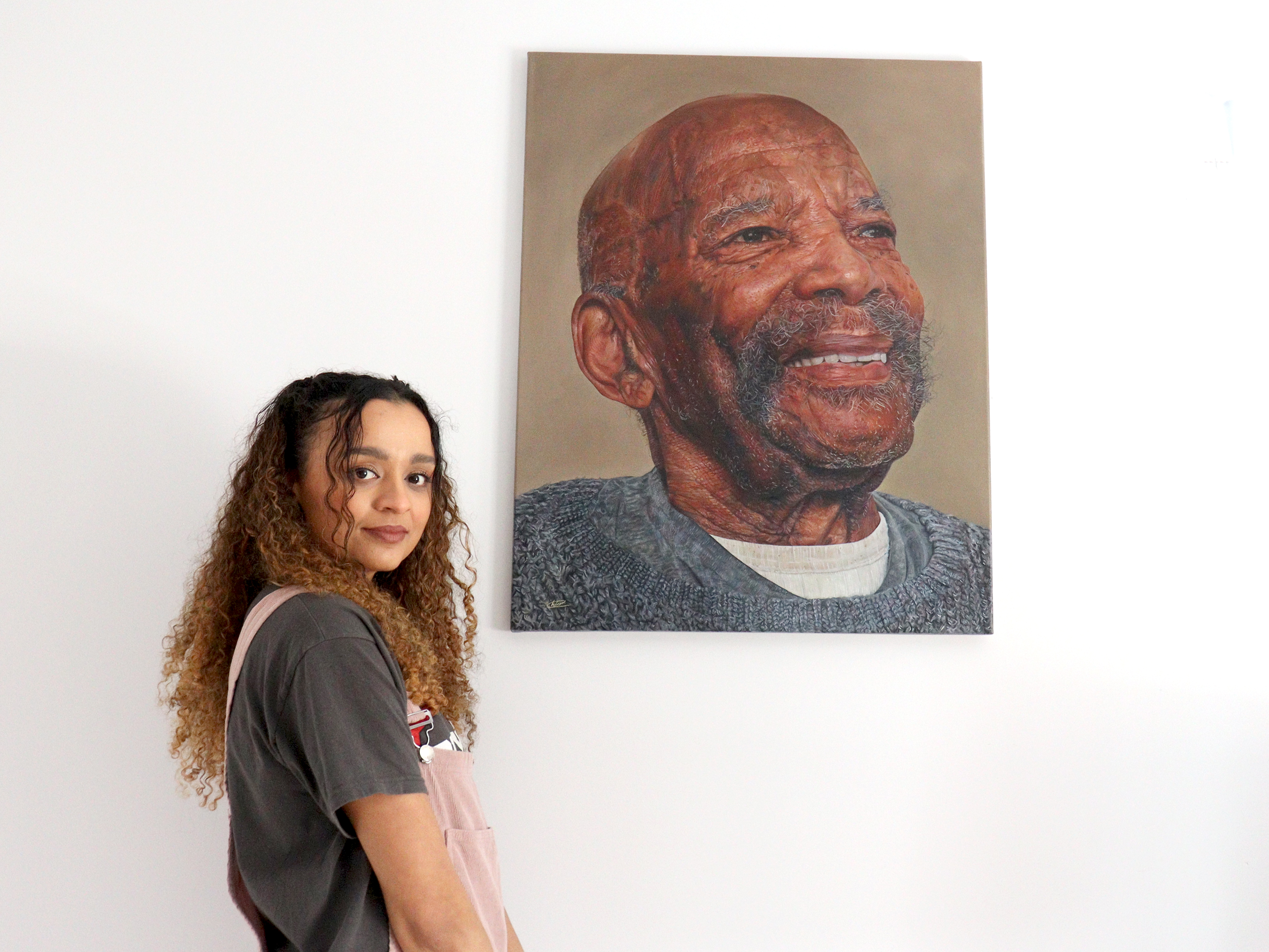
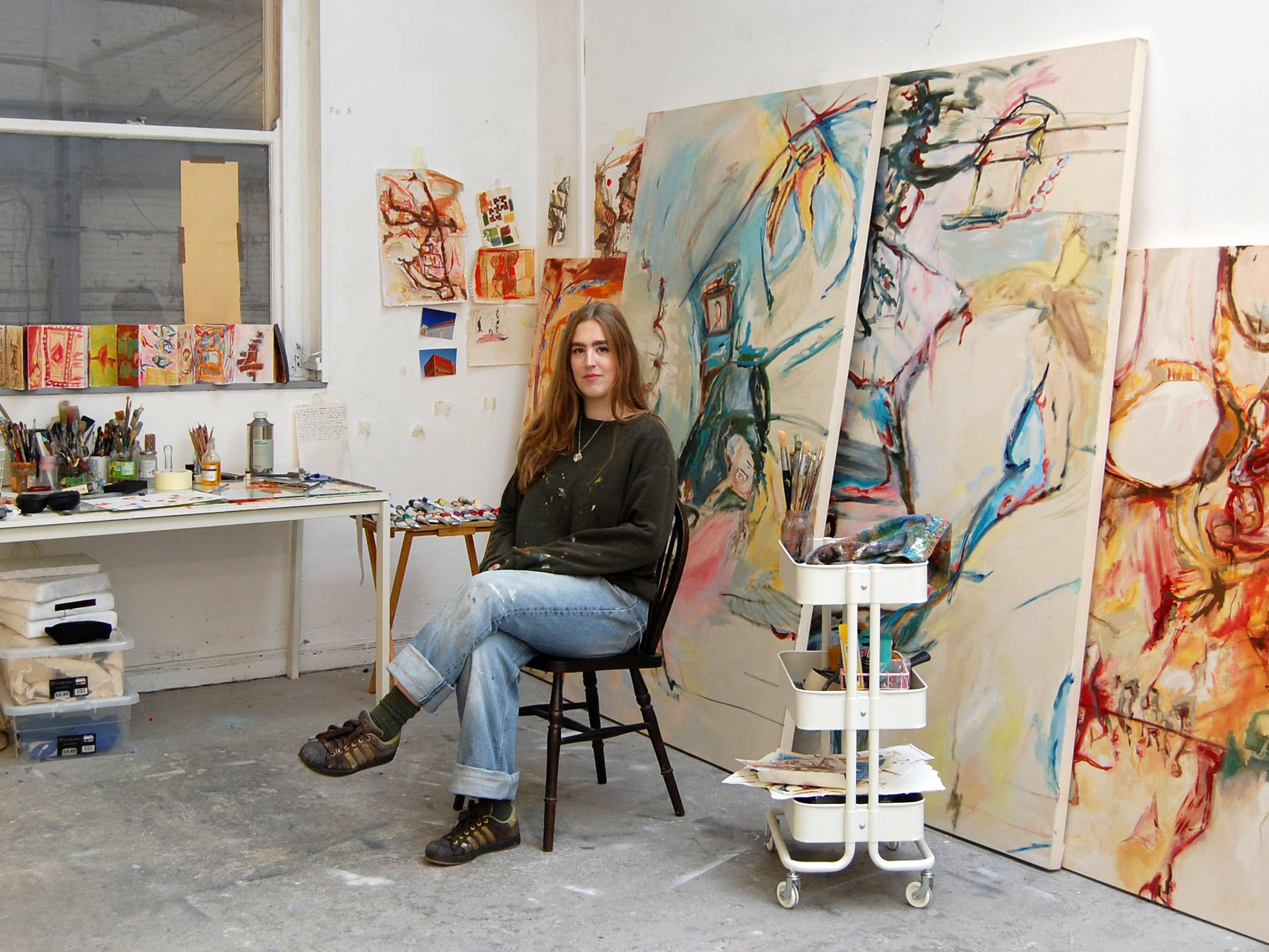
Eleanor Johnson won Jackson’s Art Prize 2025 with her oil on canvas painting Slick With Olive Oil, which you can see in person at our upcoming exhibition of finalists at Bankside Gallery.
The judges said “Eleanor Johnson’s Slick With Olive Oil is a richly wrought painting on a grand scale. The complex, circular interaction of grappling wrestlers and dancers punctuated with hyacinth grape flowers is confidently expressed with skillfully handled oils that are as juicy and glistening as the title suggests. This dizzying composition borrows from Peter Paul Rubens’ fleshy Baroque excesses to present a labyrinthine whirl of tumbling bodies, in a theatrical approach that explores themes such as aggression, sexuality, and play, and was the clear choice for this year’s overall winner.”
We visited Eleanor in her studio to find out more about the inspiration behind her winning painting, her interest in historical art, and the routine that gets her ready to paint.
Interview with Eleanor Johnson, Winner of Jackson’s Art Prize 2025
Contents
0:00 “They stripped their clothes and, sleek with olive oil, began a contest of the level discus”
0:19 Introduction
0:34 “Looking at an ancient story, but from a contemporary lens”
2:44 “It felt very surreal to find out that I won First Prize”
3:04 “I think from a very young age, creativity was really encouraged in my family”
3:48 “It ended up being a blessing that I didn’t get into art school the first time around”
4:31 “Historical art has had a big influence on my painting practice”
6:21 “Colour is definitely central to my practice”
7:09 “I’m pretty obsessed with Rubens”
7:35 “The colour that kind of dominates in this painting around the figures is Sap Green”
10:05 “Flesh is the reason oil paint was invented” – Willem de Kooning
10:48 “I love Michael Harding oil paints”
11:32 “Generally, I do go for synthetic hair”
12:14 “I can spend a few weeks of quite intense painting”
13:58 “I think the paintings that I find are my most successful are the ones that are done confidently”
14:33 “I’m lucky that painting is a bit of an obsession of mine, so I’ve never struggled with getting into the studio every day”
14:41 “I’m interested in creating a kind of imaginary world”
15:59 “I’ve got notes around my studio saying squint”
18:20 “It’s important to trust your instincts”
19:19 Credits
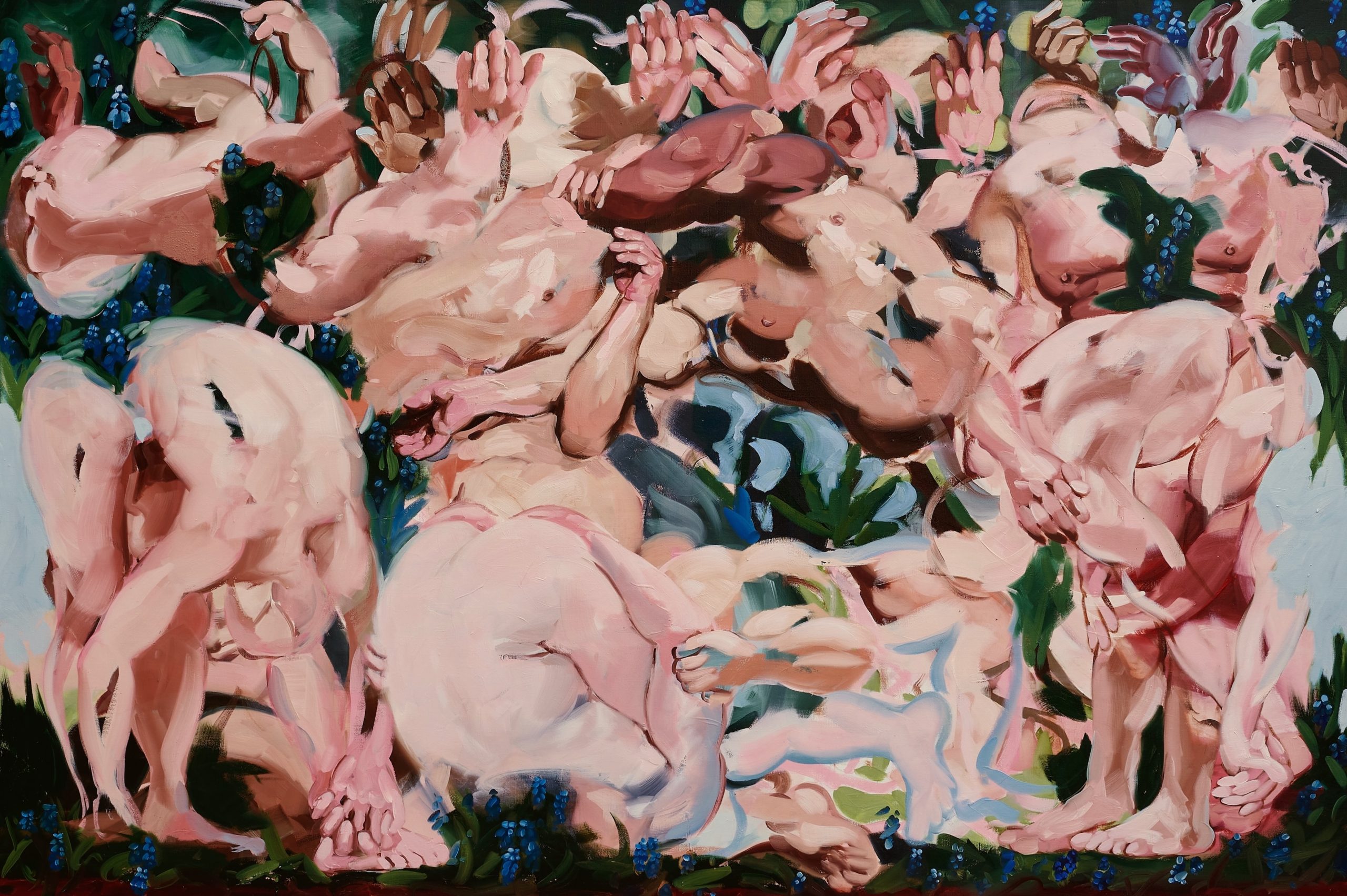
Eleanor Johnson
Oil on canvas, 150 x 225 cm | 59 x 88.5 in
“I’m always coming back to things. I keep everything, even if I don’t like it, because you never know what it might spark.”
Extract from Metamorphoses by Ovid, read aloud by Eleanor:
“Titan was at the halfway point
between
the night’s departure and its
reappearance.
They stripped their clothes and,
sleek with olive oil,
began a contest of the level discus.”
My name is Eleanor Johnson. I’m an oil painter, and I won First Prize in Jackson’s Art Prize 2025.
Slick with Olive Oil was made as part of a series I did responding to a very old poem by Ovid called Metamorphoses. The poem itself is quite dreamlike and strange. The translation that I was inspired by was by Stephanie McCarter, and Slick with Olive Oil is a quote from a translation of a story about Apollo and Hyacinthus. Hyacinthus and Apollo were lovers and they were playing discus together, Apollo threw his discus and unfortunately, it bounced off the floor and killed Hyacinthus. In Apollo’s grief, he transformed Hyacinthus into a Hyacinth flower. I’ve actually added Hyacinth grape flowers to the painting because I do add a lot of natural elements to my paintings. I don’t actually think that’s historically correct, so I took creative liberties on that.
The quote refers to their bodies that were rubbed with olive oil, glistening in the sun, and to me that was quite an evocative kind of image. It reminded me of Turkish oil wrestling: aggressive, but at the same time quite sexual. So the painting itself became this response to the story in the poem, but also thinking about masculinity today and how play can flip over into aggression. Also for the painting, I found some images of dancers and they had a similar kind of movement to them, all kind of linked. An ancient story, viewed through a contemporary lens in a way, that became something quite different.
It felt very surreal to find out that I won First Prize! I definitely wasn’t expecting it. It was the first time I think in my life where I genuinely felt like it could have been a dream. It was a lovely surprise.
Background and Artistic Journey
I grew up in Oxfordshire, I spent a lot of time in gardens, in imaginary worlds. My parents spent a lot of their lives making beautiful gardens. I think from a very young age, creativity was really encouraged in my family. Then I went to school and I had some really, really wonderful art teachers. In secondary school, I remember the first time doing some big paintings and thinking oh, maybe I could do this forever.
I started with a foundation course and applied to art schools for my BA, but after not getting into the ones I wanted to go to, I ended up studying History of Art instead. After that, I found that I had these bits of knowledge from my degree and I wanted to bring that into my painting and bridge those two things – the theory side and the material painting side. So I did my master’s at City & Guilds recently, and here we are now.

Influences
Historical art has been a big influence on my painting practice. I went to France and Italy often growing up, and saw a lot of art in the museums and the churches. Possibly my favourite fresco is in Brescia, Italy. I discovered it when I was doing a residency at Palazzo Monti, which was an amazing experience, the most beautiful frescoes, it was this complete sensory overload.
There are some incredible tapestries in the V&A Museum in London called the hunting tapestries. I remember stumbling upon them, stepping into the room and – obviously the V&A can be quite busy – but when you step into the room it’s very quiet, and the tapestry material absorbs the sound, so you feel like you’re stepping into this very calm space, a bit like a church. I think some museums can be quite church-like.
I love that feeling of immersion as well, when you’re looking at these huge tapestries which are filling the walls and they’re so high. The tapestry itself is really interesting and lovely and it’s quite absurd, it’s very busy, and there’s a lot going on.
Colour Palette
For a few years, I was just doing black and white charcoal drawings and paintings. I didn’t want to go into colour because it just seemed like this impossible thing. At that point, I started looking at Old Master paintings and doing colour transcriptions of them. I’ve continued that to this day, and that was an education in how colour works and how colours work together, but also it taught me how to mix colours. I’m pretty obsessed with Rubens. He did paint quite disturbing things, but at the same time they have this incredible beauty, and I’m really interested in how those two things can work at the same time. I think that’s something that I like to explore in my own work.
The two paintings that inspired the colour palette for Slick with Olive Oil were The Obsequies of Decius Mus and The Drunken Silenus. The colour that dominates around the figures in this painting is Permanent Sap Green, which is a lovely, deep green. For the hyacinth grape flowers, I used Cobalt Blue, which is a really nice, rich blue. I also used Alizarin Crimson, light blues, and also the flesh tones. The composition is so filled by figures, it’s mainly the colours of the bodies that are dominating, and not so much the Rubens colour palette.
More recently, I’ve been looking for colour inspiration from gardens and flowers, because there’s so much inspiration from the natural world in terms of colour palettes. So I’m branching out into that area now.
Themes of Work
One of the consistent themes in my work is the human body. Willem de Kooning said ‘Flesh is the reason oil paint was invented’, because it has this amazing gloopy quality that kind of evokes skin and folded flesh in some ways. I’ve really been interested in the way that skin folds over itself, so I’ve also been really into ceramics.
The themes of my paintings jump around quite a lot because I can get bored quite easily. I tend to work in series and I think each series looks at a different topic. For instance, for the last few years, I’ve been really interested in mythology and fairy tales. I’m also very interested in creating a kind of imaginary world and a dream-like atmosphere. There’s this state called the hypnagogic state, which is between being awake and being asleep. I’ve experienced it quite a lot where I’ll be in this state and I might imagine things around me, and it can be quite unsettling in the moment and quite absurd and strange, so I definitely take that experience of the hypnagogic state into my painting. I really want to make it look like it’s this in-between moment, which is shifting in and out of focus, and where things aren’t complete. So those are the main themes of my work.
Art Materials
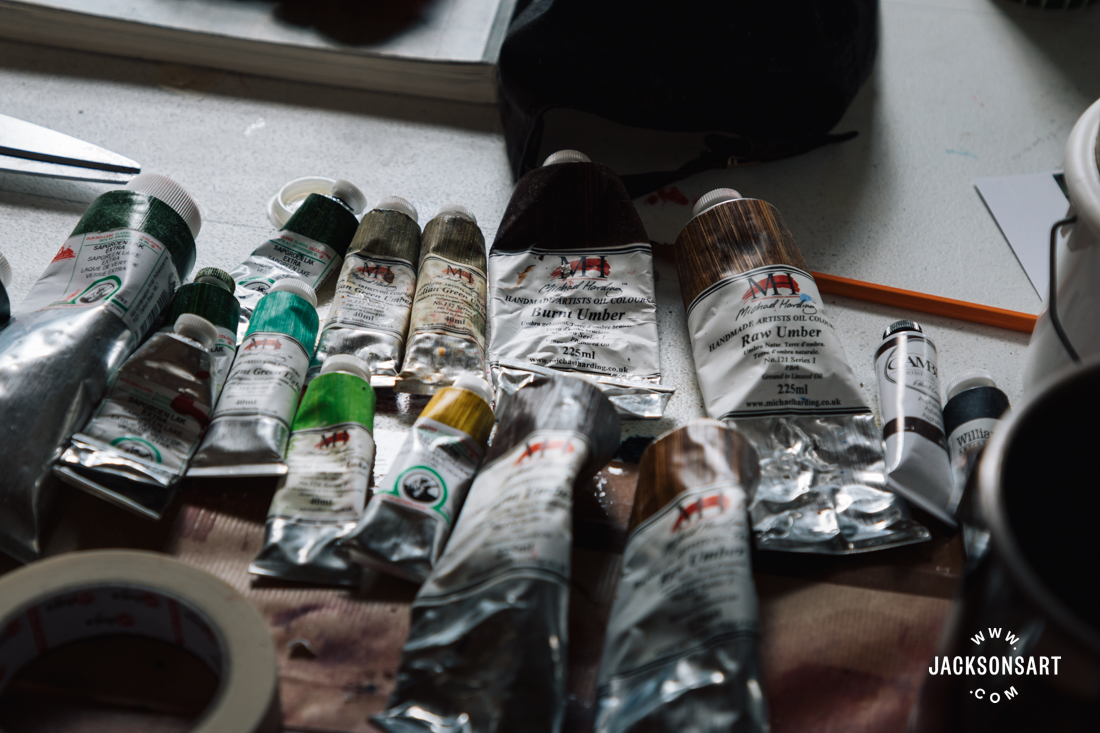
I love Michael Harding oil paints. I think their pigments are beautiful. Very, very rich, and there is such a huge variety to choose from. They have a pigment for everything. I like oil paint because I feel like it’s so versatile, and you can do so many different things with it. You can use it thickly, or mixed with linseed oil, you can move the paint around because the linseed oil has made it so fluid.
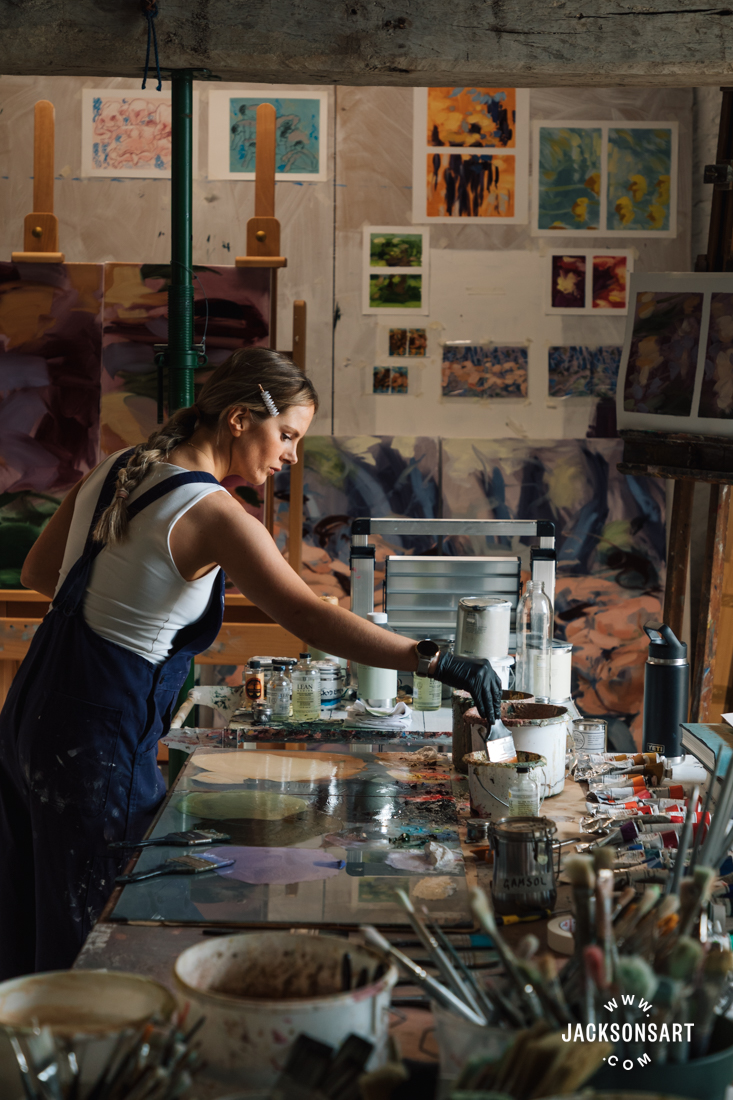
I know that oil painting can sometimes be quite bad for your health. There are certain pigments that shouldn’t really be touching your skin, it’s also not great to inhale too much turpentine. So, I like to use non-toxic or less toxic products where possible, like Chelsea Classical Studio or Gamsol. I also wear gloves when I’m painting now so that the oil paints aren’t absorbed into my skin. Oil paint can get so messy and it can be quite difficult to get off, but I just think it’s a lovely medium.
Colour is definitely central to my practice and when I start a painting, I’ll have a palette in mind. During the process, I’ll stick to that palette and I don’t tend to stray from that because I find that sometimes, if you add a colour spontaneously, it can throw the balance off and be quite jarring. But sometimes not, so it’s kind of a balance.
The first stage is the background colour palette, and it’s almost a colour transcription, but it’s a very, very blurry one. I’ll move around the colours. It doesn’t look much like the original painting. I arrange my colour palette from light to dark.
I definitely couldn’t live without a few essential colours like Burnt Umber, Raw Umber, Ultramarine Blue, Cadmium Red, Ochre, and White. I keep my whites for light tones separate from my whites for dark tones. With Zinc White, you often have to build up layers to make it more opaque and bright. Zinc White can create quite a dreamy atmosphere where the lights are quite low, whereas with Titanium White, if you want to have a really big impact with the painting, it’s great to use from the get-go. They’re two very different things.
My favourite colour at the moment is Kings Blue Light. It has a wonderful luminosity to it, and a beautiful depth of colour.
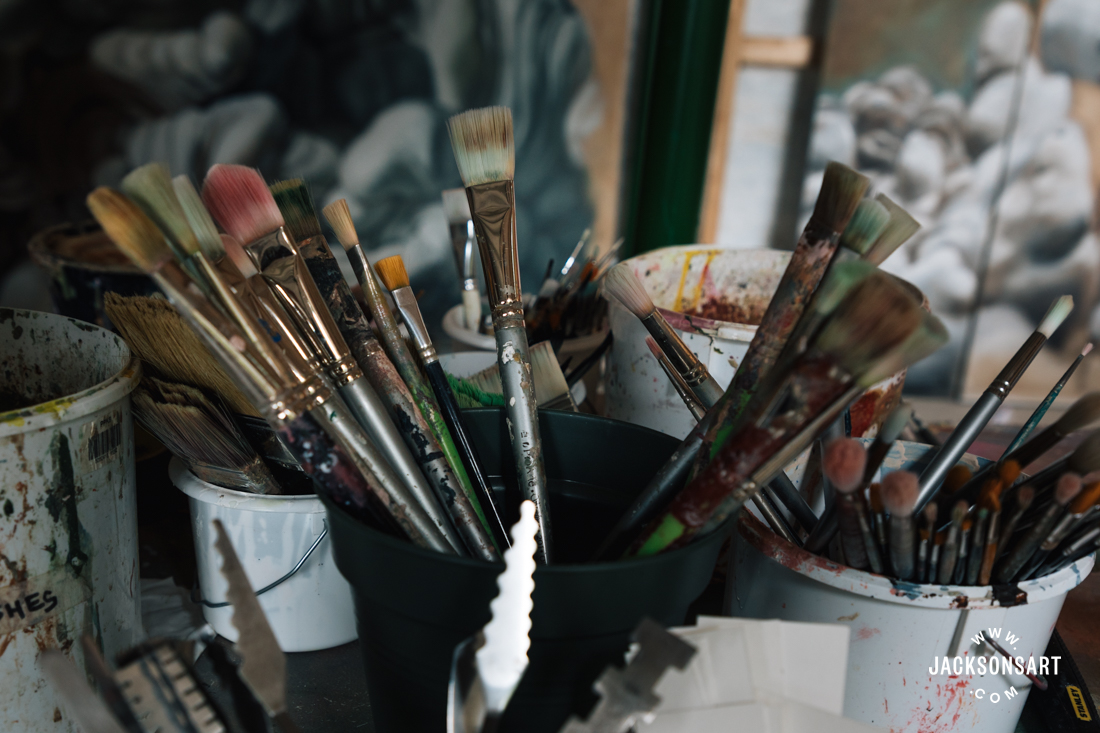
In terms of brushes, I like to use the Jackson’s mottler brush with synthetic hair. Generally, I go for synthetic hair because it has a softness to it. It means that working with the oil paint feels quite smooth. I also love Marseille soap pellets for cleaning paintbrushes. They prolong the life of your paintbrush and they can even save a paintbrush if it’s accidentally been left out.
Research and Painting Process
I have an ideas board where I keep up my main influences, like images of artists that I like and ideas that I’m thinking of, and I write little notes around my studio. If I’m painting something, and it’s gone really well (or if it’s gone really badly), I take a photograph and then write some text over the top of the photograph, like what colours I used, and what technique might have worked really well or not. I find it really useful for documenting what I do because I can so easily forget. When I’m painting from photographs, which I do quite a lot, I try to not refer to them too closely, because I find that the painting for me becomes too rigid, and it loses its abstraction.
I’ve got notes around my studio saying ‘squint’, so when I’m looking at a photograph, I’ll deliberately blur the image in front of me so that it abstracts. Then, hopefully, when I’m painting, there is a looseness to it, which is more energised and less rigid.
I turn my canvas upside down, and that completely abstracts the image. It stops me from working too literally, and something about flipping the orientation is the same if you look at the painting in a mirror – you’re suddenly able to see where something’s not working, or if you need to adjust something. I find that process really helpful.
The paintings that I find are my most successful are the ones that are done confidently. I like things to be loose, energetic. My literal movements with the paintbrush, not holding back, because I know what I’m doing. I also find that music really helps with that, but without any vocals. It really helps me concentrate, and it makes me get into the right headspace and get into a state of flow and focus.
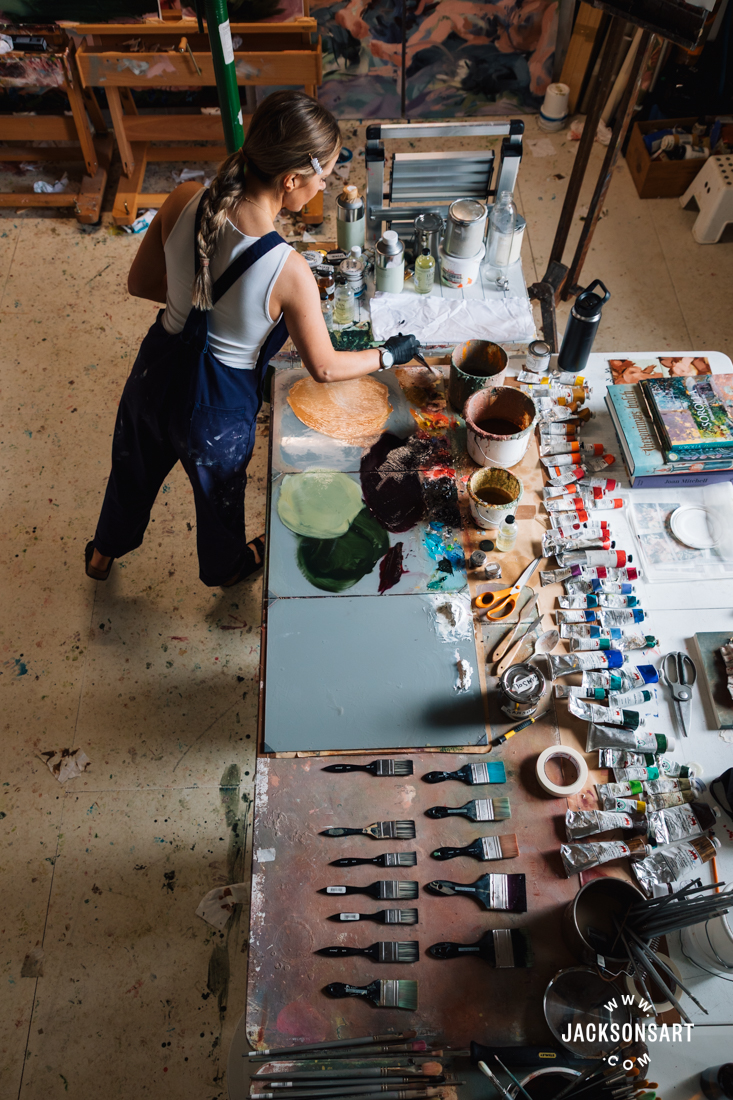
Eleanor’s Studio
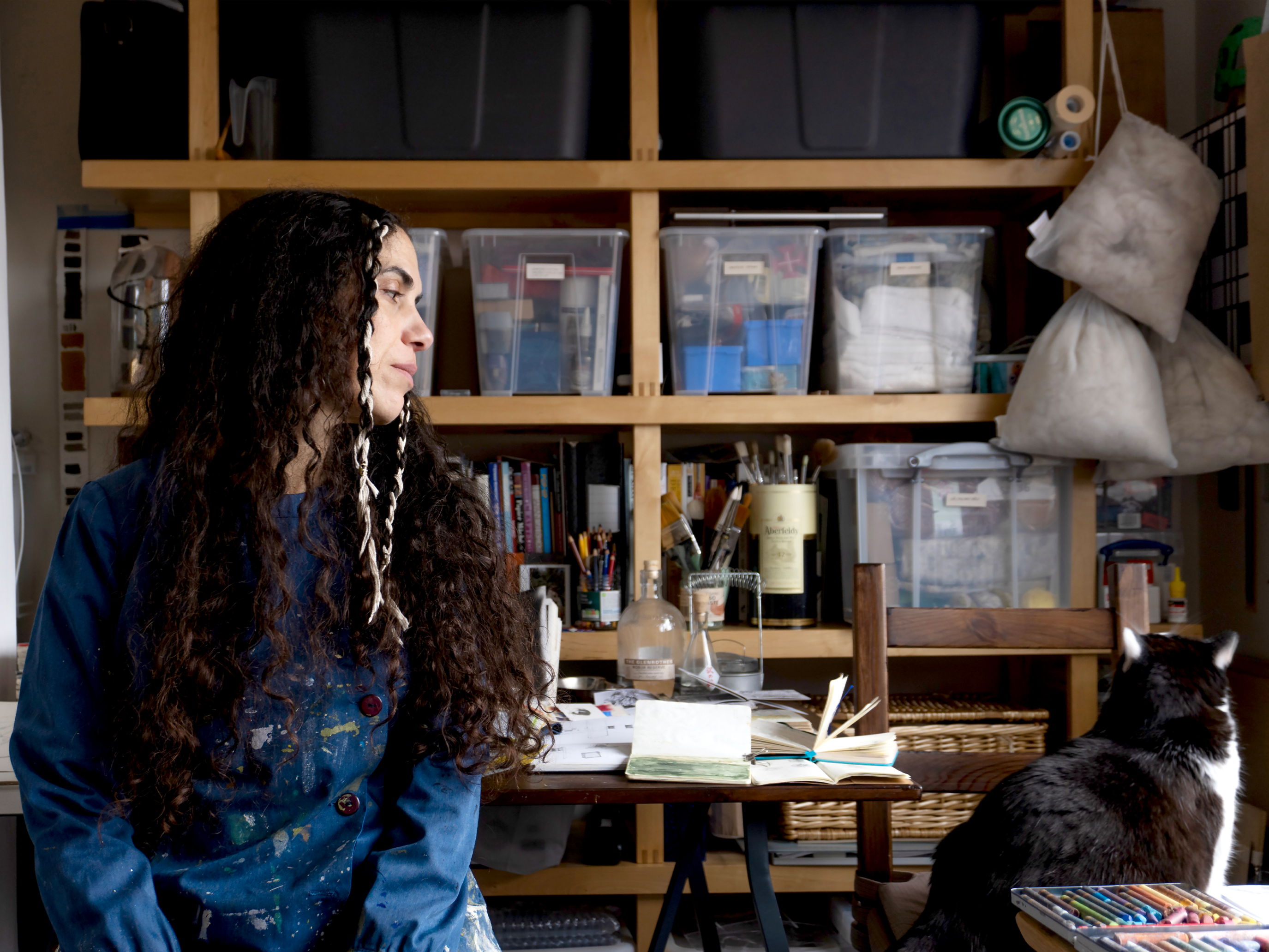
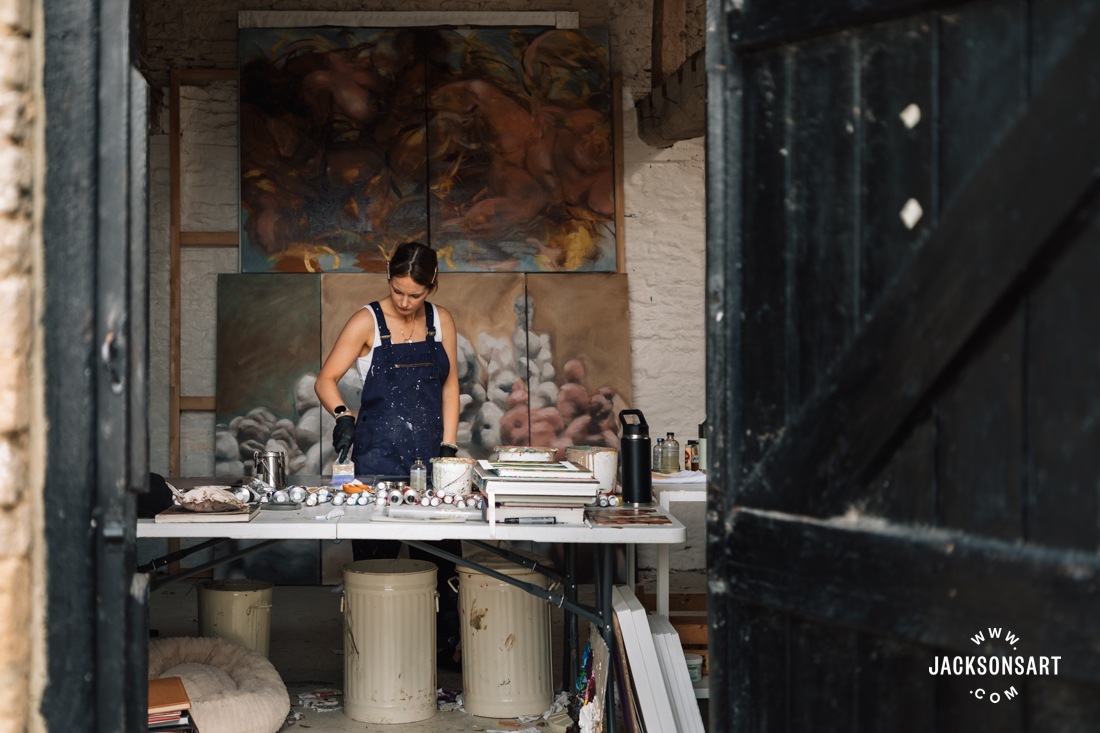
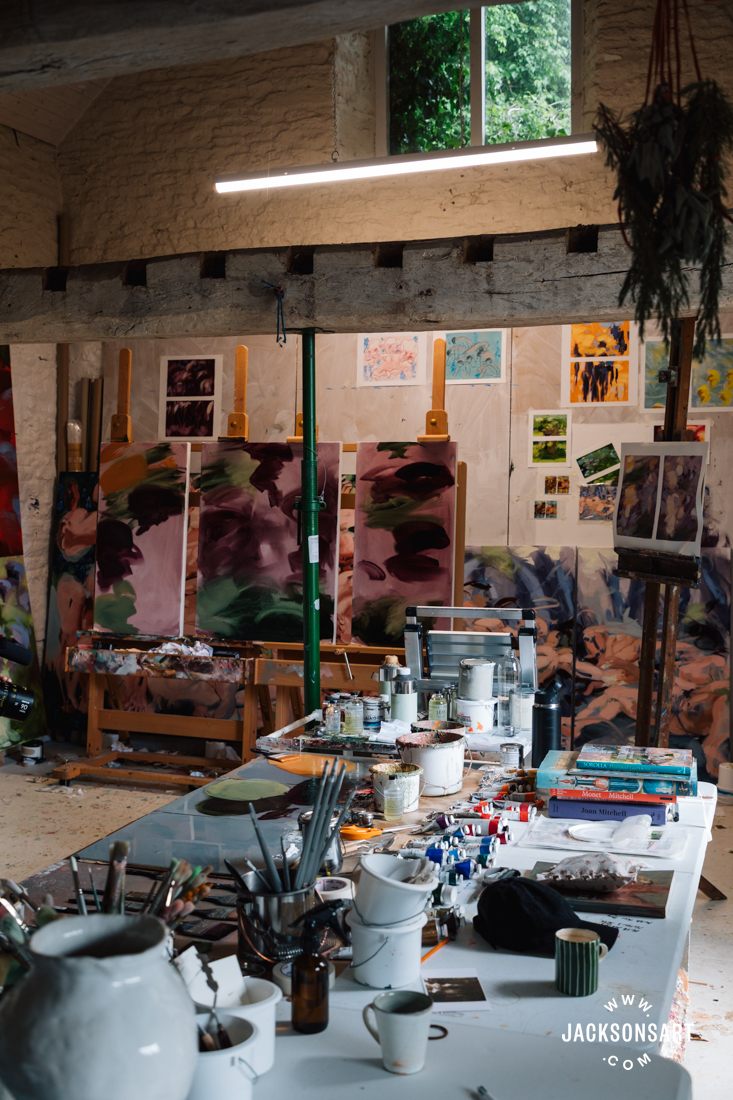
My studio is in Oxfordshire, in the countryside, in the UK, and it’s a very lovely place to work. The space itself that we’re in right now is an old stable where the cows used to be fed when it was a working farm, and I converted it into a studio space during COVID.
I tend to paint with the lights on, not just from daylight – there’s not quite enough natural light in here for that. I keep the books closest to me that are my main inspiration in that moment, and I’ll keep them kind of on the tables nearby so I can just flick through them when I need to.
It’s really nice during the day. I can hear the birds singing all the time and I can take my dog out for a walk in the fields. This area is a constant source of inspiration because there is so much wildlife and so many flowers, and it’s just very peaceful. It definitely suits me.
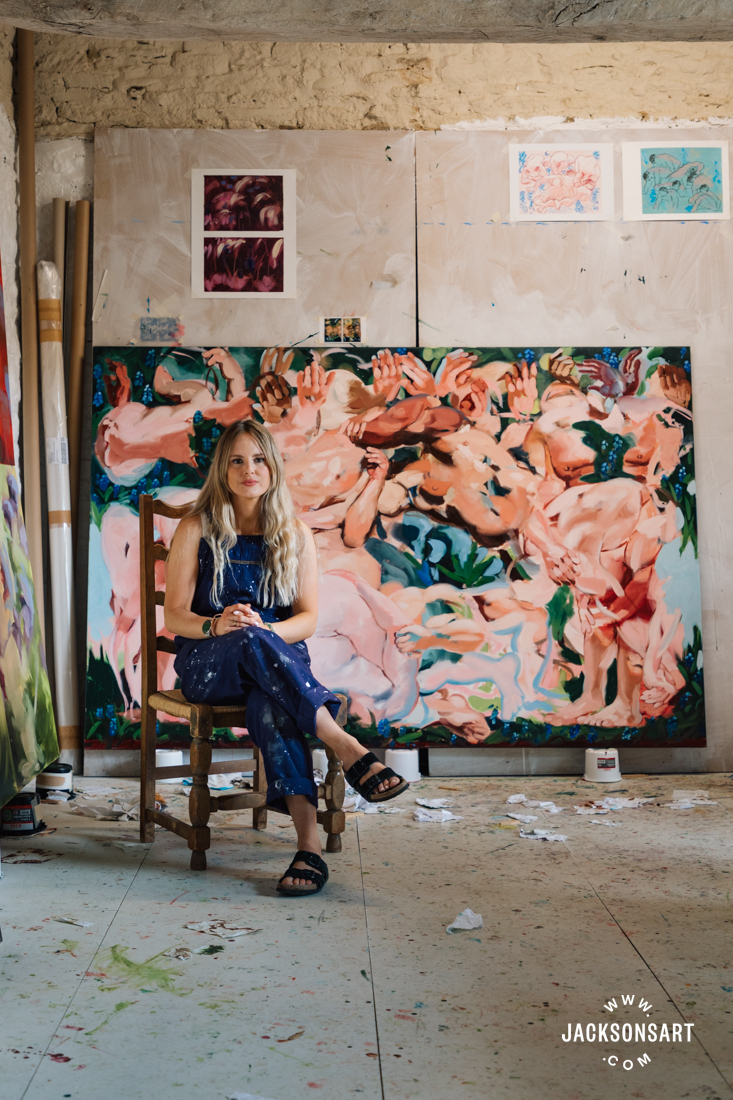
Routine
I have multiple paintings on the go because paint takes quite a long time to dry. I’ll have drawings for other paintings that I’ve planned. The ones in here at the moment are actually from last year – I didn’t have time to do them. I’m always coming back to things. I keep everything even if I don’t like it because you never know what it might spark.
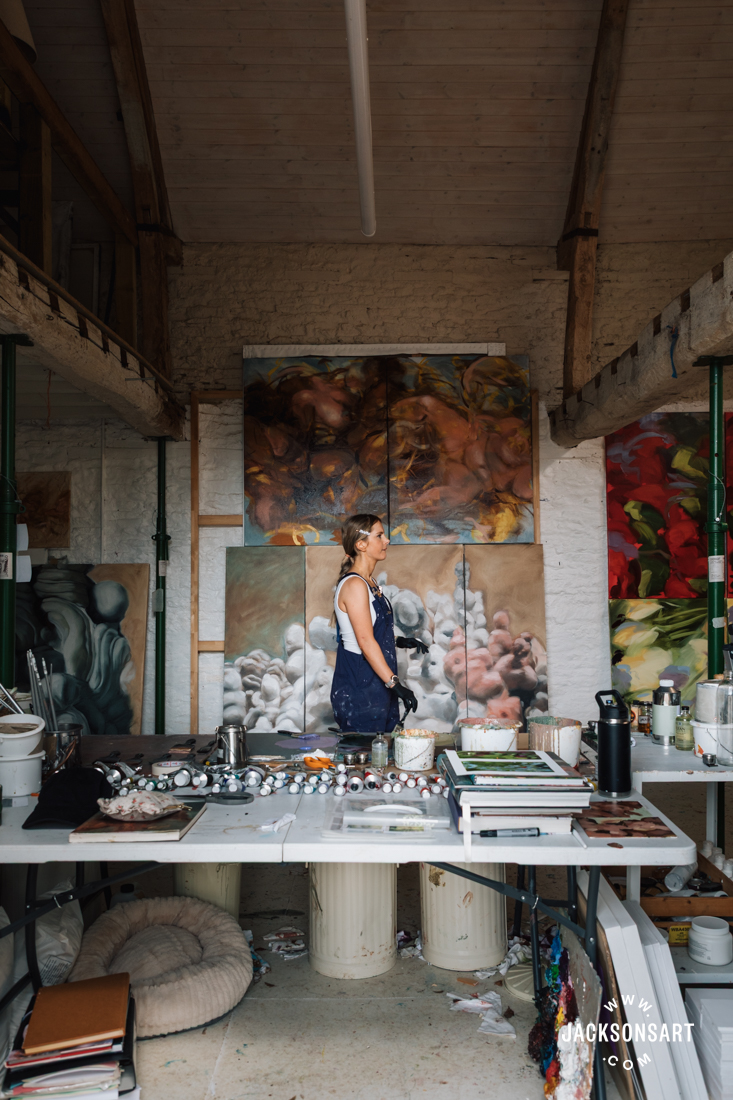
I like to stick to a routine with painting, so I really try to come in five or six days a week. As soon as I come into my studio, I put on my overalls, and that kind of puts me into the work headspace. I plait my hair every time. I like to set up the space and make sure there is a nice atmosphere. I’ll usually light some incense, put some music on, and once a week I’ll pull a tarot card, and then get to work. I can spend a period of a few weeks of quite intense painting, but then, other times I’m doing research, or I’m out trying to find inspiration. I’m lucky that it’s a bit of an obsession of mine, painting, so I’ve never struggled with getting into the studio every day.
Even if you’re at a point where your painting can be your sole income, I’ve found it helpful having other sources of income and another job, so that you’re not worrying about, “Will this sell?”, because then your work is quite heavily affected by that, and I would argue that you’re probably not making your best work. It’s important to trust your instincts. If something isn’t feeling good anymore, then it’s okay to try something new, and it’s okay to make work that isn’t amazing and stays locked away, and it’s good to try new things. Everyone works differently, and it’s good to just find your best way of working.
Extract from Metamorphoses by Ovid, read aloud by Eleanor:
“As when somebody in a watered
garden
plucks violets or poppies or else
lilies
with rigid yellow pistils—
withering,
they droop their heads, too heavy
suddenly,
and gaze not up but downward at
the earth—
like this, his face reclines in death.”
Follow Eleanor on Instagram
Visit Eleanor’s website

Interviews with Past Winners of Jackson’s Art Prize
Andrew Torr, winner of Jackson’s Art Prize 2024
Melissa Ling, winner of Jackson’s Painting Prize 2023
Lorena Levi, winner of Jackson’s Painting Prize 2022
Miranda Boulton, winner of Jackson’s Painting Prize 2021
Ruth Murray, winner of Jackson’s Painting Prize 2020
Iain Nicholls, winner of Jackson’s Painting Prize 2019
Shop Oil Painting on jacksonsart.com