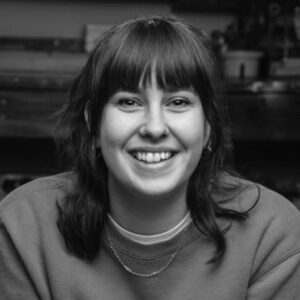
Daisy Fulton won the Student Award in Jackson’s Art Prize this year with her work Can We Not Do It Right Now. In this interview, she discusses squeezing every hour out of her university studio time, finding a rhythm with sketchbooks at a Portugal residency, and the paint colour she couldn’t be without.
Above image: Daisy Fulton in her Manchester-based studio

Daisy Fulton
Acrylic and oil on canvas, 150 x 100 cm | 59 x 39.3 in
Josephine: Could you tell us about your artistic background?
Daisy: Since I was a child, I’ve always been encouraged to be creative and messy, especially by my mum and granny. The dining room transformed into a studio, a bakery, a workshop… full of paints, clay, felt, stickers, pom poms, etc, anything to make some art with!
Art was always my favourite subject at school and the one I took the most seriously. It was in college, whilst studying art, that I realised it wasn’t just something I loved, it was something I knew I had to pursue. I had an incredible tutor who challenged me to dig deeper into how and why I make art, and the hands-on facilities there gave me room to experiment with all kinds of materials and techniques.
After college, I moved to Manchester to study Fine Art at Manchester School of Art. During my degree, I spent a semester abroad at the Willem de Kooning Academy in Rotterdam and did a placement at Waterside Arts in Sale. I was lucky to have tutors who took being an artist seriously while still recognising the ups and downs that come with it.
I graduated this summer, and reflecting on those years makes me so happy. Spending long days in the studio, experimenting in different workshops and playing with materials reminds me so much of weekends in my granny’s art shed when I was a child. It was in my second year that I really found painting, and I’ve been obsessed ever since.
So, I think I’ve always been an artist. I just had the right people around me, tutors, friends, and family, who encouraged me to keep going and never shy away from being creative.

Josephine: What does a typical working day in the studio look like for you? Do you have any important routines or rituals?
Daisy: Since graduating, I’ve been juggling a few different jobs while trying to prioritise time in the studio. Adjusting from spending five days a week in the studio at uni (sometimes staying until security kicked me out) to squeezing in a few hours here and there has definitely been a shock to the system.
At university, I had a constant flow of work. I could paint, read, draw, and reflect all in one go. Now, I’ve had to find new ways of keeping my practice up. I listen to podcasts on the train, and I work at an arts venue in Manchester, where I’m surrounded by live performances, music, poetry, and exhibitions. Those experiences feed into my work in different ways and keep my creativity going.
I try to get all the admin bits done at home so that when I’m in the studio, it’s just about making. When I get there, I always have music playing, often I have the space to myself, so I’ll sing and dance around while I paint! Music connects me to places and moments, and I find that sense of memory often slips into my work. Snacks are, of course, essential too, fuel for a good painting day!
At the moment, I’m working from material I gathered during a residency at Fábrica da Criatividade in Castelo Branco, Portugal, over the summer; photos, colour palettes, and drawings I made while I was there. I listen to the same playlist I had on during the residency to bring myself back to that mindset.
Once I’m set up, I try to pick up a brush and dive straight in without overthinking; that’s the most exciting part for me. But some days, the energy just isn’t there. Sometimes I’ll be looking forward to studio time, only to arrive and find I’m not in the right headspace. On those days, I’ll tidy, organise, or just potter around, and I’ve learned that’s part of the process of being an artist too.

Josephine: Which materials or tools could you not live without?
Daisy: Venetian Red oil paint, without a doubt. My friend Grace will probably laugh reading this, she’s definitely heard enough about my obsession with this colour! Whenever we’re out, if I spot a door, a plant pot, a building, or an image online that has that perfect Venetian Red tone, I always point it out. It’s such a beautiful shade, perfectly balanced between red and brown. It can be neutral yet vibrant, bold yet subtle. I love how versatile it is, and it’s easily my favourite colour to work with. A close second is Buff Titanium. Honestly, I think every painting I’ve ever made has that colour somewhere in it. I could talk about paint colours for hours; they fascinate me.
Brushes, of course! They’re how my ideas move from me, through the paint, and onto the canvas. I like working with a range. An old, scratchy brush alongside a new, silky one. The contrast creates interesting marks and textures, and I love the unpredictability that comes with it.

Josephine: Do you work from a reference? What is your process?
Daisy: When I’m painting, I don’t work from images or photographs. Instead, I paint from memory, from feelings, emotions, and recollections that find their way onto the canvas through the brush. The paint itself becomes my guide. I respond to its physicality, how it moves across the surface, the textures and marks it creates, and how those interact with what’s already there.
I usually start with a palette of Venetian Red, Buff Titanium (of course!), pale pinks, peach tones, and neutral browns. As the painting develops, I’ll bring in brighter colours, maybe a blue or green, depending on how I’m feeling that day. There’s no strict process I follow; I like to let the work unfold naturally. My process is all about intuition and curiosity. I try not to restrict myself too much, especially with colour, it’s the most playful, exciting part of painting for me.

Josephine: Do you regularly draw or keep a sketchbook? If so, how does this inform your work?
Daisy: I’ll admit, I used to be quite dismissive of drawing and sketching. I never valued it the same way I did painting, probably because it felt quicker and less laboured. With painting, I start from scratch: cutting the wood, building and stretching the canvas, priming, mixing colours, it’s a whole process. With a sketchbook, you just turn the page and start, and I think that simplicity made me underestimate it for a long time.
After reading Amy Sillman’s Faux Pas: Selected Writings and Drawings, I started to rethink how I viewed drawing. I began using it as a tool to inform my paintings. Working with my hand in a different way, creating new forms and textures, opened up new and exciting directions in my work.
During the residency in Castelo Branco, I didn’t have access to canvases or paints, only sketchbooks. At first, it was a real challenge to get myself drawing every day, but after a few pages, I found my rhythm. I started to absorb my surroundings and translate them onto paper. I had a concertina sketchbook that I loved filling up, and it now lives in my studio. I look through it all the time for inspiration. The group I was with were all avid sketchers, constantly drawing in cafés or during downtime. Some of my favourite memories from the residency are those moments, quick sketches of people, conversations, or silly games that became a visual diary of the experience.
The marks I make when I draw aren’t directly transferable to canvas, but they definitely inform how I now use paint, more freely, more playfully. Since embracing drawing as part of my practice, I’ve started exhibiting my sketchbooks and drawings, and I’m learning to value them just as much as my paintings. I also keep written reflections alongside my drawings, little notes about where my practice is heading, and I often revisit them to see how my ideas have evolved.

Josephine: Have you ever had a period of stagnation in creativity? If so, what helped you overcome it?
Daisy: I have to say, I’ve been on quite a roll with making ever since college, and I can’t think of a time when I’ve completely run out of ideas. I guess during Covid was strange, I was making artworks out of sticks and leaves just to keep myself creative! I think we were all clinging to anything that kept our hands and minds busy back then.
Right now, the challenge isn’t a lack of ideas but a lack of time. Not having that daily studio routine has been tough. Sometimes weeks go by without painting, and it’s hard to keep the same momentum and flow I had at university. I’m only a few months out of graduating, so I’m trying to be kind to myself, to remember that it takes time to find a rhythm between full-time work and being an artist. Talking with close friends who are also artists really helps, too. Those conversations always remind me that we’re all in the same boat, figuring out post-grad life and doing our best to keep creating.

Daisy Fulton
Oil on canvas, 250 x 200 cm | 98.4 x 78.7 in
Josephine: Are there any specific artists or mentors who have inspired you?
Daisy: My tutor at college, Kyle Kirkpatrick, and my tutors at university, including Jenny Eden and Brian Mountford, have all been huge influences. They each challenged me in different ways but always offered the right balance of guidance, support, and belief in what I was doing. That encouragement really shaped the artist I’m becoming.
I think I’m still discovering the artists who truly inspire me. I always get asked who my favourite artist is, and I honestly struggle to answer. Maybe I just haven’t met them or seen their work yet!

Josephine: What were you thinking about or exploring at the time you painted Can We Not Do It Right Now? What inspired it, and how did it come to be?
Daisy: I painted Can We Not Do It Right Now shortly after coming back from a year away from university. It had been ages since I’d been set up properly in a studio, and I was so eager to start painting again that I just began working on some old pieces. The first layers were awful, dried-up acrylic that left the surface bumpy and uneven. But I layered oils over them and let that uncertain texture guide the forms and composition. I wasn’t consciously trying to make a painting about my time abroad, but the experience subtly changed my colour palette. I used to love working with vibrant purples, reds, and pinks, but this painting feels more muted and grounded.
The design, architecture, and atmosphere of the European cities I visited seeped into the canvas almost subconsciously. Looking back, it feels like a more mature approach, letting the textures, forms, and colours speak for themselves.

Daisy Fulton
Oil on calico, 150 x 120 cm | 59 x 47.2 in
Josephine: Why did this piece feel like the right one to submit?
Daisy: This was the first piece I finished in my final year, and I was really proud of it. I loved the process, layering the paint, figuring out the colours, and seeing how the painting evolved. It was such an exciting journey. I think this painting naturally fell into place. I was working alongside a new cohort of painters and getting fresh advice from tutors, so I was able to reflect on my experiences away and use the feedback from peers to shape it. It felt like the perfect piece to show that moment of exploration and growth. Honestly, it’s a hard question to answer; it just felt right.
Josephine: How did it feel to move through the stages of the competition and win the Student Award?
Daisy: I was in complete disbelief at every stage. When I made it onto the extended longlist, I could hardly believe it, and to be honest, I didn’t fully anticipate the scale of the competition. I was shocked to know how many applications there were. When I made the shortlist, I remember FaceTiming my parents; we were all so excited and thrilled that my work was being recognised. Then, to actually win the Student Award, I was speechless. I couldn’t quite comprehend that, out of all the applications, mine had been noticed.
Receiving that recognition just before submitting all my final uni work gave me incredible motivation to really give my all. Attending the opening night with my mum was so special. Having my work shown in London felt surreal and amazing. I feel incredibly grateful for the whole experience!

Daisy Fulton
Watercolour, chalk, and pencil on paper, framed, 35 x 45 cm | 13.7 x 17.7 in
Josephine: In what ways do you feel your work has developed over the course of your art education?
Daisy: I approached university very open-mindedly, excited to learn as many new techniques and skills as I could. I got inducted into all the workshops and attended every class possible, from Adobe Cloud to plaster casting, glass blowing to fabric dyeing. The facilities were incredible, and I wanted to make the most of them. In my first year, my work was very mixed media, with collage and embroidery often thrown in.
By my second year, I realised I needed a focus to be productive; naturally, that was painting. It was the medium I could work best with and really became my main way of working. My time studying abroad didn’t allow much time for painting, so when I returned for my final year, being back in a studio and creating came effortlessly. It confirmed that painting is my art practice. I was also lucky to be surrounded by an amazing group of painters, which continues to inspire me today. I think any student will agree that art education is a journey!

Josephine: How do you decide on your colour palette, and how do you know when a work is finished?
Daisy: I don’t really overthink my colour palette. I have my core favourite colours, as I mentioned earlier, but my favourite part of using oil paints is the mess on my palette. Mixing colours and not always knowing how I got there, letting it happen naturally, is really exciting. Then comes the challenge: can I recreate it? Often, this leads to a new shade that doesn’t match perfectly but ends up working beautifully alongside another painting. My palette also picks up on my environment, what I’m seeing, feeling, or experiencing at the time.
As for knowing when a painting is finished… honestly, that’s such a hard question! I can leave a work for six months, thinking it’s done, and still come back to it. Sometimes I get frustrated or fed up with the direction it’s going, and that’s when I decide, “Right, this is done.” Mostly, though, I know a piece is finished when I keep looking at it and it feels complete – when my eye moves across the canvas and everything feels in place.

Josephine: Are there any new materials or ideas you’re excited to explore using your prize?
Daisy: I’m really excited to start making my own paints and working with pigments! I attended a talk by Suleman Aqeel Khilji, whose work I love, and learned that he hardly ever uses paint straight from the tube. I’d never considered doing that before, so I’m excited to explore that! Winning the award has allowed me to buy the right materials and explore my painting practice more experimentally. I can’t wait to learn new techniques; it feels like the start of a new chapter in my work.

Josephine: What’s coming up next for you?
Daisy: I’m really excited to be part of a project by my friend Macy Biss called Staged, which will be showing at Bankley Gallery, Manchester, 3rd-9th November. A few artists have contributed a painting, and Macy will work around them to create a contextual frame that’s neither background nor commentary, but a kind of theatrical set. It sounds really interesting!
In August, I went on a residency in Castelo Branco, Portugal, alongside 11 other artists and designers from my university. The month was transformative, not just for the friendships we built, but for the time and routine it gave me to create. I was drawing, writing, and reading every day, and that experience has inspired a new series of paintings that I’m currently working on for an exhibition in January – stay tuned for details!
I’d love to do more residencies in the future, and for now, I’m digesting everything I learned during my degree and channelling it into my painting practice.

Further Reading
Meet Eleanor Johnson, Winner of Jackson’s Art Prize 2025
Jackson’s Art Prize 2025 Exhibition at Affordable Art Fair
How We Collaborate With Artists
Expert Advice on Making Your Way as an Artist
Shop Oil Painting on jacksonsart.com