



The cold weather is upon us! There is a difference in the temperatures that oil paints and acrylic paints can tolerate during the winter. If your studio is in a traditional freezing garret or a frosty shed you need to be aware of these.
Drying of acrylic paint in cold weather
Acrylic dries in two stages- the first is the evaporation that makes the paint feel dry. Low temperatures slow the evaporative drying a bit. The second stage is more lengthy and if the paint layer is thick can take months or years to complete. This is when the paint “cures”. The underneath dries, the excess chemicals are pushed out so the colours clarify or the clear gels go clear, the plastic forms the strong and flexible molecular chains that change it from a liquid to a solid, and it shrinks by up to 40%.
If an acrylic painting is in conditions below 9C (that’s about 50F) during the curing process there may be problems with adhesion to the surface or cracking at a later date as the polymer chains do not form correctly.
I have a thermometer in my studio that stores the lowest temperature of the night before so I can see if it is getting too cold. I have an oil-filled electric radiator that I can leave on the lowest setting, that turns on with a timer, just enough to keep it at 10C.
Storage of acrylic paint in cold weather
Acrylic paints, mediums and varnishes should not be allowed to freeze. They become lumpy or rubbery and as such are not usable.
The Acrylic Painting Department on the Jackson’s Art Supplies website
Drying and storage of oil paint in cold weather
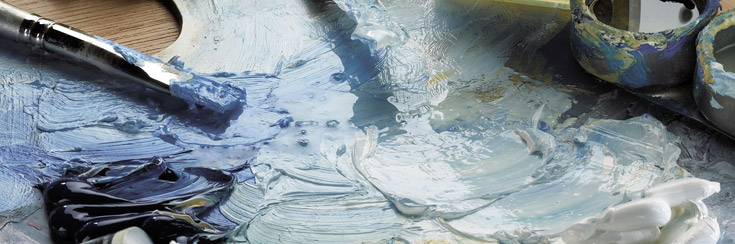
Oils polymerise fine in cold weather. So a freezing garret doesn’t interfere with the proper drying of an oil painting. Oil paints and mediums do not easily freeze so there is not much to worry about with their storage in cold conditions.
The Oil Painting Department on the Jackson’s Art Supplies website
Shop Art Materials at jacksonsart.com
Painting by Gustave Caillebotte 1878.



6 thoughts on “Painting in cold weather”
Hi can you help? I only use sennelier 5in
oil pastels ,this year the pastels have
gone really stiff to use, the lipstick feel
of the medium has gone ,this is really
bad for mixing colours etc and I use
large sweeps of colour.my thumbs are
working overtime to spread the
colour.could this be a cold issue, at the
moment they are in a warm cupboard,
with little improvment, any advice
please.
Hi Peter
Your supposition about the cold weather makes sense. But since the warm cupboard did not solve the problem I am not sure what is happening.
I have emailed Sennelier to see if they can help. I will get back to you when I have received an answer.
Hi Julie, we are brand new oil based
painters, doing the wet on wet
method.
Not all our paints seem creamy. We
are painting in a garage and its cold
all day and night. We warm it up a bit
before we paint. Is the cold paint the
problem (The heating isn’t long
enough to effect the paints
temperature, especially that in the
tubes we put on our pallet when we
start?
Hi Mike
Artists paint outdoors in the winter with oil paints, they don’t go hard at temperatures that a human can tolerate.
If you store them in the garage all winter perhaps they are freezing, I’ve never seen them that cold, but they might get quite stiff.
It’s more likely that your colours from the tube would be too stiff for your purposes at room temperature. There are three reasons that painters add mediums to their oil paints – to modify: the drying time (faster or slower), the sheen (gloss or matt), or the thickness (make it thicker or make it more liquid to give it more flow). The most common reason to add a medium is to make the paint flow better. Oil paint is stiff partly to keep it under control so it doesn’t leak out of the back of the tube fold and so you can control a squeeze and it doesn’t just pour out. So most people add a few drops of linseed oil (this will also make it dry slower), or a fast drying medium (some combination of an oil and solvent and perhaps a resin), or a solvent (too much and this will dry matt and have not enough oil to harden).
This article might help: A GUIDE TO OIL PAINTING MEDIUMS
Some brands of paint are much softer than others, so you might want to try a few brands to find one that you like.
I hope that helps.
This was helpful! I’ve linked your work in our article about acrylics: https://alkony.enerla.net/english/the-nexus/miniatures-nexus/miniature-hobby/miniatures-painting-miniatures-acrylic-paints
Thanks, glad you found it useful!
Comments are closed.