



Following on from our recent features on Pastel Painting (published to commemorate the opening of this year’s Pastel Society UK exhibition at the Mall Galleries) we have a guide to Painting a Portrait in Pastels, written by 2 experts in the field – husband and wife Pastel Society members Glenys Ambrus and Victor Ambrus.
Glenys Ambrus is an illustrator and fine artist who as well as being an Associate of the Royal College of Art has had her work in over 50 published children’s books in the UK and the US. She has written for The Artist magazine, The Artist and Illustrator and Pastel Journal.
Victor Ambrus is an illustrator of history, folk tale and animal story books. He is also an Associate member of the Royal College of Art and appeared on the Archaeology TV Series Time Team, on which he visualised how sites under excavation may have once looked.
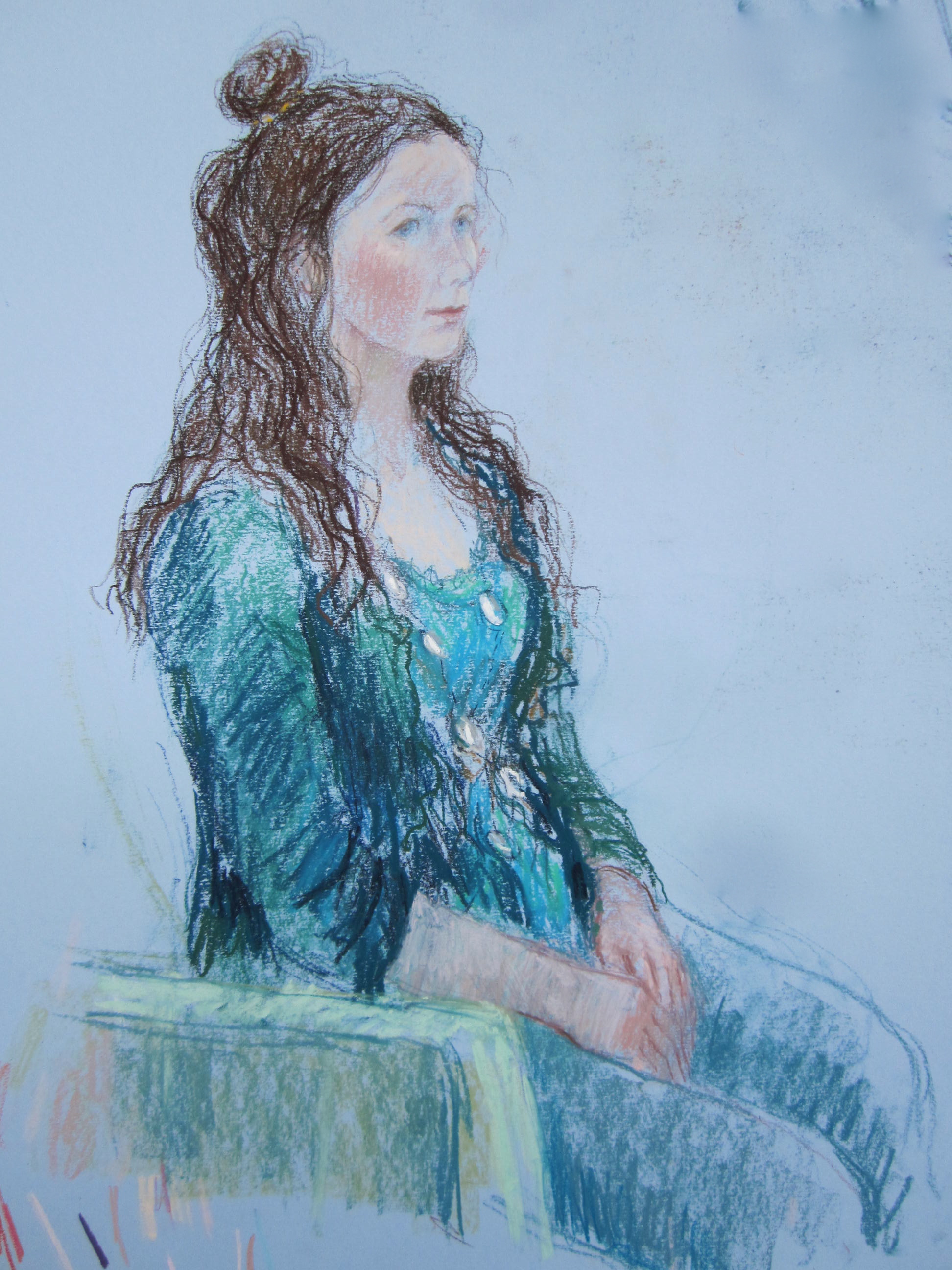
Victor and Glenys Ambrose have very generously taken the time to write out their individual guides to painting portraits in pastels. Notice the difference in their approaches and look at their contrasting illustrations of the same figures to see just 2 of an infinite number of ways of interpreting a subject. How would you approach your pastel portrait? Share your hints and tips via the Submissions and Suggestions button.

Portraiture – Choosing a support
Glenys: Try various papers or card, smooth or grained, pale or darker toned, until you can decide on a preference. I prefer to use a smooth, pale-coloured mountboard or thin card, as I like to make my own textures with pastel.
Victor: I like to draw quite large, about A2 size on heavy cartridge paper with a smooth texture – not watercolour paper as it is too coarse for my way of working and in a very pale tint.
Pastels
Glenys: Depending on the colour I need, I use a variety of different makes of pastels in varying degree of softness – Unison, Schminke, Daler- Rowney, Rembrandt, Inscribe etc and use the harder Conté crayon for drawing up and defining.
Victor: I use a variety of Schwan Stabilo pastel pencils, Conté, Wolff carbon pencils, carefully sharpened Caran d’Ache watercolour pencils for fine detail (used dry) and various soft pastels.
Setting up
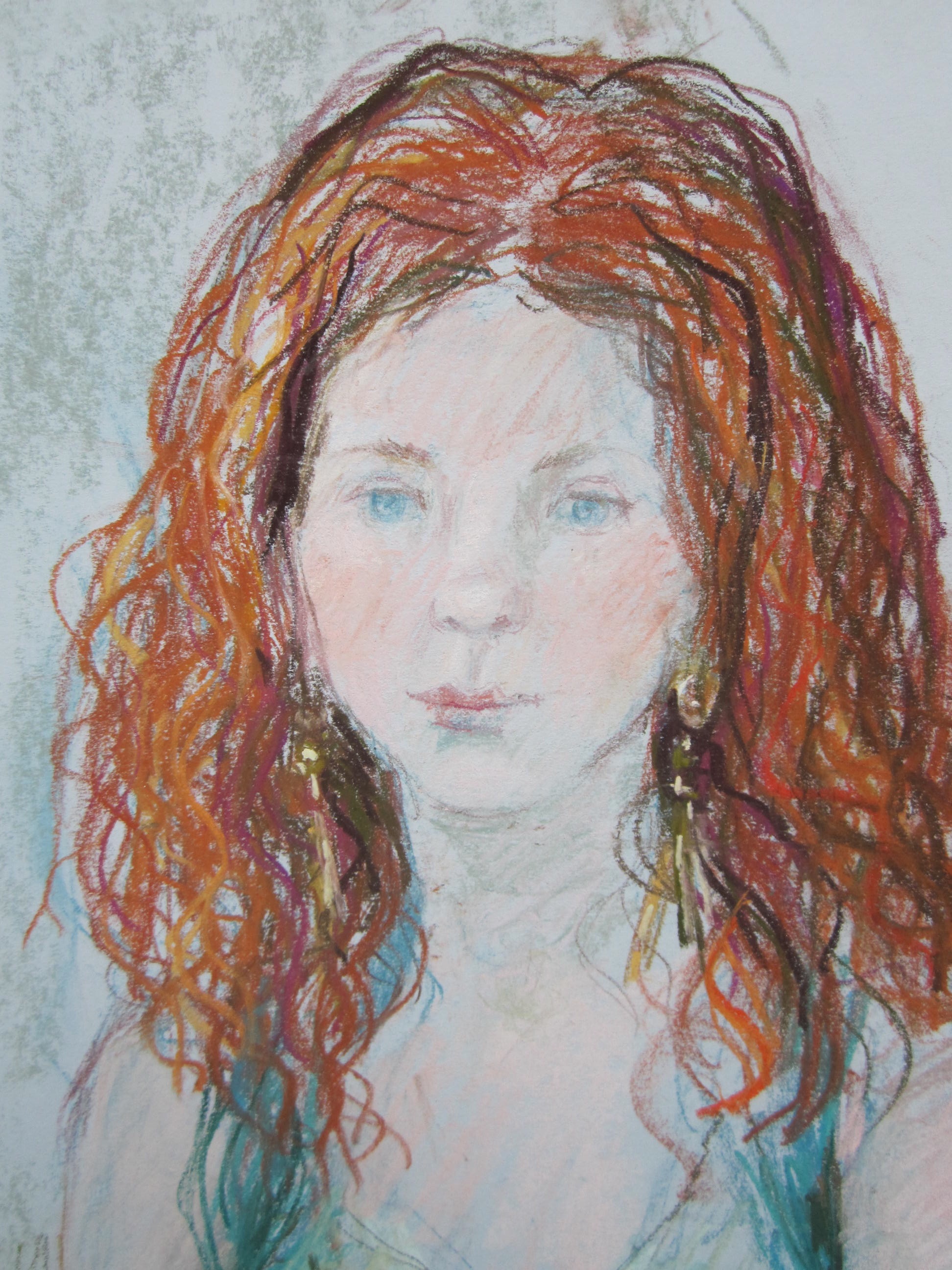
Glenys: Decide how much of the person you want to portray – head and shoulders, down to the hands or full length, and whether it will be a profile, full face or a three-quarter view. I usually include the hands as they are expressive.
Design the composition, making sure there is space at the top of the head to allow for comfortable framing. Draw up the composition loosely and lightly to allow for alterations – I use a steel blue Conté crayon – no details at this stage – just indications. Check proportions, using the head as a basic measure.
Victor: To start with, I only use pale pastel pencils very lightly as it is easier to correct. I will only look at the large forms at this stage as it is a kind of ‘marking out’ and ignoring detail. Next I will measure and check the proportion of the head to the body. It is very important to get the scale right – too big a head and the body shrinks, too small and you have stretched out a long, tall figure with a pin head. If that is all right, progress with colour.
Blocking-in
Glenys: Noting the direction of light, look for large shapes and using the side of the pastel, block in the mid- tones, gradually adding cooler or warmer colours, to model form. Still keeping the picture loose, indicate features rather than making a too definite statement. The idea is to use veils of colour to find the tone you need, but no more than three as it will make the colours grey and give a clogged effect. Keep the background simple and understated. Lay any pattern over tone.
Victor: Katie had red hair which I blocked in with the side of a soft, short piece of pastel – a short pastel held on it side is like a broad brush leaving a soft rich pool of colour – with a pastel pencil you can boost this colour or draw in on top of it to indicate the flow of the hair.

Still with a soft pastel pencil very lightly draw marks where the nose, eyes and mouth are – no detail, just light marks at this stage and very pale colours are used. If this looks correct, I will use more pointed pencil to put in more details into the features of the face.
Hands
Glenys: Hands have a lot of ‘personality’. Draw the basic shape of each hand, lightly indicating the knuckles to act as ‘landmarks’ and then block in a middle tone over the whole shape using the side of the pastel. Then pick out the different tones i.e. the back of the hand may not be receiving as much light as the first set of knuckles and will be a warmer tone. The tips of the fingers will be even warmer where they curve away from the light. Lastly, indicate the fingers, putting the emphasis on one or two fingers nearest to you.
Victor: Hands – if in the pose and composition, will be sketched in lightly. Hands should be well-drawn but not overworked – there is nothing worse than overworked ‘sausages’ that are more prominent than the face.
Concluding the portrait
Glenys: Gradually refine the drawing, checking proportions and tonal differences. Emphasize certain areas for definition, i.e. where arms rest against the body – and bring the portrait to a conclusion. I use Schwan Stabilo pastel pencils 1400/642 and 1400/615 for detailing on the head, arms and hands.
Victor: Finally I use carefully sharpened Caran d’Ache watercolour pencils – dry – no water, – to draw the fine detail of the eyes nose and mouth in line or tone.
The human skin is not pale pink all over, it has lovely cold greeny-bluey tints in the shadows. You can see this even more when you are doing a life drawing.
To see more work by Glenys Ambrus please visit http://www.glenysambrus.com/
To see more work by Victor Ambrus please visit http://www.victorambrus.com/
To learn more about the Pastel Society UK please visit http://www.thepastelsociety.org.uk/
The Pastel Society UK Annual Exhibition is on display at the Mall Galleries London from the 10th – 21st June. More information here
Workshops at The Mall Galleries, London
Glenys Ambrus – ‘Portraits with Pastels for All Abilities’, 14th June, 10am
Victor Ambrus – ‘Drawing From a Model’, 17th June, 10am
More information on workshops can be found by clicking here.

6 thoughts on “Paint a Portrait in Pastels by Glenys & Victor Ambrus PS”
Thanks, this is excellent.
Beautiful drawings and very useful tips.
Wonderful skill in drawing and colors! I will be following everything I can find on these two!
Thank you so much for sharing your talent!
Their work is so wonderful. Thank you for commenting!
Pingback: Paint a Portrait in Pastels by Glenys & Victor Ambrus PS #Zeichnung – MyBestApps
Pingback: OUR PORTRAIT – Owiwi Shrieks
Comments are closed.