



Cadmium Crisis Update –
We would like to thank all those who have already taken the time to write their Cadmium comments on the Environment Agency website and we would like to urge others to do the same. ECHA (European Chemical Agency) website
Our Cadmium Crisis email newsletter and blog post written by Michael Craine of Spectrum Paints has created quite a stir and thousands of emails, posts and tweets are circulating the internet. Michael has been trawling through these and would like to address some of the points raised to date.
Michael Craine:
1) The art world uses cadmiums of low solubility to make the small risk smaller still. They are sufficiently safe that we all make casserole in pots that are painted in cadmium orange and yellow. Even the EU themselves admit that the paints we make using the pigments we select are not considered hazards under REACH. One correspondent tweeted that she would like metals generally to be taken out of paints… however, if we were to do that, where would that leave the building blocks of painting: titanium and zinc white?
2) Some tweets, suggest that we should take environmental direction from USA paint makers, however, the USA still permits the use of lead, which really is a genuinely dangerous chemical.
3) I enclose the laboratory results (below) that I believe will rebut the arguments that alternative pigments are just as good. The difference in opacity is very clear and doesn’t need any more explanation. The difference in tinting strength is also very clear. The test about light fastness also is clear, except from the lemon yellow. Due to its shade, the difference in light fastness is not so clear. Currently we are also testing the pure yellow and we expect that this will show a more clear difference in light fastness.
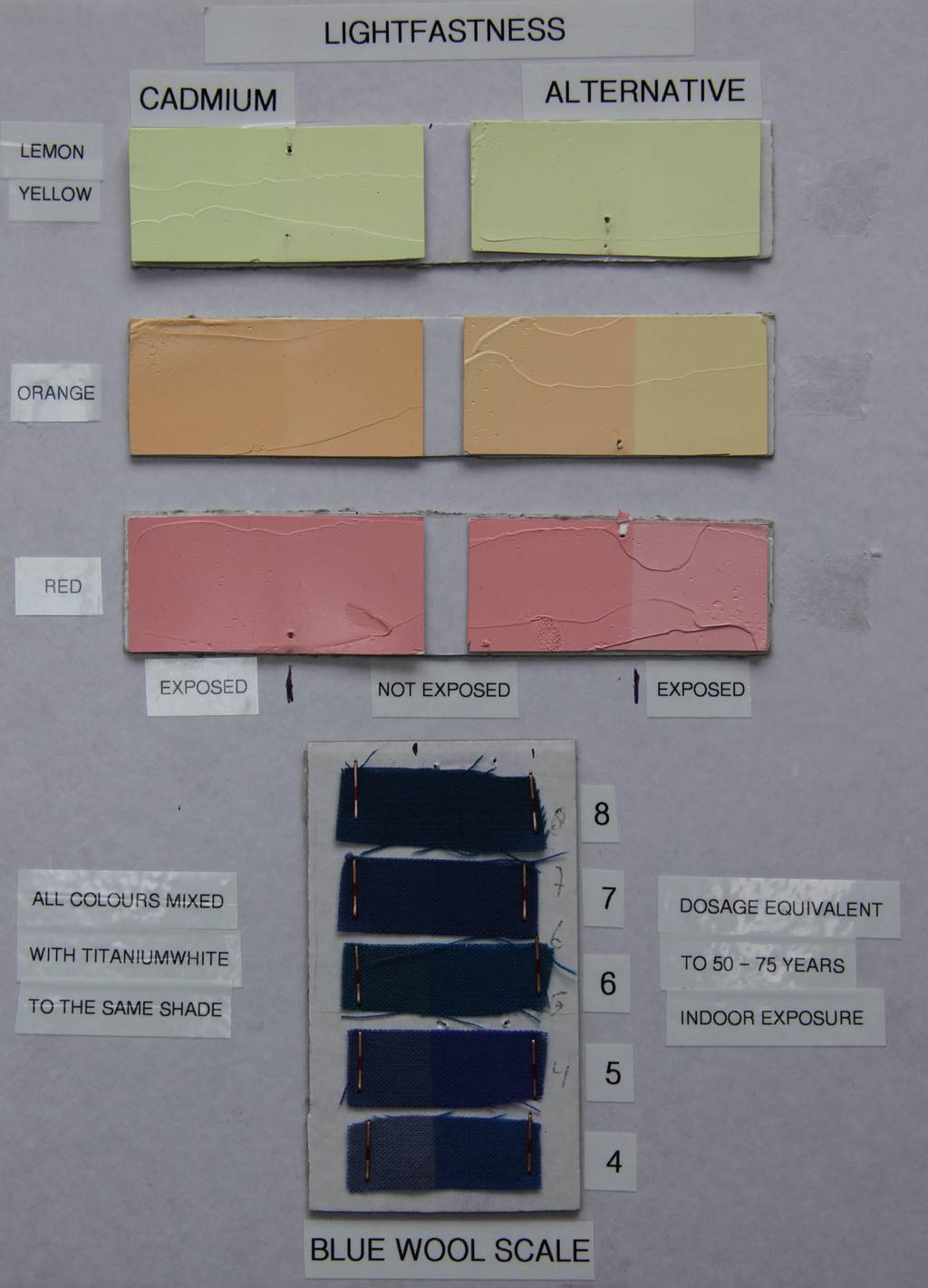
Lightfastness comparison

Tinting Strength comparison

Opacity comparison

25 thoughts on “Cadmium Crisis Update”
Apart from safeguarding the health of those involved in the manufacture of pigments using heavy metals, why aren’t adult painters like us credited with a modicum of common sense and allowed to carry on using these ( indisputably the best there are ) pigments??? Without the nannies ….
Well… Cadmium is not the best.
Artists use of C is an easy way to go for politicians. Not many that will protests.
Banning the zillion times more use of cadmium in the agral- and foot production industry (much get into our bellies with the food we eat) woud be met by som many protests from our dear farmers, since alternatives are more expensive (since cadmium fertilisers are sold with low tax/VAT, as is not their environmental-friendly alternatives) and might lower their production a bit. The electronic industry also have a strong lobby.
An then – the largest “releaser of cadmium ” in to the environment is the use of tobacco. An of course we can not ban tobacco – even if it is a major environmental threat (in many ways), it kills much more people (also those who do not smoke) in cancer and other awful sicknesses. It is a problem that a ban would also reduce health care costs in a major ways.
But doing this – many more would protest in very aggressive ways. Smoking is regarded as the ultimate cultural activity, compared to the art form of painting. And none of the decision makers are artists, at least on is a farmer, and I’ll bet several of those use tobacco.
Scapegoating is all it is!
Hi. Could you tell us what alternatives you used for this experiment, AZO’s, naphthol etc? I use a high quality brand that produces both cadmium and azo. I’ve found that azo’s have far more tinting strength than cadmium.
as a watercolour artist I’m afraid that I do not understand what effect this legislation will have on me . Help please !
Don;t suck your brush to make a better point!
Hi Wendy
If you use cadmium colours in your palette – cadmium red, cadmium yellow, etc – and they are banned then you will not be able to use those colours anymore.
As watercolour is a transparent medium you may be less concerned with opacity (cadmium pigments are the most opaque colours) but you might still be concerned with brightness of colour and lightfastness, other things that the cadmium pigments do well.
I’m not a watercolor painter. But isn’t there a “grnulation issue” with cadmiums? Mixed in with the right other pigment on a rougher paper Wet-in- wet Dut to its heavyness and to ist often larger pigment size!
Other replacenment might also be more staining. While the cadmiums them might be easier to remove after drying with a rag or a wetted bristle brush.
But as I said – I”m far from being a master of the medium.
Well I can see the differences in opacity with cadmium oil paint compared to alternative, cadmium is definitely opaque whereas alternative does not have the covering power.
I see the yellow alternatives are not sufficient either, nor orange and the red come to that, the alternatives are all weaker in colour and opacity.
Dear Camiumists!
The problem streams from the habit of amateur watecolor and acrylic artists to rince everetying directly out in the drain. Not only cadmiums are problems.. Many more than theese are poisounus. Even Zincwhite (and hence) also titanium whites) is a danger to the aquatic envirenment.
When Cadmium residues wad found in the water outside the Royal College of Art in Stockholm (were they do not teach artists anything – including how to handle poisonous remains) and the Gouvernmental building nexdore, the artists got the blame. And our swedish Minister of envirenment took an initiative to ban cadmium in paints in all EU-countries. And she has fought tough for this fairly fanatical approach, so there now finaly will be a ban, partly because, as it seems, the country with the toughest environment rules can emforrce such a thing without a majority. (The same person, also beeing minister of agriculture, has however made it easier to use fertiliser with cadmium contentet, buy removing taxes on theese fertilisers. And the amount of cadmium released from this into nature and directly into the plants is much, much, much more than cadmium from painting.
Not only are hue and transparancy an issue. But the amount of oil needed in grinding and the time fore drying is very important. And the toughness of the dried paint film. How further the pigment change in transparency as the oils polymerises and change refraction index. Also the “handling qualities” of “pure” pigmnet+minimum oil paints are an issue (can be changed by adding mediums, as also are done by most maufacturers: I only know of 3-4 major manufacturers that produce pigment-coldpressed-oil-only-paints.
Do not forget that Cadmium Yellows are about the only ones that can mix very high-chroma opaque yellow-greenish nuances (to paint sunlit foliage with over transparent duller darker bluish-green shadows and over a red-brown imprimaturas.
Those of us that can not go without lead white can to some extent make our own fairly easy as long as lead otherwise can be bought (but its is dangerous due to the possibility to become poisoned). The Cadmium pigment can only be manufactured by a very expensive and technical processes, and nothing for an amateur in chemistry.
I wrote to my politicians here in Sweden before the election recently to the EU-parliment, and most parties were not aware of the problem, but thought it being strange (even the “Environment Party” since culture also is an big issue for them). They felt the issue was strange, since cadmium in the agriculture industry, in the food manufacturing industry and in the technological industry are so, so, much important to reduce. And they thought at first this ban was a consequence of tougher rules in these other fields of use – which it is not, but mainly/only directed at artist paints. All parties that answer my questions (4 of 10) told me, that if they could get som say in the issue they would work for an exception for professional oil painting artists who knows how to handle remains of the kpaints and clean equipment in an environmentally friendly manner. And also instead put som responsibility of art material dealers about informing customs how to use and handle these paints. Maybe only toughen up laws for using cadmium in waterbased paint. But unfortunately there is low chance they would be chosen to work with this specific comity.
Unfortunately, the party of this minister was believed to not get high enough amount votes to remain their mandate in the EU-parlament, but this did not happen.
Also unfortunately, the the Royal Academy of art and the Art Colleges over here, do not know anything about anything – and one of the professor in painting recently pronounced painting realistically as being “decadent”. The Artists Union also does not bother, but might even be glad they loose some competition among those of us who still paints (i.e. still paint with some skill). Unfortunately these seems to be the people that our minister have been informed about cadmium paints about.
Regarding saturation among the cadmium colors, there are however some misconceptions about them all being the most high-chroma yellows, oranges and reds. Only the orange-yellows and yellow-oranges lives up to this. Some reds and greenish yellows coming close. But reddish orange and deep reds is not close to this.
Sometimes I find a few of the intense synthetical iron oxides can replace cadmiums to some extent for skin tones. – especially yellows. But cadmium reds are is a “must” for caucasian skintones.
Let your own country’s EU-representatives know your concerns as soon as possible. If you are part of an artist organisation or a student/teacher/professor of an art school – I think these also should write to politicians urgently. To my knowledge it is almost no way there won’t be a ban, so only major sophisticated and “touching” “lobbying” before the end of august, can maybe get result in the form of eventual exceptions in the law for professional and/or environmental concerned painters.
It was inevitable that once we allowed the mad environmentalists to grab political and internet exposure, that common-sense would go out of the window and we would see one thing after another being touted as “bad for us” or “bad for the planet”. I think the first poster here sums up very nicely, we are quite capable of using these paints without risking our lives or anyone else’s. We don’t need micro-management. This obsession with all things elf n safety plus “save the planet” has gone from the sublime to the ridiculous; now, even a pleasurable hobby (or income-source for some) is under the cosh. We need to get these meddlers to butt out, leave us and our paints alone…otherwise, if they win this round, they’ll be looking for the next thing to ban; believe me, it won’t stop with just one aspect.
I do not agree. The Swedish minister who has taken the initiative of this ban is not exactly a friend of the environment, since she has lowered taxes on fertilisers that contain cadmium (much, much more cadmium than what the artists is responsible for). The Swedish Miljöpartiet (Environmental Party) want to ban these fertilisers, but told me that they are open for an exception of cadmium paint for “professional” artists – i.e. artists who knows how to clean painting equipment and handle remains. They are kind of “artist friendly” and will probably end up in our next government after the election to our Parliament this fall – but then it is to late regarding this cadmium ban.
Unfortunately the party that this minister belongs to kept it’s mandate in the EU-parliament after the election. They were prognosed to loose it. I do not know what parties of the other EU-countries that have come to the decision to ban the cadmiums: It seems to be all the Ministers of Environment in all EU-states. According to the few comments in the news here, there is a full consensus among all countries in the EU regarding this ban. So maybe artists urgently should write to the Ministers of Culture and the Ministers of Environment in their native countries regarding this issue. I have done it, and to our parliaments “work groups” of Culture and Environments. But unfortunately artists among our swedish “art elite” has stated that there is no real difference between cadmiums and the other reds, oranges, and yellows (well they hardly paint any more, so what can you expect…)
I think the minister that want to ban artist’s cadmium paint is just using artists as some kind of scapegoat. She was asked about why she made it cheaper to use fertilisers with cadmium content but at the same time wanted to ban these paints – but didn’t want to comment on the issue.
No, I don’t agree either. When I started working in industry, cadmium was used to plate virtually everything as it is fantastic at preventing corrosion. The only problem was that workers producing it were poisoned so badly that their bones crushed under their own weight.
Industry worked hard to stop using it, and pretty-well succeeded. This was thirty years ago.
So when I started painting I was astonished to find that cadmium was still being used.
Other pigments might not be quite as good or quite as convenient but some things are more important.
Hi Felix
The cadmium used in artists paints is a different form, chemically bound with sulfur so it is stable.
It almost seems like it should be called something different to keep people from getting it confused with cadmium metal.
Here is information from the Gamblin Oil Colours Health and Safety page – Gamblin have been champions of creating a safe environment for years.
“Cadmium pigments:
In the hundred years since their first manufacture, cadmium pigments now have a very low level of bio-available cadmium metal in their chemical composition. Unfortunately, many painters still consider Cadmium artists’ colors highly toxic. If Cadmium pigments were made from cadmium metal they would indeed be highly toxic. Cadmium pigments are actually made from cadmium compounded with sulfur for the Cadmium yellows (sulfur and zinc for Cadmium Lemon and Cadmium Yellow Light). To make Cadmium reds and Cadmium oranges, cadmium is compounded with sulfur and selenium.
American manufacturers of cadmium pigments have developed production systems that yield cadmium pigments that are relatively insoluble in the human digestive system. They have been so successful that Gamblin Cadmium oil colors DO NOT REQUIRE an ASTM healthwarning label for ingestion. Over 25 years ago when I first started making oil colors, cadmium pigments were much more soluble in the human system than they are now. Cadmium pigments contained about 1000 parts per million (PPM) bio available cadmium. Now cadmium pigments that I choose to make Gamblin Artists Colors contain only about 5 PPM cadmium that can be absorbed through ingestion.”
http://www.gamblincolors.com/newsletters/pdf/GamblinStudioNotes13_StudioSafetyPigments.pdf
W ell…
EU often has stricter analysis on environmental issues that USA. But all cadmium compounds ends upp in the bilological chain sooner or later. Heavy metals have an ability to want to replace other atoms in organic molecules, du to being “heavier” also in an electromagnetical way. That’s why they are poisounus. But since the cadmium colours are very lightproof, my intellect tells me that they must be very stable compounds.
Maybe you all should inform the EU-board this (I forgot): “The cadmium colours are VERY stable – and this is the reason that we use them – making them very age- and lightproof, as they do not react with water, acids, oxygen, ozone, etc.”.
If (when) there is to be a free trade agreement between the EU and USA, Americans will have to accept the tougher environmental laws we have in the EU – including a ban on the cadmium colours. But we probbably all can go on smoking tobacco, and sow our crops in fields full of “cadmium-fertilisers”, since we all – on both sides on the atlantic ocean – do not deal with the real big environmental issues on the “free” market.
Thanks for the information Julie.
My point is that I believe the problem is at the source – production of Cd metal rather than in use or disposal.
I believe you (and Gamblin) when you say that cadmium bound to sulphur is stable, but the problem was and maybe still is earlier in the process.
Oh well said Julie Cave! Your’s is the first studied and commonsensical argument I’ve seen so far. Go for it…..
First they should bam tobacco and smokeing. This is where very large amounts enters the enivonment and peoples bodies.
Then, at the same time,t the cadmium fertilisers – since they are replaceable ones out on the market, but a bit more expensive. Also, I do nt understand why the have to use cadmium in the manufacturing of food . In the case of fertilisers and the cadmium from the food production ends up in us humans when we eat.
The handeling of electronic equipment after it’s live is over much also be much better.
Also, a total stop of import of childrens playtools with cadmium from China: There is a ban, but there is nobodey who controls that it is followed.
The artists use of cadmium ate only responsible for a so much small part of this. I do not have an exact number, but I guess 1/10000 or less – at least here where I live.
It is impossible to paint caucasian skin tones without Cadmium Reds when/if you paint in “semitransperent layers” simmilar to what “the old masters” did. The newer red just doesn’t work. It has to do with so many other qualities that just hue. Also it is the most intense opaque red when paining in such more modern ways.
Without the yellows one can ot mix the most saturated opaqu yellow-greens for “trditional” landscape pinint: First often an imprimatura with a redish ochre colour. Then the shadows with a trensparent dull bluish transparent green. And on top of this thieese opaque greens of high chroma.
Maybe my self, I do not use orange that much, but the less red otanges are the cadmiums with the higheta chroma of all a bit yellowish oranges. An its perfect for some tones – I guess abstract painters will lose an opaque orange. I use it sometimes for skin tones and some times in landschape (the coulors of leaves of the fall and sunsets).
The more dull pupelish cadmiums I use the least. But if I reaaly ned an opaque violet – I use ot as the “pase” and then mix in oter high-chroma piurputs, violets, magentas and even blues to get a good compromise.
A ban would be devastating for me.
Sorry for all misspelling. Since I toggle between my Swedish and English virtual iPad and Android-phone keyboards, these things happen. The somewhat cryptic grammatical English, I can only give blame to my eagerness in wanting to express myself, and not being a native english-language speaker.
I have not read all the comments, here, but is there anyone else who, like me, loathes cadmiums ? Trouble is, a good vermilion is impossible to find, now. A brilliant genuine vermilion outperforms any cadmium. Chromes in oils, also, but they are only available as dry pigments – try them – they’re wonderful. They do degrade under LED lighting, though. There are some very good genuine Naples yellows available in oils – again, far superior to cadmiums – none of that nasty acid green undercolour when thinned.
My kind of thinking.
What is said the red was of the Masters was vermilion. Cadmium red is Johnny come late and popularised mainly by Matisse and the likes.
Personally I use cadmium yellow sparingly, but my yellows of choice have beenNaples yellow (made from pigment) and chrome yellow since late 90’s and without these I cannot imagine painting. Similarly I would express strong bond with flake white. Currently, I am using two pallettes, historical, so flake white, Naples yellow, orpiment, yellow ochre, puzzuoli, Venetian red, Cypriot green earth, Cypriot green earth blueish, vermillion, Prussian brown and lapis lazuli. The other, more impressionist-oriented pallette is composed of lemon yellow (barium chromate, banned, btw), strontian yellow, chrome yellow, aureolin, chrome red, madder lake, cerulean, cobalt blue, cobalt violet and Veronese green (a mixture of lead white, azurite/malachite with massicot), chrome oxide green.
In water-colours I am even more restricted, Indian yellow, indigo, chrome orange, Egyptian/Han blue. There is virtually no need of incorporating any cadmiums there.
Regarding the mixing, try as might, the rose made from whites and cadmium reds will be that rosy as with vermilion.
Even if cadmiums or other pigments get banned, there will still a way to acquire them, just as it was with flake white when it disappeared from the market and now it is back.
Cadmiums were invented around the same timeline as chromates so there is no argument for their alleged replacement of the latter. Some people painted with cadmiums (Seurat, Monet), some with chromates.
Therefore I do not stock cadmiums and will carry on painting with these paints that sometimes are no longer with us.
Well, there wll not be a ban. Here in Sweden, the former government’s initiative also have died. Knowledge about the source of cadmium in fertilisers have increased. It comes from artificial phosphorus fertilisers (that the former government promoted, and wanted to have artists as scapegoats). And the origin of the cadmium in sewage fertilisers comes from airplanes and airports – not from artists. There are absolutely no environmental restrictions (international agreements) regarding the use of poisons there. The former givernment promoted a very central airport in Stockholm, so they had everyting to gain blaming us artists instad of this airport.
I can not understand advantages in the use of chromates. They are much more poisonous than cadmiums, they are impermanent and will fade, and they are much harder do get (they are banned in the EU) and hence more expensive.
Vermillion is also banned , more toxic, less permanent less bright/intense (CIE/Munsell).
Orpimemt is probbably the most poisonous of them all. And if you do not use it in a very scientifically controlled environment with protective equipment – you, and everyone visiting your studio, getting in contact with your working clothes and gear, will be affected by the arsenic. To my knowledge, it has no technical value. But I have not used this pigment myself. So be carefull
True Indian yeallow can not be obtained since many, many years ago. The process of making the urine-pigment is banned. It also fades. So if someone has sold you indian yellow, it is most likely not the real stuff!
Chromates are fast driers and barely react with other pigments, unlike cadmiums and if treated with respect will bring out the best within the painting, take for instance the one by Serusier, “Yellow farm in Pouldu”, 1890, painted in its entirety with chrome yellow light (the supposedly the weakest from the family) and still yellow, no fading, no browning.
No longer available, indeed unless you have an access to a pigment and can make your own. Their toxicity was put into question when it turned out that people who worked in chromates making factories had no health problems that were attributed to the lead chromate poisoning, so it was rebunked and as long as you do not eat a certain amount of pigment, there will be none. What exactly can be said about any other pigment considered more or less poisonous.
When mixed with white, vermilion gives the rosy cast, whereas chrome red gives the violet cast and cadmium red gives the grey, the dullest cast. Holbein makes quite decent and inexpensive vermilion and is quite good and not that pricey as for instance from Harding.
Orpiment is beautiful-here the armour has been painted with it:
https://picasaweb.google.com/104049432039882651275/9Listopada2015#6215229100192873090
but I use it only for special effects and while wearing a mask, although its toxicity is exaggerated-as long as it does not have contact with hydrogen it will not transform into arsine.
I am painting on the balcony outdoors btw, so there is no possibility of anyone entering the studio or having the slightest contact with either the pigment or ready-made colour.
Regarding indian yellow, please, read that article below, and that pigment in question is chemically the same compound so there is a strong likelihood it is the genuine article, if certainly misunderstood, magnesium euxanthate since it behaves the way it had been described in the old manuals. I am currently testing it for lightfastness and saturation.
http://toxicgraphix.blogspot.com/search/label/Indian%20Yellow
Well… Almost everything made of mercury is severely banned in the EU, with high penalties or even prison. Only very small amounts of mercury in fluorescent lamps (so artists can have good light in their studios) are allowed. They are even collecting all mercury to place it far down below in the rock – like our radioactive waist.
Scientific colorimetric and spectrometic measuring of where cadmium reds and true vermillions are in colourspace (CIE xy, CIE Lab, Cie CAM, Munsell, etc.) shows that Vermillions is much duller (less chroma, less saturation) than Cadmium reds: Vermillion has CAM-Chroma around 80 and Hue Purity close to 65. Cadmium red light has Chroma at approximately 90 and Hue Purity about 75.
I sometimes hear this statement, but visually comparing the true vermillions (6 diffrent oils and 2 watercolours) I have (the Chemical Police will knock on my door one day) with the Cadmiums (Light), I can not really understand the statement. They are or course a bit different in hue – and the same hues may be tricky/impossible to mix from cadmiums to get both hue, “undertones”, opacity and other characteristics the same.
(Napthol and Pyrrole warm reds are in fact even a tiny little bit more saturated than the cadmiums – but doesn’t have the same opacity and aren’t as lightproof as the cadmiums.)
Vermillion is also more fugitive than cadmiums with ASTM rating of III to IV – while cadmiums have a rating of I (excellent).
I guess you talk about the Chrome-Lead red pigments. They are very toxic (and not legal in the EU) compounds of two heavy metals, and you must be very, very, very careful handling these as raw pigment: never at home or in your studio, but in a chemical laboratory with the right equipment – as one should with all heavy metal pigments. They also fade (everything that fades underLED-lighting will fade even more in normal daylight – since daylight have UV-light in it, and LED does normally not.). This is why many Impressionist paintings painted with Chromes have become duller. When the Cadmiums were invented they replaced the Chromium-Lead ones. I do not know how saturated Chromes are – but if they fade relatively fast, it does normally not matter to me personally. There is even more saturated/brilliant semi-fluorescent reds if brilliance/saturation is the thing you are after – but they also do fade, and are normally not available as artist’s paint (as gouaches they sometimes are).
I now heard that next december will be the time when an eventual ban will be announced. And then it would possibly take until 1/1 2016 before a ban can be enforced.
According our former Swedish Minister of Environment — who took the initiative – a full consensus among all Governments in all EU-members existed even before the Comity handling this issue was formed – and that all protests and “lobbying” will be ignored. I can only hope she was wrong.
I will write to the new Swedish Ministers of Culture and Environment. They know that the cadmium in fertilisers comes from the artificial phosphorus fertilisers – not (mainly) from artist pigment in sewage fertilisers. The former government blamed all cadmium in fertilisers on artists and worked for this ban – while they at the same time made it easier and cheaper to use these artificial fertilisers. The new Government will ban the phosphorous fertilisers, since it also threatens the environment in other ways. But I was told, they could possibly make an exception for “responsible Artist” regarding the use of Cadmium Paint.
Although the time to write to the EU-comity is over, protests directly to governments may have a chance to be heard.
You can write to the Swedish Ministers (all are fluent in English). But be polite and make rational comments on how a ban will hinder our/your artistic expressions; in how the Professor in Painting from a Swedish College is very wrong about that there is no difference between cadmiums and other red, yellow, and orange colours; that there is flaws in the “research” backing up in how we use the paint (as an example we do not flush everything in the tubes down the drain – some actually ends up on the painting :-); the flaws in the “research” regarding how poisonous our form of cadmium are.
Here are sites where you can write to:
http://www.government.se/sb/d/8371
http://www.government.se/sb/d/2066
well I for one will stock up on th cadmiums, butin the meantime I’ll lobby against their ban.
Comments are closed.