



Jackson’s Aluminium Painting Panels are an exciting new surface for painting, suitable for all media. How do they differ from traditional supports? We’ve invited artist Oliver Reed to share the results of his recent study into aluminium with the blog. He tried out Jackson’s Aluminium Panels and found they are “extremely good surfaces for acrylic and oil painting”. He also experimented with watercolour and mixed media. He has written about his experience painting on the panels and shows us the paintings he created.
“The first thing I noticed when working the surface was its smoothness.”
Surface Tension: Drawing & Painting on Aluminium
“The first thing I noticed when working the surface was its smoothness.”
Surface Tension: Drawing & Painting on Aluminium
by Oliver Reed
First Impressions – Watercolour
My first impression on seeing the Jackson’s Art aluminium panels was one of aesthetic beauty, a smooth grey metallic surface. As the panels are already prepared and treated with a chemical for direct painting onto (which you cannot see) it was strange to even consider applying watercolours directly onto this surface.
Materials tested on the surface: Watercolour, Gum Arabic, Chalk Pastel and Carbon Stick.
Although I liked the nature of the surface, being able to move the paint around in a fluid fashion, I did discover an issue caused by the smooth surface: you couldn’t build up layers of watercolour and therefore could not optically mix the colours. The non-absorbent causes the watercolour to effectively sit on the surface. When you try and add another layer of paint on top it reactivates the previous layer of paint and therefore the two coloured layers mix. This can be frustrating, especially if by accident you splashed a drop of water onto the surface, which in turn reactivates the colour below meaning you may have to rework that particular area. As a positive, it was interesting to be able to take a scraper, knife or other sharp implement to loosely scratch the surface, which then easily lifts the watercolour paint back to the aluminium.
Creating Texture with watercolour
The usual techniques of using salt and cling film worked as you would normally expect. Although again due to the ultra-smooth surface you need to be extra careful when removing the salt; if you rub too hard you can lift and smudge the watercolour. When using masking fluid, the application and drying time was similar to that of working on paper. However, the masking fluid was much easier to remove due to the smooth surface, but if you use a finger, sponge or rag to remove the masking fluid you can smudge the watercolour so I used a knife to lift an edge before fully lifting off, and did not rub to remove.


Conclusions: Watercolour
Looking back at my first watercolour paintings I loved the sense that you can move the watercolour around on this ultra-smooth surface, lift off and replace time and time again, which could not be achieved as easily by working directly onto a watercolour paper. But it begs the question, “Would I look to use this surface over a watercolour paper?” and my answer would be, no. It is not an issue of price, although watercolour colour paper is around ten times cheaper! I feel you have more scope and control with watercolour paper, allowing you to optically mix colours, work on a ready-made white surface and finally there is the subtlety that can be achieved when creating textures.
Drawing directly onto the aluminium
My brief explorations of drawing directly onto the aluminium panels proved interesting, as the results I achieved had an almost silverpoint effect. I found that the surface does take a range of drawing materials, such as graphite, pen and oil pastels but as you would expect not chalk pastels, (as pastels need a surface with a tooth to hold the dry pigment). Working with pencil and graphite I found that you could create sharp and fine lines because of the very smooth surface. However, it isn’t appropriate for creating a reductive drawing using an eraser, as the eraser will smudge the graphite but not completely erase it from the panel.

The ghostly image (seen above) has been created mainly through a series of accidental steps. I had initially developed a thick oil painting on this surface but decided to wipe it off, as I didn’t like the result. I then started a pencil drawing, adding Gum Arabic, which allowed me to move the graphite around on the surface. However, because there had been oil on the surface beforehand and I had not cleaned the surface thoroughly, the Gum Arabic just sat on the surface, as the oil resisted water. I then wiped off this layer of Gum Arabic and parts of the graphite were also lifted leaving behind this image.
Acrylics and Oils
I have grouped these two materials together as they have a similar consistency and method of application. Although I didn’t use them, this could also apply to water-based oil paints. I have included two oils and one acrylic painting.
The first thing I noticed when working the surface was its smoothness. When applying the first layer of paint, the paint appears to slide across the surface, as there is very little or no ‘tooth’ for the surface to pull the paint from the brush and therefore the result is that your brush strokes are also included. This may be a desire for some artists and a hindrance for others, as it depends on the way you like to work the surface. However, once your first layer of paint has been applied you then have a surface like any other and it’s comforting to know that over time the surface will not bend, warp or twist.
With the surface being impervious and already primed you cannot stain, by allowing the oil within a medium to bleed into the surface for example, as you could with an unprimed canvas, paper or board. However, what it does allow that those other surfaces do not, is that you can easily remove any wet paint, oil or water-based, that you have applied in the first layer.

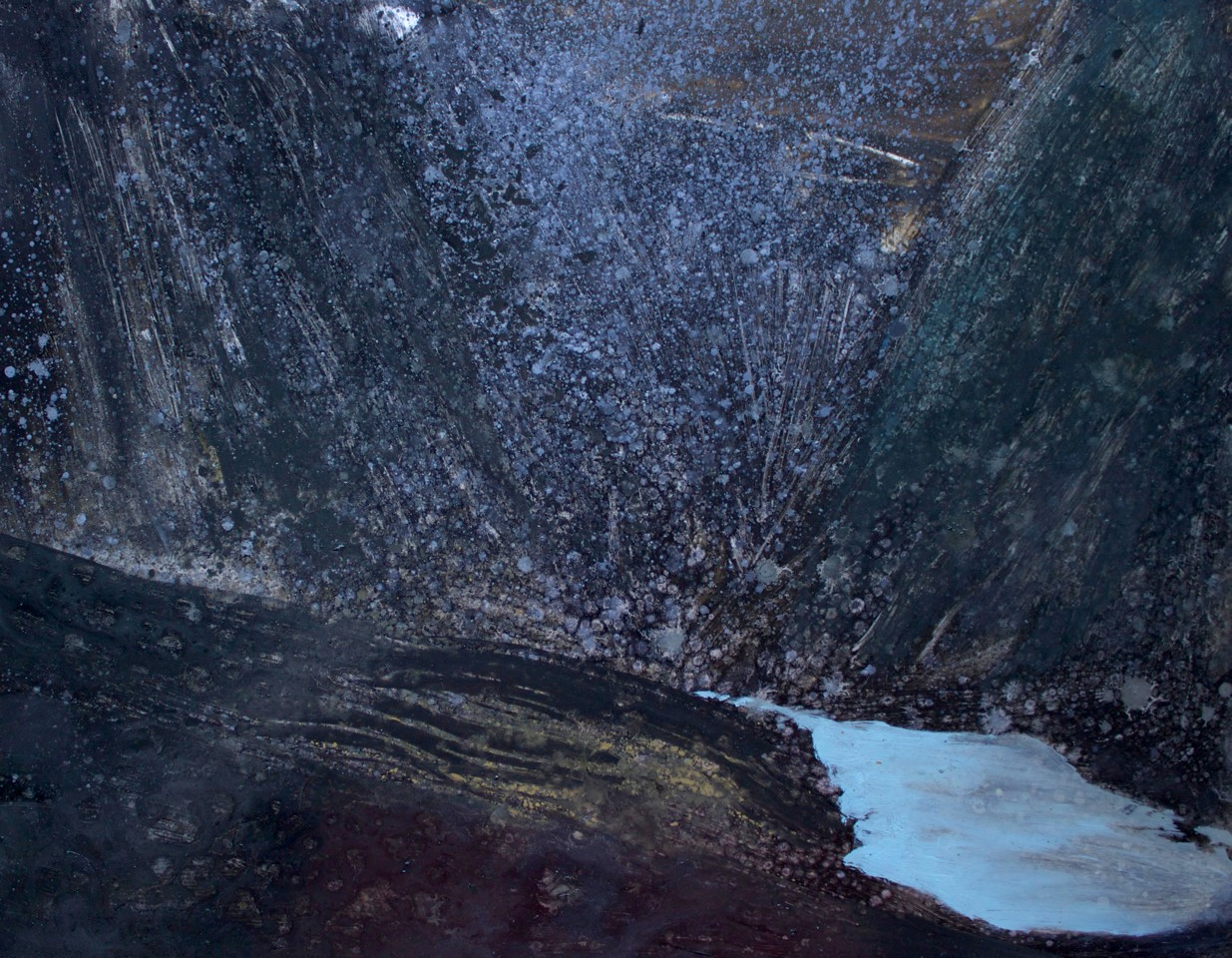
When working with acrylics I used Daler-Rowney Cryla Heavy Body paints. As these heavy body paints are thick they adhered very well to the smooth aluminium surface. Again, just as with the oil paint and watercolours it was easy to lift-out layers with a cloth and water. At one point I had two to three layers of acrylic paint applied and when I added water to the surface and left it for a short period, I found I could remove layers, effectively lifting whole areas, revealing the aluminium surface once again.

Conclusions: Acrylics and Oils
The panels work extremely well as an acrylic and oil ground, just as working on a smooth primed wooden panel board. I really liked the idea that I didn’t need to prime the surface and that the aluminium panels are prepared and ready to be worked, and reworked for that matter! Although at the back of my mind, I have found it a little disconcerting, having (for the past 25 years) primed my canvases and boards, but that’s just a personal issue.
I am yet to take these panels to a framers and it will be interesting to see how they would frame the panels, either in a float/tray frame or behind glass? Working on Jackson’s Art aluminium panels has been a new experience for me and I have enjoyed the qualities of the surface which I can see will become an addition to the various surfaces I use within the studio.
Overall Conclusions
Overall Pros
• The panels can take a range of mediums.
• The panels do not need priming.
• The aluminium panels are completely stable and will not warp or twist.
• When working with watercolours you can remove and rework the surface time and time again.
• The aluminium panels are relatively lightweight especially once you start working-up in scale, compared to plywood boards.
• The panels have an ultra-smooth surface, (but this can be a negative too).
• A minor positive, is that when you do have many panels they take up a lot less room than canvases and plywood panels due to the relatively thin material, just 3mm.
Overall Cons
• The panels have an ultra-smooth surface (as mentioned, this can be a positive too).
• The panels cannot be cut easily.
• The relative cost for working a watercolours on this surface is much more expensive than buying watercolour paper, but the surface can be reworked.
Click on the underlined link to go to the current offers on the Jackson’s Aluminium Painting Panels on the Jackson’s Art Supplies website.
Postage on orders shipped standard to mainland UK addresses is free for orders of £39.
5 thoughts on “Surface Tension: Drawing & Painting on Aluminium”
Hi is there any way to print photographic images onto alumium panels ?
Hi Gilly
If you wish to transfer a photo onto the surface one way is with acrylic gel like this: https://www.youtube.com/watch?v=RIQReMWyQ5s
If you wish to expose and develop photographic emulsion it would be best to talk to a photographic supply house like perhaps http://www.thedarkroom.co.uk
Love the ghostly drawing and first oil painting, among many.
Had noticed the aluminium panels before, wondered about trying them and found this a very useful review.
Thanks.
They are lovely paintings, aren’t they.
Glad you found the review helpful.
Pingback: Painting on aluminium - Laura Rich
Comments are closed.